

Mounting meningitis cases spotlight compounding pharmacy industry practices
As the number of cases of fungal meningitis in Michigan increased for the seventh day in a row since officials first announced the outbreak in the state, regulations surrounding compounding pharmacies have been thrown under a magnifying glass.
The case count rose to 39 cases in Michigan on Thursday, according to the Centers for Disease Control and Prevention. Thirty-three of those cases are being treated at St. Joseph Mercy Ann Arbor, hospital officials said.
The number of Michigan deaths from fungal meningitis rose to four Thursday evening, as a Cass County woman died from fungal meningitis after receiving an injection for back pain at an Indiana clinic.
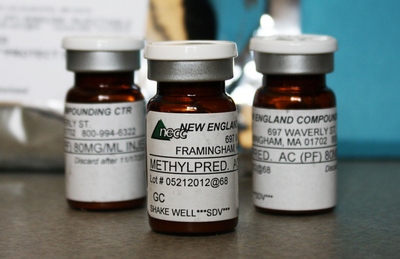
Vials of an injectable steroid manufactured by the New England Compounding Center.
The Associated Press
Michigan Pain Specialists was one of four facilities in the state that received a shipment of injectable steroid from the New England Compounding Center, a compounding pharmacy in Framingham, Mass. that is under investigation by the CDC in connection with the meningitis outbreak.
To date, 170 cases of meningitis — including at least 14 deaths — have been preliminarily linked to the contaminated steroids in 11 states.
One person identified by Michigan health officials received the steroid shot in the ankle and has an infection there.
Initially, federal health officials estimated about 13,000 people were at risk for meningitis. Thursday, they raised their figure to 14,000, but stated about 90 percent of those who may have received a shot of the fungus-tainted steroid had been notified.
A Massachusetts official said Thursday it appears the NECC violated state law governing how compounding pharmacies are supposed to work.
They are not supposed to do large-scale production like a drug manufacturer, but to produce medication for patient-specific prescriptions, said Dr. Madeleine Biondolillo of the Massachusetts Department of Public Health.
"This organization chose to apparently violate the licensing requirements under which they were allowed to operate," she told reporters Thursday.
The pharmacy has recalled the steroid that was sent to clinics in 23 states, as well as everything else it makes.
Two Democratic lawmakers -- Representatives Rosa DeLauro and Edward Markey -- on Tuesday called for stricter federal oversight of compounding pharmacies.
Representatives Rosa DeLauro and Edward Markey said in separate statements that they will draft legislation to give the Food and Drug Administration more authority to police the safety of compounded drugs.
Compounding pharmacies traditionally supply products that are not available commercially, based on an individual doctor's prescription. But some pharmacies have grown into larger businesses, operating across state lines and supplying drugs to thousands of hospitals, clinics and physicians.
Compounding medication at pharmacies like Clark Professional Pharmacy at 3075 West Clark Road in Ypsilanti is done on a prescription-by-prescription basis, said co-owner Ahed "Ed" Salamen.
A compounding pharmacist is able to prepare dosage amounts in forms that aren’t commercially available, and can create them in forms that are free of filler ingredients like dyes, sugars and alcohols that some patients may react negatively to.
Compounding pharmacies operate differently than a drug manufacturer because the specialty medications are only created and dispensed to patients with a doctor’s prescription, Salamen said.
There are times when pharmacies dispense small volumes of compounded medications to hospitals for in-office use when allowed by the state board, Salamen said, explaining that that is not what he does at Clark Professional Pharmacy.
Many are physicians — including doctors at the University of Michigan Health System and St. Joseph Mercy Ann Arbor — refer their patients to Clark Professional Pharmacy to have their prescriptions filled, Salamen said.
“There’s a lot of negative media attention our field is getting because of the attention being paid to the manufacturer on the east coast,” Salamen said.
The University of Michigan Health System stated at the beginning of the investigation that they did not stock any of the injectable steroid manufactured by NECC, but had other NECC products they discarded as a precaution.
UMHS uses medications and other products manufactured under FDA regulations from large-scale manufacturers.
However, during critical shortages of medication, physicians and pharmacists at UMHS have to come up with alternatives — which sometimes means compounding their own medications, according to a statement from the health system.
A sterile room in University Hospital is used to compound the medications, in compliance with regulations set forward by the U.S. Pharmacopoeia Convention. As a last resort, UMHS does consider purchasing medications from outside compounding pharmacies that meet the same standards on its internal facility, according to the university’s statement.
“In the case of the steroid that is at the center of this outbreak, we never reached the point where we considered using a compounding pharmacy. We have been using steroids purchased from commercial sources,” according to the university.
To ensure patient safety, Salamen said it is the doctor’s responsibility when choosing a pharmacy to which they direct their patients.
Doctors should choose pharmacies that use ingredients from an FDA-licensed source, and verify that the facility is not on probation for issues regarding compounding, Salamen said.
The Associated Press contributed to this report.
Amy Biolchini covers Washtenaw County, health and environmental issues for AnnArbor.com. Reach her at (734) 623-2552, amybiolchini@annarbor.com or on Twitter. The Associated Press contributed to this report.
Comments
fishermon
Fri, Oct 12, 2012 : 3:43 p.m.
The FDA already has the authority to deal with any entity be it a Conpounder, State health laboratory preparing vaccines, or a regular Pharmaceutical company. No one may place a Drug into Interstate Commerce without getting pre-market approval from the FDA. A Conpounder is allowed by law to prepare a drug to the specification of a physicians prescription but if the Conpounder mass markets a standardized formulation like an injectible steroid than it has violated the FDA law if it has not gotten pre market approval from the FDA and demonstrated that the product is safe and effective for its labeled use and that it has been manufactured under the GMP ( Good Manufacturing Procedures) mandated by the law. Congress does not need to pass any new laws to deal with this contamination incident and I expect that we will see more regulatory action against this company shortly.
Veracity
Thu, Oct 18, 2012 : 1:23 p.m.
Perhaps the FDA should do more unannounced inspections of facilities like The New England Compounding Center and would need new legislation for funding. Also, as a precaution, large facilities like the UofM Hospital and St. Joseph's Hospital, can be required to assess sterility of products that are purchased from compounding centers. Redundant safety measures have a place in modern medicine.
A2comments
Fri, Oct 12, 2012 : 10:34 a.m.
Those that argue for states to regulate themselves may now see that it doesn't work when the products are shipped to other states. Congress did not act in 2003 when this was brought to their attention.
Paula Gardner
Fri, Oct 12, 2012 : 2:24 a.m.
The initial version of this story omitted credit to the Associated Press for providing some of the reporting. We have updated the story to add that credit.