

U-M study traces underpinnings of childhood obesity by examining eating, lifestyle habits
Students who are obese are more likely to consume school lunch instead of a packed lunch from home, a new study from the University of Michigan Cardiovascular Center shows.
In addition, students who are obese spend more than two hours a day watching television or playing a video game.
The results come from check-ups of 1,003 Michigan sixth-graders who participate in Project Healthy Schools, a program run by the U-M Health System. Several local school districts take part in that project.
The study, which looked at lifestyle factors influencing weight, was published last month in the American Heart Journal.
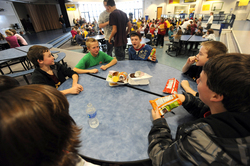
Several local school districts, including Dexter, are offering healthier lunches.
Lon Horwedel | AnnArbor.com
“For the extremely overweight child, genetic screening may be a consideration,” said study senior author Kim A. Eagle, M.D., a cardiologist and a director of the U-M Cardiovascular Center, in a press release. “For the rest, increasing physical activity, reducing recreational screen time and improving the nutritional value of school lunches offers great promise to begin a reversal of current childhood obesity trends.”
The prevalence of obesity among U.S. children ages 6 to 11 has increased from 6.5 percent in 1980 to 19.6 percent in 2008, according to the study.
U-M researchers found that 58 percent of obese children had watched two hours of TV in the previous day, compared to 41 percent of non-obese children. Forty-five percent of obese students always ate school lunch, but only 34 percent of non-obese students ate school lunch, the study's press release said.
Because the eating and exercise patterns of obese children were so different from their normal-weight peers, researchers concluded that lifestyle was more closely linked with childhood obesity than genetics, according to the press release.
“If diets and physical activity were similar in obese and non-obese students this would argue for a stronger genetic basis for obesity in children,” said study first author Taylor Eagle.
In the U-M study, 15 percent of the middle school students were obese, but nearly all, whether overweight or not, reported unhealthy habits, the study's press release said.
According to the study's press release, more than 30 percent had consumed regular soda the previous day, and less than half remembered eating two portions of fruits and vegetables within the past 24 hours. Only one-third of students said they exercised for 30 minutes for five days in the previous week.
“It’s clear that opportunities to improve health abound for the majority of our students, not just the 15 percent who are already obese,” said study co-author Elizabeth Jackson, M.D., assistant professor of internal medicine at the U-M Cardiovascular Center.
David Jesse covers higher education for AnnArbor.com. He can be reached at davidjesse@annarbor.com or at 734-623-2534.
Comments
Rudra
Wed, Feb 2, 2011 : 2 a.m.
This study could have also included the study of attitudes that shape eating habits and lifestyles. When food is consumed, in a normal, healthy person the hunger is satisfied and the body experiences a state or condition called satiation. This sensation is mediated through the Eating Center and the Satiety Center located in the hypothalamus at the base of the brain. A person who lives with self-contentment experiences hunger with a little less intensity and his hunger is also satisfied more easily after a routine meal. The attitude of contentment inhibits cravings and also food cravings. The watching of T.V. may represent that the cravings are not being restrained. To maintain optimal body weight, it will be important to promote and cultivate the attitude of self-contentment and restrain the urge for immediate sense gratification.
Rusnak
Tue, Feb 1, 2011 : 3:28 p.m.
What's the flipping mystery here? Kids nowadays sit in front the T.V. playing video games, the computer etc.... Get off your rear end. I grew up in a big family, there were seven of us. You were lucky if there was bottle of pop in the house and, if there was you had to split the thing. Mom didn't buy Ho-Ho's, Twinkies etc.... Except on occasion and if she did they came from the day old bread store. I was never deprived of anything either. Things weren't super-sized. You didn't have a lot of the processed dinner in bag that you have now which, is all processed garbage. We didn't have school lunches either or, a snack in Kindergarten I never saw a school cafeteria until high school. As far as school lunches go, chicken nuggets, tacos, are not always a wise choice. And, if you moped around at home and said "there's nothing eat here" I can still here my Mother say "have an apple" because Mom didn't buy Dorito's, and pudding cups. Who paid for this study? I could have saved them a lot of time. Like I said what's the mystery?
Rod Smith
Tue, Feb 1, 2011 : 10:32 p.m.
Good for you, but not everyone grows up like the way you do buddy. This study was essentially paid for by Project Healthy Schools, a community collaborative in Ann Arbor, Ypsilanti, Detroit, and Corunna that aims to fight childhood obesity in all of these areas. The study results, although obvious, are a part of the program where the kids are asked to report their behaviors over the past week or day. The data is just an offshoot of the program, and by the way the program has been proven to be effective in lowering students cholesterol and triglycerides as well as improve students behaviors over the course of a semester. So before you get smart and say "who's paying for it, the answer is obvious," give the people a little credit who are doing this and actually trying to MAKE A DIFFERENCE in our community.
momof2ina2
Tue, Feb 1, 2011 : 8:17 p.m.
Your house sounds exactly like mine growing up! With 9 kids in the house, I was thankful just to get something to eat, before my older brothers scarfed it all down, lol!
glimmertwin
Tue, Feb 1, 2011 : 1:22 p.m.
A study is needed for what? Nothing new here. Fat parents = fat kids. Kids don't stand a chance when their parents (role models) haven't touched a piece of lettuce their entire lives.
JenM
Tue, Feb 1, 2011 : 12:34 p.m.
@ AlphaAlpha - now if we could just convince the AAPS, and other school districts, to actually serve those cheaper, healthier foods in their breakfast and lunch programs. Ann Arbor should be a frontrunner in the country for overhauling this sad, sad public school lunch program. What do you say, AAPS? Aren't our kids worth it? Before anything else, people of all ages need nutrition in the form of pure, healthy, food. And children have to depend on adults to get it for them. We are letting them down immensely.
AlphaAlpha
Tue, Feb 1, 2011 : 3:15 a.m.
Lack of exercise, foods created in factories instead of farms, partially hydrogenated oils, processed foods devoid of essential fatty acids, 2.2 pounds of sugar per week, high fructose corn syrup, refined grains, fast foods. Hmmm. Thankfully, real, whole foods are cheaper than factory-made foods.
dotdash
Mon, Jan 31, 2011 : 10:02 p.m.
The school-lunches eating is a poverty issue. It may not be what is in the lunches per se, but the fact that poor kids are more likely to qualify for and to eat school lunches.
smokeblwr
Mon, Jan 31, 2011 : 10:39 p.m.
That is true, but I knew plenty of rich kids at my schools growing up who at school lunch every day. Of course they ate chips, pizza and ice cream and got fat just like the poor kids.