

Moravian project might not have support from Ann Arbor City Council
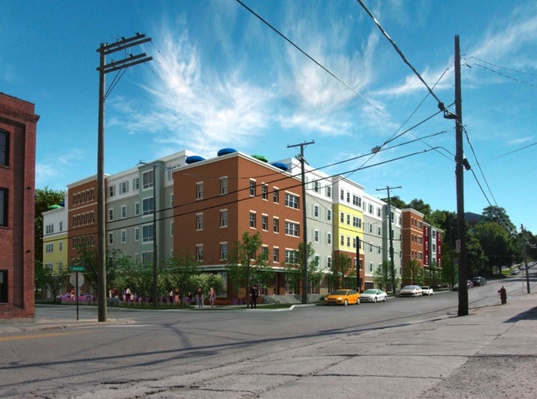
An artist rendering of the proposed development known as The Moravian at 201 E. Madison St. The City Council is being asked to rezone the site - two blocks south of downtown Ann Arbor - from R4C (a multiple-family dwelling district) and M1 (a limited industrial district) to a PUD.
A development five years in the making comes before the Ann Arbor City Council for final approval on Monday. But despite recommendations from city staff and the Planning Commission, it doesn't appear to have the support it needs from council members.
The Moravian, a proposed 62-unit apartment complex geared toward young professionals and others who want to live near downtown, needs eight votes for approval. All indications are that fewer than eight council members support the project.
"At this point, I don't think it has a shot," said Council Member Margie Teall, D-4th Ward, a supporter of the project. "It bothers me. We are throwing out all of the possibilities of what we could have if we don't take our blinders off."
After spending the last two years jumping through the city's hoops and revising plans over and over, the development team for The Moravian appears frustrated with the city and its processes.
"I still believe in this city, but the last couple of years of going through everything that we have ... it was an unforeseen gauntlet," said Ann Arbor real estate broker Newcombe Clark, a member of the Downtown Development Authority and a partner in the Moravian project.
"We've done everything we can," Clark said. "Monday night I think will be telling on whether or not the system works — that our city follows through with due process. I remain hopeful that council will come through with us."
Jeff Helminski, managing partner of The Moravian Co., has issued a call to supporters on a Facebook page, hoping strength in numbers will sway the council. Until now, the only voices council members have heard at the podium have been those of a handful of residents who don't want to see The Moravian replace the aging homes and industrial buildings at the edge of their neighborhood.
Helminski said he thinks council members should make their decision based on whether The Moravian meets the standards of the city's ordinance for Planned Unit Developments, not personal preferences.
"When we started this whole thing, we talked to the city and asked what the standards were for PUD approval and they directed us to look at previous PUDs," Helminski said. "I went through and looked at every PUD and did a big analysis of how that compared to our site. We're requesting just a fraction of the level of zoning variance that others have, and we're offering more benefits. The project is consistent with the standards of the PUD ordinance — it meets all the requirements."
The developer's site plan shows 12 of the 62 apartment units — about 19 percent — would be affordable to lower-income households. The city's PUD ordinance asks for 15 percent.
Council Member Carsten Hohnke, D-5th Ward, said he still doesn't think the project's benefits are sufficient to set aside the current zoning to create a special PUD for The Moravian. Hohnke won't be at Monday's meeting due to a personal commitment, but has relayed a prepared statement to be read in his absence.
"The existing zoning is a social compact; it is the established consensus of the community," he wrote. "Setting it aside essentially introduces a tear in that social compact. While PUDs are a necessary tool, their use should be exceptional, and their benefits to the community should be bold enough to mend that tear. I don't believe that in this case they are."
Hohnke points out The Moravian provides just three more affordable housing units than required. He said that stands in contrast to the 35 units in excess provided by the recently approved and smaller Near North PUD.Â
Helminski, however, said he thinks it's unfair to compare his private development to a publicly funded affordable housing project.
Hohnke added The Moravian — though cited by some as a benefit for downtown Ann Arbor — is not in the downtown.
"By definition and community consensus, downtown begins north of William Street," he wrote. "It is in that downtown core that we have a community consensus for realizing the benefits of increased residential density. If we prick holes in the membrane of our downtown, and allow density 'leakage' into near-downtown neighborhoods, we undermine our ability to achieve the benefits we seek in our urban center."
Clark said he worries what kind of message a no vote Monday night would send to others who want to invest in the city. He said Ann Arbor already has a reputation for being a tough town to develop in.
"For the last two years, we've been trying to stay on top of a game that continually changes its rules on us," Clark said. "This project has the ability to confirm or confound a lot of community values and ideals we often claim to hold but often have a hard time trying to demonstrate."
Helminski said he believes the project offers a wide range of public benefits. For example, he said, its energy-efficient environmental design will reduce greenhouse gas emissions by 636 metric tons annually, which is the equivalent of taking about 129 vehicles off the roads. The current site also has environmental concerns that would be mitigated.
The Moravian has support from more than 100 residents, businesses and community leaders who say the project would boost the local economy and increase the vitality of downtown. It also has the endorsement of the Ann Arbor Chamber of Commerce.
"Change is always hard, but change is coming to Ann Arbor," Clark said. "I think approval of a project like this could potentially show that we are committed as a community to moving forward."
Ryan J. Stanton covers government for AnnArbor.com. Reach him at ryanstanton@annarbor.com or 734-623-2529.
Comments
mamap
Mon, Apr 5, 2010 : 7:48 p.m.
Facebook link : http://www.facebook.com/event.php?eid=108425589187548&index=1
Ryan J. Stanton
Mon, Apr 5, 2010 : 4:31 p.m.
Here you go.
Dave Koziol
Mon, Apr 5, 2010 : 2:33 p.m.
Can anyone provide a link to the Facebook group mentioned in the article to express support for this project?
Moose
Mon, Apr 5, 2010 : 11:31 a.m.
Comments have been made that young professionals don't want to and should not be made to live in a student neighborhood. This development does not only border a student neighborhood it's in the floodplain, across from Fingerle Lumber and adjacent to a railroad track and a 24 hr gas station. This development will allow further encroachment of student rentals into residential neighborhoods that abut downtown. I seriously doubt that those young professionals who want to live in a building with character, who do not want to share living space with anyone else will find the Moravian to their liking. Additionally there are no "thousand nights of fun to stumble into" within walking distance of the Moravian. So those "millennial" young professionals will not likely stick around, put down roots and become part of the city. The city does not need more transient renters, it needs property owners who live, work and contribute to the city in ways that maintain the city's existing assets. So when those young pro's don't move into the Moravian, what will the developers and owners do? They will try to rent to anyone adding more student rentals to the existing glut. I don't have a problem with that, but Mr Helminski and Mr Clark should be up front with everyone about who they expect to be residing there. Then look 10 years down the road. The development buzzword "young professional" is being cynically used to sell their and other similar projects and when that doesn't happen it will be another monster eyesore (think five story warehouse with fake homey facades) that within a decade could very well be in the condition of the older homes that already exist at that location, just bigger. What makes anyone think that this rental property will be any different from we've already witnessed?
Ryan J. Stanton
Mon, Apr 5, 2010 : 10:44 a.m.
The Stop The Moravian group new information up on its blog site: http://stopthemoravian.blogspot.com/
john
Mon, Apr 5, 2010 : 10:41 a.m.
Let's look at this realistically.... 1)Someone wants to develop something in your city - plus 2)Especially when the economy sucks - plus 3)The area will look pretty nice compared to the way it looks now - plus 4)Businesses downtown that are hurting as it is will have more more people to potentially walk through their door -plus 5)Bigger tax base -plus for everyone For being a very progressive town this place truly shows how backwards it is
Freemind42
Mon, Apr 5, 2010 : 9:51 a.m.
This is a development project that is actually useful and the city council won't back it. Meanwhile they're all about the fiasco on the Library Lot. The houses in that area are falling to pieces and it's filled with students who don't care about the city and have no vested interest in keeping the neighborhood nice. I walk past this intersection multiple times every day and it is one of the few blighted neighborhoods in the city.
DonBee
Mon, Apr 5, 2010 : 8:29 a.m.
My concern is the 2 years of jumping through hoops, how many times have we read about similar long periods of trying to make something fit prior to coming to the city council. There should be a way, to say early in the process "No, this will never work on this site, no matter what you do" so that developers can move on to the next project. This hurts the reputation of the area, when people work hard for a long time, thinking they have a chance and then get to the final hurdle and find out that it is a brick wall. If at the 6 month point there was a requirement on applications for PUD to get a non-binding council vote that gave the developer the lay of the land, then the developer whould have an idea of where they stood.
A2guy
Mon, Apr 5, 2010 : 8:22 a.m.
The developers is not being honest, The Moravian is a TROJAN HORSE,he is disguising a student housing project as a young professionals project. If he really wants a student project, it should be presented as student project and design accordingly, present the pro and cons of a student project and at scale that fit the neighborhood.
PersonX
Mon, Apr 5, 2010 : 8:01 a.m.
In answer to those who claim that the city constantly stifles development I would urge you to look at just how many building projects have been approved downtown; some have been realized but many have not been built, and another one is coming up before planning c. very soon. The controversies have been created by a few developers who want to save money by upending existing plans and zoning to build in residential areas. "Playing by the rules" ignores the fact that the zoning rules for PUD's are strict because they are designed to prevent indiscriminate building of the wrong kind in the wrong place.
Moose
Mon, Apr 5, 2010 : 7:33 a.m.
It's a contradiction by supporters of the Moravian to suggest that to spending more money on another Calthorpe kind of study is a waste when Calthorpe was the study that encourages this kind of development. And yes, it does seem like more than a few of the youthful Moravian supporters feel incredibly entitled and unwilling to put in some time and pay some dues as adults before they get their own bedroom with a private bath in a place that requires no work on their part.
futuremi
Mon, Apr 5, 2010 : 7:26 a.m.
Thank goodness we have UM providing a building boom of sorts in AA. If it were up to the city, only city government buildings would get approval. I honestly cannot understand how this city makes things so difficult for developers that spend years and play by the rules.
A2anon
Mon, Apr 5, 2010 : 7:26 a.m.
I think this project looks great. I think the city could use it, and it should absolutely move forward.
thurber
Sun, Apr 4, 2010 : 9:52 p.m.
Wordup: "It's so sad for a young professional like myself, who would love to see a more vibrant city see a City Council and Planning Commission who are so old and out of touch." Erica Briggs was the sole 'no' vote on the city planning commission which passed it and I don't think Erica's seen the far side of 30. Vibrancy with a double dose of whining and a sense of entitlement. The property owners adjacent the proposed development have rights. Didn't your parents ever tell you 'no.'
Loretta Friend
Sun, Apr 4, 2010 : 9:23 p.m.
Ann Arbor seems pretty vibrant to me. Talk to the townies in San Jose where a project like this went up in their downtown. It changed the whole ambiance and personality of the town. They hate it.
st.julian
Sun, Apr 4, 2010 : 8:33 p.m.
A turly ugly building which will not be missed. Just becuase a speculator invests does not mean it should be built, nor does it mean their intepretation of a property's highest and best use is correct.
wordup
Sun, Apr 4, 2010 : 7:53 p.m.
I am speechless!! This is a complete JOKE! Maybe the City should waste some more money on another "Calthorpe" study! It's so sad for a young professional like myself, who would love to see a more vibrant city see a City Council and Planning Commission who are so old and out of touch. When I visit cities around the US and Canada that are of the same scale of Ann Arbor, i realize this city really is just a complete BORE and overrated! Seriously, lets just keep shunning any new development and good luck because our lame retail that we DO have will just fail also. Seriously, why don't you walk out past Madison and First Ann Arbor and see what other cities are doing! What a joke...........pathetic.
Marvin Face
Sun, Apr 4, 2010 : 7:30 p.m.
Those opposing this project are self-serving and short-sighted. If you dont like change, youll like irrelevance even less.
Tim R. Land
Sun, Apr 4, 2010 : 6:41 p.m.
Wow! That's a really ugly development.
Macabre Sunset
Sun, Apr 4, 2010 : 5:37 p.m.
thurber, there's a balance here. If a developer feels a project was unfairly rejected, the courts are an option. The courts tend to side with property owners. Cities can have difficulty rejecting a project if laws are determined to be discriminatory or the project itself is legal and there's no place in the city zoned to make that project possible. However, there is a cost to this litigation - time and additional money spent. If the developer wins, often he is compensated for that time and for legal fees - it's a huge loss for the city. But many developers don't like that kind of confrontation - why build where you're not appreciated? And why take that risk? Since Ann Arbor already has a reputation for being difficult, projects are already weighted toward the suburbs. That may have been why a relative youngster felt the city was a good location - youthful optimism that a reputation is unfairly deserved. Unfortunately, he found out the hard way that Ann Arbor does deserve it. Now he's going to have a hard decision to make. As an aside, I wonder how long it will take before the old Ann Arbor News building is redeveloped?
David Cahill
Sun, Apr 4, 2010 : 5:34 p.m.
City Council has rejected several proposed planned unit developments in residential neighborhoods in recent years. No lawsuits were filed by the rejected developers.
Gill
Sun, Apr 4, 2010 : 5:30 p.m.
Maybe if they add an attached liquor store like the Near North project has, then they could get approved...less travel distance for the residence. Also, may be they should try and be surrounded by residential properties on 3 sides like Near North, rather than just 2 (U of M and Lumber yard not very neighbor-like).
Bear
Sun, Apr 4, 2010 : 4:29 p.m.
http://www.metromodemedia.com/blogs/bloggers/NClark0047.aspx
thurber
Sun, Apr 4, 2010 : 3:38 p.m.
Doesn't the city have to uphold the rights of property owners?
Useless
Sun, Apr 4, 2010 : 3:20 p.m.
I hope the developer sues the city when they vote down this project. Ann Arbor she be renamed NIMBY Arbor - change can be good folks.
Moose
Sun, Apr 4, 2010 : 3:04 p.m.
A primary reason, besides the Moravian being a lousy project, that it will most likely get voted down is that council, despite all their wishy washy politickin', knows who actually votes in this town and they have not yet forgotten how to count those votes. Drink up on Mr Helminski and Mr Clark's dime tomorrow! I know that I will! This council meeting should be a blast!
Moose
Sun, Apr 4, 2010 : 2:13 p.m.
Jeff Helminski is the developer, not Mr Clark. But according to Mr Clark's Facebook page and the other one he posted supporting the Moravian, and IIRC, Mr Helminski's page as well, calls for everyone who wants to party before the council meeting to get together for a few drinks at Cafe Habana! Woo hoo! Thanks Jeff!
faypatri
Sun, Apr 4, 2010 : 2:04 p.m.
This sounds like a great project I hope the old misers at the city can find it within their poisoned hearts to let this young man Clark invest in our city.
Moose
Sun, Apr 4, 2010 : 1:51 p.m.
Be careful what you wish for. The floodplain is a terrible location for a gas station. The Clark on S Main is only half a block away. I'll be seeing everyone for the free drinks provided by the developer at Cafe Habana/Blue Tractor between 7 and 9:30 PM tomorrow before the City Council meeting.
a2deets
Sun, Apr 4, 2010 : 1:46 p.m.
Objections to this project are nimby, and nothing more. "Young professionals" do NOT have many options for reasonable and good housing in and around downtown, despite what older residents say. They do not want to be lumped in with students, nor should they be, and it would be ridiculous for many single professionals to buy a house with inflated property values and all of the upkeep and responsibilities that home ownership entail. The city council needs to grow a backbone and stand up for all of its community, not just the few loud naysayers that try to throw a wrench in any and all plans that would mean the city doesn't grind to a halt now that they have a home in it. I love this city, but this council is so afraid someone won't like their decision that they are unwilling to make any. Whether we like it or not, the world is getting larger, not smaller. Continuing to deny these projects will only increase sprawl and draw life away from our downtown.
Macabre Sunset
Sun, Apr 4, 2010 : 1:40 p.m.
I'm not sure what the "student slums" are, but I lived in that area while I was a student, and the landlord took a lot of pride in maintaining a nice house. The author of that comment should take a drive to some larger urban areas near here if he thinks there's anything close to that area resembling a slum. He's in for a shock. If this project is lost to Ann Arbor, the effects will be more than a few happy anti-everythings and one frustrated developer. It will add to Ann Arbor's anti-business reputation, which means lost jobs, lost tax revenue and lost opportunities down the road. Sadly, this council will only learn this is a problem 20 years from now when it's time to upgrade City Hall and add another $1 million fountain in front, only to find the money's not there.
LiberalNIMBY
Sun, Apr 4, 2010 : 12:23 p.m.
When this is turned down, I hope the developers put up a gas station and three horrendous, vinyl-sided student party houses, with a big plaque dedicating them to the pandering council people who don't want this project.
Moose
Sun, Apr 4, 2010 : 12:10 p.m.
Make sure that everyone takes advantage of the free drinks paid by the developer before the council meeting tomorrow! See you there!
Moose
Sun, Apr 4, 2010 : 11:51 a.m.
Is there a particular reason why the writer of the article adds 3 pro Moravian links (to the one "anti") to the already pro Moravian advertisement... err "article"?
Alan Benard
Sun, Apr 4, 2010 : 9:54 a.m.
Developers who present plans which meet the zoning, or PUDs congruent with the Master Plan, who are turned down by Council should sue, sue, sue. We need to build up, have higher density in the downtown core, and price out the student-housing slums.
xmo
Sun, Apr 4, 2010 : 9:40 a.m.
In a state with 20-30% unemployment, in a city with major budget problems, how can you tell these developers that you do not want them?
Ryan J. Stanton
Sun, Apr 4, 2010 : 9:35 a.m.
And here's the chamber's official statement of support.
Ryan J. Stanton
Sun, Apr 4, 2010 : 9:33 a.m.
Here's another link to a document on the chamber's website listing the benefits of The Moravian. "If you support greater downtown area density, then please make your voice heard in advance of or on the evening of Monday, April 5, at 7 p.m., when Council will presumably vote on this project," the chamber wrote in its recent newsletter.
Ryan J. Stanton
Sun, Apr 4, 2010 : 9:25 a.m.
Here's a link to two documents submitted by the developer for City Council consideration of The Moravian. One of the documents shows a comparison of The Moravian to past PUDs in the city and the other document is a fact sheet about the project that attempts to clear up some misconceptions about The Moravian.
Ryan J. Stanton
Sun, Apr 4, 2010 : 9:18 a.m.
The rezoning requires eight affirmative votes from council because a petition signed by property owners possessing more than 20 percent of the land within 100 feet of the development was turned into the city clerk. It looks like a separate petition also was turned in by other residents who state the development does not meet the standard for approving a PUD "because it has no public benefit." They cite seven reasons: 1) The Moravian does not meet a housing need that has been unfulfilled. 2) The Moravian will impede traffic on South Fifth Avenue. 3) The Moravian will take away more affordable housing stock that it creates (19 units versus 12 units). 4) The Moravian will destroy a historic neighborhood. 5) The Moravian has been push forward without adhering to the public participation ordinance. 6) The Moravian is incompatible with the Central Area Plan and it is out of scale with the underlying zoning. 7) The Moravian is environmentally unsound as it removes green space and porous surface and it is situated in the floodplain and floodway of the Allen Creek.
Diagenes
Sun, Apr 4, 2010 : 9:17 a.m.
Clearly defined guidelines for development are essential for both the city and the developer. If the developer has met the spirit of the law City Council should approve the plan. The city should encourage density in the city core and we need the tax base. This particular issue is an example of why November city elections are not good for us. The old April schedule gave people an opportunity to concentrate political debate on city issues that have long term impact. As well as careful screen the candidates we put on City Council.
Technojunkie
Sun, Apr 4, 2010 : 8:43 a.m.
I'm sure that there are a lot of unemployed construction workers who could really use this project. The university can't provide jobs for everyone around here you know.
clownfish
Sun, Apr 4, 2010 : 8:13 a.m.
If nothing else, allowing this project to proceed would rid the city of a bunch of run down student ghetto houses, replacing them with a modern, efficient, attractive building. Who cares if it is 3-4 blocks from "downtown"? Are we that lazy that nobody can envision people walking a couple of blocks? So far, I can't see any harm to the community by allowing the project to be built.
PersonX
Sun, Apr 4, 2010 : 8:03 a.m.
The developers are good at PR and networking, but the bottom line is that they seek a change in zoning in a residential neighborhood that is NOT downtown. They decry the sad lot of developers, but it is not the job of the city council to help people, often from out of town, to simply make money any way they can. There are dozens of approved development projects put together by people with proven track records that are languishing because of the economy, so this is hardly a watershed moment. The Moravian is essentially a large dorm and this is the wrong place for it. The opposition is not from a handful of people; all residents in the surrounding area are on record opposing the project; the fact that the developers have networked and gotten friends and business associates who do not live in the neighborhood to come out in support is hardly relevant. The intentions of the developers are clear from the quotes provided in the story: they not only want this to pass, but they want free reign to build whatever they want in the near-downtown areas. The PR is good, but please look closer at their proposed benefits. Most are simply required of any construction and therefore are irrelevant for a PUD. Their proposed affordable housing number is less than is currently on the spot. This might be a good project somewhere else, but not on the location that they have taken hold of. There are legitimate questions concerning the downtown, but in the long run the city must maintain a balance between "progress" and maintaining a specific town character that makes this a good place to live. There is always the threat that indiscriminate, unplanned development could have a long term negative effect, eventually making Ann Arbor a less desirable place to live. Put Moravians downtown where they belong.
red9seven
Sun, Apr 4, 2010 : 7:40 a.m.
Communities, much like companies, sports teams or other organizations either grow with vitality or wither away. There is no maintenance of 'status quo' no matter how much people want to preserve an existing situation. Ann Arbor is faced with a diminishing tax base, and our city council talks about a 'social compact' that effectively freezea our development. It's a powerful message to the progressive developers who might find Ann Arbor attractive. The other rental property presently available mirrors the situation in many communities across this economically challenged area; the key will be which communities respond appropriately to the renewed economy when it arrives. It appears that our council is sending a message that this renewal will occur north, west and southwest of Ann Arbor. But not here.
Watching
Sun, Apr 4, 2010 : 7:34 a.m.
It would have been helpful if the author had indicated why the project needs 8 votes for approval.
Moose
Sun, Apr 4, 2010 : 7:28 a.m.
Look around. There is a rental housing glut in Ann Arbor. Anyone who actually thinks that this project is designed for "young professionals" needs to understand how developers actually operate. They sell the pie in the sky and when that doesn't pan out, they make do with what they have and in this town it's student rental property. I have to laugh at the "young professionals" who are willing to tell that "small minority" what's best for the city, when they won't consider buying a real home, of which there are plenty of at decent prices. I contend that the "young professionals" are as small or smaller a "minority" as those old townies that everyone is bashing. I suggest that all those "young professionals" put their money where their mouths are and buy or rent some of the currently available and very nice residences in the city before they encourage any more construction.
happy
Sun, Apr 4, 2010 : 7:17 a.m.
The proposed site is not, I repeat not, downtown. This project, or something similar, should be built downtown. For instance, Zaragon 2 has been proposed for the area zoned either D1 or D2 at Thompson/William (near Cottage Inn) which is close to the proposed Moravian site (which is Madison/Fourth/Fifth Aves). Zaragon 2 is proposed to be 14 stories tall. I have no problem with that. The Moravian developers don't want to build in the D1 or D2 area since they want to pig out on profits available to them if they plunder and pillage a residential neighborhood. Moravian supporters, I provided the relevant geographic references to allow you to Mapquest the area...something you need to do since many of you don't know where the downtown (as defined by the DDA, D1 and D2 zoning and the Central Area Plan) is located.
Steven Tutino
Sun, Apr 4, 2010 : 7:03 a.m.
Stories like this make me wonder who the Ann Arbor City Council actually represent; do they represent the few local loud voices opposed to virtually all change or do they represent the vast majority "rest of us"? Ann Arbor does need to change. I've lived in Ann Arbor for 21 years now and drive by this neighborhood daily when returning home to Ashley Mews from my office in south Ann Arbor. Its the perfect place for redevelopment. Ann Arbor needs downtown housing for professionals. I have to laugh (or cry because they represent me) at the ignorance of the person defining downtown as north of William St. When my wife and I go for walks downtown in the summer evenings we walk through this neighborhood and many others in the downtown. This area needs redevelopment and Ann Arbor needs quality housing for the technology and professional workers we so desperately try to attract (and keep). Having neighborhoods within the downtown that are redeveloped are important to our future. I hope our elected officials understand that housing of this type is just as important to our local development and recovery as having quality technology infrastructure and access to cultural activities.
Ruth
Sun, Apr 4, 2010 : 6:59 a.m.
This seems like a tipping point--is Ann Arbor going to allow development that meet it's guidelines for higher density downtown or permanently discourage all builders. The Moravian seems to be planned for the young professionals that this community needs to attract in order to continue to be vibrant.
bruno_uno
Sun, Apr 4, 2010 : 6:29 a.m.
its the city of Ann Arbors responsiblity to provide the needed high density projects to be a vibrant urban center. however, time and time again city council listens only to a small minority of townies that do not want the city to grow for their own selfless interest.