

Free tuition for Michigan teens? Higher education experts say $1.8B program unlikely to gain support
In January Michigan senate Democrats unveiled a proposal that would send all Michigan-educated high schoolers to a state university for free.
Have you heard of it?
Probably not.
The proposal —dubbed Michigan 2020— has had a rather limp reception.
Why?
Because with a difficult economic climate and Republican-controlled Legislature, the likelihood of such a measure passing is slim, experts say. Even House Democrats, normally allied with their counterparts in the Senate, have shied away from the proposal, saying the $1.8 billion price tag is too steep in the current economic environment.
"It's a political, partisan thing. It's simply a tactic to say 'Look, Republicans didn’t want to fund public education," said House Republican Rick Olson, R-York Township. Olson said most Republicans in Lansing weren't taking the proposal seriously.
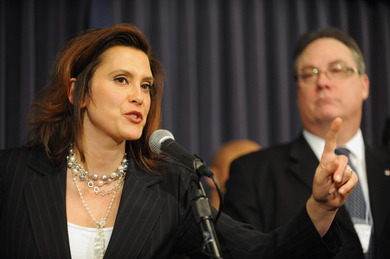
Senate Minority Leader Gretchen Whitmer, left, responds to the State of the State address while House of Representatives Minority Leader Richard Hammel, right, looks on.
Angela J. Cesere | AnnArbor.com
Senate Democratic leader Gretchen Whitmer said in an interview the proposal "isn't a Democratic plan or Republican plan. It's a genuine plan for trying to move the state forward."
Senate Democrats are proposing closing numerous tax loopholes and ending certain tax credits to pay for the program. The Michigan 2020 proposal claims that loopholes credits cost the state an annual $35 billion and that eliminating 10 percent of the exemptions would free up enough money to fund a statewide tuition allowance.
"My colleagues across the aisle gave away $1.8 billion last year," she offered. "To look at that $52 billion state budget and say we can't find savings there- it's hard to imagine they could do that."
Yet to higher education funding expert Jennifer Delaney, a scholar at the University of Illinois, such an objection isn't so far-fetched.
"The difficulty really is about affording it," she said of the proposal, which would offer up to $9,575 for tuition per student each year. That's the median tuition rate at Michigan's 15 public universities. "Michigan isn’t a top spender on higher ed and also isn’t looking terribly good in other economic measures."
Michigan currently ranks 38th among the 50 U.S. states in higher education funding. Public universities in 2011-2012 received a 15 percent decrease in state funding. University of Michigan in 2011-2012 absorbed a $47.5 million cut.
The state allotted $1.36 billion for higher education in 2011-2012 and is expected to set aside $1.4 billion for higher education in 2012-2013.
"It is conceivable in some context that a state could do something like this, but I don’t know if that’s necessarily true in the legislative context of Michigan," Delaney continued.
A similar tuition-coverage plan already exists in Michigan, but on a much smaller scale. Kalamazoo offers the "Kalamazoo Promise," a four-year scholarship covering the cost of tuition awarded to students who attend and graduate from a Kalamazoo public high school.
Whitmer noted that since the scholarship began, the economy in Kalamazoo has been on the rise, property values of rebounded and more students are opting for college.
Yet the Kalamazoo Promise and the 2020 plan are drastically different in one significant way.
The Kalamazoo Promise is funded entirely by anonymous donors— not taxpayer dollars.
"The issue is —and I don't know that we've really had any good discussion about this— what is the appropriate sharing of the cost of education?" Olson said.
"To what extent should the public share and to what extent should the person who would benefit from that education most share?" he continued. "Should the person that’s making $30,000 as a janitor share"
Leigh Greden, head of government relations for Eastern Michigan University, agreed that the state's budget difficulties pose significant challenges to the Michigan 2020 proposal.
"Eastern supports initiatives to make higher education more affordable and we have a strong commitment to doing so —we're the statewide leader in holding the line on tuition and have dramatically increased financial aid— but we also understand the financial challenges facing the State," he said.
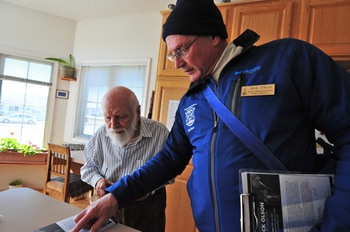
Rick Olson
"I expect this proposal will be evaluated in that light."
Education funding expert Nate Daun-Barnett, a former Lansing policy analyst and professor at the University of Buffalo, said the proposal, with its large price tag, "would be difficult to achieve with the cuts Michigan has experienced over the past eight years." He said the proposal is likely an effort by Democrats to promote discussion of higher education funding reform in Michigan.
"They’re trying to create a conversation," he surmised. "If you start small you’re going to end up with something even smaller. You might as well make it an audacious goal."
Over the last decade, lawmakers have cut more than $1 billion in inflation-adjusted dollars from higher education, according to the Michigan Presidents Council. Additionally in 2009 the legislature eliminated the Michigan Promise scholarship, which provided up to $4,000 to high school graduates who completed two years of postsecondary education.
"The elimination of the promise scholarship was a problem, it was the signature scholarship from the state," Daun-Barnett said. "Its elimination makes college seem even less affordable, so I think they’re trying to come up with a solution to that and figure out how you fill that gap."
Yet the sheer size, breadth and cost of the Michigan 2020 proposal could have a polarizing effect on the two political parties, making large and wide scale reform even more difficult.
"Lots of details need to be worked out, including whether there’s any hope in generating bipartisan support," said Michigan Presidents Council Director Michael A. Boulus.
Kellie Woodhouse covers higher education for AnnArbor.com. Reach her at kelliewoodhouse@annarbor.com or 734-623-4602 and follow her on twitter.
Comments
Roger Kuhlman
Thu, Mar 8, 2012 : 9:56 p.m.
Sure something for nothing, what isn't there to like about this plan. We will just get all Michigan taxpayers to foot the bill through our financially regressive state income taxation system. Everybody will be happy right? Well sure everyone in the state higher education system will be happy since they will be able to raise tuition more and pay their people more.
Hot Sam
Thu, Mar 8, 2012 : 4:04 p.m.
If I "invest" in everything these central planners want me too, I won't have any future myself...
AnnArborDon
Thu, Mar 8, 2012 : 2:49 p.m.
For all of you who think this is such a bad idea, please consider the following: 1) This does not make college free, it just reduces the cost. College currently averages over $25 thousand per year. A reduction of $9575 per year still means that the student will have to pay over $15 thousand per year - probably still more (adjusted) than you paid, but more in line with inflation than the over-inflated actual cost. 2) Think of it as an investment in the future. People with college degrees earn more, which comes back to the state directly, in the form of taxes on that extra income, and indirectly, as increased local spending. That sort of incentivizing is considered good and even necessary when it goes to big corporations like Pfizer, which received an $84.2 million dollar, 20 year incentive program for adding 600 jobs to the Ann Arbor facility. That works out to $7017 per job, per year for 20 years. Why shouldn't we at least consider doing the same for individuals, for the same potential benefit? 3) Many of us receive tax breaks: credits, deductions, etc. Many of us depend on them pretty heavily . We are paying the lowest tax rates in generations, and many are still complaining about the expense, and claiming that lower taxes will be the answer to our economy. How is that so different from this proposal? These kids could graduate owing a lot less. Many of them will be happier about staying in Michigan. All of them will have more money to spend locally as soon as they graduate. 4) Granted, college isn't for everyone, but there are plenty of kids who should be going to college who just can't afford it. What if one of them would have started the company that hires your children in the future, or would have created the next wonder drug that saves your life, or whatever? There used to be an advertising campaign with the tag line, "a mind is a terrible thing to waste." Have we become so greedy and self-absorbed that we can't see the value of that any more?
Booradley
Thu, Mar 8, 2012 : 1:46 p.m.
Nothing is free in life and I wish politicians would stop telling people that! If kids and their families don't have any skin in the game that it will get abused and be of little value to them as bad choices will be made. Shouldn't kids be working part-time to help pay for their education? Give them jobs to help pay for their education like many of us did back in the 70's and 80's.
Hot Sam
Thu, Mar 8, 2012 : 12:53 p.m.
@ Stuart """The best thing about free tuition though is that it would put an effective cost control on the ever increasing cost of tuition.""" I would love for you to explain that one to us...
Stuart Brown
Thu, Mar 8, 2012 : 5:46 a.m.
Marshall Applewhite raises a good point: keeping more 18-26 year old adults out of the workforce will put upward pressure on wages. We should also include Community Colleges as well.
a2citizen
Thu, Mar 8, 2012 : 5:42 a.m.
Yesterday it was free contraception. Today it's free college. Those don't help me because my fathering years are past and I have my degree. I WANT FREE BEER!!!
shutthefrtdoor
Thu, Mar 8, 2012 : 3:57 p.m.
I would support a tax deduction on it! Hahahahaha...every other one is gone... : )
Stuart Brown
Thu, Mar 8, 2012 : 5:30 a.m.
This is an excellent idea! One way to pay for it would be to cut by at least half the prison budget; this would raise about $1 Billion annually. Also, tax the top 5% of the income distribution. The best thing about free tuition though is that it would put an effective cost control on the ever increasing cost of tuition. We would not see massive increases in tuition costs above and beyond the cost of inflation.
rcastentman
Thu, Mar 8, 2012 : 2:35 a.m.
A very high percentage of Michigan college graduates leave the state immediately after getting their degree.....to find a job. Why would we use tax dollars to pay for an education when there are so few job opportunities in Michigan for college grads? I've got a better idea, why don't they fix the tax loopholes and use the money to repair our roads and bridges?
genetracy
Thu, Mar 8, 2012 : 2:44 a.m.
We need to create more welfare.
genetracy
Thu, Mar 8, 2012 : 1:29 a.m.
So the Democrats think the state of Michigan has $1.8 Billion laying around to pay for free college tuition for anyone who wants it. Why not a more round figure like 600 Gazillion? Are these legislators delusional? So this to to pay tuition. What if the student wants housing? No problem. Money for food? No problem. Child care issues? Here's a check. Sounds like a grand plan of educational welfare to me.
Marshall Applewhite
Wed, Mar 7, 2012 : 11:03 p.m.
The idea of State governments further subsidizing college education is absurd. When the state continues to pump more money into the system, this only gives colleges less of an incentive to keep tuition down. The fact of the matter is, the reason colleges are currently seeing record applications and continue to be pushed as "the only way" by government is because they are currently serving the beneficial purpose of keeping a large portion of the 18-26 year old population out of the workforce. Without unlimited government loans and unbridled enrollments, the unemployment rate would be something like 25% right now. Colleges will continue to serve this purpose until the Baby Boomers exit the workforce.
Olan Owen Barnes
Wed, Mar 7, 2012 : 8:57 p.m.
Where is this "free" money going to come from - someone got a printing press?
SemperFi
Wed, Mar 7, 2012 : 8:44 p.m.
Michigan spends a higher % of its General Fund on correctional instutions than any state in the USA. The only states that spend more money on correctional budgets are CA, NY, FL, & TX. We spend more than $33,000 per inmate per year. And we can't invest $9,000 a year in our kids. Shameful.
DonBee
Thu, Mar 8, 2012 : 10:29 a.m.
This program will not change the number of children who end up just over 18 and in prison. The vast majority of them don't have a high school education. The vast majority of them come from a handful of school systems. In the case of Detroit 3 out of 4 children NEVER graduate from the school system, 1 out of 2 that do, are functionally illiterate. So 7 out of 8 never actually get an education. Those are the kinds of young people who end up in Prison. Focusing on the failed school districts and the familes in them is the only way to reduce the prison population. Until that happens, that populatio will stay high and Michigan will have a tough time reducing unemployment and solvin other budget problems.
Monica R-W
Wed, Mar 7, 2012 : 6:06 p.m.
(Wanted to add my reply to a post, into a separate thread, as the 2020 Proposal should address needs in Higher & Vocational Education). First, the costs of Higher-Educational Administrators is far too high. These expenses add to the total costs of education at these institutions. Second, yes tuition is too expensive. If the 2020 proposal would be workable, tuition costs must to held at steady levels; with budgetary increases only considered, maybe every three to five years. Third, not everyone doesn't need to attend a 4 year university. Somehow, we have gotten away from funding Vocational Education, allowing some Michiganders to learn a TRADE and find employment, without the costs associated with a four year degree. This presents a huge problem. But, in order to return back to Vocational Education, Michiganders and our state Legislator should strongly support with our Taxable Dollars, CO-OP programming in Public Schools. Instead, with the $900 Million dollars in cuts from the School Aid Fund, these programs to prepare our next generation for decent paying employment opportunities in "skill-Trade-type fields", are in jeopardy. Just like Michigan needs Doctors, Lawyers, Business Experts and High-Tech workers; we also need Plumbers, Painters, Auto & Airplane Mechanics, Wielders, Masonry and Pipe-fitters. Hopefully, the 2020 Proposal address BOTH Vocational & High Ed career fields. Monica RW
Pixie Belle
Wed, Mar 7, 2012 : 5:34 p.m.
Pff what about the Michigan Promise Scholarship that I and many other Michigan student's earned.
cinnabar7071
Wed, Mar 7, 2012 : 10:50 p.m.
Pixie how did you earn the Michigan Promise Scholarship? I pretty sure myself and other Michigan workers earned that money working 40 hours a week. Were you paying taxes, and thats how you figured you earned it? Anyways that what happens when you count on someone else for what you should have done for yourself.
SemperFi
Wed, Mar 7, 2012 : 8:45 p.m.
It was axed from the budget by the legislature.
Stephen Landes
Wed, Mar 7, 2012 : 5:27 p.m.
This is not a serious proposal. It is a Democrat "stir the pot" noise maker -- a desperate attempt by a party used to having its own way in this State to gain some traction. Just another version of "we can solve everything if we spend enough of your money".
Commoncents
Wed, Mar 7, 2012 : 5:21 p.m.
Oh yeah, FREE education! LOL. Give me a break, it's not free. Who ever gets their taxes raised will just raise the cost of whatever they charge. Anyway, I'd be ok w/ a program, but it would have to have everything Don Bee mentioned PLUS if you get below a 3.0GPA you get $0 that semester.
SalineSara
Wed, Mar 7, 2012 : 5:16 p.m.
This article should be titled: GUMMY BEARS FOR ALL!
a2trader
Wed, Mar 7, 2012 : 5:16 p.m.
I have three teens who all plan on going to college so this program would be great for us personally. But I cannot support a program like this for one very big reason. Not all kids want to, can be successful in or are ready to go to college (4 year, community college whatever) after high school. Why would we spend money giving something to people who aren't even sure they want it, can do the work, have the maturity, or have the focus to complete a 2 or 4 year program? It is just a bad investment. Even Kalamazoo Promise found one third of kids who got money to go to college from the Promise dropped out. <a href="http://www.mlive.com/news/kalamazoo/index.ssf/2011/11/the_kalamazoo_promise_scholars.html" rel='nofollow'>http://www.mlive.com/news/kalamazoo/index.ssf/2011/11/the_kalamazoo_promise_scholars.html</a> I wonder what that cost? As Mike Hartwell suggests, a screening system would be necessary. And I can only imagine how much more state funding these state universities are going to need to build dorms, hire faculty etc to support this flood of students.
genetracy
Thu, Mar 8, 2012 : 1:31 a.m.
It would turn into an entitlement program of massive proportions.
shutthefrtdoor
Wed, Mar 7, 2012 : 5:45 p.m.
Trade schools...I hope they would be included.
John Q
Wed, Mar 7, 2012 : 5:28 p.m.
Seems like an overblown concern. Most of the kids who don't succeed in college don't have any interest in attending. The Promise kids who washed out generally did so right away.
Gary
Wed, Mar 7, 2012 : 5:12 p.m.
Sounds to me like a noble goal. I'd sure like to see some positive "can do" suggestions instead of a bunch of "can't do" proclamations. Some of the objections are legitimate but don't look to me like insurmountable hurdles. How about turning some of the Ann Arbor brainpower toward making good things happen?
Ron Granger
Wed, Mar 7, 2012 : 4:58 p.m.
Bad idea. Not everyone should go to "college". Distracted students just disrupt the education of those who are serious. Those who are motivated can go out and learn on their own. Unfortunately, we don't recognize or reward that much. College cannot inspire a "work ethic" where none already exists. Especially if that college is a free entitlement. Making this dependent on GPA just puts more pressure to inflate GPAs. "You're keeping my kid out of college!" Etc. Too many jobs require a college degree that means nothing. The days of sitting in a lecture hall are past..... Many colleges just don't know it yet. We will see increased pressure in the future to provide welfare for colleges, and to support their high tuitions. Once you appreciate how 90+% of college can be done remotely over the internet, you start asking hard questions about why the price is so high.
a2citizen
Thu, Mar 8, 2012 : 5:36 a.m.
Rod, agree with everything thing you said except "...We will see increased pressure in the future to provide welfare for colleges...". We are already providing welfare for colleges. Maybe "...more welfare for colleges..." would be more accurate. Gotta pay for Mary Sue's $700k salary (which is just the tip of the ice berg).
Right of Center
Wed, Mar 7, 2012 : 4:33 p.m.
If only those nasty Republicans would go along with the Educational Complex's desire to gobble up more and more resources! I don't think this is even a well meaning proposal. The universities may be starting to understand that they are overpriced and not acomplishing their stated mission. The quality of incoming students, graduation rates and time required to complete a degree have been heading in the wrong direction for years. Remember when the faculty use to criticize the Athletic Department's graduation rates? They can't anymore because the general student body have become dumb jocks without athletic ability, and that's a sorry state of affairs!
SemperFi
Wed, Mar 7, 2012 : 8:47 p.m.
Nothing to read here. Move along.
John Q
Wed, Mar 7, 2012 : 5:26 p.m.
Better to spend more money on the Prison Complex.
YpsiLivin
Wed, Mar 7, 2012 : 4:32 p.m.
A program like this could be successful if legislators were strategic about what they were willing to fund. It makes no sense to pay for the universities to churn out thousands of English teachers and Art History majors who can't find jobs in this state. Instead, look at the jobs here that are going unfilled for lack of qualified personnel, and pay the college costs incurred by students to train for those positions. Then require those students to either stay in Michigan and work for a certain period of time, or repay the cost of their education if they leave the state. That would help ensure that Michigan has enough engineers, nurses, doctors, researchers, pharmacists, dentists, machinists, etc., to fill positions here. Students who want to teach in certain select fields (foreign language, mathematics, science, engineering, etc.) could get a free ride, while students who want to major in fields where there are no openings can pay their own way. The Law of Supply and Demand operates flawlessly. It should be put to work in higher education. It's time to start using tax dollars strategically, instead of treating the State Treasury like a cookie jar.
daytona084
Wed, Mar 7, 2012 : 4:26 p.m.
"eliminating tax loopholes" : code-speak for "tax increases"
John Q
Wed, Mar 7, 2012 : 5:26 p.m.
Republicans had no problem with it when Synder was doing it to the average taxpayer. Why should they balk now?
MjC
Wed, Mar 7, 2012 : 4:05 p.m.
What a joke. Thousands of students were "promised" up to $4,000 in college scholarship support IF they successfully completed all the State mandated exams AND attended a State college. The kids did their part only to have the State eliminate the program completely. Didn't even grandfather kids in. Maybe I'd be more supportive if I could trust this government and if I didn't JUST pay the last FULL tuition bill for my youngest.
justcurious
Wed, Mar 7, 2012 : 3:56 p.m.
Great. Spend more money to turn out college graduates to wait tables and take jobs away from the high school graduates or just plain leave the state for warmer climes. I'm tired of paying money to "educate" other peoples kids. I have never had a child in the schools, yet I pay and pay...and then find out that they don't even know who is the Vice President. Enough!
jcj
Wed, Mar 7, 2012 : 4:01 p.m.
I'm with you all the way on this!
Mike Hartwell
Wed, Mar 7, 2012 : 3:51 p.m.
I could easily support this. However, I would attach strings. Graduate HS 2.5 GPA or above, Graduate college in 4 years with 3.0 GPA, two years in state service post graduation
Mike Hartwell
Wed, Mar 7, 2012 : 4:07 p.m.
Yeah baby, pay to play.
Mike Hartwell
Wed, Mar 7, 2012 : 3:56 p.m.
PS: West Point and Annapolis and Colorado have been doing the same thing for a long time now.
shutthefrtdoor
Wed, Mar 7, 2012 : 3:46 p.m.
This is a great idea!
Mick52
Wed, Mar 7, 2012 : 3:45 p.m.
I am sure this is great news to the police, firefighters and K-12 teachers who have been laid off. If you want to ponder eliminating tax credits and loopholes I can think of a lot of areas that need that funding rather than free tuition for college students. I think Rep Olson is correct. This a "chicken in every pot" hype presented only so they can whine about it when clear heads give it no consideration. Go ahead with the tax reform Ms. Whitmer if you dare, but let's come up with some more important areas to spread it around. I used to be a democrat. What turned me was dumb ideas promoted and good ideas opposed by the party.
dading dont delete me bro
Wed, Mar 7, 2012 : 3:36 p.m.
more handouts woot woot guess i can convert my kids college funds to my retirement accounts? woot woot
EyeHeartA2
Wed, Mar 7, 2012 : 3:34 p.m.
"Senate Democrats are proposing closing numerous tax loopholes " If they are indeed loopholes, they should be closed regardless of how we intend to spend the money. "My colleagues across the aisle gave away $1.8 billion last year," "isn't a Democratic plan or Republican plan. It's a genuine plan " hmmmmm.....sounding kind of partisan to me....wadaya think there Gretchen? "To look at that $52 billion state budget...." So our so Gretchen is proposing we click our heels together and spend about 3.5% of our state budget on this. Clowns like her make it easy for guys like Rick. Thank you, Gretchen.
DonBee
Wed, Mar 7, 2012 : 3:31 p.m.
I would be perfectly happy to fund such a program, even with a tax increase. IF AND ONLY IF the universities agree to hold the increase in tuition at or below the inflation rate for in state students. I am not in favor of another run away program where the costs can go up at any rate of speed people choose and the tax payer is on the hook. The increase in the state share of Medicaid this year is another roughly $500 million dollars - a decision made by someone not in the state government and also not by the tax payers. Also I think higher education needs a broader definition than "college" many jobs that are out there need strong vocational skills. A degree in English Literature does not make you a qualified welder. While I am not sure I would want it, or would know how to do it, I think a quota system like the Medical system has for doctors might be needed to direct the taxpayer money to programs that will result in jobs in the state.
SemperFi
Wed, Mar 7, 2012 : 8:55 p.m.
lumberg... The union careers you mentioned all require that the individuals attend trade school and apprenticeship programs. All of that is sponsored by the unions themselves. Union dues going to a good cause.
lumberg48108
Wed, Mar 7, 2012 : 5:54 p.m.
Interesting take because Plumbers, Painters, Auto & Airplane Mechanics, Wielders, Masonry and Pipe-fitters are (usually) union careers and (right now) those careers are more lucrative than most Literature, Arts and Sciences degree fields and most schools have the most students in LSA programs. this might change but for most of my college friends who chose LSA for a degree, we watched high school kids get trained in vocations and out earn us, right out og the gate
Monica R-W
Wed, Mar 7, 2012 : 5:08 p.m.
DonBee, Usually we disagree but on this one, surprisingly we don't, on most of your post. Maybe a combination of yours and Ignatz's post is what needs to occur. First, the costs of Higher-Educational Administrators is far too high. These expenses add to the total costs of education at these institutions. Second, yes tuition is too expensive. If the 2020 proposal would be workable, tuition costs must to held at steady levels; with budgetary increases only considered, maybe every three to five years. Third, yes DonBee everyone doesn't need to attend a 4 year university. Somehow, we have gotten away from funding Vocational Education, allowing some Michiganders to learn a TRADE and find employment, without the costs associated with a four year degree. This presents a huge problem But, in order to return back to Vocational Education, Michiganders and our state Legislator should strongly support with our Taxable Dollars, CO-OP programming in Public Schools. Instead, with the $900 Million dollars in cuts from the School Aid Fund, these programs to prepare our next generation for decent paying employment opportunities in "skill-Trade-type fields", are in jeopardy. Just like Michigan needs Doctors, Lawyers, Business Experts and High-Tech workers; we also need Plumbers, Painters, Auto & Airplane Mechanics, Wielders, Masonry and Pipe-fitters. Hopefully, the 2020 Proposal address BOTH Vocational & High Ed career fields. Monica RW
Ignatz
Wed, Mar 7, 2012 : 4:24 p.m.
Unfortunatley, inflation rates for universities are different from those of the general public. Students expect new technologies to be funded and day to day costs are increasing more, as well. For instance, Joe Homeowner pays for the unkeep on residential type systems. Universities have to pay for comercial grade structures. This doesn't even take into consideration the ridiculous saleries of administrators.
John Q
Wed, Mar 7, 2012 : 3:22 p.m.
"To what extent should the public share and to what extent should the person who would benefit from that education most share?" he continued. "Should the person that's making $30,000 as a janitor share" Olson needs to get an education. The states that are the wealthiest in the county have the highest percentage of college graduates. A janitor making $30,000 will benefit from that even if they choose not to take advantage of such a program.
SMC
Wed, Mar 7, 2012 : 3:14 p.m.
It's a nice idea, but unfortunately, it's not going to happen any time soon. The Governerd's children attend private school, so we can be pretty sure he has no interest in seeing every kid in this state being given a chance to attend college based solely on scholastic achievement, rather than their parent's wealth.
UtrespassM
Fri, Mar 9, 2012 : 3:24 a.m.
If our governor really cares about the further of the state of Michigan, and also has the fund to help our kids in college, please restore the $4000 scholarship the state promised before.
garrisondyer
Wed, Mar 7, 2012 : 11:52 p.m.
@SMC -- Waaaiiiiiit just a second here. As a Greenhills grad as well as a teacher at a public middle school, I take exception to the second sentence in your post. You need to check your logic here. What is it about parents of children who are enrolled in a world class private school that equates them with people who have no interest "in seeing every kid in the state being given a chance to attend college based solely on scholastic achievement", as you put it? You're making an uninformed leap here... Your readiness to put everyone in their own little box is alarming. People come from all sorts of backgrounds and have all sort of differing opinions on topics such as this one. I'd bet more than $1 but less than $10 (thin wallet these days...) that my own parents don't fit your assumption of them based on what you wrote above.
jcj
Wed, Mar 7, 2012 : 3:59 p.m.
Didn't happen on Granholm's watch either DID IT!
DonBee
Wed, Mar 7, 2012 : 3:26 p.m.
SMC - 1/2 right. The Governor's son attended Huron, where the Governor was very active in education issues at the school. His daughter did attend public schools, until she asked to attend Greenhills. The Governor and his wife were perfectly happy to have their children in public schools. As to attending college. If you are rich you can go (your money), if you are poor you can go (Pell Grants), if you are middle income - you and your children are out of luck.
Soothslayer
Wed, Mar 7, 2012 : 3:25 p.m.
That's because most all public schools fail, especially at college prep. Greenhills is the best choice in the county bar none. Too bad all kids don't have the same opportunity, they should.