

Attorney general: Graduate assistant union would 'seriously jeopardize' U-M's excellence
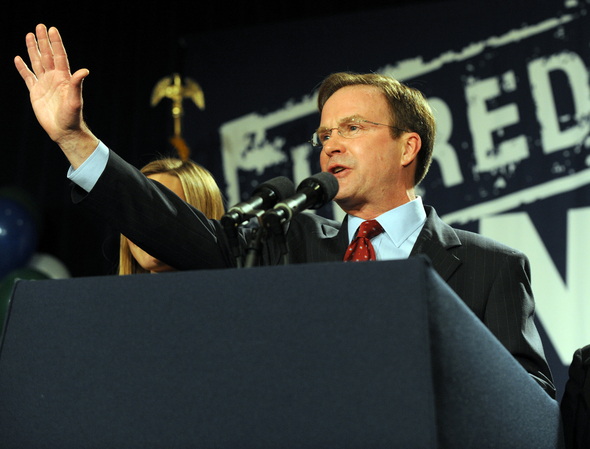
Michigan State Attorney General Bill Schuette says allowing graduate research assistants to unionize could make the University of Michigan less attractive as a research institution.
AnnArbor.com photo
Bill Schuette, who has held the state's top legal advising position for 11 months, tried to stymie the year-long unionization effort by filing a motion with the Michigan Employment Relations Commission yesterday.
“Unionization will compromise the integrity of the mentor-mentee relationship essential to a successful and prestigious doctoral program,” Schuette wrote in the motion, saying unionization would "significantly damage" and "seriously jeopardize" U-M.
The unionization of GSRAs has been a controversial issue since early this year, when the Graduate Employees' Organization sought permission from the commission to unionize in April. GEO includes student instructors, who already have a union, and research assistants.
Despite fervent criticism of unionization from U-M President Mary Sue Coleman, the Board of Regents voted this summer to support the unionization.
The commission disagreed with the regents.
It decided in September to deny the GEO petition, citing a 1981 Michigan court ruling that states GSRAs are students and not employees.
The GEO, however, immediately filed a motion for the commission to reconsider its decision, once again arguing that they are paid for university-related work and should therefore be considered employees.
That reconsideration hearing is Dec. 13.
In the balance is the ability for about 2,200 U-M GSRAs and tens of thousands of GSRAs from other state universities to unionize.
In his motion, Schuette asks the commission to affirm its original September decision on the grounds of the 1981 ruling. He also seeks official involvement in the commission's Dec. 13 review.
"The imposition of a third party into the educational process could make the university less attractive as a research institution and compromise its ability to attract the top students, top researchers and significant private and public research funding," Schuette claims in the motion.
In October, 19 current and former U-M deans wrote a letter to university administrators expressing similar concerns.
After Schuette's filing, GEO officials shot back at their opponents, reasserting their desire for a union election.
"GSRAs have a right to make this decision for themselves, without interference from outside parties,” Christie Toth said in a statement.
In an interview, U-M graduate student instructor Liz Rodrigues echoed Toth's concern.
“Form our point of view, this is another example of someone who's neither the employer or the employee getting involved,” said Rodrigues, the GEO communications chair. “GSRAs have the right to decide if they want to form a union.”
“It’s a right-to-vote issue,” she continued.
Rodrigues denied Schuette’s claim that unionization would damage U-M.
“As a graduate student instructor myself, I know that the strong Graduate Employee Organization at the University of Michigan is one of the reasons I decided to come here,” she said, adding that GSIs have been unionized for more than four decades. “Our program is strong nationally.”
In November, the Michigan Student Assembly passed a resolution supporting the unionization effort.
Read Schuette's filing here.
This story has been updated.
Kellie Woodhouse covers higher education for AnnArbor.com. Reach her at kelliewoodhouse@annarbor.com or 734-623-4602 and follow her on twitter.
Comments
Peter Adamczyk
Fri, Dec 2, 2011 : 5:33 p.m.
What is so silly is that they are actually trying to claim the GSRA's are not employees. Of course they are trying to claim that, because if the GSRA's _are_ employees (as the Regents said), then it doesn't matter what anyone thinks, they have the right to unionize. Whether they should or not is a separate discussion. Having been a GSRA at UM, I know that: (1) They get a paycheck. (2) They have a portion of it withheld as "payroll tax" just like everyone else. (3) They sign a W-4 when they're hired and receive a W-2 in tax season. Sounds like an employee to me. I suppose it might be telling to know if the U sends checks to the IRS for the "Employer Portion".
Rod Johnson
Fri, Dec 2, 2011 : 11:49 p.m.
Right. This is really they key point. It doesn't matter what the university wishes were the case--there is nothing distinguishing them from other employees. Students move back and forth from GSI and GSRA status pretty fluidly anyway, depending on their advisors' funding. It's ridiculous to claim there's a qualitative difference in their status. Face it, they're employees and deserve the same protections as other employees regardless of how you feel about unions.
Rork Kuick
Fri, Dec 2, 2011 : 5:29 p.m.
Framers of our constitution gave us Regents. Why would they have done a crazy thing like that? Our legislative and executive branches know the answer, but don't like it, and sometimes act like they don't know. I was one of the two GEO stewards there, about 30 years ago, when we and Shapiro finally signed a contract after 4 years of legal appeals by the administration - but at least it was the administration fighting us, and the regents finally told them to stop. (OK, they had just lost another appeal too, but could have kept us tied in string a few more years - their lawyers were capable.) MERC had ruled in 1977 that we teaching assistants were employees, but the research assistants weren't, cause their work was "directly related to educational goals". Half a win for both sides. Not saying I agree with that, or that it should mean they are not employees. A research associate or scientists sitting 6 feet away might be doing the same thing, and they are employees. (Hope the picture I took of David Marker signing is hanging on the walls somewhere. We thought that day might never come.)
Ron Granger
Fri, Dec 2, 2011 : 2:48 p.m.
"Unionization will compromise the *exploitation* of the mentor-mentee relationship essential to a successful and prestigious doctoral program," Fixed that for you.
Bridget
Fri, Dec 2, 2011 : 2:41 p.m.
It appears that the students are also employees, and as employees, can unionize if they choose. The regents, who are closer to the students, have ruled appropriately and should be upheld. Schuette is trying to advance the Republican anti-union agenda, not support the law of Michigan.
Bob Krzewinski
Fri, Dec 2, 2011 : 2:35 p.m.
Unions are a terrible idea. After all, employers ALWAYS have the best interest of the employee in mind all the time. They will tell you so! Besides, what employee would want legally binding pay rates, protection from being fired on a whim by management (as if that would ever happen!) and the ability to negotiate working conditions.
Dante Marcos
Fri, Dec 2, 2011 : 1:46 p.m.
Wait a minute: one of the richest institutions in the world would be "jeopardized" by graduate students no longer being slaves? It's going to be the opposite, big brother.
Edward R Murrow's Ghost
Fri, Dec 2, 2011 : 12:26 p.m.
Yeah. Bill Schuette knows more than MSC and the Board of Regents about what it takes to attract top graduate students to a research university. Same is true of the usual suspects here. To quote one of them: "And that unionization would interfere with the mentor relationship necessary for advanced education." The TAs at the U of M have been organized for more than 30 years. I wonder if any of the anti-union folks here might elaborate how that has damaged the "mentor relationship" and have caused the UM's graduate programs to decline. Don't worry: we won't be holding our collective breaths waiting for a coherent answer to that one. Good Night and Good Luck
Left is Right
Fri, Dec 2, 2011 : 1:58 a.m.
I don't believe unionization is in the best interest of GSRAs. But have a vote--only if all GSRAs vote. My guess is that it would not come out in GEO's favor.
hut hut
Fri, Dec 2, 2011 : 2:18 p.m.
Kind of like a vote is only valid if everyone who's eligible votes? If that were the case, no election in American history would be valid.
cibachrome
Fri, Dec 2, 2011 : 1:24 a.m.
You mean the one with the golden crow stuck in the top of her head?
Billy Bob Schwartz
Thu, Dec 1, 2011 : 10:18 p.m.
Historically speaking, that picture reminds me of something. Now what was it??
Maxwell
Fri, Dec 2, 2011 : 2:57 a.m.
Hilarious comment - I salute you!
Tex Treeder
Thu, Dec 1, 2011 : 10:46 p.m.
A foolish and inappropriate comment.
Anders
Thu, Dec 1, 2011 : 10:26 p.m.
Der Fuehrer?
the major
Thu, Dec 1, 2011 : 10:12 p.m.
Schuette is one of the worse ever. I can actually live with Snyder but Schuette is just bad news 1
shitfromshinola
Thu, Dec 1, 2011 : 9:50 p.m.
As a potential graduate student, I would find Michigan much more attractive if I knew that there was a stable contract negotiated by my fellow students as well as an organization that had my back in the case of a labor-related dispute between my mentor and I.
David Cahill
Thu, Dec 1, 2011 : 9:43 p.m.
So, Schuette reaffirms his support for bosses and opposition to unions. I hear recall petitions are being widely circulated.
Meg
Thu, Dec 1, 2011 : 9:24 p.m.
Apparently Bill Schuette missed the fact that peer universities, including the University of Washington and the University of California, already have unionized graduate students. So does the University of Michigan -- the GEO is one of the oldest graduate student collective bargaining unit in the US. They are student-employees exercising their right to collectively bargain with their employer, while also doing excellent research. And, amazingly, the skies have not fallen. But, you know, don't let that get in the way of the union-bashing.
Regularjoey
Thu, Dec 1, 2011 : 9:23 p.m.
BS is determined to be a one man army when it comes to pushing his political as well as personal beliefs on Mi. citizens. He is either delusional or fully aware that he has less than a 0% chance at re-election and has decided he has 4yrs. To put Mi. Citizenry firmly in the hands of the republican party's policies. He seems hellbent on ignoring his true job duties as our chief law enforcer and writing his own laws reflecting policies he and the republican party can get fat off of for years to come. I myself have to believe it will backfire completely by mobilizing those who find his misuse of office extremely dangerous and offensive as well as illegal. His anti-workforce agenda is oh so painfully obvious as he kicks teachers, students, collective bargaining rights, and frankly anything that doesn't benefit his benafactors or his own agenda squarely to the burn pile.
Jeremy Peters
Thu, Dec 1, 2011 : 8:56 p.m.
Reprehensible. Schuette is injecting political opinion into a discussion and something that is between the Graduate educators at the University and the University itself. Last I checked, employees have the right to organized and be represented for collective bargaining in this State (for the meanwhile at least, given the hardcore rightward bent in Lansing these days). Better paid educators mean increased achievement in the classroom, not to mention more dollars being spent at small businesses in downtown Ann Arbor and other communities. It is asinine to think that cutting pay will result in prosperity -- how else will people be able to support the businesses we hold dear on our Main Streets?
A24eva
Thu, Dec 1, 2011 : 8:49 p.m.
This article is a good example of reporting as opposed to journalism.There is a decided lack of objectivity and due diligence in the reporting of this article. Schuette's straw man argument against unionization is taken at face value without meaningful follow-up or investigation. Is there even empirical data to support the claims he is making? Were any efforts made to gain insight/interview actual graduate student research assistants? Leadership from the Graduate Employees Organization?
Victor22
Thu, Dec 1, 2011 : 9:21 p.m.
Kellie, is there a reason that you use anti-union jargon in the article? Have you not written on unions previously?
Kellie Woodhouse
Thu, Dec 1, 2011 : 9:09 p.m.
@A24eva FYI: I've put in an interview request with the GEO, but they did not respond by the time of posting. That's why there's the disclaimer 'this story is being updated.' In the meantime, I included the GEO viewpoint that GSRAs are employees and included a statement from the GEO. As soon as we talk to someone from GEO, there will be an update. Thanks for reading.
Alan Goldsmith
Thu, Dec 1, 2011 : 8:29 p.m.
Bill Schuette is a runaway train, misusing his elected political office for his own interests and right wing agenda. If he continues this, he deserves to be recalled. Enough!
Gorc
Fri, Dec 2, 2011 : 2:14 p.m.
No it doesn't, but your last thread proves my point.
Alan Goldsmith
Fri, Dec 2, 2011 : 1 p.m.
The Mayor has been invisible with this issue of course. Must be the 'feather bed' teaching job tossed his way by the U of M. Not only does it help but them City park land, they get his silence on this type of issue as a bonus. He was silent as a mouse when the U of M Nurses were trying to settle their contract as well when other local Democrats spoke out and marched with them. He's a coward when it comes to speaking out on REAL issues. This one isn't his 'fault' but keeping his mouth shut IS. Hope that addresses the issue for you. Lol.
Gorc
Thu, Dec 1, 2011 : 8:53 p.m.
I'm surprisd you haven't blamed the mayor for this one too.
Macabre Sunset
Thu, Dec 1, 2011 : 8:07 p.m.
It would be interesting to see a vote. For the most part, I think students understand that unions are viewed as a huge negative for the types of jobs they hope to fill down the road. But times are a-changin', and students can be very political animals when it actually might affect them. I agree that it's impossible to reconcile the terms professional and union member. And that unionization would interfere with the mentor relationship necessary for advanced education. But the pro-union forces are organized, and the students who are truly interested in becoming professionals are probably too busy to be paying attention. This could do a lot of damage.
Victor22
Thu, Dec 1, 2011 : 9:19 p.m.
Macabre, I think the only damage that could happen with respect to the mentor mentee relationship has already happened. And it's purely a result of President Coleman and the Deans pushing faculty to hold GSRAs in anti-union captive audience meetings.
hut hut
Thu, Dec 1, 2011 : 7:19 p.m.
Scheutte's opinion on unions is well known. He and his judicial rubber stamps known as judges are a scourge against the rights of Michigan citizens. This is not news. He's always running for officer and it's his job as a politician to let everyone know he's not soft on crime and the right of free association and collective bargaining, which he considers a crime.
Roadman
Thu, Dec 1, 2011 : 7:18 p.m.
Bill Schuette hit the nail on the head. Unions should not be able to organize graduate research assistants.
craigjjs
Fri, Dec 2, 2011 : 12:31 p.m.
Based upon his conduct in office, I think someone must of hit Bill Shuette on the head.
Victor22
Thu, Dec 1, 2011 : 9:18 p.m.
"Unions should not be able to organize graduate research assistants." I don't think you understand the concept of the union. There's no mythical union "organizing us." We, GSRAs, are organizing a union made up of and run by us.