

Aliens, witchcraft and zombie philosophers: 8 unconventional courses at University of Michigan
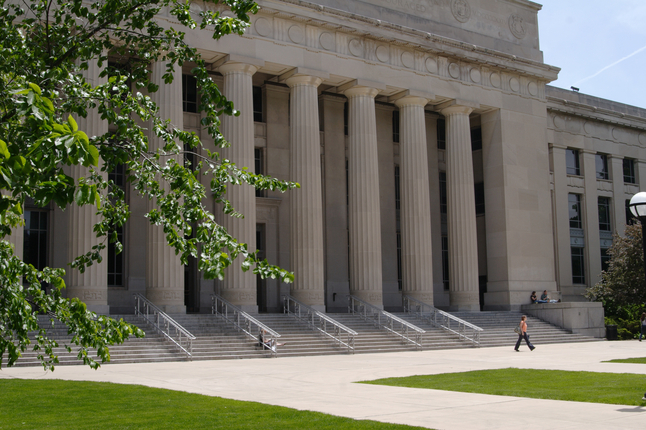
Angell Hall is one of the largest classroom buildings at the University of Michigan.
Steve Pepple | AnnArbor.com
Last year, Michigan State University raised eyebrows when it offered a course called "Surviving the Coming Zombie Apocalypse."
This fall, U-M doesn't seem to be offering courses quite as controversial or off-the-wall as those two, but the school definitely has a few oddballs sprinkled in its course packet.
The unconventional offerings include courses that explore whether aliens really exist, whether Robin Hood was real and what famous thinkers would be saying and doing if they were alive today.

For example, a literature professor and an economist paired up during a recent semester to teach a course titled "Jane Austen and Economics," in which famous narratives like "Pride and Prejudice" are taught through the lens of economic theory. The course, and others like it, explores simple subjects using unlikely angles.
"At the fundamental level there's a sense that we have a core curriculum that we need to cover and then on top of that we want to offer our students interesting and new ways into topics," said Deloria.
"Students are super pragmatic. They know 'Oh my gosh, I'm pre-med therefore I have to get into this requirement chain,' " Deloria continued. "Then you throw in a fun course and a lot of times it's good. ... A student will be caught by surprise, thinking 'Well I took that as a fun class but that was my most enjoyable learning experience.' "
And for professors, the courses are an alternative way to convey a subject they've taught for many years.
U-M professor Eric Lormand has taught philosophy at U-M since the 1990s. When he was thinking about the next iteration of a "History of Philosophy" course, he decided to spice up the lessons by channelling the dead.
In his 100-level "Talking Dead" freshman seminar this fall, Lormand will channel long-deceased thinkers like Socrates and act as if he is the philosopher's zombie.
"I thought I would come visit (students) as zombies and attack them with ideas and they have to fend me off to save their brains," he said.
Although the idea is unconventional, Lormand says he worries that students will tire of the zombie act after the first class or two. Lormand says it's the subject, and not the delivery method, that will interest students the most.
"I doubt that the students who sign up for this course are signing up because of the zombies. They're probably more interested in learning some philosophy," said Lormand, who refers to each class as a seance. "It's not that hard at the University of Michigan to keep students interested."
Here are some other unexpected courses offered by U-M this fall. Many of them are 100-level offerings.
"Aliens"
Does ET really exist? That is the question this 100-level mini-course tries to answer as it discusses the possibility that aliens are real, either in or outside our solar system, and explores efforts made by man to discover extra-terrestrial life and communicate with it. Further, it will look at which planets could, or could not, sustain life.
"Beyond 'Will and Grace' "
This first-year honors course is based on the premise that most Americans have attained their understanding of what it's like to be gay from sitcoms and other television shows, including "Queer as Folk," "Glee" and "Modern Family." The professor asks: Are these accurate portrayals of what it's really like to be gay? If not, what's it like?
"Robin Hood: History & Fiction"
This 100-level history course and freshman seminar looks at the evolution of the Robin Hood tale and asks the question "Was there ever a real Robin Hood?" The seminar looks at the earliest Robin Hood ballads of England and examines how the character turned from a selfish criminal to a childhood hero over the centuries.
"Philosophical Babies"
This 100-level philosophy seminar course looks at how infants gradually learn which rules are unbreakable and how to identify authority figures. "Babies face a lot of questions ... that are hard, important and philosophical. We’re going to look at developmental research into how babies answer these questions," the course description reads.
"Dog Cognition, Behavior and Welfare"
"This is a class for people who love dogs," begins the university course description. The 400-level psychology course is designed to explore "how dogs think, problem solve, and learn." Students partaking might get a change to imitate Cesar Millan, the "Dog Whisperer" from the National Geographic Channel, as they begin "looking at training techniques — the good, the bad, and the ugly."
"Boy Meets World"
This first-year honors course is designed to what its like to be a man in modern America. The course description asks: "What role does Viagra play in maintaining and shaping what it means to be a man? What do beer advertisements tell us about American masculinity?... Do nice guys really finish last?"
"World-Wide Witchcraft: Witch-Belief & Witch-Hunting in Global Perspective"
Why did so many cultures, across several centuries and continents, work so hard to identify and kill so-called witches? This 100-level history class and freshman seminar encourages students to ask that question. It also looks at cultures and incidents where the persecution and killing of suspected witches still happens today.
Kellie Woodhouse covers higher education for AnnArbor.com. Reach her at kelliewoodhouse@annarbor.com or 734-623-4602 and follow her on twitter.
Comments
FeatOfClay
Wed, Sep 5, 2012 : 4:53 p.m.
One of the better college courses I ever took would likely not pass muster with the commenters here, given their propensity to evaluate a course's worth by nothing more than an attention-grabbing title and brief description. That course changed the way I think about the world, and made me appreciate economic theories that had previously been vague & abstract. It made me a better thinker, which was the ultimate goal of the education I sought. Sometimes the point is not the content, but the approach, the discussion, the challenges to conventional assumptions.
TravisT
Tue, Sep 4, 2012 : 9:04 p.m.
The only real problem I have with this is that one of these courses (Dog Cognition, Behavior and Welfare) is a 400-level course.
Lovaduck
Tue, Sep 4, 2012 : 7:56 p.m.
Such hogwash from what once was one of the finest Universities in America. Of course since students come to even the best place with no "taken for granted" pool of knowledge and rapidly decreasing writing and reading schools, I suppose such junk is necessary to "reach" them. Good luck!
Lemmy Caution
Tue, Sep 4, 2012 : 6 p.m.
I think all of these classes could be excellent. The point is whether they work to sharpen the students' thinking, reading, and writing skills. When it comes to those basic skills of a liberal arts education, practically any subject matter is just fine. It's too bad the haters here didn't do some extra credit work and look at the course descriptions at wolverine access to see what exactly will happen in the classes beyond the sometimes snazzy title. Yes higher education in the US is in general too expensive, especially at elite private and public schools. Just compare the tuition prices at the finest schools in Canada for a reality-check. But that point is not especially connected to these classes. Such classes are taught in Canada and elsewhere as well. It's about getting students to think hard, read carefully, learn arguments, and write effectively.
jns131
Tue, Sep 4, 2012 : 4:50 p.m.
I heard one of those elite colleges on the east coast does a Harry Potter thing too. Kind of interesting if you ask me.
catmi
Tue, Sep 4, 2012 : 3:26 p.m.
I should clarify.. pottery would have been relevant if my interests had been in art. I considered it fun because I wasn't using it to focus on my major but just for personal interest. It is certainly relevant to other majors. No disrespect meant.
catmi
Tue, Sep 4, 2012 : 3:24 p.m.
I think you can title classes with anything to pique their interest, as long as the actual content is something that is developmentally educational and encourages personal and professional growth and insight, not just silliness or fun. College is about furthering your education and looking toward the future. You can have fun doing that and still learn, don't take a "fun" class and expect anything more than that, just fun. I took pottery in college when I was studying a degree in the social sciences field, but I knew it was not to learn anything educational, just a way to relax. As long as kids know the difference I think it's all ok.
Aaron Bragman Bragman
Tue, Sep 4, 2012 : 3:07 p.m.
I took "Witchcraft" when I was an undergrad there in '93. At the time however, it was a Freshman composition course, an English writing class that was simply themed in its topic. The purpose was writing and composition, but the theme made the reading material and discussions far more interesting than some simple generic subject, and taught me about some cultures I might not have otherwise studied (African, Caribbean, Southern American immigrant). Why NOT offer such creative things, instead of boring regular classes that one can take anywhere?
Mike
Tue, Sep 4, 2012 : 2:37 p.m.
This is happening in universities all over the nation. Get used to it and just pay your overpriced tuition......
porchbear
Tue, Sep 4, 2012 : 1:49 p.m.
These courses seem like valid topics of study to me. If you're capable of reading beyond the titles, they're simply astronomical, historical, sociological, and psychological topics.
GoNavy
Tue, Sep 4, 2012 : 5:36 p.m.
Which one do "zombies" fall under?
Dog Guy
Tue, Sep 4, 2012 : 1:44 p.m.
Questions switch on the human desire to know. Trivial, absurd, mythical questions avoid preconceptions and prejudices which close the mind to learning. Parables and koans are some of the highest teaching practices, Some subversives may be attempting to revive U of M's teaching tradition.
GoNavy
Tue, Sep 4, 2012 : 8:51 p.m.
Terri Eagen-Torkko: You do understand that tuition at Michigan is "all in," as opposed to "a la carte," correct? In other words, I can't "elect" not to fund those courses - PS My advice stands: If you want to save money and expand your horizons, there's no better place than the web to start your journey. You certainly don't need to pay somebody several thousand dollars a year to teach you.
Terri Eagen-Torkko
Tue, Sep 4, 2012 : 6:50 p.m.
GoNavy, you do understand that these are electives, yes?
GoNavy
Tue, Sep 4, 2012 : 5:35 p.m.
All this is great. For those wishing to save on spending $25k a year to be "taught" this stuff, I recommend this nifty resource: www.TheInternet.com It's full of free information, most of it probably as good as (or better than) what you'll pay to hear at the University.
music to my ear
Tue, Sep 4, 2012 : 12:47 p.m.
I love zombies, lets study where they came from duh!!!!
music to my ear
Tue, Sep 4, 2012 : 12:45 p.m.
I love zombies, lets study where they came from duh !!!!!
jns131
Tue, Sep 4, 2012 : 4:51 p.m.
Walk like a zombie!!
jcj
Tue, Sep 4, 2012 : 12:21 p.m.
And these classes will help us catch up with the rest of the world how?
jcj
Tue, Sep 4, 2012 : 11:21 p.m.
And how much do these "fun" classes cost?
aggatt
Tue, Sep 4, 2012 : 3:01 p.m.
They're just fun classes to take when you have a schedule full of other very difficult courses. I took a fun mini course one semester when I was taking calc 2, genetics, and an upper level evolutionary bio class. Sometimes it's nice to have something cool to distract you from all that math and science--it's not meant to "help us catch up with the rest of the world". It's so we can have some balance and some time to enjoy ourselves and destress. Plus I actually learned quite a bit of cool stuff in my mini course.
jcj
Tue, Sep 4, 2012 : 12:19 p.m.
Looks like one of the "professors" or the "students" don't like the reality check!
jcj
Tue, Sep 4, 2012 : 11:26 a.m.
To answer my own question Mr Deloria makes about $143,000 a year!
FormerMichRes
Tue, Sep 4, 2012 : 11:24 a.m.
Some commenters make light of these courses. I do to. The question I have is why UM is offering such courses? And doesn't it foster the idea that many of the degree programs offered are simply useless, causing a run up in college debt without the probablity of a job at the end? These courses would be better taught at the relatively inexpensive community college level, I think.
GoNavy
Tue, Sep 4, 2012 : 5:34 p.m.
You're being downvoted because those who originally envisioned the "liberal arts education" most certainly believed that teachings of the occult, hobbies, and other minutiae of life were seen "valuable contributions to developing a well-rounded individual."
jcj
Tue, Sep 4, 2012 : 11:19 a.m.
Whats next comic books of the 20th century? And these alleged professors earn how much?
jcj
Tue, Sep 4, 2012 : 11:18 a.m.
So Kellie covers higher education. I don't think this qualifies as higher education.
HB11
Tue, Sep 4, 2012 : 10:43 a.m.
You forgot to put the "Dog Cognition, Behavior and Welfare" course on the poll.
Leah Gunn
Tue, Sep 4, 2012 : 10:43 a.m.
Puhleese - it's Jane Austen!
Julie Baker
Tue, Sep 4, 2012 : 3:49 p.m.
Indeed. That's fixed.
Nick Danger
Tue, Sep 4, 2012 : 10:30 a.m.
Don't forget the new zombie class at community high school