

Just who are you? Police learn a lot during death investigations
For more than half of my career, I was involved in death investigations in the city.
Thankfully, Ann Arbor doesn't have many homicides, but like any other place, there are plenty of deaths. Death investigations are extremely interesting because people’s lives are so interesting.
Most of us die in some sort of medical facility. Only about 7 percent of us will die in our homes or outside of a medical facility. For that 7 percent, the death is investigated by the police and the medical examiner’s office.
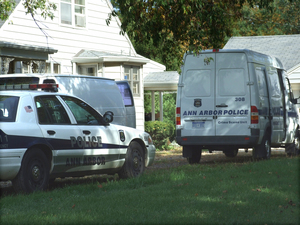
Ann Arbor police investigate the death of a man in a home on Ann Arbor's southeast side in 2008.
File photo
The police and the medical examiner’s office must necessarily suspect the worst in a death until the manner of death - natural, accidental, homicide, suicide or undeterminable - can be established.
To establish how a person died, many times the police must look at how the deceased lived. Before heading out to a death scene, I always liked to run the dead person’s name on the computer to see whether police had any contacts with the individual in the past.
Police reports can show anything from ambulance requests in the past, which would indicate past medical issues, to criminal complaints, which might indicate a possible motive if the death turned out to be a homicide.
If the manner and cause of death aren't obvious, investigators must dig deeper to explain why a person died. In the course of the investigation, the decedent’s personal effects and living area will be searched for clues. (This is one of the reasons I am not a big fan of potlucks - I’ve seen some pretty filthy kitchens.)
Witnesses, neighbors, family members and co-workers may be interviewed. Many times during an investigation, conflicting information will arise from the various people interviewed as investigators try to piece a person’s life back together. The last hours of a person’s life are obviously the most crucial for the investigation, but inevitably, investigators learn a lot about a person’s entire life.
Sometimes, families are quite shocked if they read the police report later because the person they knew was much different from the person described in the police report. In the act of being human, most of us leave some sort of skeletons in our closet.
Think about your life and your relationships. There is a person your spouse or significant other knows. There is another person your children know. There is the person your best friend knows. There are sides you show your co-workers and another side you show to your bosses. There is a side of you only your parents or siblings remember. Distant friends, relatives and acquaintances will see another person. There is also the side only you know about.
When the police investigate a person’s death, they must speak to many of these people. Investigators must then report what they have learned. In the end, a very multidimensional portrait of the deceased is revealed. This portrait - although a true and accurate depiction based on the facts and evidence uncovered - is almost always surprising and sometimes shocking to loved ones.
Loved ones who order a copy of a death report from a police department must understand the graphic nature of these reports. They must also realize humans are flawed, and it might be best to remember a loved one as the person you knew instead of the way the police found them.
Lock it up, don’t leave it unattended, be aware and watch out for your neighbors.
Rich Kinsey is a retired Ann Arbor police detective sergeant who now blogs about crime and safety for AnnArbor.com.
Comments
Mick52
Fri, Jul 23, 2010 : 8:20 p.m.
Rich is describing the concept of victimology, the study of the person, and their lifestyle. Where they hang out, who they hang with, their habits and preferences gives a peek into their lifestyles, some of which are more hazardous than others and thus can point the police into areas to seek answers. Like the Sarge says, A2 does not have many murders but there has been some doozies.
krc
Fri, Jul 23, 2010 : 8:41 a.m.
Rebba: Whaaaaa.....???
krc
Thu, Jul 22, 2010 : 10:43 a.m.
Do they do the same for unmistakable suicides?
bunnyabbot
Thu, Jul 22, 2010 : 9:56 a.m.
I'm going to go home and clean my kitchen, again
Jason
Thu, Jul 22, 2010 : 8:44 a.m.
I'm with you 100% EyeHeartA2...
CountyKate
Thu, Jul 22, 2010 : 8:05 a.m.
Yes, EyeHeartA2, but the police are going to talk to more than just the neighbor, so in the end the entire picture is more well-rounded than any one person's impressions of the deceased. This is a good article, but it makes me want to go home and make sure my underwear drawer is in order. Thanks, Rich. If ever there was incentive for clearing out my junk, this was it!
Buzz
Thu, Jul 22, 2010 : 8:01 a.m.
The "portrait" isn't based on one person's description. If you read the whole sentence it is a combination of everything the police have learned....sort of like a jigsaw puzzle. Yes, if you call our neighbor a bum, maybe he isn't, but if everyone says the same thing then maybe the picture gets a little clearer.