

University of Michigan eyes e-books as a way to lower soaring textbook costs
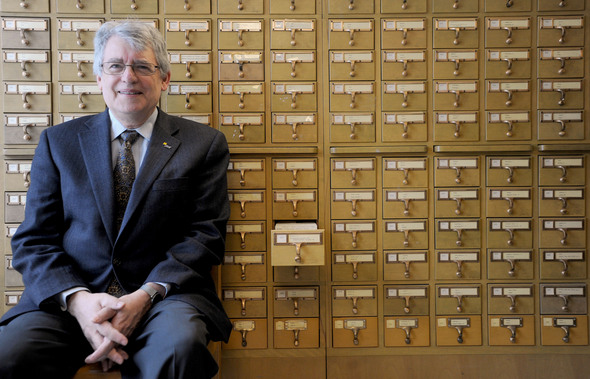
U-M Dean of Libraries Paul Courant is considering a new e-book program for the University of Michigan.
Angela J. Cesere | AnnArbor.com
But how cost effective will a move toward the 21st century version of the classic textbook be?
U-M librarian Paul Courant estimates that a typical e-book costs between 20 and 30 percent less than its printed counterparts. But he says it's possible to lower costs further.
At a Senate Advisory Committee on University Affairs meeting in late November, Courant said that if the university can create partnerships with textbook publishers, the school could possibly negotiate low, bulk prices and make e-books available to students as part of a course fee.
"What will happen if we don’t do anything about it?" Courant asked of soaring textbook costs during the November meeting. "The publishers and the booksellers will get very good at selling to our students. Electronic textbooks... will be somewhat cheaper, in the range of 80 to 70 percent of the cost, rather than a real breakthrough."
Public university students spend an average of $1,168 on textbooks per year, according to 2011-2012 figures from the College Board Advocacy and Policy Center.
Recently released results of a new study by Daytona State College show that while most students realize some level of cost savings when buying electronic textbooks, some e-books are nearly as expensive as traditional books.
The study found that in one economics course, e-books were generally about half as expensive as print books. In another economics class, however, the electronic version of a textbook was just $1 cheaper than its printed counterpart.
Couple low savings with the inability to resell used electronic textbooks, and sometimes e-book savings are non-existent.
Meanwhile, printed textbook rentals ranged between 70 and 75 percent less than the cost of a new textbook and were the cheapest option for students, the study found.
Courant, however, envisions an organized e-book program in which the university would work to curb costs by negotiating with publishers. With a student body of more than 42,000, U-M's size can wield significant negotiating power.
"Piggy-backing" off success
AnnArbor.com file photo
A similar model will be instituted this semester at Indiana University, which has been running e-book pilot programs since 2009.
In many of its courses, Indiana is requiring students to buy e-books. By mandating the e-book purchase, the school is able to negotiate low prices with book publishers by guaranteeing a high number of purchases.
Among the publishers partnering with Indiana is McGraw-Hill Higher Education, a mammoth force in the textbook industry. A McGraw-Hill official told the Chronicle of Higher Education last year that Indiana received a 20 percent discount off the publisher's usual e-book prices.
In an interview, Nik Osborne, chief of staff for Indiana's Office of the Vice President for Information Technology and facilitator of the school's e-book project, said e-books sold through the school are on average 50 percent cheaper than if students purchased them on their own.
Course fees, which include the book price, he said, range from $15 to $70.
And unlike most electronic textbooks, which are "going to go poof 180 days" after purchase, Osborne says students retain access to Indiana-issued e-books until they graduate, a provision negotiated by Indiana last year.
Courant says U-M is "piggy-backing off" Indiana's e-book model. Like Indiana, U-M doesn't plan to force professors to chose e-books over printed books, but instead plans to encourage them by stressing the benefits of a switch.
In August, Indiana released a report summarizing the two-year pilot program. It followed 1,700 students in 22 different courses.
The report stated that 60 percent of students on Indiana's eight campuses noted preference for e-books over traditional textbooks. The report did note a decline in a preference for e-books after the school began instituting a course fee for the books in Spring 2011.
During the two-year period, the school found that skeptical students adapted to e-books after repeated use. For example, a student using an e-book for the second time was 11 percent more likely to embrace electronic textbooks over traditional versions.
Kellie Woodhouse covers higher education for AnnArbor.com. Reach her at kelliewoodhouse@annarbor.com or 734-623-4602 and follow her on twitter.
Comments
Lac Court Orilles
Tue, Jan 10, 2012 : 12:49 a.m.
Present day teachers are required to take reading courses so they'll be able to help students to read their textbooks. Teachers are taught in these required reading classes to have students underline, highlight, and make notes in the margins. All of this will be voided if students are required to read from a computer screen. As for me and a lot of other students, we prefer to do our reading from a textbook. Many students will be printing a copy of the text simply because it is too irritating to read from a screen. When the pages are read most will dispose of them. Textbooks will get used over and over. Technology should make things more useful and cheaper, but this new type of technology does not satisfy this requirement. Summary: Dumb idea !
thehawk
Tue, Jan 10, 2012 : 3:13 a.m.
Whether you use a computer or an e-reader, you can still highlight, underline and make notes in the text. The bonus of using electronic media is the Search function. Very quickly find *exactly* what you need in the text. I was skeptical and slow to try the e-reader, but a friend bought me a Kindle to make it easier to read to my children (I now always have a book or 20 in-hand), and now it can't be pried out of my hands. I *love* it!
Ron Granger
Mon, Jan 9, 2012 : 7:43 p.m.
Is it that the actual printing of the books adds so much, or is it that the margins for profit on the E-books are much, much greater? Plus, e-books kill the used book market. Publishers hate the used book market. Some of those books are great references and worth keeping. Not so with the e-book versions; here today, gone tomorrow.
grimmk
Mon, Jan 9, 2012 : 7:08 p.m.
But how much are the e-readers going to cost students? And how do you make notes in the e-books? Can you highlight certain passages? Unless the schools are willing to loan/rent out e-readers I don't think hard back books will go away. The prices are still staggering.
DAN
Mon, Jan 9, 2012 : 6:36 p.m.
Excellent idea whose time has come. My on [a U of M engineering graduate] was the chief engineer for a company developing just such a device and program. I recall that they met a good deal of resistance from textbook publishers because they feared a loss of profits. If the university required E TEXTS, that would spur cooperation from the publishers. djm
whatsupwithMI
Mon, Jan 9, 2012 : 6:33 p.m.
Savings may be not a useful dollar amount, and ebooks aren't the preferred-by-student textbook model. --------------- Here's a 2 year pilot study findings, and results. .... The study, which was funded by the U.S. Department of Education, compared four different textbook distribution models: buying traditional printed books, renting printed books, renting e-textbooks, and renting e-books along with an electronic reader. In three out of four semesters, researchers found that students using electronic texts pilot saved just $1 over the cost of a traditional hardback book. The reason? Publishers typically say the bulk of their costs come from paying textbook writers and researchers, not from printing, so they can't make e-texts less expensive. ..... Summary and additional links available here: <a href="http://www.good.is/post/why-digital-textbooks-don-t-always-save-college-students-cash/" rel='nofollow'>http://www.good.is/post/why-digital-textbooks-don-t-always-save-college-students-cash/</a> <a href="http://www.educause.edu/EDUCAUSE+Quarterly/EDUCAUSEQuarterlyMagazineVolum/AStudyofFourTextbookDistributi/242784" rel='nofollow'>http://www.educause.edu/EDUCAUSE+Quarterly/EDUCAUSEQuarterlyMagazineVolum/AStudyofFourTextbookDistributi/242784</a>
M.
Mon, Jan 9, 2012 : 5:45 p.m.
I attend Washtenaw Community College. This semester my books for only two of my classes total $383. They offer e-book versions as well - at about the same price as a used copy of the book. There is absolutely no reason an e-book should cost 70-130 dollars!!! There's hardly reason enough for a hardcopy textbook to cost that much! I am outraged by book costs, but they are required for courses so what am I supposed to do? Add it to the rising tuition and it's a huge slap in the face as we struggle to earn degrees to hopefully be able to afford such expenses.
InsaneGeek
Mon, Jan 9, 2012 : 5:26 p.m.
What is the real reason they are 30% cheaper? Take a $100 textbook, by simply removing the physical aspect of it, could it really save $30 (30%)? Since I can buy a hardcover book of the same physical dimensions for <$30, it tells me that it's not the physical aspect of the book (paper, shipping material, shelf space in brick/mortar) that makes it more expensive. So my guess as to the reason they are so expensive? 2x things 1) Not as many textbooks are printed so initial cost per item is more 2) Textbooks have a captive market, where you have to purchase a specific book for a class and there are no other options While true the initial cost per item is more with a limited run of printing it's not $50 more than other books, so it really is the fact that publishers have a locked in market and they can charge whatever they want for it. Whether it's physical or digital doesn't change that; they still own the rights to something that students *have* to buy to take a class. I can see book publishers pushing heavily for digital books and intentionally holding their prices lower than physical books , to close the used book market as I'm sure they will be locked into the buyers electronic device and won't be allowed to be resold or shared. In the future the digital books prices would go up because again they have a locked in market that has no real competition. I'm sure the publishers are more than willing to take less margin on a digital book now to be able to kill off the used book market in the future.
mw
Mon, Jan 9, 2012 : 5:18 p.m.
The printing costs of a books is trivial -- a few $$ (out of what is often a $100-$200 text). Lowering costs of textbooks will require cooperation with publishers--the shift to eBooks itself will make little difference if the publisher fees are not changed. And the U as a whole cannot easily negotiate bulk fees if individual professors retain the authority to select texts for their courses. Also--it sounds like the publishers would be willing to go along only because the change would be in their favor: 1. The cost of the ebook would be rolled into course fees (so students couldn't share texts or buy used copies or read the text at the library) 2. The ebooks couldn't be resold 3. Students wouldn't even get to keep the books (either beyond the end of the course or beyond graduation as at Indiana). In other words, publishers would lower the price (possibly only temporarily?) in order to force every student in a course to buy the 'book' every term.
Mark
Mon, Jan 9, 2012 : 4:10 p.m.
I thought textbooks were expensive when I went to college in the 1970s, but the cost today is insane. On top of that, the textbook companies operate their scam without remorse. Considering what it really costs to publish a book, and unlike small presses, we are talking about many thousands of copies a year, it's safe to say that textbook publishers have been ripping students off for years. I'm all for e-books in education. It will save weight, save trees, and your copy won't have someone's yellow highlighter marks on it.
Barb
Mon, Jan 9, 2012 : 2:22 p.m.
Gee, what a cutting edge idea - this should be a no-brainer. Still requiring students to purchase textbooks is insane. Talk about soaking the students...
whatsupwithMI
Mon, Jan 9, 2012 : 10:42 p.m.
Data shows that the costs are not that difference, for the student.
dading dont delete me bro
Mon, Jan 9, 2012 : 11:26 a.m.
does the book have to be strictly on an ereader? what about a kindle fire? which is a reader and has internet access? i.e. internet access meaning researching questions during a test?
M.
Mon, Jan 9, 2012 : 5:42 p.m.
You're typically not allowed to use your hardcopy textbook during a test either. Your ereader would be no different. If it's open book, instructors usually have no issue with using the internet when it's take-home exam.
dading dont delete me bro
Mon, Jan 9, 2012 : 5:02 p.m.
@johnnya2, i don't believe you can surf on a pure ereader. i maybe wrong, but don't think so.
johnnya2
Mon, Jan 9, 2012 : 1:39 p.m.
Why would internet access be any different than ebook access during a test?
cook1888
Mon, Jan 9, 2012 : 11:21 a.m.
What happens when we have another inevitable widespread power outage? The cost of textbooks is shameful, but a way will be found to soak the students and parents for ebooks as well.
johnnya2
Mon, Jan 9, 2012 : 1:42 p.m.
"Inevitable widespread power outage" and you would be concerned about the ebooks? This so-called inevitable power outage would cancel classes. It would also make reading at night nearly impossible. An e-book will last several days without a charge, and can be recharged to last several more. If you want to find something to complain about that is fine, but at least get something that is a real complaint.
Smart Logic
Mon, Jan 9, 2012 : 11:23 a.m.
A good ebook reader can go for days or weeks without needing to charge.