

How a 2005 EMU grad became a leading opponent of Michigan's emergency manager law
A 2005 Eastern Michigan University graduate who championed social justice and racial equality as a college student has morphed into a chief headache provider for Gov. Rick Snyder and supporters of the state’s emergency manager law.
Brandon Jessup, CEO of Detroit-based Michigan Forward, said he’s “absolutely” convinced that his nonprofit will secure enough signatures in a statewide petition drive to temporarily freeze the emergency manager law and give voters a chance to repeal it in November.
Jessup, 30, who has never held elected office, has nonetheless become the face of the fight against the emergency manager law.
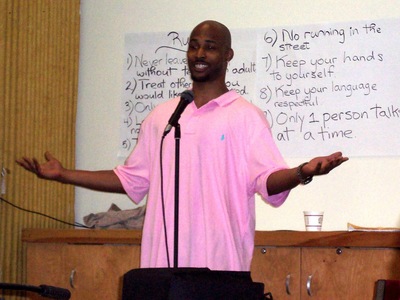
Michigan Forward CEO Brandon Jessup, a 2005 graduate of Eastern Michigan University, is leading a petition drive to repeal the state's emergency manager law.
Lisa Carolin | For AnnArbor.com
Jessup, former president of EMU's chapter of the NAACP, and other opponents of the state’s emergency manager law say that it undercuts democracy and unfairly targets communities with a large population of black residents.
But supporters of the law fear that struggling cities, including Detroit, could be forced to file for bankruptcy without an emergency manager to impose financial prudence.
In an interview Tuesday, Jessup described the emergency manager law as a “disaster for Michigan’s urban communities” and a threat to democracy. He said he’s confident his group will secure the 161,305 valid signatures required by the state to place legislation on the ballot. So far, the group has compiled more than 157,000, he said.
“The state of Michigan is waking up,” Jessup said. “We’re definitely going to get there. We’re going to get there sooner than a lot of people expect.”
If the signatures are submitted and certified — a process that is sure to involve legal disputes, experts say — the law would be frozen until the November election.
Michigan Forward’s critics say that result could be disastrous for cities and school districts that need an emergency manager to avoid bankruptcy.
“The bottom line is what Brandon is doing unfortunately may be very destructive for the city of Detroit,” said Bill Ballenger, editor of Inside Michigan Politics and a former Republican state legislator.
Petition drive draws attention
Snyder’s administration is taking Michigan Forward’s petition drive seriously. State Treasurer Andy Dillon acknowledged last week that the Legislature may have to adopt alternative legislation that would replace the emergency manager law at least until an election can be held.
Sara Wurfel, a spokeswoman for Snyder, said the governor does not consider bankruptcy an acceptable option for struggling cities such as Detroit, which is reportedly set to run out of cash by spring without major cuts.

Michigan Forward CEO Brandon Jessup said Gov. Rick Snyder needs to play a constructive role in Detroit's revitalization.
Photo courtesy of Brandon Jessup
Snyder, a Republican, believes the emergency manager law is necessary to help distressed cities and school districts permanently repair their finances.
“The governor feels strongly that he has a responsibility to the citizens and taxpayers of struggling communities and our overall state, and that we simply can’t ignore these fiscal crises of communities or school districts and allow them go into bankruptcy,” Wurfel said in an email.
“If the law is suspended, the potential ramifications and unintended consequences could be severe and not in anyone’s best interest.”
The state’s emergency manager law, Public Act 72, passed in 1990, got an overhaul in March when the state Legislature passed new legislation, Public Act 4, giving emergency managers additional power.
Now, after a thorough financial review, emergency managers appointed to run a municipality or school district are given broad authority to restructure union deals, slash compensation, cut contracts, lay off workers, reduce budgets and strip elected officials of their authority.
In Washtenaw County, some officials have suggested that the city of Ypsilanti and school districts in Ypsilanti and Willow Run could eventually be subjected to an emergency manager.
Republicans have championed the legislation as critical to helping struggling cities and schools avert catastrophe and achieve financial sustainability.
But critics, including Jessup and the Washtenaw Community Action Team, describe the law as an affront to democracy and an attack on the state’s urban areas. Jessup rejected the suggestion that repealing the law would lead to chaos.
“There’s nothing to be afraid of in democracy. We believe in democracy. We believe in the process, so we don’t foresee crises,” Jessup said. “We don’t want bankruptcy, neither do we want emergency management, and we know that emergency managers increase deficits.”
Jessup founded Michigan Forward in 2008 as an “urban public policy think tank.” The group is structured as a “nonpartisan” 501(c)(3), Jessup said, and is currently in the midst of a fundraising campaign.
Jessup said Michigan Forward gets limited financial support from various groups, including unions such as the Michigan Education Association, which donated petitions. He said “thousands of volunteers” have distributed petitions and secured signatures.
“This is 100 percent grassroots,” he said. “You look at the bank account of Michigan Forward, and you don’t see many zeros there.”
Ballenger said the state’s major employee unions are using Michigan Forward as a proxy to fight Snyder’s emergency manager law.
“I don’t care how much they talk about elbow grease, it seems to me you have to have financial backing to get this on the ballot,” Ballenger said.
Jessup enters the spotlight
The petition drive has elevated Jessup’s public profile. On Sunday, he was the featured guest on Lansing journalist Tim Skubick’s “Off the Record” program, which airs on PBS stations throughout the state. He’s also been quoted in the Wall Street Journal, many Michigan newspapers and TV stations as a leader of the movement against emergency managers.
Jessup’s interest in civil rights can be traced back to EMU, where he served as president of the university’s chapter of the NAACP, fought against tuition increases, campaigned for improvements to on-campus housing and supported development of a “campus creed.”
Jessup, who was born in New Orleans and lives in Detroit, graduated from Bishop Borgess Catholic High School in Redford in 1999. He enrolled at Defiance College in Ohio but quickly transferred to EMU in 2000. Shortly after 9/11, he felt inspired to join student government and quickly became an influential figure on campus.
“His work with the campus chapter of the NAACP propelled the group to a place of distinction among student organizations,” said Heather Neff, an author and EMU professor who specializes in African-American literature and women's literature, in an email. “He showed himself to be principled and dedicated to issues of social justice at an age when many young people are struggling to discover their direction in life.”
Jessup said one of his most formative experiences at EMU revolved around his coursework with the Department of African American Studies. He said his experiences at EMU exposed him to a broader definition of diversity.
“When I came to Eastern, I learned what diversity looked like,” he said, citing the many nationalities represented by the student body. “I was prepared for leadership, I was prepared to be flexible, to listen to other ideas, to try to bring those common solutions that really benefit everybody.”
After graduating from EMU, Jessup joined the One United Michigan campaign to oppose a 2006 ballot initiative that amended the state’s Constitution to outlaw affirmative action.
He later joined a Washington D.C.-based social advocacy group called the Advancement Project, which successfully pressured Michigan to restore voting rights to more than 7,000 people who had been “illegally purged from the voter rolls,” Jessup said. He also founded an information technology consultancy called NorthStar Innovation using his EMU bachelor’s degree in computer information systems.
Jessup is not shy about his ambition. He has been quoted as saying that he would like to be president of the United States some day — and he reiterated that goal on Tuesday.
In the near term, though, Jessup is viewed as a likely candidate for public office in Michigan at some point.
“If the people of Michigan and voters ever decide that they would like to see me in elected office, I would definitely answer that call, but right now my focus is” on Michigan Forward, Jessup said.
Ballenger suggested that Jessup’s involvement in Michigan Forward could be tactical.
“Maybe he thinks this is his ticket to ride to glory,” Ballenger said.
Jessup said the push to repeal the emergency manager law “has been a labor of love,” describing Michigan Forward’s involvement as “a stand for history” despite its limited financial resources.
“If you look at the history of civil rights and movements like this, they don’t start with a lot of money,” he said.
Neff said Jessup’s involvement in the statewide political initiative is not a surprise.
“I don't think that anyone who taught him is surprised by his activism or the courage to his convictions,” Neff said. “He is now a role model to younger students and to others in his community who are looking for concrete means to address social inequality."
What role does race play?
The debate over the role of race in Michigan’s emergency manager law is proving to be divisive. Emergency managers have been appointed in several communities, including places like Benton Harbor and Flint, where racial tension is common.
“The numbers don’t lie. And we have to say it: African Americans are being disproportionately impacted by this legislation. Gov. Snyder can’t run from that,” Jessup said.
Jessup said Snyder needs to play a constructive role in revitalizing Detroit.
“We need him sitting at the table,” Jessup said. “He needs to come down, roll up his sleeves and meet the working families of Detroit. He has to embrace the fact that Detroit is key to the region and key to the state.”
Since the early days of his gubernatorial campaign, Snyder, a former Ann Arbor venture capitalist, has emphasized the importance of Detroit’s recovery to Michigan’s future.
Wurfel, Snyder’s spokeswoman, said emergency managers are being appointed “because of financial facts and crises, not because the make-up of their populations.”
She added, in her email: “Gov. Snyder believes deeply that he represents, and is accountable to, ALL Michiganders regardless of where they live or what color their skin is. And that now is the time for unity and that we all need to be standing and working together to collectively address these challenging times.”
Contact AnnArbor.com's Nathan Bomey at (734) 623-2587 or nathanbomey@annarbor.com. You can also follow him on Twitter or subscribe to AnnArbor.com's newsletters.
Comments
Chase Ingersoll
Thu, Dec 15, 2011 : 12:14 p.m.
<a href="http://michiganforward.org/index.php/join-the-coalition/repeal-public-act-4-petition-sites-2" rel='nofollow'>http://michiganforward.org/index.php/join-the-coalition/repeal-public-act-4-petition-sites-2</a> Mostly AFSME and Teacher Union Offices. But I am mostly stunned that he volunteered the brushed "fashion" photo that appears in this article and his organizations website. There is an inherent degree of vanity, putting one's name on an organization, ballot or cause. You look at this guy's resume and compare it to The Nerds, and that of another Nerd (State Treasurer Andy Dillon...who was subjected to a recall effort while a member of the State House) and why is it not a fair comment that he is attempting to substitute style for gravitas?
chefbrian1
Thu, Dec 15, 2011 : 6:02 a.m.
As someone who talks to dozens of people on this subject getting registered voters to sign the repeal public act 4 petition, I hear the pro EFM argument. It goes like this: "X city is messed up, so an EFM is the only way." Interestingly, I still get most of the EFMers to sign the petition because they feel that the people should be able to have this on the ballot for a vote. I am not making that up folks. Most people think democracy is a pretty good thing. Not all EFM supporters sign of course, but many do. I know I am a good salesman, but I am not that good. (smiles). For me, this issue goes far beyond damage control for X city. It has to do with democracy. And I fear that this law can/will be used/abused to achieve a political means and it will be a power grab/threat to any town and city who does do was party X who is in power wants. Can anyone say that it won't? One thing is for sure. Any town now with an EFM will be voting in November for local representation in name only unless this law is on the ballot for repeal. Democracy is not always easy folks. It can be messy and slow and lets be honest, it is a work in progress. It was not long ago that woman, African Americans or people 18 years of age could vote. Heck, probably 30% of the people (mostly college students) who I talk to as a petitioner are not registered to vote. I figure when times are tough like they are now, we define who we really are, and for me, I think we need more democracy not less to get us through.
Stuart Brown
Thu, Dec 15, 2011 : 4:33 a.m.
Way to go Brandon! The EFM law is just corporate dictatorship under the bogus pretense of financial prudence. Ann Arbor's former city manager, after running up debt to about $250 million, is now working for Andy Dillon in a position advising the the state on the implementation of the EFM law! Rodger did a dodger after his bond arbitrage scheme blew up in his face (leaving Ann Arbor with a pile of debt no less.) The current rendition of the EFM law is designed to make it impossible for cities to default on their bond debt. Defaulting on debt is an issue a sovereign democratic entity should decide on after weighing the pros and cons; this issue should not be decided by snuffing out democracy! There is also significant cronyism that can occur on the EFM manager's watch. Anybody who is sentient and for the 99% should realize that the EFM law is a continuation of class warfare by yet another avenue. Why are bonds so sacrosanct? Why is it that hard working people need to be screwed whenever a financial crisis arises? The current liquidity trap we are stuck in is the result of deliberate manipulation by the financial industry; but working people are expected to clean up the mess by doing with less while the fat-cats gorge on their ill-gotten gains. Letting municipalities default on their debt is a good way to make the people who created the current financial mess get their just reward. Kill the EFM law!
f4phantomII
Thu, Dec 15, 2011 : 1:53 a.m.
Detroit: The city that can't get out of its own way.
outdoor6709
Thu, Dec 15, 2011 : 1:47 a.m.
If Detroit goes bankrupt, an unelected federal judge will administer Detroit. For those who oppose the EM law, is that preferable?
InsideTheHall
Wed, Dec 14, 2011 : 7:54 p.m.
He's a young Obama. A community organizer who has never had a real job. Hey FIRE RICK how is the signature collection to recall working out for ya?????????????
thecompound
Thu, Dec 15, 2011 : 2:23 p.m.
Apparrently organizers don't care for winter much.
Smart Logic
Wed, Dec 14, 2011 : 10:19 p.m.
Fire Rick, thanks for showing everyone what your priorities truly are. Good luck with your massively failed recall that will, quite simply, never occur. Did you think that perhaps it did not occur because it was simply wrong, and not because you ran out of money? You were right about not getting backing from major organizations and it not being organized. It was poor, is poor, and will never work. Good luck.
Barb
Wed, Dec 14, 2011 : 8:58 p.m.
Thanks for calling in Fire Rick - free publicity!
Fire Rick
Wed, Dec 14, 2011 : 8:13 p.m.
The signature collection to repeal Public Act 4 is wrapping up quite nicely. We're getting quite a bit of national coverage which is only encouraging more people to get out and find a petition. As for the recall of Rick Snyder, the first effort failed simply because we did not have the money (or the backing) from major organizations like the MEA. However, there will be a second attempt this spring that will be much more organized. Look for the petitioners to sprout up again this spring. :-) <a href="http://michiganrising.org/" rel='nofollow'>http://michiganrising.org/</a>
moveon2011
Wed, Dec 14, 2011 : 7:44 p.m.
NORTH STAR INOVATION ...hmmmm the Cadillac Allante had a North star engine ....but that was before Jessup time..So what is North Star Inovation?
moveon2011
Wed, Dec 14, 2011 : 7:41 p.m.
EMU got $ 1,5 Million to retrain workers , so how many have a new job? any numbers on that ? really like to know.
Joe Kidd
Wed, Dec 14, 2011 : 7:29 p.m.
I don't think it's the law, it's who passed it. Had Virg Bernero won the election and done the very same thing, Mr. Jessup would be seeking a job as an EFM. The state really had no option than to update the law and give EFM's the tools to do the job. I really do not understand why anyone would oppose this law. It's an idea that makes sense. We should see if it helps or makes things worse. No one has proposed a valid reason to repeal it.
Barb
Wed, Dec 14, 2011 : 8:57 p.m.
"Had Virg Bernero won the election and done the very same thing, Mr. Jessup would be seeking a job as an EFM. " Oh please... I can give you lots of reasons why it's wrong... one easy on is that it's Unconstitutional. Even if it does help, it's the wrong way to go about it. People get to chose their leaders. It's called Democracy.
sh1
Wed, Dec 14, 2011 : 7:39 p.m.
Had Virg Bernero won the election, we wouldn't have seen money funneled away from schools into business in the first place.
Roadman
Wed, Dec 14, 2011 : 6:51 p.m.
I agree with the Emergency Financial Manager Law, but I do like Mr. Jessup's activism. We need more young people with his energy and involvement.
Mick52
Wed, Dec 14, 2011 : 6:49 p.m.
The other thing I am wondering is why Mr. Bomey did not ask Mr. Jessup what his alternative ideas are for cities in fiscal distress. I think to post a story like this requires that inclusion.
Sparty
Wed, Dec 14, 2011 : 6:47 p.m.
How about some facts: An early government financial emergency in the city of Flint was originally declared on May 22, 2002, by then-Governor John M. Engler. This is from the City of Flint website. Engler, as you may remember, was a Republican! Nice attempt by many at blaming Governor Granhom, but that would be very wrong on the facts.
moveon2011
Wed, Dec 14, 2011 : 7:39 p.m.
55 000 people left michigan and 74 000 died ...so there is no need to raises taxes since the need srunk....the richer part left for warme states so we need less taxes CUT goverment by 50% and lay of the STATE worker .....till after the election Nov. 2012 ....equall sacrifies NOW.....
moveon2011
Wed, Dec 14, 2011 : 7:32 p.m.
Engler raises the road and bridges budget by 369% from 1990 $ 328 million to 2001 $ 1,54 BILLION and look what we have ..holes in the road time to audit lansing and audit the contraters that Build the roads,,,More money to lansing doesnot give better work .just more .......Detroit NEWS april 2001 betty deVos comments TAX HIKES won`t cut it, when it comes to fixing state budget. dec. 9 2003 AUDIT THE STATE NOW
Mick52
Wed, Dec 14, 2011 : 6:39 p.m.
I can understand that some people may be opposed to measures taken by legislation that are intended to deal with issues. But in this case as in others where the issue is fiscal deficits, there is always a missing element that is very a critical factor. That point is, "what do you propose as an alternative to address the issue?" Mr. Jessup finds it easy to complain, using the same old rhetoric" "disaster for Michigan's urban communities and a threat to democracy. " But alas, he does not present any alternative. If you want to suspend an effort to dig communities out of the hole they have dug themselves into, what will you replace that with? A shovel? Or do you propose just waiting until a city goes bankrupt, and thus may have a chance to have many of its bills, sometimes money owed to businesses, dissipated in court? Or is the secret solution simply increased taxes or a bailout from the state or federal govt? I think to propose something like this, you must include your solution, your plan and if anyone approaches me with a petition they better be able to answer that question. In regard to Detroit, the Gov is being very accommodating. And Detroit City Council is discussing layoffs and budget cutting plans but the problem is they will just not act. What are they waiting for? The longer you put off some solution, the worse the problem becomes. Detroit Public Schools deficit grew to almost $300 million before Gov Granholm assigned Robert Bob under the previous law. A little late I think. This law is a major gift to cities with fiscal problems that just cannot balance their budgets due to contracts approved over the years that turn out to be not good ideas. If you do not like it give some alternatives other than letting the local govt solve it themselves. That simply is not working.
Tesla
Wed, Dec 14, 2011 : 6:24 p.m.
The amount of subtle and not so subtle racism in these threads is always obvious and disturbing. Honestly? I keep hearing about how A2 is so Liberal this and Liberal that but the majority of the comments I read here (and not just on this thread) seem to be coming from the far right wing of our community.
average joe
Wed, Dec 14, 2011 : 10:44 p.m.
FYI- The Bankruptcy judge will be colorblind......
Smart Logic
Wed, Dec 14, 2011 : 10:17 p.m.
How can you think these comments are all racist? Everyone is commenting about how things should be treated as colorblind, but Brandon Jessup is making it about race. Seriously? This looks like another oh-so-common attempt to throw a political punch at the other side (in this case, the right wing) by claiming racism.
andys
Wed, Dec 14, 2011 : 9:34 p.m.
"Unfortunately, many who are commenting here are not only insensitive to racism, but wouldn't be able to identify it if it was staring them in the face. My hunch is that many of those commenting here aren't even from Ann Arbor (not that it excuses any of the racist comments). What a shame." That's the contention is it not, that white people don't understand racism, are not sensitive to it, and cannot possible see it in themselves, because we are not black. So the conversation ends there. How many times do I see this said. It's intractable problem, or so we are left to conclude, because those that would exhibit it, can't possible recognize it, so are unable to change.
Fire Rick
Wed, Dec 14, 2011 : 8:27 p.m.
@Tesla - You are absolutely correct. It saddens me that racism is so pervasive in the comments following this article and in Michigan. Those who are sensitive to racism would easily identify the obvious problems with Public Act 4. Unfortunately, many who are commenting here are not only insensitive to racism, but wouldn't be able to identify it if it was staring them in the face. My hunch is that many of those commenting here aren't even from Ann Arbor (not that it excuses any of the racist comments). What a shame.
InsideTheHall
Wed, Dec 14, 2011 : 7:58 p.m.
BS Tesla, this fella is a community agitater no more no less. As part of the 99% I loathe those who feed off the system like this chap.
Hmm
Wed, Dec 14, 2011 : 7:19 p.m.
Nothing about Ann Arbor is liberal except the MJ law and the city's reputation. Nothing but yuppies and students left in this town
Mick52
Wed, Dec 14, 2011 : 6:52 p.m.
I do not see one single post here that could be interpreted as racist. Race has nothing to do with this issue. For crying out loud, the entire state of Illinois is having the same problem even after raising its income tax by 66%.
djm12652
Wed, Dec 14, 2011 : 6:34 p.m.
far right? don't think so...maybe just from common sense
Harry B
Wed, Dec 14, 2011 : 5:49 p.m.
Jessup, former president of EMU's chapter of the NAACP, and other opponents of the state's emergency manager law say that it undercuts democracy and unfairly targets communities with a large population of black residents. What a racist statement. He is saying black communities drive the city to bankrupcy more than other races. What a bizzare statement.
Smart Logic
Wed, Dec 14, 2011 : 5:30 p.m.
Brandon, the law targets a disproportionately high number of black people? Perhaps the Michigan State Police crime statistics should be fought against as well. They do, after all, show that one ethnicity has approximately 600% higher crime rate than another. If you truly want to make a difference you should start working on an issue like that. The proof is in the numbers, which are easily matched up against the latest census date. I'm frustrated by the one way street of accountability as it pertains to minorities, and how we embrace champions of causes that have nothing to do with race but are turned into issues about race.
Smart Logic
Wed, Dec 14, 2011 : 10:15 p.m.
For the record, no, I'm not racist and simply recited facts anyone can find on the MSP and census sites. The point, which I do believe you may have missed, is how obnoxious it is when someone makes an issue about race. Since Brandon Jessup has made this about race, perhaps he could devote his time to something more productive if he's unable to see colorblind like others do.
Fire Rick
Wed, Dec 14, 2011 : 5:47 p.m.
Clearly, racism is alive and well in Michigan. SMH
KeepingItReal
Wed, Dec 14, 2011 : 4:57 p.m.
Mr. Jessup. Blacks are the only group left in this country that believes in democracy and only when we are in control of large municipalities such as Detroit. Admit it, we have failed to utilized these institutions to our advantage and are not paying the price of failed leadership. I wish you luck.
Billy Bob Schwartz
Wed, Dec 14, 2011 : 4:27 p.m.
For people who claim to believe in small government and the "he who governs least governs best" concepts, these right wing republicans sure think differently when they are the ones with the power, don't they? This attitude has been rampant at least since Gingrich and his crowd announced their Contract On America, and continues to find wild new areas to show their arrogance and paternalism. It's time for the people to insist that their rule is not contingent upon some higher human authority for approval of their decisions. What is the point of elections and contracts and all that if the state can just decide to override it all and "do what is best for their children," the people of Michigan? Reminds me a lot of the history of the Jim Crow days and of the attitude of the white man's government toward the American Indians, both then and now. It's time to decide if we want democracy or not. If so, let's live by it. If not, well, let's see who comes along to rule us.
Mick52
Wed, Dec 14, 2011 : 7 p.m.
"What is the point of elections and contracts and all that if the state can just decide to override it all and "do what is best for their children," the people of Michigan?" The point is that if local govt engage in decision making that results in huge fiscal problems and are not able to solve it, it becomes the responsibility of the state. All local govts get their authority from the state.
EyeHeartA2
Wed, Dec 14, 2011 : 4:46 p.m.
NIce painting everyone with a broad brush. But you wouldn't stereotype, would you? Of course not.
Michisbest
Wed, Dec 14, 2011 : 4:27 p.m.
So why isn't he protesting at Grahnholm's house? She appointed the first EM I heard of for DPS. Better yet let's protest at Kwame's place or Ficano's they are those wonderful elected officials that were voted in and stole the people blind. By the way nice Glam Shot.
Mick52
Wed, Dec 14, 2011 : 7:05 p.m.
The difference, Fire Rick, between what Gov Granholm did compared to what Gov Snyder is doing is timeliness. Gov Granholm waited until the DPS was nearly $300 million in debt and she failed to rein in the school board, who fought Mr Bob, even filing lawsuits. If the alternative is to wait until a local govt/school district is so far in deficit it cannot be fixed, then the new law is essential. And that's the fact, Jack.
Fire Rick
Wed, Dec 14, 2011 : 5:46 p.m.
Please educate yourself before you type silly posts. Granholm appointed Robert Bobb under the old EFM law, Public Act 72. Snyder appointed Roy Roberts (and other EMs) under the new EM law, Public Act 4. It's the differences between the old and the new law that people take issue with. Public Act 4 gives far too much power to Emergency Managers.
outdoor6709
Wed, Dec 14, 2011 : 4:24 p.m.
It is the responsibility of voters to understand how the policies of their elected leader will effect the governmental units long term financial health. If you continually voter for elected officials that spend more than they take in you have to know that defecit spending cannot last forever. The best choice is to hold elected officials responsible and elect officials that will get the job done. In the case of Detroit, Detroiters continue to vote for politicians with a feel good message, but are irresponsible with the taxpayers money. Voters in Benton Harbor, were against a FM when he was appointed. It would be interesting to know what they think now.
outdoor6709
Thu, Dec 15, 2011 : 1:41 a.m.
I would have been in favor of less spending during Bush's reign. He spent about $4 trillion in his 8 years that we did not have. Does this mean you will support impeaching President Obama for his overspending of $5 trillion in 3 years?
Billy Bob Schwartz
Wed, Dec 14, 2011 : 4:45 p.m.
"The best choice is to hold elected officials responsible and elect officials that will get the job done. In the case of Detroit, Detroiters continue to vote for politicians with a feel good message, but are irresponsible with the taxpayers money." ----------- So we should have impeached Dubya Bush when his drove us so deeply into debt with his "feel good revenge/WMD/go to war and cut taxes to pay for it" message? I like that idea, but you present it too late to save the day in that case.
djm12652
Wed, Dec 14, 2011 : 4:17 p.m.
Okay, this is a lose lose situation...if Emergency Mgrs are put into place, it's racially motivated...If nothing is done and the cities are allowed to default and bankrupt....that too will be considered racially motivated.
chefbrian1
Wed, Dec 14, 2011 : 4:02 p.m.
EFM is not democracy. Democracy is not a far weather sport folks. It is not only for town/city who a surviving this recession better than their neighbors. This is like a cop deciding to not follow the rules when he feels like it. "It would be so much easier to fight crime if these annoying citizens did not have rights." Or "It would be so much easier to govern if people did not get a vote." And for all of the folks who think its OK to simple break contracts, I am with you. I can be my own EFM and break my contracts so I will not have to pay back my student loans, my credit cards, my mortgage, my doctors bill, my taxes or honor any agreement I made. That would sure help me balance my budget. I will be solvent in no time. We should all break our contracts. Why should EFMs get all of the fun.
Harry B
Wed, Dec 14, 2011 : 5:55 p.m.
You fail to realize that the city is broke. They can not pay the people who work for the city anymore. No different than bankrupcy. And yes you can be your own EFM by declaring bankrupcy. When your city is broke all bets are off. How do YOU suggest you pay the workers?????
Huron74
Wed, Dec 14, 2011 : 3:08 p.m.
Unionized workers will be the death of us. Okay unionoids let's take away the EFM law and replace it with what? The only recourse then will be US Bankruptcy Court. Please note: those are federal courts with life time appointed judges and who not subject to recalls, elections, or referendums. Nor are they influenced by demonstrations, occupations, petitions, or much else for that matter. And, if a bankruptcy judge voids your entire pension benefit or any part thereof (as they are able to do) you are out of luck. If this is what you want so be it. But let's see if you want what you're going to get.
5c0++ H4d13y
Wed, Dec 14, 2011 : 7:28 p.m.
Yea increase taxes 'cause you know people wont just move away.
Mick52
Wed, Dec 14, 2011 : 7:17 p.m.
There is another recourse other than bankruptcy Huron74 and that is raising taxes, city taxes, both income, business and property taxes. Enso is wrong by suggesting taxing the wealthy. And that idea has no place in this conversation. We are talking cities here, not an idea the President has proposed at the federal level. If that were the solution, how many rich folks does Detroit have to raise taxes on? Surely not enough to solve its problems and raising taxes on the rich in a city is absurd. It is real easy to move from a city if you are rich and avoid not only the increase but all the taxes. Dumb, dumb idea at the city level, the rich will move out and thus result in overall lower tax revenue. Increasing taxes at the state level so cities who dug themselves in a hole get a bailout? Good luck passing that one. JohnnyA is wrong too. Jobs are being created in states where workers reject unions, probably the major reason union membership has fallen. Businesses move from union states and so do people, thus Michigan's population drop.
johnnya2
Wed, Dec 14, 2011 : 4:18 p.m.
"Unionized workers will be the death of us" This is the biggest lie republicans and the righties use. When was union membership highest in this country? The income disparity and the cities were booming. Union membership has declined rapidly for several decades and the income disparity and the quality of life in those cities has declined right along with it. The fact is, LACK of union membership is the death of this country. As more people accept corporations as people and money equaling speech they widen that gap between the haves and the have nots. There will be a tipping point which will spark a revolution. Maybe look back to people like Marie Antoinette and see how their attitude worked out for them.
cinnabar7071
Wed, Dec 14, 2011 : 3:43 p.m.
Enso so what happens after you take ALL their money? Have you thought that far ahead?
SonnyDog09
Wed, Dec 14, 2011 : 3:33 p.m.
So, Enso, are you planning to tax the "wealthy" in Ypsilanti, Detroit or Flint to keep union pay and benefits from changing? How much to do you expect to raise via this scheme? Or, are you planning to tax the "wealthy" who do not live in these cities to keep union pay and benefits from changing? Is that what you consider to be "democracy?"
Forever27
Wed, Dec 14, 2011 : 3:24 p.m.
the fact that you use terms like "unionoids" shows your complete lack of willingness to even entertain opposition arguments. Stop lumping anyone who differs in opinion from you into one group that you can easily dismiss. You might find there is some logic in their perspective.
Enso
Wed, Dec 14, 2011 : 3:16 p.m.
You replace it with taxes on the wealthy. We have the lowest tax rates in the modern history of this country. What is so hard to understand about that?
Enso
Wed, Dec 14, 2011 : 3:05 p.m.
To all you righties saying there is no alternative but dictatorship because there is no money... there IS money, there is A LOT of money. We are the wealthiest country in the world. The question is WHO has the money?
andys
Wed, Dec 14, 2011 : 9:17 p.m.
Sbbuilder... do you think poverty today is equivalent to poverty in the great depression? So by that standard you'd wish us back to the great depression so that the poor would have it better? I mean, I just cant' believe some of the comments here.
sbbuilder
Wed, Dec 14, 2011 : 3:50 p.m.
Enso Last time I looked, our great country was sliding rapidly down the rankings in so many ways. We are the world's wealthiest country? You sure about that? Poverty at an all-time high (including during the great depression), banks failing right and left, personal ownership of homes going down in flames; cities, even counties going bankrupt, corporations going bankrupt. Yet we're wealthy. I think that is simply not true anymore.
cinnabar7071
Wed, Dec 14, 2011 : 3:40 p.m.
So that is the question? "WHO has the money?" Once you answer that I suppose you intend on just taking it? Good luck with that. LOL!
stunhsif
Wed, Dec 14, 2011 : 3:37 p.m.
Start with yourself Enso, get your check book out and write the City of Detroit a nice fat check so you can prop them up for another day or two ! As for myself, I say leave them alone and let them go belly up. Then all their union contracts can be torn up and thrown out. Go Green Go White
chefbrian1
Wed, Dec 14, 2011 : 2:58 p.m.
So they pass a law that is up for a possible repeal on the ballet, so Snyder and his gang want/will put a different in-name-only law on the books? Talk about playing political cat and mouse. The people are changed up and we will repeal that law too. And Snyder will not serve a full term. He will be recalled. Of course, does anyone see the problem of a system that can put a repeal on a ballot only to have law makers make an identical law the next day? It must be good to be the King Snyder.
chefbrian1
Wed, Dec 14, 2011 : 7:18 p.m.
smart (?). The recall did not work this round, true...but Snyder will not be in office for a full term. Heck maybe he does even want too. b But the Repeal Public 4 will make it on the ballot. I got 10 more signatures today. But Guv'ner does not like that (That being Democracy), so there is talks to pass a new, new law to counter a democractic process of a ballot. If we are on and off again decocracy fans, I say why not have the president fire state governors and set his own budget for the states.
Harry B
Wed, Dec 14, 2011 : 6:03 p.m.
You tried to recall him REMEMBER. You weren't even close. Synder will fix the states financial and stop union employees from retiring will full benefits at 50 ( at the cost of the tax payers)
Smart Logic
Wed, Dec 14, 2011 : 4:50 p.m.
Good luck with the recall. Just because you are a left winger does not mean your right wing governor will be recalled. What you far left types miss is that eventually someone has to be accountable for their actions. Everything is not super duper happy and everyone is not honest and giving. You can oppose the law all you want, but many of us across the political spectrum are tired of supporting cities like Detroit when they refuse to help themselves.
Stephen Landes
Wed, Dec 14, 2011 : 2:53 p.m.
Mr. Jessup apparently learned very little at EMU. A nice photo of a thoughtful looking young man does not mean there is any serious critical thinking going on in his approach to the problem of failing cities. When one falls back on statistical inference (i.e.: more Blacks are affected by this law than Whites) rather than analysis (what are the common factors in the failure of these cites; factors such as single party politics, corruption, sweetheart deals, intransigent unions, etc) one is bound to come to false conclusions. Mr. Jessup is treating a symptom rather than the root cause. Somewhere in his computer science degree program he should have been taught about root cause analysis, jumping to conclusions without all the facts, and the serious consequences of "fixing" the wrong thing! In a computer program the negative consequences of fixing what isn't broken just means you have to issue release 3 to correct your corrections. When dealing with human beings and their government organizations you risk complete disenfranchisement, unforeseen costs, broken lives, and shattered dreams. Mr. Jessup and his "coalition" should tread carefully.
YpsiVeteran
Wed, Dec 14, 2011 : 4:21 p.m.
Excellent post. I also find it disturbing that someone who's supposedly so focused on "social justice" would fail to see that the citizens of Detroit have been disenfranchised by the corruption and incompetence of their elected "representatives." Where's the social justice for them? How many more generations of children need to be discarded before someone steps in and gives them a chance? People who work for the city have a better chance at preserving some income under an EM than they do with a bankruptcy judge. The city of Flint's first go-around with an EM is a perfect example. The EM did not unilaterally void union contracts. City services were improved, the budget was balanced and the compromised behaviors of the elected council were removed from the equation. The world did not come to an end and unions did not get destroyed.
Stan Hyne
Wed, Dec 14, 2011 : 2:52 p.m.
Mr Jessup doesn't like the emergency manager law because it affects primarily black cities but still backs affirmative action. The state has given financial aid to Detroit forever and they still can't get their act together. Maybe they should go bankrupt. Thats the same for everyone.
djacks24
Wed, Dec 14, 2011 : 2:39 p.m.
"How a 2005 EMU grad became a leading opponent of Michigan's emergency manager law" Nice title there A2.com. Almost seems like a surprise to you that an EMU grad made it to the spotlight. What if he had been a UM grad? I'll bet the title wouldn't read "How a 2005 UM grad became a leading opponent of Michigan's emergency manager law".
Fire Rick
Wed, Dec 14, 2011 : 5:42 p.m.
On the contrary. This is fantastic press! It shows an intelligent and passionate young person actively engaged in politics. Most 30 year olds couldn't even tell you what Public Act 4 is, let alone lead the effort to have it repealed. As an EMU (and UM) grad, I am proud of Brandon! I just wish more of my colleagues and peers had half of Brandon's passion and motivation.
djacks24
Wed, Dec 14, 2011 : 5:23 p.m.
"Brandon is the kind of EMU grad that embarasses me." I agree! Seems like the only press EMU gets in this online rag is bad press mostly.
Dan Byrne
Wed, Dec 14, 2011 : 3:10 p.m.
Nate Bomey is an EMU grad! --the kind that makes me proud to be an alum. Brandon is the kind of EMU grad that embarasses me.
stunhsif
Wed, Dec 14, 2011 : 2:32 p.m.
"Jessup said one of his most formative experiences at EMU revolved around his coursework with the Department of African American Studies. He said his experiences at EMU exposed him to a broader definition of diversity." Hmmm, how does studying under the "Department of African American Studies" expose you to a broader definition of diversity ? Perhaps if he studied under the Department of World Cultures or Department of American Cultures, but alas, those don't exist. This is all about protecting the unions ( and being funded by the unions) and playing the race card, nothing more nothing less. I suggest someone find out who is funding them, we all know it is eight hundred different unions in Detroit. Go Green Go White
treetowncartel
Wed, Dec 14, 2011 : 2:22 p.m.
I really hope anybody opposed to the EMF law and/or who signs the petition has never filed bankruptcy. That would be hypocrisy at its best.
xmo
Wed, Dec 14, 2011 : 2 p.m.
The City of Detroit has been RULED by Democrats since the 1960's. It is a prime example of what happens when Democrats are in command: Poor education, Financial trouble and Corruption! Now Mr. Jessup comes along and wants to prop up this third world city, where is the social justice of the PEOPLE OF DETROIT?
Barb
Wed, Dec 14, 2011 : 5:35 p.m.
Oh please, as if corruption is party-specific. Ted Stevens anyone? Just one example. There are plenty on both sides. Start thinking about facts in entirety before spouting silliness.
Smart Logic
Wed, Dec 14, 2011 : 4:47 p.m.
It's raining cold hard facts up in here. Detroit has been ruled by Democrats and has been the pinnacle of corruption. Whether there are other direct links between them is not for me to say, but, xmo's facts are correct.
sbbuilder
Wed, Dec 14, 2011 : 3:45 p.m.
Enso Except what xmo is factually correct, and indisputable. Your comment, on the other hand is pointless.
Enso
Wed, Dec 14, 2011 : 2:53 p.m.
Yeah, Republicans set the standard for purity. No corruption on the right.... yours is a laughable comment.
snoopdog
Wed, Dec 14, 2011 : 1:55 p.m.
"How a 2005 EMU grad became a leading opponent of Michigan's emergency manager law" How, because no one else wants to head an organization that is completely without merit and wants to blame someone other than themselves for where Detroit is at this point in history. I suggest to Brandon that he round up current and former leaders of Detroit and stand in front of a big mirror, those are the folks he should be upset with, not the governor. Good Day
EyeHeartA2
Wed, Dec 14, 2011 : 1:54 p.m.
Memo to Jessup; OK, you are right. Snyder is wrong. No financial manager or money for you, Detroit, Flint or Benton Harbor. Now figure out how to dig yourself out of that hole. I disagree with Snyder in the need to rescue Detroit. Let it collapse under it's own stink. Then pick up the pieces or bulldoze it. No matter one way or the the other to me or most of Michigan. That stinkhole of a city turns down every opportunity for help. Kwami Coleman Reeves Conyers The Boogian Mansion Tamara Green Let the place die of natural causes.
Mike Martin
Wed, Dec 14, 2011 : 7:57 p.m.
Don't forget school board members with chauffeurs to take them to board meetings. Naw, there's no evidence that our failing cities need to be considered emergency cases and be taken over by budget conforming managers. I agree with "eyeheart"
easy123
Wed, Dec 14, 2011 : 4:45 p.m.
I fully agree. Let the Ann Arbor Libs. take care of them and they do the token "homeless" who have no sense but to accoust everyone they walk by. Don't be surprised to see a bunch young upstanding gentlemen pounce on your pretty little sons and daughters as they walk their merry way to classes!
sbbuilder
Wed, Dec 14, 2011 : 3:43 p.m.
You left out the former police and fire chiefs who are now serving prison sentences. Former and current council members under investigation or indictment, etc.
Silly Sally
Wed, Dec 14, 2011 : 2:06 p.m.
Oh, No! Do we want Ann Arbor Libs welcoming 750,000 Detroiters to our city? Our warming hut is full. Let us keep Detroit functioning.
grye
Wed, Dec 14, 2011 : 1:43 p.m.
If Jessup is going to focus on the race issue instead of looking at the bigger picture of potential bankruptcy for these cities, he'll never get it. He will always believe that the underlying issue will be race and nothing but race. These cities just happen to have a majority of black citizens. If this were to be a city of mostly white citizens, the law would still apply. He needs to move on to other issues.
Enso
Wed, Dec 14, 2011 : 1:39 p.m.
No, no, no. You guys have it all wrong. Republicans HATE government, unless they are taking it over.
clownfish
Wed, Dec 14, 2011 : 1:38 p.m.
I have to say that I am highly amused by the current crop of GOP government types. It used to be about Family Values, so they back Newt Gingrich. It used to be about "local control", now they want EM's to run things locally. It used to be about "rule of law", now they want the power to break contracts. It used to be about democracy, now it is about ignoring "the people", be it in MI,Ohio or Wisconsin. It is about Power. And hypocrisy. Some of these folks crowed and roared about "local control, Family Values etc" for years, now they can come up with every reason in the book why their particular issue does not apply to former political positions. Why don;t they just come out and say what they really want, a return to Lords and Serfs.
djm12652
Wed, Dec 14, 2011 : 4:29 p.m.
Cool...I want to be a Lady in Waiting!
Forever27
Wed, Dec 14, 2011 : 3:03 p.m.
I also find it ironic that the same group of people who felt so strongly in the sanctity of the contracts in place that they had to give the Wall Street CEO's their bonuses have no problem severing contracts with unions. hmmmm, political motivations seem clear here.
grye
Wed, Dec 14, 2011 : 1:37 p.m.
For those who support the emergency managers: What about elected officials who were lawfully voted in being replaced by appointments, with no tie to the local constituents? What about cities that can no longer run themselves, are on the virge of bankruptcy, and could completely fold up and go away? How do you propose to rectify poorly run governments? What about contracts signed and agreed upon by both sides being torn in half so someone unfamiliar with the negotiations can make decisions for them? What if the citizens can no longer pay these contracts? If there is no city, no tax base, then there is no pay for these former employees. Better to re-do the contracts or have them be employees at will than to have no job at all. Anyone who feels these two things are okay must admit they no longer believe in the power of democracy. I believe in democracy but I also believe that drastic changes are often necessary to correct bad situations. Think of the potential bankruptcy issues as a war. There is not much democracy within the military. This is liking having he military come in and correct the problem.
rusty shackelford
Wed, Dec 14, 2011 : 1:23 p.m.
This is a difficult issue and I see about equal merit on both sides. Jessup's critique is correct, but soon, there will be little other choice. The truth is that the political elites of cities like Detroit and Flint (which reflect the racial make up of the city as a whole) have consistently failed their constituents. That said, I do find it odd (1) this article was assigned to the business beat, not the political beat, and (2) it seems to be structured so as to give Ballenger the last word on Jessup, point for point, even though a lot of what Ballenger says is nothing but unfounded personal attacks.
Sparty
Wed, Dec 14, 2011 : 1:18 p.m.
It's the "cut contracts and strip elected officials of their authority" that is at the heart of the illegality and what will cause it to fail, if not by State action then by Federal action ..... And the soon the better.
YpsiVeteran
Wed, Dec 14, 2011 : 9:19 p.m.
As another poster pointed out, I was incorrect about who sent the 1st EM to Flint. It was Engler, not Granholm. Sorry for the error. Who sent him wasn't the point, however.
YpsiVeteran
Wed, Dec 14, 2011 : 4:33 p.m.
Back in Granholm's term, the first thing Flint's EM did was remove all decision making authority from the Flint City Council. I don't recall anyone having a problem with it.
Fire Rick
Wed, Dec 14, 2011 : 1:10 p.m.
I have worked directly with Brandon Jessup on the effort to repeal Public Act 4. He is an activist to the core and a man of great character. Thank you, Brandon, for working so hard to protect the rights of voters and democracy in Michigan. The Mitten is extremely fortunate to have someone with your passion to inspire and lead the masses. We WILL get this done! :-)
InsideTheHall
Wed, Dec 14, 2011 : 8:01 p.m.
Hey Rick, when state dollars arre dumped into Detroit and squandered you bet we want some teeth in EFM law. How's the signature collection going these days? You and your MEA pals cannot sway the day eh???????????
Fire Rick
Wed, Dec 14, 2011 : 5:36 p.m.
@djm12652 Granholm appointed Robert Bobb under the old EFM law, Public Act 72. Snyder appointed Roy Roberts (and other EMs) under the new EM law, Public Act 4. It's the differences between the old and the new law that people take issue with. Public Act 4 gives far too much power to Emergency Managers.
djm12652
Wed, Dec 14, 2011 : 4:25 p.m.
how come no one wanted to fire Granholm when she appointed Robb?
YpsiVeteran
Wed, Dec 14, 2011 : 4:08 p.m.
I don't think you will get it done. You may succeed in getting it on the ballot, but an overwhelming number of voters in the state support efforts to end institutionalized corruption and incompetence in units of local government. Cities that want to avoid Emergency Managers have choices and can do so by taking care of their business. If they choose not to, the people they are failing to serve need someone on their side.
grye
Wed, Dec 14, 2011 : 1:45 p.m.
Does Mr. Jessup have any suggestions to resolve the financial crisis for these cities or is that not a concern of his? Is he only worried about how things look instead of how things are?
gonefishing
Wed, Dec 14, 2011 : 12:47 p.m.
everyone is an opponent of the EM law---if it is going to effect them---it is about accountablity--something people do not want, it they have been accustomed to using other folks money----now the other people who had their money funneled off to folks who expect hand-outs---are running low on funds themselves----it is a big shock to folks who aren't to thrilled with losing their free money-----now we have to ramp up the blame game---let's stick it to the man---only now THE MAN----is not buying the crap anymore--end of story --or should be--however we will always have some newspaper reporters who need a crying sensitive story----
suswhit
Wed, Dec 14, 2011 : 12:38 p.m.
This story reads like opinion not news. Not that I'm surprised. Looking for a job with the Snyder camp, perhaps?
Smart Logic
Wed, Dec 14, 2011 : 4:44 p.m.
Your opinion reads like an opinion. The story is full of information to let you make your own decision. Do you side with the emergency manager law, or, with the 2005 EMU grad that is leading the opposition? Why does everything have to come down to a perceived support for a political figure?
Silly Sally
Wed, Dec 14, 2011 : 12:34 p.m.
This man fails to see that the emergency manager law is colorblind. It is based upon failing cities. The real problem is why the people in these residents have high crime, low incomes, and few jobs. Are their education levels the same? Family structure? The emergency manager has nothing to do with race and everything to do with debt and cities that want state aid. He wants the aid with no accountability. NO DEAL
average joe
Wed, Dec 14, 2011 : 10:12 p.m.
Ypsiveteran said-".....and I think eliminating the sources of corruption and inefficiency is a good place to start." Exactly. Today I seen that it takes five Wayne County workers to replace one stop sign.
Olive
Wed, Dec 14, 2011 : 7:10 p.m.
"This man fails to see that the emergency manager law is colorblind. " Yeah, right.....and I have a bridge to sell you.....
Barb
Wed, Dec 14, 2011 : 6:55 p.m.
HA! Thanks - same to you. As usual, there is no easy solution to this. "Accountability" can be very loosely defined; same with words like "corruption" and "inefficiency". The first one is easier - the second is more vague.
YpsiVeteran
Wed, Dec 14, 2011 : 6:15 p.m.
I'm all for that, also. : ) It's nice to discuss something with someone who doesn't resort to partisan politics and "I know you are but what am I" arguments to support their ideas. Thanks.
Barb
Wed, Dec 14, 2011 : 6:04 p.m.
I'm not arguing literal interpretation. I'm arguing the intent of the founding fathers. It's very clear that this country was created with the premise that people would vote in their representatives. Once we start telling citizens that officials can overrule their vote, then you've got a mess on your hands. We don't get to pick and choose when voters decide. As for a possible solution, what about we hold the elected officials accountable when they do something unethical or damaging?
YpsiVeteran
Wed, Dec 14, 2011 : 5:41 p.m.
Article 1 of the Constitution also used to value a slave at a fraction. Do you really want to argue a literal interpretation? What is your alternative? In a community where illiteracy and poverty is the rule and not the exception, as is the case in Detroit, arguing that they could always just recall ineffective leaders is ridiculous. What do you suggest?
Barb
Wed, Dec 14, 2011 : 5:29 p.m.
'Government that is not "for the people," but instead, only for itself, even if it is "by the people," is not an ok long-term option.' Seriously, that argument won't get you very far in Constitutional law. The Founding Fathers didn't make this stipulation and you're just manipulating words to conform to your argument. It doesn't work that way. Once our state government starts arbitrarily throwing out elected officials because the state thinks they know better, you're headed down a dangerous path that is detrimental to everyone.
YpsiVeteran
Wed, Dec 14, 2011 : 5:22 p.m.
I also have reservations about the EM law. I don't think people who are forced by law to join a union should lose their jobs because of union incompetence and corruption, any more than taxpayers should see their cities run into insolvency by the failure of their governmental representatives to govern responsibly. Something has to give, however, and I think eliminating the sources of corruption and inefficiency is a good place to start.
YpsiVeteran
Wed, Dec 14, 2011 : 5:15 p.m.
The part that says "for the people." Government that is not "for the people," but instead, only for itself, even if it is "by the people," is not an ok long-term option. No failing city is an island; people who do not have voting rights yet are impacted severely by neighboring failure also must have some representation.
Barb
Wed, Dec 14, 2011 : 4:51 p.m.
"No government body has the right to choose unlimited, unregulated failure as a permanent way of doing business." really? Where is that in The Constitution?
YpsiVeteran
Wed, Dec 14, 2011 : 4:04 p.m.
Barb, you say "no more kings," yet you have an entire council in Detroit, for example, willing to put people out of work while absolutely refusing outright to give up even a portion of what is universally acknowledged to be the biggest council budget for a city that size in the country. It's a sickening level of malfeasance that can't be allowed to continue. No government body has the right to choose unlimited, unregulated failure as a permanent way of doing business.
cinnabar7071
Wed, Dec 14, 2011 : 3:16 p.m.
Barb the rest of the state has been supporting Detroit for the 50 years I've been living in Michigan. So just when will "Detroit figure out good skinning techniques"? I saw as long as we prop them up they never will.
Barb
Wed, Dec 14, 2011 : 1:48 p.m.
No accountability? You think they're not being held accountable already? Please. Look at Detroit and know they are suffering from the mistakes made there. We live in a democracy. Sometimes things don't work out as we hoped but we don't take the rights of constituents away just because mistakes are made. There's more than one way to skin a cat and Detroit will figure out good skinning techniques. If you take the power aware from the people we're back to square one. No more Kings!
Silly Sally
Wed, Dec 14, 2011 : 1:25 p.m.
Oops, "in these residents" I meant CITIES
sh1
Wed, Dec 14, 2011 : 12:16 p.m.
For those who support the emergency managers: What about elected officials who were lawfully voted in being replaced by appointments, with no tie to the local constituents? What about contracts signed and agreed upon by both sides being torn in half so someone unfamiliar with the negotiations can make decisions for them? Anyone who feels these two things are okay must admit they no longer believe in the power of democracy.
doglover
Wed, Dec 14, 2011 : 8:55 p.m.
How much power will the people have under bankruptcy? Snyder is right that the whole state would be hurt by a Detroit bankruptcy.
sh1
Wed, Dec 14, 2011 : 7:35 p.m.
Smiley, we're not talking about cities seeking aid. We're talking about the state telling the cities that their elected officials have no power, while they put in an outsider and give him unilateral control over decisions and budgets.
Mick52
Wed, Dec 14, 2011 : 6:45 p.m.
I'm with Craig. Clownfish is mirroring Mr. Jessup. Complaining but offering no solution. Makes me suspicious that their "solution" is so unpalatable that no one would support their position or sign their petition. Thus they keep it secret.
Smiley
Wed, Dec 14, 2011 : 4:15 p.m.
sh1 - Your argument is flawed. If these cities want to keep their elected officials in place, they don't have to seek the aid. No government agency should give handouts without conditions, and most don't (although the conditions should be much more stringent in nearly all isntances).
cinnabar7071
Wed, Dec 14, 2011 : 3:12 p.m.
I'm also waiting on clownfish's other options, but I will not hold my breath.
sh1
Wed, Dec 14, 2011 : 3:01 p.m.
So, what you're saying is you believe in democracy up to a point, and then dictatorship is okay.
Forever27
Wed, Dec 14, 2011 : 3:01 p.m.
I keep hearing about terrible contracts that governments sign with local unions as being the biggest drain on the budgets. What about the no-bid contracts that the governments sign with private firms? Why don't I see the same level of vitriol towards that corruption? Stop letting the anti-worker rhetoric of the conservatives distract you from the real problems here.
SonnyDog09
Wed, Dec 14, 2011 : 1:50 p.m.
I would like to hear what Clownfish's other options are? Merely saying that there are other options does not make it so.
Craig Lounsbury
Wed, Dec 14, 2011 : 1:47 p.m.
clownfish, are there more than 2 choices? I agree that more options would be nice but what are they? Option #1 a local Government operates within its means no matter what it takes Option #2 a third party does it for them. Option #3...?
clownfish
Wed, Dec 14, 2011 : 1:32 p.m.
There are more than two choices. Saying it is either bankruptcy of EM is like saying if we don't go to war in Iraq we face nookyular annihilation.
SonnyDog09
Wed, Dec 14, 2011 : 12:51 p.m.
The problem is with contracts where "both sides" fail to represent the taxpayer. The politicians are happy to sign contracts with the unions that they know cannot be paid. The alternatives are either an EFM or a bankruptcy judge. Which would you prefer?
Craig Lounsbury
Wed, Dec 14, 2011 : 12:25 p.m.
I appreciate all you say. But even in a democracy some how some way Governments need to live within their means. That is the dilemma.
Craig Lounsbury
Wed, Dec 14, 2011 : 12:05 p.m.
since the state struggles to balance its budget every year and the fed's just get more and more in debt every year maybe they need emergency managers too. Maybe Ann Arbor needs one since we slash fire and police while funding art.
MixedStock
Wed, Dec 14, 2011 : 11:50 a.m.
"The group is structured as a "nonpartisan" 501(c)(3), Jessup said, and is currently in the midst of a fundraising campaign." Perhaps "nonpartisan" is Jessup's intent but I am pretty sure only one political party will be joining the effort. This is not a racial issue, or political. It is financial. When a city goes down it affects everyone in the state, not just those in that city. What is bothering those who oppose the law is that now the emergency manager has teeth to break union contracts, something the elected official can't do. That is the reason there is suddenly opposition to the law now, despite the fact that it has been in existence and used for years to put managers in place. It's union power behind this fuss. While I admire Mr. Jessup's passion, I wish he could have picked a more worthy issue on which to expend his energy.
Mick52
Wed, Dec 14, 2011 : 6:41 p.m.
Erocypsi, those elected officials cannot solve the problem.
Silly Sally
Wed, Dec 14, 2011 : 1:20 p.m.
But the people of Detroit elected Kwami instead of Freeman Hendricks or another responsible manager-mayor. His corruption made a mess. 'nough said.
Erocypsi
Wed, Dec 14, 2011 : 12:25 p.m.
I agree that the backlash created by this law is because of the power to break union contracts, I think that the larger issue that people have with the EMF law is that it takes elected officials out of power undermining the voters and their decisions.