

High radon levels persisted in basement where Ann Arbor police officers worked, records show
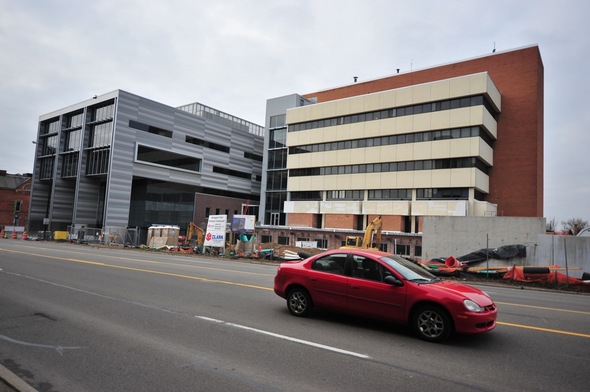
The new police-courts building, officially called the Ann Arbor Justice Center, now stands adjacent to city hall. Up until recently, police officers worked inside the lower levels of city hall where potentially cancer-causing levels of radon were present for years.
Ryan J. Stanton | AnnArbor.com
Top city officials were aware of the problems, reports show, but measures taken — including a mitigation system installed in the 1990s — failed to keep radon below federal safety levels, and it wasn't until 2009 that the city moved employees out of the basement.
Members of the police officers union believe there may be a link between the radon in the air they breathed in the basement offices — along with asbestos and mold issues — and health problems experienced by several officers, including two recent deaths.
Vada Murray, 43, a police officer in Ann Arbor for two decades and a former defensive back for the University of Michigan football team, died April 6 two and a half years after a lung cancer diagnosis. Neither Murray, nor his parents, ever smoked.
Jason Zogaib, 35, died March 13, 2009, after a two-year fight against leukemia. He had been an Ann Arbor police officer for more than 10 years.
Radon, a radioactive gas that is naturally occurring in the earth's atmosphere and commonly found in basements, is the second-leading cause of lung cancer in the United States.
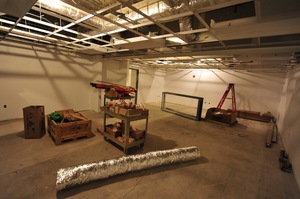
A look at renovations in progress in the old city hall basement in November. Police department employees officially have moved out of the space and into the new police-courts building adjacent to city hall.
Ryan J. Stanton | AnnArbor.com
Test results as recently as two years ago indicated radon levels more than seven times the U.S. Environmental Protection Agency's action level — the point at which remedial action is recommended because the levels are considered unsafe and pose cancer risks.
As city officials celebrated the recent opening of the city's new police-courts building on Saturday, City Administrator Roger Fraser talked with AnnArbor.com about the radon problems inside city hall, which housed the police department for decades up until recently.
Fraser said he doesn't believe any health issues cited by the police officers union, including the two deaths, are linked to radon levels in the building's basement.
"Even before they raised concerns, we've been monitoring what's been happening in our building with air quality," Fraser said, adding it seemed to be meeting all standards. "It hasn't been a lovely place and we'll concede that, and there has been some discussion about elevated radon readings. But we have no reason to believe they've been elevated over any period of time, and that's what it would take to create any kind of a health risk."
What the records show
The police officers union has had longstanding concerns about air quality in city hall, including radon, asbestos and mold. In a formal complaint filed with the state about two years ago, it referenced the fact that two officers had been diagnosed with cancer.
Radon is measured in picocuries per liter of air, or pCi/L. The EPA action level is 4 pCi/L, an amount exceeded many times over the years in the basement of city hall.

Photos of Vada Murray are on display in a glass case in the police department lobby in the new police-courts building.
Ryan J. Stanton | AnnArbor.com
According to the EPA, if 1,000 people who never smoked were exposed to 20 pCi/L over a lifetime, about 36 could get lung cancer. The number goes up to 260 for smokers.
Despite the high readings, Jeremy Kapalla, an industrial hygienist from MIOSHA, sent city officials a letter on Sept. 15, 2009, informing them the inspection resulted in no citations for either asbestos or radon, and the letter closed a pending case. It's not clear in city records but the case appears to have stemmed from a complaint filed by the police officers union.
"What MIOSHA found was that we had elevated levels of radon, but they weren't at a critical stage at that point," said Bob Cariano, the city's safety manager. "But we did have some high numbers, there's no doubt about that."
MIOSHA's report wasn't the first alarm to sound. After earlier tests confirmed high radon levels in the basement, a number of concerned police employees moved from their offices in February 2009. The basement housed roughly 30 employees at the time.
Some employees moved to vacant desks elsewhere in the department, which also occupied the first floor, and some moved to other city offices. Matt Kulhanek, the city's fleet and facility manager, said at the time the city conducted air quality testing in city hall every two years, and the last results from May 2008 had given the city no reason to be concerned.
But the police officers union had concerns, records show. The union cited one instance where, two days prior to testing done by MIOSHA around 2001, the city allegedly ventilated the basement by opening ground-level doors and running industrial fans.
In November 2008, the union asked for employees to be moved from the building after home radon test kits indicated pCi/L levels in the high teens to low 20s. The request to be moved from the building was denied, the union claimed.
An outside firm hired by the union, GZA GeoEnvironmental Inc., later conducted short-term and long-term tests and both found elevated levels of radon in the basement work area.
MIOSHA began investigating the union's concerns in February 2009. It was around that time that city officials agreed to let police employees move to other offices if they had worries.
"Certainly to the extent that somebody's got it in their head that they're at risk, that's a perception issue and it's something that we have to deal with," Fraser said. "Anytime anybody expressed concern, we found other accommodations for them."
On March 18, 2009, a company called Protech Environmental Services sent the city a letter indicating it tested for radon over the previous three days and all readings were above the EPA action level of 4 pCi/L. Despite an active radon mitigation system in operation in the basement, the readings still ranged from 15.6 to 21.7 pCi/L, test results showed. The levels were cited as unacceptable and remedial action was recommended.
Radon Special Report
Related coverage
- Ann Arbor Police chief says he was 'ashamed' of conditions police officers endured inside city hall
- Washtenaw County is a natural radon hotspot, and local experts suggest testing your home to be safe
- Video testimony: Vada Murray believed radon, asbestos at Ann Arbor city hall caused his fatal lung cancer
- Radon and asbestos concerns in Ann Arbor city hall left police employees 'petrified about their health'
On April 23, 2009, the city administrator's office sent a memo to city employees alerting them that Protech would be back working in the basement to evaluate the building's radon extraction system. As part of the evaluation, the company would be drilling holes in various basement locations and utilizing smoke testing to determine the extent of airflow movement.
Protech issued a report about a week later stating it took steps to address some of the shortcomings of the system, but test results still showed radon levels ranging from 6.8 to 9.5 pCi/L afterward. The company reported it was working on outlining proper corrective measures to reduce the radon levels below the EPA action level.
Fraser acknowledged in a Feb. 26, 2009, staff memo the existing radon extraction system, which had been in place several years, was no longer effectively regulating radon levels.
"City staff are working to identify an environmental firm that will assess and redesign the city hall radon mitigation program," Fraser wrote in the memo. "The chosen firm will implement an effective radon mitigation program and regular testing will take place to monitor air quality throughout city hall."
Asked on Saturday what steps the city took to implement a new system, Fraser said: "I'm not going to get into the details of that."
But he said the problem all along was the 1963-era city hall basement, and that's since been completely gutted and renovated as part of the police-courts building project.
A company called Testing Engineers & Consultants Inc. conducted tests in the renovated basement two months ago in mid-February. The purpose of the tests was to verify the efficiency of a sub-slab pressurization radon mitigation system recently installed.
The tests indicated that, at eight of nine monitoring locations, radon concentrations were below the EPA action level of 4 pCi/L, but one location identified as an IT training area was slightly elevated at 4.6 pCi/L. The average of the nine samples was 3.05 pCi/L.
Based on those results, the company recommended the city do additional followup sampling. About two weeks later, test results from three areas ranged from 2.7 to 3.6 pCi/L.
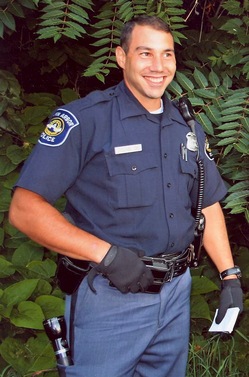
Officer Jason Zogaib, who died following a two-year battle with leukemia, in 2009.
File photo
"I can tell you that I had no idea when I took this job that there had been a history of radon in the building," he said. "But as soon as I found out it was high, I went to Roger Fraser and told him I wanted to get my people out of the basement because they had a fear of high radon. And then they advised me that they had a history of high radon in this building."
Records dating back to the early 1990s show readings as high as 20 pCi/L, though most readings on reports viewed by AnnArbor.com hovered between 6 and 10 pCi/L.
A company called Radon Testing and Reduction Systems recommended in December 1993 that the city install a ventilation system after tests showed levels ranging from 5 to 7.9 pCi/L.
In early 1994, the city contracted with the Howell-based company to install the system at a cost of $3,134, which reduced the levels to between 2 and 3.6 pCi/L, according to tests done by the company shortly after the installation.
It's unclear whether the city kept up with regular monitoring after that. A test conducted in January 2001 eventually showed radon levels had ticked back up to 5.9 pCi/L.
Three months later, MIOSHA came in to investigate a complaint alleging 65 employees working in the basement were exposed to radon. The city received no citation in the incident, but MIOSHA stressed that didn't mean the city was in compliance with state standards.
MIOSHA recommended the city make improvements to the mitigation system, including adding a bigger fan. City staff communications show a state inspector informed the city the company that installed the system several years prior had a reputation for doing shoddy work.
An emotionally charged issue
While it's no surprise to the police officers union that radon levels were high, it's unclear who else has seen the results from tests paid for by the city, beyond top-level administrators. Mayor John Hieftje said the reports never made their way to him.
"I've never seen the testing numbers and I just don't know a whole lot about this issue," Hieftje said. "I understand that obviously there was radon at one time down in the lower level of the Larcom building because we had a radon extraction system and I noticed that years ago. But I have not ever really been too briefed on this issue."
Deputy Police Chief Greg Bazick said he had no idea the readings were so high, and he's never been briefed on what the reports show.
"I just have not been involved in the administrative-level discussions and I'm not privy to the details," he said. "I wasn't aware that they were that high."
Representatives of the police officers union declined to comment for this story, citing concerns about discussing the issue in the press.
The union has used the issue of radon and asbestos as leverage in labor negotiations with the city. The city is asking officers to agree to concessions and to begin contributing more toward the cost of their health care, but the union isn't budging.
Facts About Radon
Since the late 1980s, radon tests have been taken throughout the United States. According to data available from the county, about 12 percent of Michigan's single-family homes have indoor radon levels greater than 4 pCi/L, the EPA action level. Washtenaw County has an even greater potential for elevated levels. According to estimates, more than 40 percent of homes in the county could have radon levels above the EPA action level.
Radon decays into tiny, radioactive particles that stick to dust and debris in the air and are inhaled. The particles break down quickly, releasing radiation in the lungs, potentially leading to lung cancer.
Radon is the second-leading cause of lung cancer in the United States, responsible for an estimated 21,000 deaths per year, according to the EPA. Smoking significantly increases the chances that someone exposed to radon will develop lung cancer.
Home radon levels can be greatly reduced by mitigation systems installed in a single day by a qualified contractor for about $800 to $1,200. For more info, click here.
City Council Member Stephen Rapundalo, chairman of the council's labor committee, fired back at a recent public meeting by saying there's no evidence that Ann Arbor police officers have a higher need for health care because of the building in which they previously worked.
Still, the city has cited air quality problems in the basement of city hall as a reason for constructing the new police-courts building. A fact sheet on the project states the old police department was "badly deteriorating" and there were "air quality issues and black mold in many areas of the police facility." The same city document states the area in which police were housed was originally designed for storage space and not meant to be inhabited.
Council Member Christopher Taylor, D-3rd Ward, also acknowledged those issues in a newsletter sent to constituents last month explaining the reasons for the new building.
"The condition of the police station was particularly troublesome — cramped quarters, leaks, security insufficiencies, radon, asbestos," Taylor wrote in the letter. "The arrangement was considered ‘only temporary’ in the 1960s."
Fraser said the city still maintains "there was nothing scientifically or otherwise to worry about." He said he's sorry for the recent loss of an officer to lung cancer, but he doesn't believe there's any connection to the radon levels in the place where he worked.
"Vada Murray's demise is certainly sad, it's tragic," Fraser said. "He did, in fact, file a worker's comp claim about a year or so ago and that's still in process. I don't know what the current status of that is. But we've talked with others about the health risks of radon. They have looked at how our employees have used the building, and we've not heard anything to lead us to believe that there is any potential that the kinds of concerns that some of our employees have had are related to our building, and we continue to believe that's true."
AnnArbor.com is in the process of seeking more details about Murray's worker's compensation claim. Asked if the city is contesting the family's case, Fraser said: "We pay a carrier to handle our worker's comp stuff so we don't directly get involved in that."
Hieftje, who attended the deceased officer's memorial service last week, said Murray was a patrol officer and didn't regularly spend extended periods of time in the city hall basement.
Bazick said Murray still would have spent time in the basement.
"We all have worked in the basement up until moving out of this building in that our lockers for changing were there," he said. "The detectives and the dispatchers primarily spent the most time down there, and there were a few civilian employees who had offices down there. But almost everybody would have had some exposure to the basement."
Bazick, who stressed he was offering his own viewpoint and not speaking for the department, said personally he's not too concerned about the radon levels. He said he worked in the basement for many years as a supervisor in the communications section.
"The two recent deaths of these relatively young officers are tragic, and I understand that they looked after their own health and it makes it that more puzzling why they contracted what they did," he said. "I know this is an emotionally charged issue for some people and I don't want to in any way diminish their perspectives. I can just tell you that I'm not concerned that I'm going to contract an incurable disease because of the many years of exposure I, too, had in the basement, and that's just an individual perspective."
Murray played football for U-M from 1986 to 1990 under Bo Schembechler, who took the Wolverines to the Rose Bowl in 1987, 1989 and 1990. A number of former teammates attended his memorial service on Thursday to pay their respects.
The police department honored Murray with the same ceremony it would afford to an officer killed in the line of duty, including a solemn procession of more than 100 uniformed officers. Hundreds packed into Cliff Keen Arena for the service.
Jones said he's confident no Ann Arbor police officer will have to worry about exposure to radon any longer, and hopefully the same goes for future users of the city hall basement.
He said he's learned a valuable lesson in all of this, too.
"I've said to myself quietly many, many times, if I were ever to leave this police department, and I left to go someplace else, I would do a heck of a lot better on researching than I did coming here," Jones said. "If I move again, you better believe I'm going to look at building plans and historical perspective of environments and everything else."
Ryan J. Stanton covers government and politics for AnnArbor.com. Reach him at ryanstanton@annarbor.com or 734-623-2529. You also can follow him on Twitter or subscribe to AnnArbor.com's e-mail newsletters.
Comments
snapshot
Tue, Apr 19, 2011 : 4:08 a.m.
Cancer is a terrible disease. I feel for the families of all cancer deaths but it stretches the imagination that the causal factor singled out by unqualified individuals is a radon issue to be used in union negotiations.
lester88
Wed, Apr 20, 2011 : 2:52 a.m.
You make this same baseless comment about the union and negotiations on every article concerning this issue. Zero votes tells the story. Your snapshot is from the deserted island you're on. Documents show complaints from employees for over 20 years.
Jack
Tue, Apr 19, 2011 : 3:28 a.m.
I wonder how many of you who are so outraged by this were outraged enough to vote for the new City Hall when it was up on the ballot? Almost all I ever see from the public is how a new City Hall was sooooooooooooo unnecessary. Where were you all then? City Hall has been like this for years - riddled with asbestos and radon. It is not just the police, albeit the police garner the most sympathy from the public: form what I read from the public, the rest of the city employees are all slackers. Perhaps you should have put your vote where your mouth is and these people could have worked in a safer environment years earlier.
Awakened
Tue, Apr 19, 2011 : 1:12 a.m.
SURGEON GENERAL HEALTH ADVISORY: "Indoor radon is the second-leading cause of lung cancer in the United States and breathing it over prolonged periods can present a significant health risk to families all over the country. It's important to know that this threat is completely preventable. Radon can be detected with a simple test and fixed through well-established venting techniques." January 2005 <a href="http://www.epa.gov/radon/pubs/citguide.html" rel='nofollow'>http://www.epa.gov/radon/pubs/citguide.html</a> 10 second google search to be briefed more fully, Mr. Mayor.
shepard145
Tue, Apr 19, 2011 : 12:48 a.m.
I have all the respect in he world for police and fire but radon gas is common in south east Michigan (but more so in other states) as the result of decaying uranium in the soil. Basically this is a half baked hack piece on City Hall by a Joanne Woodward wanna be. Since you piled on mold and asbestos with equally little knowledge, why not go back to your main source, Google, and tell your unfortunate readership how many mold strains there are and how many are toxic Ryan? Mold is ubiquitous (sorry for the big word) but you even heard of black mold and do you know where it is generally found? ...and how many miles is that from Michigan? Let your fingers do some more research since you're clearly adverse to any actual reporting. Reporters know nothing but how to read and write (which most people learn in the 1st grade) so are obligated to ask those of us who are educated in these things rather then tackle em all by yourself with that high powered liberal arts degree as is the fashion these days. ...and what about that asbestos Ryan - where was it found and how DO YOU think it was hazardous to the police department? Radon is easy to get rid of – it just take ventilation. The system could have worked fine in the 90's but either acceptable standards changed, other sources of air into the space changed (to save energy!! LOL) or it wasn't maintained.
Mike
Mon, Apr 18, 2011 : 10:55 p.m.
What a bunch of political self serving garbage. The City knew about these problems in the 90s. They prohibited employees from bringing their own tests in, under threat of disciplinary action. Employees were told that test were taken, but everything was normal. For Hieftje to say an officer didn't spend substantial time in the basement is a crock. The training rooms were in the basement. The locker rooms were in the basement. In addition to Detective, Administrative services, training and communication were all in the basement. Interesting to see that Fraser is now a scientist. He doesn't believe these number were elevated for any significant period of time? Only at least 19 years. Who knows how long before that. Fraser claims anytime anyone expressed concern, steps were taken to alleviate those concerns? What nonsense. When brought to the City's attention in the late 80s/early 90 they flat out denied there was a problem. And Fraser doesn't want to go into what steps were taken to alleviate the problems? Shouldn't that be a matter of public record?
Steve
Mon, Apr 18, 2011 : 7:23 p.m.
Let's not forget there are many more employee's that worked in the basement and 1st floor of City Hall, not just the police. There were also several premature deaths from those that had retired. I think we will see a lot more to come of this. More to come.
Marshall Applewhite
Tue, Apr 19, 2011 : 1:32 a.m.
You do realize that there are many "premature deaths" in society? Not everyone lives to 100.
Hunterjim
Mon, Apr 18, 2011 : 6:18 p.m.
The article barely touches on the asbestos issue in city hall. This has always been a problem for the entire building. All the pipes through ou the building are wrapped in asbestos. They are fine as long as they were left alone. But as the building was modified to accommodate more workers, and technology required phone and computer wires to be strung throughout the building, the asbestos was chipped away to allow access through the walls. I saw this first hand for years, many times without any protection for the maintance crew or employees working in the room at the time. I spent many years working in the basement of the building, and can attest to the conditions. The employees did raise the issue many times and test results were not shared by the city until the union paid to have its own testing done. But the part of this that bothers me the most is the attitude of both the Mayor and City Administrator that they did not see this as a problem for thier employees. Shame on them. Vada and Jason are not the only workers with health issues thay "may" be attributed to these issues. No one will ever know for sure. For the city to have know that these issues could affect the health of employees and citizens who used city hall and swept what they knew under the rug is inexcusable.
Dog Guy
Mon, Apr 18, 2011 : 6:15 p.m.
63Townie mused, "If only there had been a legitimate challenger in the last election..." I have observed worthy mayors of different outlooks--Creal and Pierce for two--challenged for office. Without challenged elections, we may expect predatory management both elected and appointed. Absent a challenge, predators ignore anything but the stalk and the kill; we feed our cat, Erwin, but if the dog isn't out Erwin kills anything that walks, hops,or wiggles. Joyce Cary wrote that the only good government is a bad one in a hell of a fright. A legitimate challenger need not be elected to be effective.
Mick52
Mon, Apr 18, 2011 : 4:41 p.m.
Sure are a lot of "I didn't knows" here. I don't know and I don't remember are cover ups for lies. My association with AAPD began in the late 70s and the city never treated them well. They should have been put in decent facilities 20 years ago. Finally they get a usable facility but only with the court and city hall piggybacking on the PD. Cannot understand why we need two court houses downtown. It will confuse people. Seems it makes sense to have all the courts in the city in one building. The excuse the county courthouse was unsafe is bunk. Is so, tear it down and build a courthouse on that block for all the courts. AAPD and AAFD are fantastic departments, wish the city would treat them as such.
say it plain
Mon, Apr 18, 2011 : 4:41 p.m.
@Barb and others, I don't love how this issue has suddenly become a part of police-contract negotiations, but still... on lung cancer, radon is recognized by the EPA as the second-leading cause of it, and their 'action levels' should be taken seriously. You can bet that the EPA doesn't tend to be overly cautious about such stuff ;-) And there is mention made here about *black mold* which is a big health concern, can cause chronic lung problems and infections, *plus* has been linked to Leukemia! Here's a little link from the livestrong website on the issue. <a href="http://www.livestrong.com/article/27251-effects-household-mold-humans/" rel='nofollow'>http://www.livestrong.com/article/27251-effects-household-mold-humans/</a> It isn't just radon that was a problem in this basement, and however people felt about building a big new fancy building, it sounds like this place was never meant for people to inhabit, much less spend a lot of time in.
63Townie
Mon, Apr 18, 2011 : 4:39 p.m.
Just when I think I've heard it all from Fraser, he stuns me again. The fact that he has been retained by our Mayor for such a long time speaks volumes (to me) regarding the character of both. Blatant disregard for the health and well being of residents and city employees. ...Mayor John Hieftje said the reports never made their way to him. "I've never seen the testing numbers and I just don't know a whole lot about this issue," Hieftje said. "I understand that obviously there was radon at one time down in the lower level of the Larcom building because we had a radon extraction system and I noticed that years ago. But I have not ever really been too briefed on this issue."... Yeah, you can never be "too briefed" on an important issue regarding your employees, now can you? Mr. Mayor, if you can look a reporter straight in the face and utter the above words, it really makes me wonder what you have been doing in office all these years. If only there had been a legitimate challenger in the last election...
Barb
Mon, Apr 18, 2011 : 4:19 p.m.
I just want to reiterate a point that one other commentator made that may have been lost in the discussion: Radon is only linked to lung cancer. Only. Not leukemia. So, I would advise caution before jumping on this bandwagon. Other commentators are also mentioning that radon is not the threat everyone is making it out to be. Do some research here before going out on this limb, I would advise.
say it plain
Mon, Apr 18, 2011 : 5:32 p.m.
Also, I'd love to hear more about the prevalence of molds, because some varieties can be powerfully bad for one's immune system, and even cause cellular-level damage and liver and kidney problems, and blood and other cancers. If there was black mold *and* radon, that could be a powerfully unhealthy mixture, reducing one's immune system's abilities to stave off damaging processes induced by the radon. The reason why it's all an issue of probabilities in this domain rather than direct 100%-likelihood causal links is that people's bodies respond differently to the same sorts of exposures. But if you can start showing multiple toxic exposures as well, phew, that becomes more and more problematic, because it becomes more and more likely that we can point to the confluence of factors and say that this was important to the disease etiology, no? I'd assume that the city's lawyers are busy busy on this count, sad to say...
Steve
Mon, Apr 18, 2011 : 5:10 p.m.
Barb most of those people worked in the BASEMENT of City hall. 8+ Hours a day 40+ hours a week. Unless you have a finnished basement at HOME, I don't think most people spend much time in there basements.
say it plain
Mon, Apr 18, 2011 : 4:53 p.m.
@Barb, perhaps because people spend hours a day in their homes (though probably not too much of it in their basements per se, but still we worry about the basement levels because they are highest there so we measure there and we remediate from there, and we spend some time down there sometimes) like people might spend hours a day at their workplaces.
Barb
Mon, Apr 18, 2011 : 4:46 p.m.
@Steve, note it says "home"... and then think about why that might be.
Steve
Mon, Apr 18, 2011 : 4:33 p.m.
From the EPA: "Radon is estimated to cause many thousands of deaths each year. That's because when you breathe air containing radon, you can get lung cancer. In fact, the Surgeon General has warned that radon is the second leading cause of lung cancer in the United States today. Only smoking causes more lung cancer deaths. If you smoke and your home has high radon levels, your risk of lung cancer is especially high."
MjC
Mon, Apr 18, 2011 : 4:18 p.m.
We live in tough financial times and have for many years now. But I've always supported a new City Hall that would provide new space for the Police Department. As a voter, I should have voiced my opinion more loudly. Shame on me. We live in one of the most prosperous cities in Michigan and we treat our City employees as second class citizens. Shame on all of us.
Steve
Mon, Apr 18, 2011 : 4:04 p.m.
Spoken Like a TRUE Politician – COVER UP.. Thank Roger.
Tru2Blu76
Mon, Apr 18, 2011 : 3:17 p.m.
Uh, as usual, people are jumping based on whatever view fits their ideological context first - and ignoring the science. Science fact: Radon is a low level radioactive threat which requires A LIFETIME of exposure to cause statistically detectable damage. There's a difference between outside workplaces and homes: the time of exposure in homes is likely to be ~ 2X that of exposure in workplaces. So the standards and the term "lifetime" are really applies to homes, not to workplaces. Then: "the EPA: if 1,000 people who never smoked were exposed to 20 pCi/L over a lifetime, about 36 could get lung cancer. The number goes up to 260 for smokers." = Means non-smokers have less than 1 in 28 chance of getting cancer from Radon IF they spend "a lifetime" of exposure. Most police and city employees are non-smokers and those people were exposed (at most) to 1/10th to 1/6th of a lifetime. If the radon threat was as severe as some folks here are claiming - then there'd be more victims beyond the two (still awaiting confirmation). That workplace has existed for about 48 years. Only TWO alleged victims have resulted from their part-time exposure?? No one should buy into the mob psychology here and start blaming Fraser, Hieftje or "the city." Disclaimer: I am not employed in any capacity by the city nor do have I any interest in seeking public office. I'm a political independent who distrusts both Democrats and Republicans.
Awakened
Mon, Apr 18, 2011 : 6:47 p.m.
According to the American Cancer Society, radon is the second leading cause of lung cancer. Asbestos the third.
John B.
Mon, Apr 18, 2011 : 4:36 p.m.
It's not that specific. The key words (above) are 'could get lung cancer.' Maybe zero people contract it, maybe 100 do. You can't predict that accurately. Your argument is therefore meaningless. And the EPA also says that no level of radon exposure is safe, by the way.
say it plain
Mon, Apr 18, 2011 : 4:31 p.m.
Please explain the calculations you employed to get at your expectations about rates? Tell me how I'm off in thinking based on your numbers that hmm, if we might expect 1 in 28 people exposed to that level of radiation for 10 times as long then we might expect 1 in 280 people to get it from the amount that actually was present, no? So, how many people are in our denominator, thousands and thousands?! Fraser Hieftje et al surely didn't pump radon into that basement, but perhaps they failed to remediate properly, and this was their responsibility as a provider of workplace environment.
Alan Goldsmith
Mon, Apr 18, 2011 : 3:06 p.m.
"Alan Goldsmith and David Cahill and others who VEHEMENTLY fought to keep the police in that basement and now they have the gall to come and criticize the city. Maybe, just maybe if those members of the public who opposed the police courts building could have seen the forest through the trees, then we could have had a new police courts building 10 years ago." Out and out NOT true, whoever you are who posted this. I fought for reviewing other building options, leased space, putting the building up for a vote rather than raiding the operating fund and putting the city into debt, NOT for poisoning city employees. What crap. I was against Hieftje's million dollar water fountain and not looking into less expensive replacement options. It's the fault of the people asking questions and not the City Manager and the Mayor? If the City was aware of these working conditions and failed to act immediately, by moving the staff into temporary space, then it should be a crimincal investigation. I'm sick to death of the Mayor and his supporters NEVER taking responsibility for ANYTHING other than 10 Best City awards in Ride My Bike magazine. Good lord. Time for an outside investigation of all the events that have taken place here. And while I have more than a bit critical of AnnArbor.com, Ryan Stanton deserves praise for his investigative reporting here.
Cash
Mon, Apr 18, 2011 : 7:52 p.m.
Alan, You are completely correct in your assessment. I do remember reading your opinions more than once on the subject. We know better. Posters are not to blame for this. That's absurd!! My goodness, a trailer could have been put up rather than have them closed in basement full or radon and mold!
Gorc
Mon, Apr 18, 2011 : 4:50 p.m.
A2 Congrats AnnArbor.com The lede line for this story just made me so appalled with the low level quality of journalism at your publication that I just called to cancel my subscription. This after being an Ann Arbor News/AnnArbor.com subscriber since 1973. " It's early on a Friday morning and Ann Arbor City Council Member Stephen Rapundalo is shaking his head, a look of distaste frozen in his eyes." To allow THIS quote from a political hack, with a passage from a reporter that actually says 'distaste frozen in his eyes' like some cheap 50s noir novel shows either you don't have a clue about slanted news coverage or you do and don't care. Either way, until reporters and editors like the ones responsible for this sort of 'news story' are gone, you won't be getting any money from me. I was skeptical of all the early promises AnnArbor.com would cover local news in an in depth and world class level way, but was willing to give you a chance. Time's up.
say it plain
Mon, Apr 18, 2011 : 2:58 p.m.
Great article, keep the pressure on the city about stuff like this! Hieftje is a real-estate professional! Councilmen like Taylor can claim that the new building was needed in part because of problems in the old one with 'radon, asbestos' etc. and black mold too. This is stuff typically *very much on the radar screen* of real-estate pros! I don't buy for a second that Hieftje didn't know about it in some significant way. Surely exposure to *both* radon and asbestos would increase risk, and we're not talking about needing to see a huge increase in cancer rates to connect radon exposure to lung cancer. If a mitigation system was needed in the first place, then surely the city would have been responsible for tracking its effectiveness, which it apparently did not do.
tiredncranky
Mon, Apr 18, 2011 : 2:39 p.m.
Sure seems to me that some members of the public had a lot to do with delay of moving the police out of the basement. I find it appalling that some of the same people who criticized the construction of the new police building are now going to blame the city for not moving the police sooner. Alan Goldsmith and David Cahill and others who VEHEMENTLY fought to keep the police in that basement and now they have the gall to come and criticize the city. Maybe, just maybe if those members of the public who opposed the police courts building could have seen the forest through the trees, then we could have had a new police courts building 10 years ago. Radon is natural radioactivity that is in many buildings. Radon has been linked to lung cancers only, not any other cancers. Although Radon can be a problem, it is not a crisis. It is everywhere, there is only so much you can do about it. Which is why the police never really brought up the issue publicly before. They never brought up the issue until they wanted to use it as a bargaining chip for their salary negotiations. Appalling. I was for the police /courts building from the start. However, I never really saw the police completely support this project to the extent that they may have felt their lives were in danger. I find them being opportunistic now and that is very disappointing. Their cries of "victim" ring hollow now.
Awakened
Mon, Apr 18, 2011 : 6:44 p.m.
And I thnk this makes the assumption that bloggers knew of this problem. It seems that the City was covering up the problem. I will assume from their comments now that had they known they would hav esupported moving the police. But they may still have had a desire for a more cost effective (or aesthetic) solution. This would summarize my position.
deb
Mon, Apr 18, 2011 : 3:31 p.m.
im not sure a $50 million building was needed to take care of this concern (maybe for other concerns, not just this one alone.) I will venture to say that the radon problem in the old building could have been fixed for much less then $50 million
say it plain
Mon, Apr 18, 2011 : 3:08 p.m.
I agree that it surely should not have been a bargaining chip in salary negotiations, but it surely is relevant to workers comp considerations and the city should have been monitoring levels.
actionjackson
Mon, Apr 18, 2011 : 2:18 p.m.
A company called Radon Testing and Reduction Systems recommended in December 1993 that the city install a ventilation system after tests showed levels ranging from 5 to 7.9 pCi/L. In early 1994, the city contracted with the Howell-based company to install the system at a cost of $3,134, which reduced the levels to between 2 and 3.6 pCi/L, according to tests done by the company shortly after the installation. It's unclear whether the city kept up with regular monitoring after that. The article later states that an inspector from the State reported that this company was know for perfoming shoddy work! These officers, especially Vada Murray, were risking their lives to protect ours and the city uses a Howell based "shoddy company" Wonderful.
actionjackson
Mon, Apr 18, 2011 : 2:29 p.m.
Google this company! No website, no recommendations, between 1 and 4 employees, and what looks like a home based business! Lowest bid? What training did these "shoddy workmanship people have? Any follow up on this company by Ann Arbor.com would be greatly appreciated.
Tony Dearing
Mon, Apr 18, 2011 : 1:53 p.m.
A comment was removed because it violated our guidelines. Please do not post comments regarding someone's physical appearance.
Ron Granger
Mon, Apr 18, 2011 : 1:42 p.m.
Given the high radon levels in Washtenaw county, shouldn't the city require all rental properties to be ventilated against radon? So many rental properties have people living in basements, whether sleeping or as part of living space. We could require testing as a precursor to mandatory remediation. But I think a lot of "landlords" would fake the test results. Home owners tend to take care of this for themselves, but renters do not have that luxury. And as this story shows, remediation efforts do not always work. Some rental properties have cracks in basement walls that make them a much more extreme risk for radon.
dgomg1
Mon, Apr 18, 2011 : 1:17 p.m.
Are Fraser, Heiftje and Rapundalo for real? What insensitive and obviously completely incompetent people you show yourselves to be. Cover your back sides and mitigate a serious issue when it had been covered up for years and then claim ignorance on the findings. I'm sure you would have a completely different perspective had you or your family been the victims of the city's negligence. God help the State of Michigan now that Fraser is moving his evil ways there but it is certainly Ann Arbor's gain. I'm sure it is another case of Fraser now being about to remember the details!!!!
deb
Mon, Apr 18, 2011 : 1:11 p.m.
I like the fact the mayor said he didn't know anything about the readings. Last week Fraser said no one cared to make a comment to him about the closing of a fire station. Are the officials not listening, lying or do they not care???
Awakened
Mon, Apr 18, 2011 : 6:39 p.m.
D.) All of the above.
Blue Eyes
Mon, Apr 18, 2011 : 12:57 p.m.
The only thing Cash didn't mention was that this is the same group of City officials that didn't think there was a problem with the high carbon monoxide readings in the "old" building while construction was occuring in the "new" building. Again, it took someone bringing in a home monitor that went nuts at the readings before the building was evacuated - more than once! Always nice to know how caring and proactive your bosses are about the safety of their lowly employees. Good riddance to Roger....and please take the rest of your pals with you.
aanonliberal
Mon, Apr 18, 2011 : 12:42 p.m.
Maybe people will now realize that the Police Union has concern to keep health care as a top priority. 43 and 35, these were two phenominally well conditioned cops and they are dead from extremely rare diseases. Sure nothing is wrong???? I think i said when the story was about Rapundalo firing back that there is no evidence to support the unions claim of needing health care to remain at what it is that he wasn't stupid enough to say that there was no proof to it..Now what Mr. Rapundalo??????????????????????????????????????????? NOW MAYBE PEOPLE WILL RECOGNIZE THE DANGER THE ANN ARBOR POLICE OFFICER FACED EVERYDAY (JUST COMING TO WORK) and even before they went on the street to protect you. Who is next? To Fraser those two precious lifes lost (fathers, husbands, brothers) are just statistics and they were not worth the costs of stepping up to the plate and fixing the issue and taking care of those exposed.
Matt Damon
Mon, Apr 18, 2011 : 12:38 p.m.
It seems the only thing city officials know for sure is that they are not working in the basement of city hall. Good move, let the servants occupy this space, after all they did swear to serve and protect. Seems all bases are covered. Who can the city kick next?
snoopdog
Mon, Apr 18, 2011 : 12:37 p.m.
I work from home , my work office is in my basement so I spend around 6 hours per day in my office when not out seeing clients. I also have had high levels of radon and put in a ventilation system. If I get sick I have no one to sue unlike those who work for the city. Good Day
snoopdog
Mon, Apr 18, 2011 : 11:11 p.m.
@aanonliberal, had house built ground up in 1992 so how do you research that especially back in 1992. I could move my office , good point but my point stands. Good Day
aanonliberal
Mon, Apr 18, 2011 : 12:45 p.m.
move your office, do your research when you buy your house. The cops cannot put in a vent and asked for years for just that and they cannot change their work place and are due a healthy work environment!
Wolf's Bane
Mon, Apr 18, 2011 : 12:36 p.m.
I'm surprised that Police Officers were allowed to work in such an unhealthy environment and that nothing was done to limit their exposure to deadly radon gas? Most Ann Arbor households have been or get tested for radon, if levels are high, then have Radon mitigation fans installed. We have had a system in place since we purchased our home back in 2005. Why could the city not ensure that all municipal buildings were tested in a timely fashion? I think I smell a lawsuit coming on.
David Cahill
Mon, Apr 18, 2011 : 12:16 p.m.
This is an excellent story, Ryan. Keep digging.
Awakened
Mon, Apr 18, 2011 : 12:05 p.m.
The comments by Heiftje/Fraser may seem incredibly callous and uncaring but are probabaly to be intended to limit personal liability in the inevitable lawsuits. After all if a few sacrifices have to made so that they can pursue their agenda uninterupted....So.... Everyone below Fraser who has connection to dealing with this problem is probably being measured for the 'scapegoat' shirt. I hope they all have their ducks in a row. Also. If Chris Taylor knew about the radon and asbestos to help justify the new building, and therefore WAS briefed, how come the Mayor has not?
Donovan
Mon, Apr 18, 2011 : 11:44 a.m.
It must be something about Ann Arbor area Police Departments. The University of Michigan Police Department is housed in an old factory. It actually has monitoring sites in the floors that they look at to keep check of the levels of the waste that lies below. They have also had an officer die of luekemia, as well as a custodian die from brain cancer. Another officer continues to fight cancer in his retirement years.
Cash
Mon, Apr 18, 2011 : 11:19 a.m.
The contrast between the comments from Ann Arbor city officials regarding the life and death of humans and the comments in the article below about pet deaths, is astonishing.
Alan Goldsmith
Mon, Apr 18, 2011 : 11:04 a.m.
"Hieftje, who attended the deceased officer's memorial service last week, said Murray was a patrol officer and didn't regularly spend extended periods of time in the city hall basement." Hieftje, as you practicing your testimony for the lawsuit? How can you insult the memory of this officer by making excuses for an investigation that is still ongoing for the worker comp case? And how can you look at yourself in the mirror after mouthing these words?
Wolf's Bane
Mon, Apr 18, 2011 : 12:40 p.m.
If Hieftje really said this, he has a problem. Police officers spend a great deal of time doing paperwork, especially good officers. So, it would make sense that patrol cops would need a place, such as a desk and/or chair to do their work? C'mon, Hieftje!
Alan Goldsmith
Mon, Apr 18, 2011 : 11:02 a.m.
"I've never seen the testing numbers and I just don't know a whole lot about this issue," Hieftje said. "I understand that obviously there was radon at one time down in the lower level of the Larcom building because we had a radon extraction system and I noticed that years ago. But I have not ever really been too briefed on this issue." If anyone believes this crap for a second I have a Stadium Bridge to sell you. Here is a political hack who has micro-managed every two bit city activity for the past decade and when it comes to possible major employee safety issues that may have contributed to the death of police staff, he was 'not really too briefed on this issue". I won't quote the Al Franken book title for his book on Rush but it captures the Mayor's words perfectly. Several things. Kudos for tracking down this story. It would have taken a bit more guts to publish this and the piece about his pension for nine years of work while Roger Fraser was still working for the city and not heading out the door. But the arrogance Fraser displays with his insults of fire staff and now this coverup of possible life-threatening work conditions for staff staff are welcome reporting, at long last.
Cash
Mon, Apr 18, 2011 : 10:27 a.m.
If it was so safe, Roger Fraser, why didn't you lead by example and move your office to the basement to assure staff? The quotes attributed to Fraser are unbelievable. And this is the guy who is going to Lansing to "help" entities as a EFM. I hope that you will be joining me in writing to Lansing demanding that he not be put in a position of authority over others. His disregard for other human beings, as displayed in this article, is a disgrace to every Michigan citizen. "Certainly to the extent that somebody's got it in their head that they're at risk, that's a perception issue and it's something that we have to deal with," Fraser said. Well Roger, I've got it in my head that you need to take all of your pensions and get out of public "service" forever.