

Could you change 10 percent of your diet to locally-sourced foods? Washtenaw County summit to issue challenge
Sitting down on a recent Friday morning to a freshly cooked meal of eggs, sautéed potatoes and homemade waffles topped with canned peaches, Ann Arbor resident Gus Teschke looked in a state of mild bliss.
He was sitting amidst other diners in the large kitchen of a west side Ann Arbor home positively bustling with lively music, conversation and the smells of breakfast as residents showed up to try the weekly bounty. Don't be shy about ordering everything on the menu, he suggested. "Everything here is wonderful," he said.
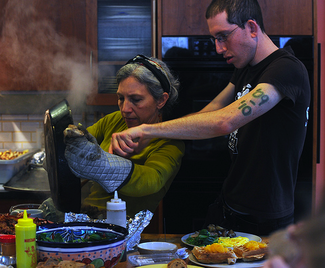
Remi Holden, right, helps Lisa Gottlieb with a pan of potatoes during her and her husband Jeff McCabe's weekly Friday Mornings @ SELMA (Soule-Eberwhite-Liberty-Madison-Affilitation) breakfast in their Ann Arbor home Feb. 19. Lon Horwedel | AnnArbor.com
And all of this food, from the fresh milk for the coffee to the meat that supplied the bacon, all comes from southeast Michigan, said the chef and a host of the meal, Lisa Gottlieb, as she briskly cracked a few eggs into a sizzling pan.
In fact, showing folks how enjoyable local foods can be, is kind of the whole point.
It's part of the Friday Mornings @ SELMA (the Soule-Eberwhite-Liberty-Madison-Affiliation), a breakfast gathering meant to showcase local food in the community and to raise funds to support the local food movement in Washtenaw County. The event is affiliated with the nonprofit organization Slow Food Huron Valley.
This growing group of folks is leading a push to take the trend of eating local and seasonal foods mainstream. They will be brainstorming ideas at the HomeGrown Local Food Summit 2010 on the University of Michigan campus in early March. About 200 people are expected to attend.
"People are really hungry for community," said Jeff McCabe, who hosts the breakfasts with Gottlieb, his wife. "We want to be a catalyst."
The summit, to be held March 2, will feature discussions with local stakeholders, such as chefs, farmers and eaters, about progress made in Washtenaw County in expanding efforts to encourage local food consumption.
"This is the idea good food for every one needs to be a basic human right," said Kim Bayer, a member of the leadership team at Slow Food Huron Valley.
This second annual summit will also focus on brainstorming ways to meet a goal of increasing the share of locally grown food that is part of the $1 billion worth of food consumed within the Washtenaw County to 10 percent in the next decade, McCabe said.
Currently, it's estimated about 1 percent of the food consumed within the county is local, he said.
The summit will look at establishing benchmarks for growing the local food movement, such as creating more community gardens and helping young farmers get access to good land.
Improving local food sources is an economic, environmental and food security issue, Bayer said. For instance, buying locally sourced food keeps dollars supporting local farms in the community, reduces the amount of miles food must be shipped and allows consumers to build a trusting relationship with the person who produces their food.
If a person's produce comes from a local farm, they could go see for themselves what sort of practices are being used to produce or process that food, she said. "Most people probably don't even know they can do that," Bayer said.
Eating local can also be more healthy because it often means avoiding highly processed foods for more seasonal, natural foods. "The entire lifestyle that develops around (eating local) is really quite affordable," McCabe said, referring to planning and cooking at home that's often involved.
"We’ve made a substitution in our culture," McCabe said. "Where we used to pay about 10 percent of our income on health care and 30 percent on food only about 50 or 60 years ago, it’s not the other way around and now I would say we probably are spending 30 percent on health care and 10 percent on food. It wouldn’t necessarily be a terrible thing to spend more on food."
It also often takes an organized push of support for policies that support local food agriculture when many government policies usually support commodities like corn and soy beans, he said.
Teschke said he plans to attend the summit so he can get more involved in the local food movement.
"Most of my involvement up to this point has been eating," Teschke said. "I want to see what they're doing, what the future brings. It's important. Local food builds community and it's better food."
Tina Reed covers health and the environment for AnnArbor.com. You can reach her at tinareed@annarbor.com, call her at 734-623-2535 or find her on Twitter @TreedinAA.
Comments
melissa
Mon, Mar 1, 2010 : 4:31 p.m.
Yeah sure. But how do you know it's local? And it needs to not be a huge pain to do it. There's no parking in Kerrytown and I'm not driving to A2 on Saturday mornings. The farmers market near me is awesome, but only open 6 months of the year. You want people to buy local? Make it easier.
Ann English
Sun, Aug 12, 2012 : 12:31 a.m.
What do people visiting the Ann Arbor Farmers Market at 315 Detroit Street do with their cars, if there's no parking lot? Is parking along the curb forbidden in Kerrytown altogether?
Somewhat Concerned
Mon, Mar 1, 2010 : 11:04 a.m.
Some Michiganders think the solution to our economy is to push everyone to buy locally, whether or not local goods are as good as their competition. In food, local goods often are fresher, healthier and better tasting, but not always. In many categories, local goods are no better, not as good, and almost always more expensive. Since we can't seem to compete with the rest of the World (and still live our cherished over-consuming Michigan lifestyle), the rest of the World won't buy enough of our goods, so we'll have to buy them ourselves - until Michigan grinds down to being the Bangladesh of North America. Wouldn't it be a refreshing change for our goal to be to produce World-class products that people everywhere will buy, rather than putting our efforts into complaining about companies, states, and countries that have done that and raised their living standards. Wouldn't it be refreshing to put our efforts into producing compelling value rather than trying to convince ourselves that we owe it to someone in the next town to buy their stuff, whether or not it is great stuff. We might actually stop losing jobs and population and our pensions. It would be a big change - a very big change because we're used to thinking we're entitled to what we want and that others are obligated to buy from us.
mw
Mon, Mar 1, 2010 : 7:05 a.m.
Unfortunately, too many U.S. citizens don't understand this or they just don't care. I understand and care, but think 'buy local' movements are a bad idea. Autarky, mercantilism, and isolationism are not recipes for wealth and economic success. Ann Arbor's economic health depends on selling goods and services to people who aren't from here -- students at the U, patients at our hospitals, out-of-towners coming to football games or to enjoy our nightlife. Our high-tech firms couldn't possibly survive on local customers only--nor could Toyota, Hyundai or any of the Detroit automakers. I have no objection to buying locally produced foods when they are fresher and better-tasting than alternatives, but then I am buying them because they are fresher and better-tasting -- not because they are local.
garrisondyer
Mon, Mar 1, 2010 : 1:57 a.m.
@ JT Exactly. Unfortunately, I think a lot of people don't really care. Unbelievable, though!
ypsinational
Sun, Feb 28, 2010 : 11:37 p.m.
How many Old Westside Subaru drivers does it take to make breakfast? I do enjoy buying local - from my Nikes at Running Fit to my pretzels at Benny's Bakery in Saline. But I must be honest... I do travel to Canton for haircuts. Is that still local?
jcj
Sun, Feb 28, 2010 : 8:57 p.m.
Yea buying local is sure to lower health care cost. Get real. If you are going to make an argument make it an honest one! Lots of good reasons to buy local, but lowering health care cost is more than a stretch.
Chelsea Larry
Sun, Feb 28, 2010 : 6:39 p.m.
I see many comments about the high cost of buying locally produced foods. The other benefit of local, if you buy from the right source, is healthier food. Better health, lower health care cost. You can't afford to NOT eat better. While the US Congress debates the cost of health care, I'm taking mine into my own hands, buying and producing good, healthy, local food.
snapshot
Sun, Feb 28, 2010 : 6:23 p.m.
Locally produced food is way too expensive. I read articles about the Ann Arbor Farm Coop that grows fresh herbs and produce for local consumption and it was extremely expensive. I like the automotive analysis. The bottom line is that you have to have a reason to buy that fits your needs and your budget. Local produce doesn't fill that void just as American cars have failed to satisfy many foreign car owners who buy their produce locally and maybe even sell it.
Dog Guy
Fri, Aug 10, 2012 : 11:19 p.m.
American cars fail to express the contempt of the tax-supported for the tax-paying and fail to demonstrate the complete superiority of tax consumers to ordinary people.
JT
Sun, Feb 28, 2010 : 4:53 p.m.
It's a simple formula: buy local goods -> less fuel is consumed to get those goods to market -> demand for fuel is decreased along with prices -> more local jobs are created -> local citizens have more money to spend -> more Michigan income taxes are paid -> education and gov't programs don't have to be slashed every year -> and I could go on and on. Unfortunately, too many U.S. citizens don't understand this or they just don't care. This country cannot continue the habits that got us into this situation and expect anything to change.
llspier
Sun, Feb 28, 2010 : 3:36 p.m.
FYI-Meijer buys as much of their produce and meat locally as they can (from within their 5-state service area). Walmart imports more food from foreign sources than any other grocery chain. Michigan used to be a major producer of all types of produce and meat. Moving this production to AZ or CA for cheaper labor and trade agreements has made us dependent on food of dubious quality from who-knows-where.This also contributes to the water crises in these new production areas. It makes much more sense to move production back to local areas where producers can actually engage in 'dry-farming' without the need for constant irrigation. Bio-fuel production also skews local food production. So, when discussing local food production, look at the whole picture, including the point where your kharma is running over your dogma.Do you want locally-grown cabbage or ethanol? Do you want trade to uplift the 'third world' and are you willing to feed your pets and babies melamine and salmonella because of your beliefs? Looked at in this light,it is definitely more cost-effective to eat locally-grown food!
Ann English
Sun, Aug 12, 2012 : 12:20 a.m.
I've noticed that produce I buy at Meijer comes from Mexico. To think that bell peppers, butternut, zucchini and rainbow chard used to be grown right here? That must have been before the late 1980s, when I got interested in trying out most of the vegetables I mention above. Washington State cherries seem all right compared to the cherries grown here in previous, moister growing seasons. At least it was the drought that caused the transport of Washington cherries here, not cheap labor and trade agreements.
jcj
Sun, Feb 28, 2010 : 10:56 a.m.
This is a worthwhile cause as long as it doesn't cost me money. I support the idea of buying locally. However this will have little impact except on the growers. And that's fine with me. Just don't expect to change the world. Its too late for that. Given a choice of buying local for a little more I would choose local every time. But if it cost a significant amount more I am buying cheaper.
InsideTheHall
Sun, Feb 28, 2010 : 9:49 a.m.
Yep, I buy locally at WalMart, Fantastic prices!
CountyKate
Sun, Feb 28, 2010 : 9:45 a.m.
If locally grown and raised food was more available, I'd love to buy it. I frequent the Ypsilanti Farmer's Market when it's open. Would that I could year round. For me, a little sign saying "locally grown" would be a selling point.
xmo
Sun, Feb 28, 2010 : 8:16 a.m.
Buying local is great if you have the time,money and desire. With the present economy, time and money seem to be in short supply.