

First responders: Many motorists fail to follow rules of the road when emergency vehicles approach
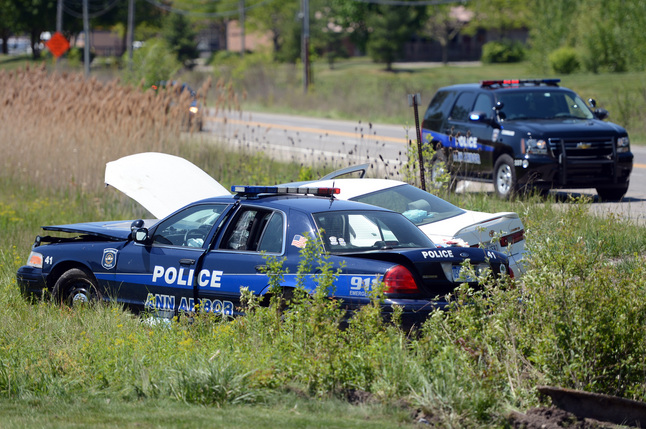
Two Ann Arbor police officers suffered minor injuries when they were involved in a car crash while responding to a shooting in May. The other driver involved in the crash said she didn't notice the emergency vehicle. Emergency responders say drivers frequently ignore them on the road.
Melanie Maxwell | AnnArbor.com
The blaring of sirens and the flashing of lights are two indicators to anyone who has ever driven a car that an emergency vehicle - be it a police car, firetruck or ambulance - is approaching.
In driver’s education class, people learn the appropriate response: Pull over to the right as much as possible and let the emergency vehicle pass. After all, it’s en route to what could be a life-or-death situation.
More specifically, state law says that if an emergency vehicle with lights flashing and sirens blaring is within 500 feet, “The driver of another vehicle shall yield the right of way and shall immediately drive to a position parallel to and as close as possible to the right-hand edge or curb of the roadway, clear of an intersection, and shall stop and remain in that position until the authorized emergency vehicle has passed, except when otherwise directed by a police officer.”
But many drivers aren’t obeying this fundamental rule of the road.
In May, two officers from the Ann Arbor Police Department were injured in an accident while responding to a shooting at North Maple Estates. The officers were westbound on Ellsworth Road near State Street when an Ohio woman in the same lane attempted to make a left turn into a car wash, directly in the path of the police car, which had its lights and sirens activated.
Both officers were taken to the hospital with minor injuries afterward. Lt. Renee Bush of the AAPD said the officers are doing fine and back on duty. There wasn't any new information to release about the Ohio woman, she added.
Why do these types of incidents occur? The consensus of the public and the agencies who respond to emergencies seems to be that some drivers are just too distracted to follow the law.
“There’s a lot of strange, erratic behavior” on the road, said Huron Valley Ambulance spokeswoman Joyce Williams. “It’s definitely a source of frustration,”
HVA paramedics say they wish there was some sort of nationwide educational program to teach - or reteach - drivers how to behave when there is an emergency vehicle approaching.
The failure to yield to police cars isn’t always intentional, though, said Sgt. Geoff Fox of the Washtenaw County Sheriff’s Office.
“I don’t think they do it on purpose,” he said. “They just don’t see the lights, don’t hear the sirens.”
Drivers are listening to the radio, eating, putting on makeup and, of course, talking on cellphones - the most notorious of driver distractions these days.
“People are doing a lot of other things in their cars,” Williams said. “Turn down the radio and start looking around.”
Sue Eckstein has noticed people not paying attention to emergency vehicles during her daily commute from her Ypsilanti Township home to the Ann Arbor bank where she works. Her route generally includes Washtenaw Avenue and Packard Road.
“I think people are too distracted when they drive,” she said. “People aren’t paying attention and not always regarding the sirens and lights. It’s bad enough to be in a situation where you have someone who is critically ill or injured, but then to have to deal with people who are totally oblivious to the rest of the world (makes it worse).”
The reality is the responders, who receive special driving instruction and take classes in how to navigate the roadways on emergency runs, are prepared for the poor driving habits of the public.
“Most first responders are so used to it; it just becomes part of your emergency tactical driving,” Fox said.
The sheer size of their trucks adds another dimension to the challenges firefighting agencies face on the road.
“Our vehicles are big and cannot maneuver very well,” said Ypsilanti Fire Chief Jon Ichesco. “We really need room to turn. We don’t stop that well.”
Ichesco said part of the problem is sirens have become more commonplace. A few decades ago, people took notice when they heard the blare of a firetruck coming, he explained. Now, the frequency of sirens is so great, the sound can seem like just background noise to drivers.
“They’re just not aware,” he said. “It’s just part of the day.”
Ichesco recalled a vehicle that crashed into an Ypsilanti firetruck near the intersection of West Michigan Avenue and Hamilton Street recently. The driver’s car suffered extensive front-end damage. The more stalwart firetruck wasn’t damaged, but the accident took the truck and firefighters out of action at a time when they could have been helping people, he said.
Pittsfield Township Fire Chief Sean Gleason said he was nearly in an accident at the intersection of West Michigan Avenue and Platt Road while responding to a fire recently. Gleason was in the department’s SUV - with lights and sirens going - attempting to get through the intersection. A vehicle that was stopped behind a line of other cars pulled out and tried driving through at the same time.
“This car decided to go around,” Gleason said. “It was very close to an accident.”
While the car narrowly missed Gleason and he got to his destination, he’s surprised there aren’t more accidents. He blames the fact that cars are more soundproof now and people just don’t notice the trucks despite their 100-watt speakers and LED lights, which are brighter than ever.
In most cases, people are not ticketed, Fox said. Police responding to an incident usually don’t have the time to stop and ticket a motorist.
“You’d have to be doing something pretty egregious,” he said.
Some people are doing more than failing to yield, however. Williams said a disturbing trend involves drivers trying to take advantage of the path cleared by emergency vehicles.
“They’ll speed up in front of the ambulance or get behind it to go faster,” Williams said.
Canton resident Stan Walewski III said he’s witnessed behavior like this.
“People just keep going,” he said. “Somebody could be in one of those ambulances and it could be a life-threatening situation. You just don’t know.”
Vincent Bonnici drives Michigan Avenue from his home in Dearborn to work in Ann Arbor every day. He said he pulls over and stops as soon as he sees an emergency vehicle. Bonnici had a message for drivers who don’t:
“They need to go to driving school,” he said.
John Counts covers cops and courts for AnnArbor.com. He can be reached at johncounts@annarbor.com or you can follow him on Twitter.
Comments
Julius
Sat, Aug 11, 2012 : 3:48 p.m.
The firs poll might have a response like this "I just wanted to use this opportunity to pass another car I wouldn't otherwise have been able to pass."
Madeleine Borthwick
Wed, Aug 8, 2012 : 7:08 p.m.
Hang. Up. And. Drive. hang-up-and-drive. hangupanddrive. HANG UP AND DRIVE!!!!!!!!!!!!!!!!!!!!!!!!!!!!!!!!! every day that i am at the bus stop, and it IS every day, I invariably see someone driving down the road w/one hand on the wheel, other hand glued to cell phone/cell phone glued to ear. I have had several near-misses while crossing the street, on MY green, IN a marked crosswalk and had to literally jump back because someone thought that that phone call was more important than anyone else's safety. if you are driving, and you receive a call, please do the following: 1) pull into the nearest side street/parking lot. 2)THEN answer the phone. If the caller has ended the call, you can (gasp!)call him/her back If you won't do any of these things, and you end up KILLING someone because of your self-centeredness, any guilt you carry around with you for the rest of your days will be nothing less than you deserve. To repeat: hang up and drive. the life you save may be mine. my children and grandkids will thank you.does this sound harsh? GOOD.
hmsp
Wed, Aug 8, 2012 : 2:32 p.m.
@ Basic Bob, re: "If we are both attempting to turn left, your method fails because we will both be waiting for each other to cross the intersection before making the turn." Why would either one of us wait? We still have to drive halfway across the intersection before we start our turns, whether we have our signals on or not. But yes, you have pointed out one instance in which my method cannot make the traffic flow more smoothly, although I still do nothing to slow it down: If faced with a left-turner who refuses to enter the intersection when it is his/her turn, all I can do is to turn on my signal, and go. But as I said before, if everybody does it right, traffic advances in pairs of two, no matter whether they are turning left, right, or going straight. My method for eliminating the confusion for less-skilled drivers really does work. Think about this the next few times you come to a busy 4-way. Watch who does it right, and who refuses to take their turn, and why. You will see that the most common cause of hesitation is the sight of an opposing left turn signal.
hmsp
Wed, Aug 8, 2012 : 1:49 a.m.
More, re 4-way-stop etiquette: What works best for me in almost all situations is to drive assertively and decisively, but not aggressively: If I am approaching a light-traffic-load 4-way stop (the kind that Soft Paw & jns131 seem to be talking about), and another vehicle is approaching on the cross street, I assess the situation — if the other car is going to arrive there first, I brake early, making this arrival differential even more obvious to the other driver. That way, even a timid driver will see me yielding the right-of-way, and they will come to a stop, then proceed, without a lot of maddening, "After you, my dear Alphonse," dancing around. I make a point of controlling the situation, which does not at all mean that I drive aggressively. That could lead to road-rage incidents. Rather, if the other driver clearly has the right-of-way, I just act like a subtle traffic cop, and wave them through with my (car) body language. Conversely, if I am clearly going to arrive at that intersection first, I accentuate that differential as well — I wait a split-second before braking, in order to pull up to the stop sign that much earlier. I then brake crisply and come to a complete stop a little short of the stop sign, well before the other car arrives. All of this is to once again ensure that there are no ties — one vehicle clearly got there first. As with the left-turn-signal BS, the goal is to cleanly ensure the smooth flow of traffic, with no hostility, and no ambiguity.
Basic Bob
Wed, Aug 8, 2012 : 3:26 a.m.
If we both pull up to the stop sign, opposing each other across the intersection, and you don't have your turn signal on, I will assume you are indicating that you are travelling directly across the intersection. If I am doing the same, we are good. If we are both attempting to turn left, your method fails because we will both be waiting for each other to cross the intersection before making the turn. Quit trying to make us read minds and clearly indicate your intent.
Frustrated in A2
Wed, Aug 8, 2012 : 1:19 a.m.
Unfortunately this happens more often then people would believe, we're just lucky we don't get more crashes involving emergency vehicles. On another note I wish people would learn how to turn into the proper lane. When you turn from the curb lane you turn INTO the curb lane, not swing wide into the next lane over. The same applies when turning left, you go into the lane furthest to the left. It's the law people and they used to teach it in driver's ed, who knows what they teach these days.
hmsp
Wed, Aug 8, 2012 : 1:10 a.m.
@ Soft Paw & jns131: Go back and do a more careful read of my post. Note that I said, "... at busy 4-way stops." In my book, "busy" starts at around 2-3 cars per stop sign, 8-12 per intersection. While, "At a 4 way stop whoever arrives first should go through first," is the rule when one or two cars are at the intersection, at a higher traffic volume, the regularly-alternating pattern of two E-W, two N-S, two E-W, two N-S settles in. You know what I'm talking about, you've been there, and at some of those intersections you have said, "Y'know, one of these days they're going to have to put a light here." Re: "It's always best to signal a turn, both for safety and courtesy," This situation is an exception to that rule, since turning my blinker on as I pull up to the stop sign serves no useful purpose — that is not information that the oncoming driver needs to know, since I have no intention of turning in front of him/her, and the only way it could affect the situation is by confusing a timid and hesitant driver into impeding the flow of traffic, as I described above. Re: "It is who ever is on the right goes first," In this situation we have four cars, each of which has a car to its right! We might as well climb out and pitch our tents in the middle of the road, no one is getting through, if we are going to simply follow that rule blindly! Re: "Then it is the nicer of the two to let the other one go first," is precisely the problem that I am trying to avoid! Please, read my post! This "nicer" approach is precisely what bogs down the traffic! Take your turn unapologetically, instead of breaking the rules, and trying to usher some other driver in first! It doesn't work!
jns131
Wed, Aug 8, 2012 : 2:35 a.m.
Thus the problem continues with irate drivers and people like you who are always in a hurry. Slow down and enjoy the drive for once.
drewk
Tue, Aug 7, 2012 : 10:12 p.m.
What did all of the texting while driving idiots do before cell phones?
Madeleine Borthwick
Wed, Aug 8, 2012 : 6:53 p.m.
apply make-up, shave, eat, adjust the radio station, pick their noses, button clothing, zip zippers, tie shoes, etc. etc. etc. stupidity has more than one outlet!
jen777
Tue, Aug 7, 2012 : 9:42 p.m.
As long as we are on pet peeves of bad driving, i get annoyed by right on red drivers who think right on red means merge into traffic as if it is a 4 way stop and it is your turn. I have been going 30 mph with the right of way only to have a car cut in front of me for a right turn on red - I was taught you wait for traffic to clear. A few seconds to 30 seconds is not too long to wait for safety.
Billy Bob Schwartz
Tue, Aug 7, 2012 : 11:39 p.m.
Jen...Oh! Are we supposed to STOP at a red light? How about at a stop sign? My observation is that many (most?) people don't stop for stop signs, and sometimes don't even slow down, esp. when making a right turn on the red or the stop sign. It's gotten so bad I'm almost afraid to stop because I will get rear-ended by someone making a right turn without stopping.
Bill
Tue, Aug 7, 2012 : 9:21 p.m.
I have often wished police cars would follow ambulances through intersections once in a while just to hand out tickets to people who do not pull over or even slow down!
jns131
Wed, Aug 8, 2012 : 3:21 p.m.
Great idea.
snapshot
Tue, Aug 7, 2012 : 9:04 p.m.
for those of us that do pull over don't you love the fact that that driver do not know the proper way to re-enter the roadway to continue on their way. It becomes a free for all.
snapshot
Tue, Aug 7, 2012 : 8:49 p.m.
People are distracted because they don't care. They can get away with being self centered and egotistical because they've been taught "they are special". Law enforcement and elected officials need to get on the ball and start ticketing drivers at stop lights for texting. There needs to be the equivelent of speed traps for illegal cell phone use, tailgaiting, improper turn signalling, stop sign running, and legislation requiring mandatory jail time for an accident while using a cell phone. These discourteous and careless drivers are far more dangerous than drunk drivers. Show these drivers just how "special" they are and put them in jail like we do drunk drivers. Folks are in an uproar over gun control and these drivers kill and injure far more innocent people and think nothing of it.
Billy Bob Schwartz
Tue, Aug 7, 2012 : 11:35 p.m.
So what are you suggesting? Should we raise taxes in order to put more peace officers on the road to do this? There have already been so many cuts in that area that adding this work will just plain not work. I think it's a great idea to ticket these people, but we have to pay for it.
BioWheels
Tue, Aug 7, 2012 : 8:14 p.m.
Just try riding your bike while everyone is texting and driving their cars @ the same time. A few weeks ago a woman yelled @ me when I asked her why she didn't stop @ the stop sign - she was texting and I'm sure she didn't even see the stop sign. If I hadn't noticed her, I'd be six feet under by now. Please! Don't text and drive!
einy
Tue, Aug 7, 2012 : 7:55 p.m.
I have specifically gone to "What Every Driver Must Know" in the past to look this up AND I have it open now... the manual says you must yield and give the right of way. To me what the law wordage and "What Every Driver Must Know" differs in instruction. If they want people to pull over and stop it must say so then it would specifically be clear to everyone. I also have specific questions regarding bike lane use but again, the driver's manual doesn't cover this. Law wordage isn't clear. Why can't it be in plain English?
einy
Wed, Aug 8, 2012 : 8:47 p.m.
snapshot: Yield does not mean stop. Yield means stop if it's not clear.
Billy Bob Schwartz
Tue, Aug 7, 2012 : 11:32 p.m.
slapshot....What does being a public employee have to do with what you said? Or is this just another gratuitous teacup cheapshot at public employees.
snapshot
Tue, Aug 7, 2012 : 9:32 p.m.
You must be a public employee use to being able to discuss everything to death . Just pull over and "yeld your right away". Not ambiquous at all.
einy
Tue, Aug 7, 2012 : 8:09 p.m.
Ooh, wait I found the one time it says stop. My bad. There is one reference to stopping in two paragraphs, it still could be more clear though.
MgoBlueMomma
Tue, Aug 7, 2012 : 7:32 p.m.
People fail to slow down for emergency vehicles as well as construction workers all the time. Its horrible! So what if you have to slow down. Its not that big of a deal. We are not SOOOOO busy in life that we have to jeopardize lives.
Ron Granger
Tue, Aug 7, 2012 : 6:38 p.m.
Why did we never hear anything more about the woman the cops hit, and the subsequent self-investigation by the police? Where is the dash cam footage? Why wasn't that released? Where is the black box data showing the speed of the police car? Flashing lights do not absolve them of their responsibility to drive safely - especially when they move into the on-coming lane of traffic to pass cars. It was suggested the police were traveling at a high rate of speed while enroute to the scene, but it was pointed out that this collission happened long after the original incident was over and the emergency had passed.
SMC
Wed, Aug 8, 2012 : 1:10 a.m.
If she failed to notice that everyone else on the road had pulled over to yield to the emergency vehicle, she has no business driving a car on public roads.
Ron Granger
Tue, Aug 7, 2012 : 11:14 p.m.
SMC, apparently you haven't bothered to consider that not every situation is exactly the same. She was making a left turn. That is a busy area, and there were likely other cars nearby, or stopped behind her. There could have been a truck or SUV behind her, blocking any view of a police car, and even contributing to the noise. How was she to know the siren was on her road, further away, or around the corner? Do we know how long the siren was engaged prior to the impact? They are often used only intermitenttly. Facts are important.
SMC
Tue, Aug 7, 2012 : 7:44 p.m.
The woman who turned was in the wrong, because anyone with common sense and their foil hat removed knows to pull over and remain stationary until a police/emergency vehicle passes. The woman who caused the accident did none of these things, and if she has a hard time noticing a car coming up with lights and sirens on, she has no business driving on public roads.
bunnyabbot
Tue, Aug 7, 2012 : 6:35 p.m.
pulling to the right for emergency vehicles to pass is important, but so is knowing when you should SLOW DOWN and get in the passing lane if emergency vehicles are pulled over on the shoulder. I'm also amazed how on the highway people either don't get over when a cop is on the shoulder or a disabled car or semi or towtruck/repair is there, if you can just move over.
Plubius
Tue, Aug 7, 2012 : 6:19 p.m.
This is one of the stupidest laws on the books and only serves to a) annoy drivers and b) pad the pockets of the municipalities how right tickets for the offenders. It has NOTHING to do with safety. When I am on a two lane road, with driveways/intersections and I see an emergency vehicle coming towards me, what possible reason is there for me to pull over? Even if I am on a road with intersections, a fire truck moving at 50+ mph cannot turn on a dime, and it should be evident if nearby intersection are possible targets for said emergency vehicle. Too many laws exist to protect those who work for us which greatly inconvenience us. Time to put some balance back into the system.
salinemom2712
Wed, Aug 8, 2012 : 3:11 a.m.
Are you serious? I read your entire post twice because I was sure there would be evidence of some attempt at humor. . . but instead I was just an annoyed driver, err I mean reader.
drewk
Tue, Aug 7, 2012 : 10:10 p.m.
So you know when the fire truck needs to turn in front of you? YOU are obviously part of the problem.
Matt Cooper
Tue, Aug 7, 2012 : 7:34 p.m.
"Too many laws exist to protect those who work for us which greatly inconvenience us." Yes! Those darn paramedics trying to get to where they're needed to save someone else's life...how dare they ask the rest of us to move out of the way! Who the heck do they think they are anyway? As for your comment about "it has nothing to do with safety"...I'm wondering if you've ever ridden in an ambulance, or driven one as part of an EMS crew, or worked on one. I'm wondering how many times you've driven a fire truck or police cruiser.. I'm guessing...never. Being formerly an EMT I have ridden many times on an ALS rig and know all too well the idiocy medics deal with each and every day by drivers who think 'this has nothing to do with safety'. Maybe you might think differently if you were the one in the back of the ambulance potentially dying because someone "Geez, I don't have to get out of his way, it might inconvenience me!". or perhaps if it was your wife, or child. Whether you think so or not, this is completely about safety.
Macabre Sunset
Tue, Aug 7, 2012 : 7:11 p.m.
Because they can operate most efficiently if they know exactly where you're going. And they can best make that assessment when your car is pulled to the side and not moving.
jns131
Tue, Aug 7, 2012 : 6:18 p.m.
Lets see, this can also include school bus drivers being cut off, texting while driving, on the cell phone and the list continues. Having a new driver in the house I remind the newbie that is it important to pull over. It could be grandma in one of those things. I always pull over, it is the ones who are always in a hurry who cause the problems. I heard about that accident. So glad everyone walked.
JRW
Tue, Aug 7, 2012 : 5:58 p.m.
It's not only distraction, like texting while driving, it's drivers who wear head phones in the car!
hmsp
Tue, Aug 7, 2012 : 5:19 p.m.
A bit off-topic here, but I have recently found a law that is much safer to break (or at least half-break) than follow: I have started to train my self NOT to use my left-turn blinker at busy 4-way stops! Against the law, sure, but MAN does it help with knucklehead drivers driving in the opposite direction! When people do it right, two opposing cars get through at the same time, alternating with two cars at right angles to them. For example, one northbound and one southbound car move though the intersection at the same time, followed by one eastbound and one westbound. Then one northbound and one southbound. Etc. Likewise, when one or both drivers want to turn left, they will both enter the intersection at the same time, IF THEY KNOW WHAT THEY ARE DOING. By the time they cross in the middle of the intersection, both cars will be in position to either continue straight, or turn BEHIND the other car. Traffic flows smoothly. That's fine, but too much of the time you get an overly-hesitant, or overly-polite, driver who decides to let an opposing left-turner go first. The left-turner, waiting patiently, and yielding the right-of way, finally gives up and turns — usually just as the other car finally decides to go. Screeches of brakes all around. If everyone is lucky, there is no fender-bender, but 4 to six cars could have gotten through the intersection in that same amount of time. And what if the left-turner simply turns? Whose turn is it now? Is that hesitant driver now going to enter the intersection? Or, having given up his/her turn, do the two cars on the cross street now go? Either way, someone will have to wait an unnecessary extra cycle. And quite often, cars from the side street will enter the intersection at the same time as the hesitant driver. More screeches of brakes. So now, I wait until the opposing driver has entered the intersection, and only then turn on my turn signal. Works like a charm every time, and traffic flows smoothly!
jns131
Tue, Aug 7, 2012 : 6:21 p.m.
Actually having a newbie on the road? It is who ever is on the right goes first. If two opposing cars approach? Then it is the nicer of the two to let the other one go first. This is the rule of the 4 way stop sign.
Soft Paw
Tue, Aug 7, 2012 : 5:48 p.m.
At a 4 way stop whoever arrives first should go through first. It's always best to signal a turn, both for safety and courtesy.
Jon Wax
Tue, Aug 7, 2012 : 4:51 p.m.
3 outta 5 motorists say: "Sor-rryy! i'll pull over when i'm done texting!!" Peace
Fatkitty
Tue, Aug 7, 2012 : 4:16 p.m.
Putting on makeup, retrieving a dropped cigarette or hamburger, yakking on the cell, texting, reading a book, reading the Nook, looking at the passenger while yakking, etc. etc etc
63Townie
Tue, Aug 7, 2012 : 3:40 p.m.
It's not only about driver distraction. This article could have been more helpful if it had included tips as to what to do if you can't safely pull over to the right.
Pete
Tue, Aug 7, 2012 : 3:55 p.m.
It was early on: pull as far to the right as you can, parallel to the traffic lane, and not blocking an intersection.
John of Saline
Tue, Aug 7, 2012 : 3:38 p.m.
I wonder if future cars might include a dashboard indication ("Emergency vehicle behind you--pull over") triggered by some sort of signal from the vehicle. Of course, if THAT got hacked....
Frank Lee
Tue, Aug 7, 2012 : 3:59 p.m.
I mentioned this technology in my comment above. It's already available. It's the same signal being sent by emergency response vehicles to manipulate traffic lights. Some radar detectors currently have the ability to receive this signal and warn you, but it should be standard equipment in all vehicles.
Robert Granville
Tue, Aug 7, 2012 : 3:34 p.m.
I once saw a man in a lexus on state ignore an ambulance to pass all the traffic before finally stopping at the eisenhower light across from shell. My roommate and I both flipped him off and yelled at him, "that could be your grandma for all you know." He proceeded to follow us for about two miles trying to get us to pull over and fight. Eventually we pulled up beside him and let him know if he wanted to fight he'd be doing so two on one. He decided following us wasn't such a great idea anymore and sped off.
jns131
Tue, Aug 7, 2012 : 6:24 p.m.
I've noticed that too. If you have the better of the car? You seem to have the better of the road. Kind of frightening if you ask me.
JRW
Tue, Aug 7, 2012 : 6:01 p.m.
Figures. In a Lexus. It's the lux drivers who feel they are above the law, by parking frequently in handicapped spots with no handicapped tags, ignoring emergency vehicles, and cutting people off on highways. They drive to their own drummer.
Ghost of Tom Joad
Tue, Aug 7, 2012 : 3:25 p.m.
that first poll question is completely useless. of course everyone thinks that THEY follow the rules, it's just everyone else that doesn't. ;)
John Counts
Tue, Aug 7, 2012 : 3:16 p.m.
I received a couple of emails from HVA personnel who wanted to make it clear they are not just "ambulance drivers," as the story originally referenced them. This term doesn't reflect their extensive training. They are better referred to as paramedics who happen to drive an ambulance. I have made the change in the story. I want to thank them for pointing this out to me and all they do for the community.
jns131
Wed, Aug 8, 2012 : 2:31 a.m.
Thank you Billy Bob. I have been called that one too. Insane was another one. But I love my job no matter what. I guess I am hoping for some cute young guys with white coats to take me away some day.
Billy Bob Schwartz
Tue, Aug 7, 2012 : 10:57 p.m.
jns...how about "masochist"?!
jns131
Tue, Aug 7, 2012 : 6:25 p.m.
I wonder what term I can use instead of school bus driver? Professional child handler? Need some thought to that one.
Woman in Ypsilanti
Tue, Aug 7, 2012 : 2:55 p.m.
Just yesterday, I was driving on Washtenaw and was stopped at a red light. Admittedly, I was daydreaming a little bit as I sometimes do at red lights. I wasn't listening to the radio but did have my windows rolled up and the a/c on. A Huron Valley Ambulance came by and I was startled by it. I didn't even hear it until it was almost passing me. I had no time to move over to the right lane. I kind of wonder if maybe the sirens need to be a little louder. I should be able to hear that siren over the fan in my car even with the windows rolled up.
BHarding
Tue, Aug 7, 2012 : 11 p.m.
If you'd just crack your window a quarter inch, you'd easily hear a siren.
hail2thevict0r
Tue, Aug 7, 2012 : 2:49 p.m.
One last thing to point out. At least in Michigan you don't need to take drivers ed after you turn 18. All you have to do is pass that joke of a written test and the physical driving test. We really need to bump up our driving requirements. People now think it's a right rather than a privilege. Every 5-10 years you should have to go through another driving class to update you on newer rules and refreshing old ones. A great example are the roundabouts. I'll be honest, when those first popped up around the area I had no idea how to treat them. It ends up being a free for all with a bunch of people who were never trained on how to deal with them just diving head first into one because they're forced to.
jns131
Tue, Aug 7, 2012 : 6:28 p.m.
Should take these 18 year olds up to the proving grounds to see if they really can handle the road. Some cannot. Trust you me, the school bus is very scary to run off the road. Good point. Everyone who starts driving? Should also go thru Segment I and II before getting the real deal. Kind of funny to be sitting with mom and day for 4 months.
Atlas Shrugged
Tue, Aug 7, 2012 : 2:38 p.m.
Several years ago I was a volunteer firefighter in a township east of Ann Arbor. I responded to a structure fire, driving a rather long, big, and unwieldy ladder truck up a major road where bicyclists often rode, and they were riding 2 and 3 abreast that evening, taking up the north-bound lanes of the road and occasionally encroaching on the south-bound lane. I had two sirens going, in addition to an air horn that even Hellen Keller would have heard (no disrespect meant). The cyclists were unphased, and there is no way they could not have heard the warnings. The cyclists didn't move over an inch to let me by, and this was on the crest of a hill on a 2 lane road where I didn't dare pass to the left. Good news? The alarm turned out to be a false alarm, so we got canceled. Even better? The Washtenaw County Sheriff department had a substation at our other fire house, where I stopped and turned around to return to my station. I reported the incident to the deputy. Although no tickets were issued to the cyclists, they got their proverbial butts chewed out, as should be the case. This issue of disrespecting or ignoring sirens has been going on too long, and there is no valid excuse for that. Although this happened awhile ago, I was so incensed that I've never forgotten the incident.
Billy Bob Schwartz
Tue, Aug 7, 2012 : 10:54 p.m.
Bikes...If you are trying not to hit some clown flying thrugh against a red light, it is probably going to be a problem to get a picture of it.
aabikes
Tue, Aug 7, 2012 : 9:16 p.m.
We're not entitled to peddle in Ann Arbor at all without required street permits. But in seriousness, JRW, pics or it didn't happen. Tired of the anecdotes.
JRW
Tue, Aug 7, 2012 : 6:05 p.m.
Lately, the bicyclists I've seen on Washtenaw and various busy streets do not obey the traffic lights at intersections and zoom right through, regardless of any traffic in the intersection, the stop signs or the lights. Bad news. I guess they feel entitled to keep peddling and not slow down at intersections like every one else.
leezee
Tue, Aug 7, 2012 : 6:04 p.m.
What planet are you from? They are bicyclists in Ann Arbor. They can do as they like. Not all...but many.
John of Saline
Tue, Aug 7, 2012 : 3:35 p.m.
Not a surprise, unfortunately. When you think red lights are advice and blaze through stop signs without pause, it's not a big leap to ignoring emergency vehicles.
LXIX
Tue, Aug 7, 2012 : 2:35 p.m.
Motorists can always get the tag number of the offending vehicle and (later) call the police. The police might then call the owner for an explanation.
jns131
Tue, Aug 7, 2012 : 6:29 p.m.
I was told by WCSD that if you get the vehicle number, description of the car and owner? Some will go to court with you to file that complaint. Trust you me, a few speeders need to be slowed down.
bunnyabbot
Tue, Aug 7, 2012 : 2:33 p.m.
part of my "driver education" was when I was little, the radio only got am stations and therefore wasn't on, there was no air conditioning so the window was often open, this was before cellphones, TVs in cars or iPods so my parents had to talk to me which often turned to "traffic" talk or question and answer time. Also, I would say that my parents were better drivers with a mini-backseat driver watching there every move. I almost got hit yesterday by a woman on her cellphone at a four way stop.
conairaa
Tue, Aug 7, 2012 : 2:31 p.m.
Does anyone else think the sirens aren't as loud as they used to be?
Billy Bob Schwartz
Tue, Aug 7, 2012 : 10:48 p.m.
Say what???
jns131
Tue, Aug 7, 2012 : 6:30 p.m.
Unless my hearing has gotten real sensitive, those things to me seem louder.
Dog Guy
Tue, Aug 7, 2012 : 5:42 p.m.
Nothing is as loud as it used to be . . . sigh.
Tom Teague
Tue, Aug 7, 2012 : 2:44 p.m.
I think cars have better soundproofing insulation and the in-car music systems are designed to fill the passenger areas with more sound. When I've heard sirens up close while outside my car, they are still ear splitting.
Frank Lee
Tue, Aug 7, 2012 : 2:28 p.m.
Many motorists fail to follow rules of the road...period. This will never change until changes are made at a government level. Start ticketing drivers who fail to follow some of the most simplistic and fundamental rules of the road. These drivers will be required to complete mandatory training and testing. Word will spread and drivers will correct their bad habits. Unfortunately, law enforcement is under staffed and only look to issue high revenue citations when they have the time to do so. We have technology available right now that will render a cell phone inoperable inside of a vehicle, disable an ignition if you fail a breathalyzer, warn you when emergency vehicles are approaching, etc. These all could be Federally mandated equipment on new vehicles. However, the almighty dollar will always be priority number one.
Frank Lee
Tue, Aug 7, 2012 : 11:29 p.m.
Billy Bob – We could toss around hypotheticals all day. How did we ever survive without cell phones? What if….you tried to use your cell phone and you had no service? Can you hear me now?
Billy Bob Schwartz
Tue, Aug 7, 2012 : 10:45 p.m.
Frank...How often does that happen? Well, three times in the past few years while I was driving, my wife called in to report a drunk driver. It's entirely unsafe to pull to the side of an expressway to make that call. Also, in one case, the drunk jerk left the expressway just after we phoned it in, so we followed off the expressway and phoned it in again, giving the exit number, and which direction the drunken jerk went on the side street. I would hate to give that up. Also, what about, say, a woman with kids who is under running attack by some road raging nut? Should she pull over to her 911 call for help? The bottom line here is this: only a driveer can control his/her driving. Even with delimiters of some sort, for a hundred bucks they can no doubt hire someone to bypass it. We really need more traffic cops and better "booster shots" for drivers ed.
Frank Lee
Tue, Aug 7, 2012 : 7:35 p.m.
Cell phone restricting technologies can range from jammers to GPS/cell-tower triangulation that disables the phone after exceeding 10 mph. I like the idea of jammers on personal vehicles for multiple reasons. Yes, this would affect passenger's cell phone use as well. Passenger's use of cell phones could be a distraction to the driver and extra sets of available eyes and ears can only make travel safer. If you need to phone in an emergency, pull over to use your cell phone. How often is that going to happen? As you stated, some radar detectors have the ability to warn you of emergency vehicles. Those detectors can be found for as little as $43. Pulling that one specific feature from the radar detector and producing it on a mass scale would drive the cost down significantly. Vehicles prices will likely rise regardless of justification. I don't see any evidence of significant vehicle price increases directly associated with other federal mandates such as seat belts, emissions, etc. In a nutshell and to answer SonnyDog09… This would come as a minor cost or inconvenience to some, but it is for a greater benefit to the majority. Vehicles have been around MUCH longer than cell phones. The two do not need to work together and are a proven safety concern when trying to do so.
SonnyDog09
Tue, Aug 7, 2012 : 6:44 p.m.
"For the greater good of society." Really? How would that work?? I don't see how keeping passengers from talking on the phone does *any* good, let alone contributes to "the greater good." Perhaps you could enlighten us?
Dave Kozina
Tue, Aug 7, 2012 : 4:52 p.m.
Frank, Some very good points made sir, but I'll have to disagree with you about it being a government mandate. Yes the technology is available, but how should it be applied? Should passengers not be allowed to use their cell phones? What if you witness an accident on the freeway, how are you going to call 9-1-1 if there is a jammer in your car? Would I love to see a device that tells you an emergency vehicle is approaching? Absolutely. I have been to a few cities where they have signs up next to their traffic lights that will light up and point in the direction that an emergency vehicle is coming from. Incorporating that technology into a small device on the dash of your car probably wouldn't be that hard, as evidenced by the number of radar detectors which are equipped to sound an alarm when an emergency vehicle is approaching. I'm just wary of the government issuing another mandate which the car manufacturers can use for justification to jack up the price of a vehicle even more.
Frank Lee
Tue, Aug 7, 2012 : 3:49 p.m.
SonnyDog09 - For the greater good of society.
SonnyDog09
Tue, Aug 7, 2012 : 3:33 p.m.
"We have technology available right now that will render a cell phone inoperable inside of a vehicle..." Why should my passenger not be allowed to talk on the phone?
Billy Bob Schwartz
Tue, Aug 7, 2012 : 2:24 p.m.
I agree with those who would like to see a new category of crime: DWO. That's Driving While Oblivious. It should be a felony, right up there with other crimes that recklesslly endanger life and limb. I mentioned in my doctor's office what I thought of texting while driving, and the receptionist blushed and said she should probably stop doing it, but it's so hard to give it up. Yeah...give it up after you kill someone. Anyhow, just remember that it isn't just drivers of motor vehicles who ignore traffic laws. It's cyclists and pedestrians, too. I always try to be aware of all that is going on around me on the road. The better to survive, my dear. Oh, and I love the folks I call Liners. They "merge" onto the expressway by following the right line, and assume that means they have the right of way to just keep going, and people have to make way for them. I also have a category I call Phone Liners. These are the people who hug the righ line on the highway, driving with one tire on the line or wandering a bit. These are almost without exception people who are on the phone. Check it out. I guess they think they are in a slot car and the slot will keep them on the road.
hail2thevict0r
Tue, Aug 7, 2012 : 2:13 p.m.
Another thing to point out is how frequently radio stations, songs and other forms of sound inside of your car are using fake sirens and things like that which desensitize people to the sound. I've noticed a few times that I've been late in missing an emergency vehicle just simply because I was listening to the radio and at first thought it was part of the show, song or commercial that I was listening to. I'm not sure what you do to stop this problem but I have noticed that it's been an issue, at least for me.
jen777
Tue, Aug 7, 2012 : 9:39 p.m.
totally agree - i am tired of radio stations and commercials using sirens. I have actually started to slow down to pull over and then realize it is the radio. we are becoming totally desensitized
LauraM
Tue, Aug 7, 2012 : 4:05 p.m.
I've always thought that radio commercials should not be allowed to have the sounds of sirens, car horns blowing or screetching tires. I've put my brakes on and looked around so many times because of a radio commercial.
John of Saline
Tue, Aug 7, 2012 : 3:32 p.m.
There is one particular song on one of my CDs that gets me every time because it has a momentary siren in it. I turn the player off, look around, then remember "oh, yeah...."
Dog Guy
Tue, Aug 7, 2012 : 2:10 p.m.
If there actually were "good drivers," they would be bad drivers who realized they were bad drivers and constantly pretended to be good drivers. As it is, there are only proudly precise drivers and smug slobs. How can anyone hear a siren over the "ta-THUMP" of their subwoofer? A driver using a cellphone is not really there. At the Secretary of State Office, I've seen people studying "What Every Driver Should Know" and arguing with the author: "Look at this, they got this all wrong!" (Not you, of course, for you have not read that booklet in decades.) Be patient and understand that imports don't have turn signals. Always scan the horizon: the life you save might be mine.
Robert Taylor
Tue, Aug 7, 2012 : 2:06 p.m.
im not sticking up for people but i see police officers use the light and sirens to go threw light just the other day a Taylor police officer went threw a light at ecorse and pardee. lights going sirens sounding and pulled right in to tim hortons to go threw the drive thur i pulled in right behide him he ordered a coffee and something to eat and as far as EMS go and any first responder goes state law is there only alound to go 10 miles over the speed limit just because your a first responder does not give you the right to drive anyway you want people have to respond to first responder too. they think they own the roads we understand their doing there jobs but what if a kid,dog,cat or just a person pops out to see whats happening there is more traffic on the roads then 10 years ago just because you drive a EMS a police car fire truck there a people that do see you until the last min and dont react and then try to move and theres someone right next to them again 1000's of more car then 10 years ago
Angry Moderate
Wed, Aug 8, 2012 : 6:51 p.m.
Yeah, I'm sure his emergency call to a bank robbery got canceled right while he was speeding through a red light into Tim Horton's.
Dave Kozina
Tue, Aug 7, 2012 : 4:32 p.m.
So let's discuss your post (and we'll leave the grammatical and spelling errors out). So you saw an officer light it up to get through an intersection. How do you know he wasn't responding to a call such as a bank robbery, home invasion, etc., which required an emergency response but not in a way which would alert the perpetrators that officers were on the way (by sounding their sirens)? How do you know that officer didn't get cancelled, and decided that he was going to take a coffee break? Too many variables involved here. Secondly, Michigan law does NOT state "10 miles over the speed limit". Michigan operates under a prima facie law, which basically states that emergency vehicles can go as fast as they want just as long that they're doing it with due regard for safety. That being said, the operator of an emergency vehicle is still responsible for the safe operation of the vehicle. They are required to make a safety stop for a red light and insure the intersection is clear before proceeding (even if lights and sirens are activated). As you said, "what if a kid, dog, cat or person pops out..." Then you better be able to stop the vehicle in a hurry. The potential hazards you mentioned apply to residential streets, and driving habits are different there compared to on the highway. Pretty sure I don't know anyone who is going to go blasting down a residential street at 70+ mph. So how do I know these things? Oh I dunno.... 12 years in emergency services, a former fire department lieutenant, and a former EVOC (Emergency Vehicle Operators Course) instructor. Do me a favor? Go right for sirens and lights. The emergency that we're responding to may be yours. These comments and views are my own and do not reflect the views of my employer.
arborani
Tue, Aug 7, 2012 : 4:31 p.m.
As with James Joyce, there is a measure of point there, if you read carefully.
Billy Bob Schwartz
Tue, Aug 7, 2012 : 2:28 p.m.
Robert Taylor...are you really James Joyce?
Tom Teague
Tue, Aug 7, 2012 : 1:45 p.m.
Oddly, when I first moved to Ann Arbor, I was struck by how many drivers actually followed the rules compared to my experiences in Atlanta where the operating principle seems to be "if the ambulance/police car/fire truck can't catch me, I don't have to pull over." When I first moved there, I thought that city services intentionally sent out a phalanx of BMW drivers to clear the roads for the emergency vehicles. The only place I've seen with greater compliance than AA is Southern California.
Tom Teague
Tue, Aug 7, 2012 : 2:37 p.m.
When I visit Atlanta now I rent a car with a full tank of gas and a damage/collision waiver, and I don't return the car until the gas or the waiver is nearly used up.
Billy Bob Schwartz
Tue, Aug 7, 2012 : 2:31 p.m.
Atlanta is the nightmare driving experience of the universe! My respiration rate just jumped thinking about it. Washington, D.C. is a delight, too, but what could be better than Atlanta: fifty lanes running all over the place, pedal to the metal, signs coming up just after you missed the turn they were identifying. Driving in that town IS an emergency.
Paula Gardner
Tue, Aug 7, 2012 : 1:18 p.m.
I just posted another poll on this story to get your sense of how often you see drivers ignoring sirens. I had an experience recently when an impatient driver (black Honda Accord) tried to get around my vehicle on the left, as I'd pulled to the far right of a left-turn lane. I could see the ambulance coming, and so could other drivers - he pulled right into its path, and the HVA driver swerved to miss it. I spent the rest of the turn cycle wondering about how foolish that driver felt - and if he knew just how lucky he was.
Jim Walker
Tue, Aug 7, 2012 : 1:15 p.m.
Yield to the emergency vehicles. Some day they may be responding to help you or someone you care about. James C. Walker, National Motorists Association, Ann Arbor, MI
mixmaster
Tue, Aug 7, 2012 : 1:08 p.m.
Since when did the law or the "rules" of the road ever pertain to drivers who feel incredibly entitled behind the wheel of their two ton lethal weapon?
Ricebrnr
Tue, Aug 7, 2012 : 1 p.m.
considering the amount of bad drivers on the road, perhaps it is time to remove this privilege from "regular" people and restrict it only to the professionals? After all we have public transportation, we don't NEED personal vehicles. Imagine the lives saved and the benefits for the Earth. Our country alone might reverse global warming. With such high stakes and benefits wouldn't we be selfish not to give up a little luxury to save our future?
Ricebrnr
Wed, Aug 8, 2012 : 1:40 p.m.
lol Macabre, I think you'll find most of my up votes are probably from those that know me and that I was proposing an analogy to certain other arguments. I agree with you why should I be restricted from owning things because other people can't or don't know or care to utilize them appropriately?
Macabre Sunset
Wed, Aug 8, 2012 : 3:39 a.m.
Why shouldn't I be free to purchase anything I like, even a Hummer H2 if I so desire? Why are only wealthier people expected to make sacrifices? You want to solve the world's problems? Lower the darned birth rate. Not sure how, but it needs to be done.
Ricebrnr
Tue, Aug 7, 2012 : 7:43 p.m.
arborani - millions of people in New York City do so daily or walk them home. I know I lived there. nothing beats shlepping 50lb sacks of rice home on the subwayu when you're in your early teens. It's character building. Macabre - ah the ole rural versus urban cente argument. Ok then compromise. If you choose to live in an urban center you can't have a car. Fair enough? Surely since we give up other liberties to live in those places this one priviledge is not much to ask.
Macabre Sunset
Tue, Aug 7, 2012 : 6:41 p.m.
Contrary to our inflated egos, the USA only comprises about 4% of the world's population. While we use much more in energy, experts are still unsure of the causes of temperature change and other experts have difficulty predicting the energy needs of emerging markets. Meanwhile, if you step outside an urban center, you might find there is still considerable need for personal transportation.
arborani
Tue, Aug 7, 2012 : 4:25 p.m.
Noble concept, until you consider getting $50-$100 worth of groceries home on a bus.
Dave
Tue, Aug 7, 2012 : 12:55 p.m.
How do I hate driving? Let me count the ways! Examples: People, including some cops (not on emergency runs), fail to signal for turns. Failure to signal lane changes. Failure to yield for emergency vehicles, as the article states. Driving 5 to 10 mph slower than the posted speed limit. People tethered to and addicted to cell phone use, whether talking or texting (close calls every time I'm on the road). Being cut off by people paying absolutely no attention to anyone/anything else on the road. People that, for some reason, can't keep their vehicle in one lane and are constantly straddling the lane divider lines. Roads in horrendous disrepair. Rain grooves on the freeways cause my vehicle to skitter all over the place (feels like I'm driving on ice). Poorly timed city traffic lights that cause me to stop at almost every block or two, forcing an excessive use of gas due to constantly stopping and starting and, yes, I'm doing the speed limit. These are just a few examples. I would gladly give up driving an automobile if a decent and prompt public transit system (Ann Arbor is the closest to that I've found in the Detroit metro area) existed. I used to enjoy driving and took pride in it. Now, it's not worth the effort, aggravation and risk.
Bryan Ellinger
Tue, Aug 7, 2012 : 8:21 p.m.
Race to the next light. Hurry up and wait. Gas is cheap!
Macabre Sunset
Tue, Aug 7, 2012 : 6:38 p.m.
The Michigan Department of Transportation was kind enough to provide a special lane for passionate believers in speed limits: it's called the right lane.
leezee
Tue, Aug 7, 2012 : 6:02 p.m.
A slow driver can be just as dangerous, if not more, than someone going too fast.
Basic Bob
Tue, Aug 7, 2012 : 4:39 p.m.
Too slow? Michigan Avenue between Platt and Saline. Under 40 in a 55 is common.
Woman in Ypsilanti
Tue, Aug 7, 2012 : 3:12 p.m.
I think it is perfectly ok to drive under the speed limit although I am kind of curious about where anyone would encounter such drivers. My experience around here is that if I am driving the speed limit or even 5-10 mph above the speed limit, most people are still passing me.
Steve Burling
Tue, Aug 7, 2012 : 1:26 p.m.
You know, it's a speed *limit*. You're not supposed to exceed it; you're not required to drive exactly that speed.
AySquared
Tue, Aug 7, 2012 : 12:44 p.m.
Of course for the "Do you pay proper attention to emergency vehicles on the road?" poll 97% of the people said "yes". From what I have witnessed the results should be 3% of the people voting "yes".
Jimmy McNulty
Tue, Aug 7, 2012 : 12:31 p.m.
When I moved to Michigan, I observed that one part of the Emergency Vehicle law differs from other states in which I have lived: Motorists must yield to Fire/Police/EMS vehicles in the other lane (oncoming). I had never encountered this before moving here.
jen777
Tue, Aug 7, 2012 : 9:36 p.m.
I too learned to drive in Ohio - always pull over both directions - you never know when the emergency responder may need to use the lane you are in. I have also lived in Texas, Illinois and California and that was the law there too.
snapshot
Tue, Aug 7, 2012 : 8:59 p.m.
I don't know of any state that does not require on coming traffic on an undivided highway to stop for passing emergency vehicles. Those emergency vehicles may have to use that oncoming lane to pass through traffic. I suspect you are mistaken in your statement.
a2susan
Tue, Aug 7, 2012 : 8:06 p.m.
I was taught to do this in Mass. where I learned to drive. Since you do not always know where the emergency vehicle is going, pulling over on both sides gives the emergency vehicle clearance if it has to turn on the opposite side from which it is driving.
jj45678
Tue, Aug 7, 2012 : 7:25 p.m.
Yes this is the strangest thing I have ever seen. An ambulance is coming the other way and people in the oncoming lane pull over (even with a double lane road. People visiting from outside michigan always have a good laugh when they see this. The other odd driving behavior is people merging 2 miles before the merge arrow on a highway.
HeimerBoodle
Tue, Aug 7, 2012 : 5:23 p.m.
It's been a long time since I had driver's ed, but I'm pretty sure that's how we were taught in IL as well.
Basic Bob
Tue, Aug 7, 2012 : 4:34 p.m.
In Ohio we were taught to stop for either direction unless there is a median. And slowing down does not help the driver of the emergency vehicle predict what you will do next. Please stop and wait until the vehicle passes.
sellers
Tue, Aug 7, 2012 : 12:21 p.m.
The poll is somewhat of weak value, I am curious to know how many would answer that they don't - as I believe most people think they do - even if they don't.
djacks24
Tue, Aug 7, 2012 : 6:08 p.m.
It is funny how 98% of 891 votes so far always do pay proper attention to emergency vehicles. Yet a combined 87% of 497 votes so far, at least sometimes see a vehicle ignoring an emergency vehicle. Ironic that nearly all the votes do the right thing, yet mostly don't see others doing the right thing as well?
Barb
Tue, Aug 7, 2012 : 12:51 p.m.
Yeah, that poll is probably one of the more pointless ones.
BHarding
Tue, Aug 7, 2012 : 12:13 p.m.
It can be noisy inside a car so I try and keep my window cracked for sirens. Don't get me started on drivers not following the rules of the road. A friend of mine claimed he didn't know it was a law that you signal to change lanes. My question is: Was getting rid of high school driver's ed such a good idea? My high school had an excellent program (Way back then) with films and discussion and constant grilling on the laws. Maybe everyone now thinks of driving as a video game?
Julius
Sat, Aug 11, 2012 : 3:42 p.m.
Unfortunately, a turn signal is an invitation to other drivers to try to prevent you from doing what your signal says you intend to do. I don't use it as a strategic decision.
dogman32
Tue, Aug 7, 2012 : 6:40 p.m.
What part of Fly's post are you not understanding? It comes from the Michigan State Police and quotes a Michigan Court of Appeals ruling on the law, MCL 257.648.
leezee
Tue, Aug 7, 2012 : 6 p.m.
Actually, I was told by a county sheriff that it is a law that you signal in order to make a turn - unfortunately, it is not a law to signal in order to change a lane. The lack of turn signal usage just exemplifies how inconsiderate people have become. It takes a second to use the signal, yet most people don't.
flyonthewall
Tue, Aug 7, 2012 : 2:38 p.m.
From the MSP FAQ's: Question: When are turn signals required to be used and does this include changing lanes? Answer: MCL 257.648states in part. "The driver...before stopping or turning from a direct line, shall first see that the stopping or turning can be made in safety and shall give a signal as required...". Common sense and state law agree that whenever you are turning, a signal is required, however, much debate has occurred over whether that language required the use of turn signals when simply changing lanes. The Michigan Court of Appeals has finally clarified the language in MCL 257.648 requiring the use of a signal when changing lanes, or "turning from a direct line." Their decision--published, and therefore binding on lower courts--states in summary "...a reasonable person of ordinary intelligence is not required to speculate about the phrase's meaning, and MCL 257.648 provides fair notice of what conduct is proscribed. We hold that MCL 257.648 requires drivers to use a turn signal when changing lanes on a highway and is not unconstitutionally vague."
Robert Taylor
Tue, Aug 7, 2012 : 2:23 p.m.
there is no law saying you have to signal to change lanes. a turn signal is for turning a court just ruled in the favor of the drivers that the officer can not give a ticket for changing lane with out signaling first the officer gave out something like 18 tickets that day and eveyone of the ticket was dismissed and the officer was told not to write any more
Billy Bob Schwartz
Tue, Aug 7, 2012 : 2:13 p.m.
MA....Or in experienced drivers!
flyonthewall
Tue, Aug 7, 2012 : 11:56 a.m.
Oh, and people, you do not have to pull over for a funeral procession, especially if it's on the other side of a divided highway!
drewk
Tue, Aug 7, 2012 : 9:57 p.m.
Well if people would pay attention to their driving, then there probably not be any crashes.
dogman32
Tue, Aug 7, 2012 : 6:53 p.m.
Exactly, Macabre. The most respectful thing to do is to continue the orderly flow of traffic. What does Michigan State Police traffic law expert Sgt. Mike Church have to say about all this? "Obviously, vehicles should be appropriately respectful of funeral processions, however, they are not required to pull over," Church said. "My grandfather recently passed away," he added. "During the funeral procession, I noticed numerous oncoming cars pulling to the right shoulder and stopping. This is not required and could be potentially dangerous." So, not only do you not have to pull over, but if you do you could cause a crash.
Macabre Sunset
Tue, Aug 7, 2012 : 6:35 p.m.
Maybe out of respect for the deceased, they should refrain from activities that may lead to an innocent stranger also becoming deceased. What is the point of a funeral procession, except for a head of state? Just drive to the funeral on your own, following the rules as you would ordinarily.
drewk
Tue, Aug 7, 2012 : 4:52 p.m.
But often it is done out of respect for the deceased and their family.
flyonthewall
Tue, Aug 7, 2012 : 1:30 p.m.
http://www.mlive.com/news/index.ssf/2011/06/traffic_talk_what_are_the_rule_1.html
flyonthewall
Tue, Aug 7, 2012 : 1:15 p.m.
Agreed that you cannot interrupt the flow of the procession, but from M.Live's own column of June 2011, not only are drivers not required to pull over but doing so may cause an accident. Traffic talk: What are the rules for funeral processions? Do drivers have to pull over? | MLive.com
City Confidential
Tue, Aug 7, 2012 : 12:27 p.m.
Actually, funeral processions do have the legal right of way if they are using funeral flags (bright orange with black symbols and the word "funeral"). The last car will have 4 flags (on all four corners of the roof of the car) to let you know that the procession has ended. You do not have to stop on the other side of a divided highway, but while driving a hearse I have seen several serious accidents happen involving funeral processions. It adds unwelcome stress to an already stressful event for the mourners.
hail2thevict0r
Tue, Aug 7, 2012 : 11:36 a.m.
You could have stopped the title at, "Many motorists fail to follow rules of the road". It's shocking to me how many people out there simply do not know, or choose not to follow, very simple traffic laws or common courtesies. On my way into Ann Arbor today there were two lights out at the Jackson, Dexter ave fork and at Huron and 7th. In both cases it seemed at least 50% of the people didn't know how to handle a light that was out. Some people just chose to blow right through it like it was a green light. Terrifying to think about.
jns131
Wed, Aug 8, 2012 : 2:24 a.m.
Try this one on for size. A school bus is stopped at Pauline and 7. The driver? A student from the hi school drops her phone and struggles to reach it. Yup, you guessed it. The driver hit the back end of the bus. Took an hour to extricate the car. Driver was fine and shaken. Again we let distraction into our cars and this happens.
Becky H
Tue, Aug 7, 2012 : 6:22 p.m.
My boyfriend was almost struck by a vehicle at Huron & 7th this morning when a woman plowed through the intersection at full speed without stopping. He jumped out of the way of the car just in time. If that driver had been struck and killed by cross-traffic, she would have deserved it. Earlier that morning (at the same intersection), we heard the unmistakable crunch of metal against metal. I don't think anyone was hurt too badly, since the accident was cleared in a few minutes.
Joe_Citizen
Tue, Aug 7, 2012 : 3:38 p.m.
Yes this is common place. Before handing out DL's the secretary of state should require a questionnaire/test at the office or through the mail, and these important questions should be on it. This will remind people of how to handle an emergency. I used to drive for a couple of taxi company's, and being a professional driver i see people doing crazy and insane stuff a lot, and it seems as though some people are trying to get into an accident for some reason, and it could be to make a claim through their coverage. When I drove for Yellow Cab is when I had several daily occurrences in which used to just baffle me. Although is was drive a giant reflective yellow pylon with lights on and an illuminated taxi sign on top, in which someone could clearly see on a pitch black night and ten miles away, decide to pull out in front of me when I clearly have the right of way, and giving me twenty feet to make a complete stop with 2 elderly people riding with me, and in the middle of the day. This happened regularly in Ann Arbor especially. It is usually a person with a cell phone pasted to their ear, or texting. I had to quit driving for a living because my road rage was getting bad, and just couldn't handle the stress of dealing with idiot drivers all day, and on a daily basis. I could not understand why this kind of thing happened all the time. Although I never had an accident, i did come close quite a few times. So I can relate with the emergency vehicle's who have the same problems when they are flashing, and blasting their sirens, and I saw they have the exact same problems as I did.