

Feds considering installing hydropower stations at Argo and Geddes dams in Ann Arbor
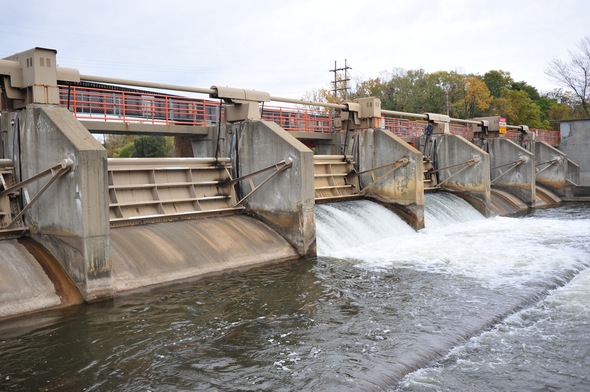
The U.S. Department of Veterans Affairs says it is strongly considering adding hydroelectricity capabilities at Argo Dam, shown here, as well as at Geddes Dam further downstream, giving hope to proponents of saving Argo Dam.
Ryan J. Stanton | AnnArbor.com
The federal government is seriously considering installing hydroelectric power stations at the Argo and Geddes dams in Ann Arbor in an attempt to boost its renewable energy portfolio, says an engineer from the U.S. Department of Veterans Affairs.
If the city and VA reach an agreement, it could be a significant game changer in the debate over Argo Dam's long-term future, boosting the odds of keeping the dam in the Huron River.
"It certainly would be one of the pieces to consider," said Council Member Sandi Smith, D-1st Ward, who has argued against removing Argo Dam. "I don't know if there's enough information at this point, but it adds another layer to an already complex dialogue."
Jeffrey Means, energy manager for the VA's Veterans Integrated Service Network based in Ann Arbor, sent a letter to Mayor John Hieftje and City Council members on Friday. In it, he expressed the VA's interest in using the two dams to power the nearby VA hospital on Fuller Road.
"The VA has determined that the project concept has some value and has taken some steps to determine if the VA believes this project merits funding," Means said, adding the decision will be made by VA officials in Washington, D.C. "VA lawyers and Army Corps of Engineers lawyers are working on this project now to determine if the VA should move forward."
The VA commissioned a study through the U.S. Army Corps of Engineers regarding the feasibility and economic benefits of installing hydroelectric power stations at Argo and Geddes — dams that started their lives nearly a century ago and once provided hydropower. The study was completed in late September, validating a previous study commissioned by the city.
Means said the project has been found to be technically feasible, and it appears to be a good opportunity for renewable power generation. In economic terms, he said, the hydropower project is better than other renewable energy projects the VA has considered, including solar photovoltaic and biomass projects and DTE Energy's Green Currents program.
Means said the study has been forwarded to the VA Central Office in Washington, D.C., and the office agrees with the technical conclusions. He said questions remain regarding legal liabilities and other issues, which are under review in Washington.
Ann Arbor City Council members say they're definitely interested in the idea of using the two dams to help the VA shift away from energy sources that rely on burning fossil fuels.
"Many unanswered questions remain, but the VA's clear and ongoing interest in hydropower at Argo and Geddes is an exciting opportunity to advance Ann Arbor's commitment to renewable energy," said Council Member Christopher Taylor, D-3rd Ward. "The building of power-generation facilities at Argo and Geddes would increase the economic and community value of dams, and, I believe, reduce the likelihood that they would be removed."
Council Member Sabra Briere, D-1st Ward and a strong proponent of keeping Argo Dam, was responsible for Friday's letter being sent by the VA after she talked with Means.
"It certainly changes the perspective of the purpose of the dam," she said. "It has the potential to be a significant game changer, but only if the feds say this is OK and we say yes."
The city owns four dams on the Huron River, including Barton, Argo, Geddes and Superior. Following a 1981 study of the hydroelectric generation potential at all four dams, the city issued bonds to restore hydropower at Barton and Superior.
Higher construction cost estimates and lower energy production potential kept the Argo and Geddes dams from being recommended for hydropower projects at the time.
The proposed hydroelectric stations at Argo and Geddes would power the VA hospital on Fuller Road. The VA's current annual electricity charges total $2.15 million. The study shows that could be reduced to $1.7 million a year — or by about $436,287 — with dedicated transmission lines running from the two dams to the hospital.
However, the upfront costs are substantial. The VA's study found it would cost anywhere from $10.8 million to $14.7 million to construct stations at both dams, depending on which options are selected. The transmission lines would cost another $1.3 million.
Factoring in another $220,000 a year for operations and maintenance of the dams, the net savings grow slimmer, and the payback period looks to be decades.
The Huron River Watershed Council, a group lobbying the city to remove Argo Dam for the environmental benefits of a naturally free-flowing river, has expressed hesitations about the VA's study, saying the cost-benefit analysis doesn't seem to show a feasible project.
"The documents get pretty technical, but from what I understand you don't do a project unless the cost-benefit ratio is one — Argo comes in at 0.33 or 0.37, and Geddes looks a bit better at 0.66 (both with a direct power line)," Laura Rubin, the Watershed Council's executive director, wrote in an e-mail to AnnArbor.com. "Neither are near having the costs equal the benefit, or in layman's term, not worth the cost."
While discussion of removing Geddes Dam has been off the table, city officials have found themselves in the middle of a fierce community debate over Argo Dam. Many environmentalists favor dam removal, while the rowing community and others have fought to preserve the dam for the recreational amenities it makes possible in the form of Argo Pond.
Meanwhile, the state has raised concerns about the stability of an earthen embankment extending from the dam, and city officials are being asked to make repairs.
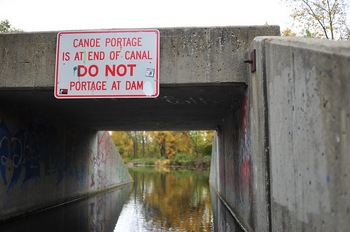
This sign at the entrance of the Argo headrace would disappear after a reconstruction project that includes eliminating the sometimes cumbersome canoe portage.
Ryan J. Stanton | AnnArbor.com
The City Council meets at 7 p.m. tonight and is expected to approve a $1.17 million reconstruction of Argo Dam's headrace and earthen embankment. The project addresses the state's safety concerns, while adding whitewater amenities and removing a portage.
A related resolution, sponsored by Council Members Carsten Hohnke and Margie Teall, directs the city administrator to fund the project without tapping into the city's water fund. City staff had proposed using $300,000 from the water fund, but an ongoing debate centers on the appropriateness and legality of spending water fund money on a recreational dam.
Additionally, the resolution directs the city administrator to find a way to fund future operations and maintenance costs for Argo and Geddes starting July 1, 2011, without continuing to tap into the water fund like the city has done for years.
The city's Environmental Commission recommended in May 2009 that city officials take steps to remove funding for Argo and Geddes from the water fund and reallocate that money to implement a Source Water Protection Plan. But the council hasn't acted yet.
An analysis by city staff shows the city expects to spend more than $3.3 million over the next two decades on maintenance and insurance for the Argo and Geddes dams. Dam-in proponents say those costs could be avoided or minimized through a hydropower agreement with the VA.
A report prepared for the city by Stantec Consulting Inc. in January 2009 showed it would cost about $1.3 million for complete dam removal.
Click here to read a report titled "Erosion Potential of the Huron River Downstream of Argo Dam Following a Dam Removal," prepared by Barr Engineering of Ann Arbor.
Ryan J. Stanton covers government and politics for AnnArbor.com. Reach him at ryanstanton@annarbor.com or 734-623-2529.
Comments
Huron River Paddler
Sun, Nov 21, 2010 : 1:28 p.m.
From the Environment Report in October 2009: Ron Corso is with the United States Society on Dams. Theres enough sites out there to dramatically increase the amount of hydropower that exists today, and the FERC has more applications in front of it than it has in twenty years. The FERC is the Federal Energy Regulatory Commission. It's the government agency that oversees dams. Corso says communities are weighing the economic costs before repairing or retro-fitting an old dam. And if the dam is small say under 20 feet tall Corso says it often is not worth the cost. THE HEIGHT OF ARGO DAM: 18 feet The best alternative energy is energy efficiency!
DonBee
Mon, Nov 15, 2010 : 10:36 p.m.
@A2Scott - Given the costs in the study, I would suspect that the VA will attach to existing poles, since most poles in Ann Arbor are already joint use (telephone, cable and electricity), so no new easement should be required. Some poles may need to be replaced to get enough height get proper separation. @Steve Bean - Most feasiblity studies are done on existing hydrodynamic models, because it take time and money to setup new equipment. I am never surprised to see studies done based on 20 year equipment, because it was in the model. I have no doubt that the equipment quoted was the newest, but the models were probably not. I do not have direct knowledge, but running the model I have based on the data I have been able to gather indicates the report is conservative. As to insurance question, the Federal Government is self insuring, so the VA will not end up paying an insurance fee. Costs for hydro-power vs. non hydro power dams for maintenance normally are all on the equipment side of the electrical generation, not the dam structure. The bigger question is how much will the city allow the pond level change in order to make power. I have no clue what any agreement will be. @braggslaw - Based on the numbers at the Energy Information Agency, Hydropower is indeed the cheapest source of energy today in the US. Note that most of the dams are fully depreciated, so only upgrades and maintenance figure in the costs. Quebec is building major new dams since that is the cheapest way to add additional power. All - As to an agreement between the city and the VA, I have no clue as to what they might work out or not. It might be a lease for a set period of time, a transfer of the dam, a joint operating agreement, or any one of many other choices. It will be up to the lawyers involved. If you want to see this happen or not happen, this is the place to either help it move forward or stop it. Without an agreement on this point the project cannot move forward.
AlphaAlpha
Mon, Nov 15, 2010 : 6:54 p.m.
It is doubtful a dedicated transmission line would run anywhere except to the grid itself. There is no need to run any new wires across town.
a2scott
Mon, Nov 15, 2010 : 6:04 p.m.
The better NPV values in the report are based on a direct transmission line. Where is this line going to be routed and at what voltage? Will it be overhead of underground? Is there a feasible route where permits or easements would be issued? I don't trust the estimated cost in the report.
AlphaAlpha
Mon, Nov 15, 2010 : 5:08 p.m.
"Dams harm rivers -- end of story." Gracious. Should we reprimand the beavers?
Georgetown Dad
Mon, Nov 15, 2010 : 4:18 p.m.
This would be awesome. I am all-in for hydro. Hydro and nuclear are the way to go.
braggslaw
Mon, Nov 15, 2010 : 3:51 p.m.
The best environmental solution is to take the dam out. That being said, let's not let environmental dogma dictate the direction. Hydro is not necessarily green and it is not cheap. In Washington they spend more money fixing the environmental damage (salmon counting etc.) than the dollars generated from the electricity. Many in Washington call the hydro-industry the salmon counting public works administration. Well reasoned financial analysis must be used for any conclusion.
Steve Bean
Mon, Nov 15, 2010 : 2:58 p.m.
Thanks, Ryan. I had missed that. It's not clear whether the VA's study includes those costs with other annual maintenance they reference. The annual maintenance category refers to various repairs and such, but not insurance. One question (if it ever became relevant, and I don't think it is yet) would be, who would pay that cost in the future? Also, would that cost be higher for a hydro dam?
Ryan J. Stanton
Mon, Nov 15, 2010 : 2:35 p.m.
@Steve Bean There's a link in the story to an analysis by city staff showing maintenance and insurance costs for Argo and Geddes. Insurance for each of the dams this year is about $17,500.
Davidian
Mon, Nov 15, 2010 : 2:33 p.m.
@DonBee: Are any of these new methods cost effective, particularly in the context of an economic crisis? I agree that dams are bad for rivers, period. However, if there is cost-effective and efficient renewable energy involved, that's an entirely different proposition.
Steve Bean
Mon, Nov 15, 2010 : 2:22 p.m.
@DonBee, why wouldn't Canadian Hydro Components quote their newest turbines? It seems that your speculation on that aspect isn't supportable. The VA isn't likely to choose both dams since they don't need to. Geddes seems to be the clearly preferable option, based on what I read in the study report. I wonder if anyone will point out the political nature of all of this at tonight's meeting. Also, the report doesn't reference insurance costs for the dams. Ryan, could you find out what those are currently?
Rork Kuick
Mon, Nov 15, 2010 : 1:30 p.m.
DonBee: It was true I was forgetting about other methods for a moment, but I think we are definitely talking about a dam here. I think the main answer to Davidian's question is that the VA is willing to loose money on this because of an energy portfolio mandate they have. The article is saying, though un-economic, it is less so than some other options like photo-voltaics and they have to pick something (their mandate is fairly near-term, so how cheap solar will get in the future may not be that influential in their decision).
Speechless
Mon, Nov 15, 2010 : 12:58 p.m.
A few dam-out advocates make an effort here to dance around the local VA hospital's federal requirement to acquire a source for renewable energy. That some form of action has to be taken by the hospital substantially changes the cost-benefit calculation, making it more desirable to consider Argo Dam as a supplemental power source in the near future. Question:  Should the VA opt to go ahead with a project at Argo Dam, might that in any way impact the plan city council will presumably vote on tonight?
DonBee
Mon, Nov 15, 2010 : 12:36 p.m.
@Davidian - Several things have changed in the last 3 or 4 years and are continuing to change: 1) Lining materials for the inflow and outflow to the turbines, reducing losses significantly 2) Efficiency of low head turbines 3) Efficiency of the smaller generators Each of these contribute to higher overall energy production and a lower cost to maintain. Canada and China have done a lot of power/re-powering of small dams and have done a huge amount of research on how to do it better. The report for the VA still does not take into account the lining materials, so the numbers for generation are conservative. If the research continues (hey Ann Arbor, want to get into a growth business?) like it is, many older, smaller dams will become useful sources of electricity. That means many more electric cars can be charged from renewable sources. @Rork Kuick - Be careful lumping all hydro power into large dams, there is a lot of work being done on "run of the river hydro" and water fall hydro, as well as seasonal run off in the mountains. None of this has any impound to it and does not disrupt the normal fisheries. The work here is mostly new and tinker quality, not industrial "improved" quality. Again an area where smart engineers and scientists could build a manufacturing company and make money and jobs.
Davidian
Mon, Nov 15, 2010 : 12:15 p.m.
If this sends the message that Ann Arbor is committing itself to green energy through action, I would say that's great. However, when you look at the cost/benefit, this sounds less like a real energy solution and more like a political badge of honor. Unfortunately, that's a very expensive bad, all things considerd. The critical question is this: if hydroelectricity was deemed inefficient at Geddes and Argo decades ago, what has changed? That's not rhetorical...what am I missing here?
Rhe Buttle
Mon, Nov 15, 2010 : 12:11 p.m.
I've got to say, I'm all for it. There will be an eventual payback period, after which the electricity cheap - neer free like some people believe. Maintenance costs will always be there. As to those who are jumping on the cost-benefit ratio, how about comparing it to the cost of electricity today, and the cost in the future. Somehow I think that has been overlooked. Its not like the taxpayers OR the government is adding the potential energy to the river, that is there to be used. So USE IT! And just like consumers, if the VA puts the hydro plant in, then sells the juice to whatever electric company, that goes to reducing their current costs.
81wolverine
Mon, Nov 15, 2010 : 11:52 a.m.
@Andy Jacobs: There isn't nearly enough available land at Ford Lake to accomodate all the extra parking, boathouse storage, and dock space to accomodate that many extra rowers. I guarantee you the school system, the parents, and the rowing clubs do NOT have the money to buy land even if it were available. Plus, it's a bad idea from the standpoint of forcing hundreds of extra round-trip commutes back and forth by parents and kids driving over there. Think of all the extra energy,time, and money that A LOT of people would have to spend - plus with all the extra miles driven would increase the risk of traffic accidents. BTW, it takes more than 10 minutes to get to Ford Lake! Conservatively, all this would cost multiples of the $70,000 per year maintenance of the dam (from Huron River Impoundment planning document). All this just to gain nebulous environmental benefits of removing one dam while keeping the upstream and downstream dams intact? Sorry, but removing Argo dam is a bad idea that will cost far more than the pro-dam removal crowd will admit. I think the hydroelectric proposal is a good idea that should be evaluated by the Federal Government. One factor the government may be looking to achieve is an emergency source of sustainable power in case the power grid is disrupted for an extended period of time. Hospitals obviously have a critical need for electricity all the time.
aareader
Mon, Nov 15, 2010 : 11:49 a.m.
Electric power by water is a Win, win, win. No Fossil fuels used and no air pollution from this source. The price of the water is stable. Over the long term the cost of making this electricity will become relatively cheaper as the price of coal, oil and natural gas rise. Ask the folks in Washington State and Saint Saint Marie, Ontario what the cost of their electric bills are. Both get a lot of their electricity from hydro electric power. The ratio sited earlier... does it take into account the long time span cost of providing electric power to the the rising costs of power from other sources. Solar and wind power can be intermittent but hydro will more stable. This is a great idea.
runnergirl
Mon, Nov 15, 2010 : 11:26 a.m.
What about MY tax dollars being used to repair an aging dam that harms the Huron River? The personal attacks lodged against Ms. Rubin are unconscionable. Let's look at the science, folks, and what we're really talking about here. Dams harm rivers -- end of story. The rowers don't want to move -- they're comfortable and they have a sympathetic ear with the Council. Let's take it to the vote of the people and really see what the taxpayers think.
Ryan J. Stanton
Mon, Nov 15, 2010 : 11:04 a.m.
Click here to read a report titled "Erosion Potential of the Huron River Downstream of Argo Dam Following a Dam Removal," prepared for the Watershed Council by Barr Engineering of Ann Arbor. It's my understanding that dam-in folks are now pointing to Section 3.2 as a description of the river training efforts that might be necessary to protect against DTE site overflow.
Rork Kuick
Mon, Nov 15, 2010 : 10:58 a.m.
Hydropower is renewable and clean, but hardly "green". If you care about the river's ecology and services at least. From that perspective dams are abominations, anti-green. The VA may be willing to loose money on this, but don't count on them or the Army Corps to be good stewards of the river. Or the Ann Arbor council or mayor for that matter, but at least you have some control over their actions. Don't just sell the river.
abc
Mon, Nov 15, 2010 : 10:55 a.m.
Alan, have you read the study? Are you saying that you think this study has justified the cost? How should we read the analysis found at the bottom of page 12 of 22 in the report? I think everyone who comments on the feasibility, or lack thereof, of this proposal should note whether or not they read, or even looked at, the study. I skimmed the costs pages but will certainly look more carefully when I have time.
xmo
Mon, Nov 15, 2010 : 10:22 a.m.
Just think the VA could help save the Planet! Of course, the Army Corps of Engineers would be involved which might cause some of the Libs in AA to turn the project down. Let The VA get power from the river!
alan
Mon, Nov 15, 2010 : 10:16 a.m.
I hate to be a fuss, but Ms Rubin's 'layman' comment suggests that she doesn't understand. She is actually referring to benefit-cost ratio, not cost-benefit. There is a big problem when people who don't understand the problem are in a position to influence decisions. It is just plain irritating when they pretend to know better. Oh wait, this is America.
Ryan J. Stanton
Mon, Nov 15, 2010 : 10:16 a.m.
Further analyzing the issue, if the VA wants to merely meet the minimum renewable requirements, it could go with Option 1 on Argo (where the hydro facility would be placed near the left abutment) at a cost of about $5.5 million (which factors in a $1.1 million contingency), and then go with one of two options: (1) send the power directly back to the grid by selling it to DTE Energy and offset annual energy costs by $104,122, or (2) spend an extra $781,000 up front on a transmission line to directly power the facility and save $159,870 a year on energy costs. But either way, there's still an estimated cost of $110,000 a year for maintenance.
Gfellow
Mon, Nov 15, 2010 : 10:04 a.m.
In a world where energy resources become increasingly networked into large co-dependent conglomerations, local electrical generation makes for really good insurance. If one may recall the three day national power failure half a decade ago, the concept of locally generated energy makes a lot of sense. From the numbers I read in the article, it seems the project would pay for itself over about three decades, and having the independent system in-town is a great plus. I'm all for it.
Soothslayer
Mon, Nov 15, 2010 : 9:59 a.m.
This statement from http://arborwiki.org/city/Argo_Dam is either incorrect or quoted incorrectly: "Arguments against the destruction of the dam include the fact that an entire community of over 600 rowers would be forced to commute to Belleville." EMU Eagles and Saline Crew have been on Ford Lake for years with great program success (maybe theres an advantage practicing @ Ford?). About as good of a rowing lake as you can find anywhere (long and narrow). If Saline & EMU can make the trek here why not Huron, Pioneer & UM? Then they can build the boathouse/ERG facility they've been planning. 10 min drive at most for 2 straight miles of rowing? Whats the issue here? I don't believe Ypsi has cooties (last time I checked).
Ryan J. Stanton
Mon, Nov 15, 2010 : 9:50 a.m.
And from Section 3.5, which touches on the requirements for the VA hospital to comply with the Energy Policy Act of 2005: "The VA Ann Arbor HCS is part of the VA VISN 11 integrated service network which requires compliance with the Energy Policy Act of 2005 and the E.O. 13423 requirement for 7.5 percent renewable energy. Using the electricity billing statements that were provided from April 2009 to April 2010, the average annual energy consumption was about 24,066 MWh. To satisfy the 7.5 percent renewable energy requirement, the average annual generation from Geddes and/or Argo would have to be at least 1,805 MWh. The generation estimates used in this study indicate that the average annual generation would range from approximately 2,002 MWh (Argo-Option 1) to 3,358 MWh (Geddes). As a result, development of a hydropower facility at either dam site would be sufficient to meet the renewable energy requirements, provided the 2009 electricity usage is representative of future energy consumption."
Ryan J. Stanton
Mon, Nov 15, 2010 : 9:46 a.m.
From Section 2.1 of the VA report: "Based on our review of the proposed locations of the powerhouses, for Geddes Dam, we agree that from a hydraulic and constructability standpoint, the preferred powerhouse location would be between the two existing spillways. For Argo Dam, the east abutment is the preferred location for a powerhouse. Placing the powerhouse at the end of the millrace would eliminate the canoe portage and does not appear to be practical."
braggslaw
Mon, Nov 15, 2010 : 9:42 a.m.
If it makes economic sense and we are stuck with the dam... fine. BUT I don't want to be paying quadruple per kw/hr. (which is what this may pencil at) I don't want this to be another feel-good green project with no tangible economic benefit other than to say we have "hydro-power" what ever the heck that means.
DeeDee
Mon, Nov 15, 2010 : 9:29 a.m.
Restoring power generation at Argo and Geddes dams - what a great plan! Ann Arbor can and should be leading in increasing renewable energy generation and usage. This is a chance to walk the talk by taking an existing recreational resource and expanding it to a renewable energy resource. Even better, put up some posters about the history of hydropwer in these locations, and about hydro-generation, and make it an educational resource as well! These would be great places for school children to see renewable generation in action, and for the many community members who use these walking paths to learn something about it as well. Here's hoping the VA and community move forward together on it.
Soothslayer
Mon, Nov 15, 2010 : 9:25 a.m.
nope. DNR, HRWC and econonimic studies show that Argo dam needs to be taken down. other places nearby to row that are more suitable & better all around. just rip the bandaid off already
John of Saline
Mon, Nov 15, 2010 : 9:13 a.m.
Weren't both of those dams hydroelectric a long time ago? There's an old power station on the Argo headrace at the obvious location of a turbine. I thought Geddes also used to generate power.
scooter dog
Mon, Nov 15, 2010 : 8:16 a.m.
There is nothing wrong with the present VA hospital. If there were then why do veterans come from up to 350 miles away to be treated here. I am a veteran and talking to out of state veterans the reason most of them make the long drive is because of the up to date modern hospital and excellent care they receive
DonBee
Mon, Nov 15, 2010 : 8:08 a.m.
All Federal facilities are required to get a portion of their electricity from renewable sources. They have no choice, it is in the 2007 and 2009 Energy Acts. So the VA needs to find a solution. To Ms. Rubin's point on cost benefit ratios. In this case it is not purely do something or not, but rather, which has the higher result of the available choices. The offset of costs is not from their current electric bill, but rather from the cost of putting in or buying renewable energy. This one has some advantages over others: 1) It is usable at times when wind and solar are not 2) The price of the energy is fixed, rate increases over the life of the equipment will not impact the power from this source 3) It has a lower initial cost than putting in enough Photovoltaic to make the same amount of energy over a 24 hour period 4) It is reasonably close to the VA 5) Newer turbines for low head applications have been developed over the last few years and what gets installed will probably offer more power than the study shows 6) Most hydro facilities have a life span measured in multiple decades 40 to 60 years is a better life span for the structures, and 30 years for the turbines, longer for the turbines, but with changes in technology, 30 years is about when it makes sense to replace them for more efficiency. So the cost side is higher than it should be. 7) Because the dams exist, it is the closest to invisible that any of the choices the VA has. It also has some disadvantages: 1) Some folks in Ann Arbor will protest anything other than removal of the dams 2) It has a high initial cost 3) It will require new skills in the maintenance department at the VA 4) It will mean the VA will become responsible for the Dams 5) The level of the ponds may change more over the year as the dam makes power I would suspect there would be larger protests if the VA proceeds with a biomass plant, burning wood or trash, which is the other reasonable option given their location. It would have about the same initial cost, but then several large trucks a day would have to arrive at the VA full of fuel for the biomass plant. They could buy from DTE or someone else, but then would be subject to changes in market price. Even long term Power Purchase Agreements have riders that would allow the price to change. Given the law that the VA operates under, I would say this is a win-win for almost everyone. But I will leave it to you to make your own decision. Without removing the legal requirements the VA operates under, they have to do something.
David Cahill
Mon, Nov 15, 2010 : 8:05 a.m.
Hydro at Argo. What a neat idea!
My2bits
Mon, Nov 15, 2010 : 7:51 a.m.
A very good article. Another bad poll at the end. Ann Arbor.com - are you listening? I would suggest removing your polls. How about a readers revolt against bad polls!
A2.com.user
Mon, Nov 15, 2010 : 7:48 a.m.
While watching the recent public comments on the Argo Dam I heard one individual, who was one of the original builders of the dam, state that the recurring flooding on Depot Street and Summit Street was prevented from getting worse because of the Argo Dam The flooding on Depot and E. Summit Street, which happens after every heavy rainfall, is not related to the dam or the river. The flooding on these two streets is because Depot and E.Summit St. are at the base of large hills which drain from downtown ( Main St.) and W.Summit Street The flooding is caused by the inability of this water to drain back into the river because of inadequate drainage systems under E. Summit and Depot Street, also the railroad tracks and development along the river on Depot Street have altered and block the natural drainage field of the water coming down these large hills which Main Street and E.Summit Street are built on. Two years ago, after serious flooding on Summit Street, the drainage systems were repaired but the repairs were not adequate and need to be done again because E. Summit and Depot Street still flood severely after heavy rainfall. I recently sustained serious damage to my car from the last flooding and had to total out my car. (I live on E.Summit Street). From what information I''ve been able to gather the idea of dams controlling flooding is largely a myth since back-up flooding behind dams can be as serious as flooding in front of dams. This back-up flooding is caused by water not being able to drain quickly down the river and out to a bigger lake, river or ocean because of dam blockage. ( just look at the massive flooding on the Indus River in Pakistan this year.....the Indus River is heavily dammed, dredged, diverted, levied and channelized ). Dams dry-up downstream riverside floodplains/marshes which are highly beneficial to wildlife. This allows development on those riverside floodplains. The floodplain developments then becomes highly vulnerable to flooding when heavy rainfall overcomes the upstream dam. It seems that rooftop solar or other means would be better for the V.A. to fulfill it's renewable energy portfolio without further altering the eco-system of the Huron River. Multiple dams on the Huron River are blocking fish spawning/fish migrations which come up from Lake Erie, which the Huron River drains into. Developing Hydro-power on the Huron River basically means these eco-system damaging dams will likely never be removed. The small amount of electricity generated by these small dams could be easily generated by other means or through conservation measures.
Brad
Mon, Nov 15, 2010 : 7:35 a.m.
I agree that the Courts-Police building and accompanying kiddie pool are a huge waste, but this sounds like one as well. How is a money-losing proposition "win-win"? Sounds like a "Hey Look How Green We Are!" showcase project that we can't afford in this economy. I looks better at.66? That just means that you only throw away 34 cents of every dollar then. Win-win??
5c0++ H4d13y
Mon, Nov 15, 2010 : 6:23 a.m.
If the VA has that kind of money to slosh around it would be better spent on upgrading the hospital rather than meeting some bogus "renewable energy portfolio".