

Ann Arbor students receive honorable mention in NASA space settlement design contest
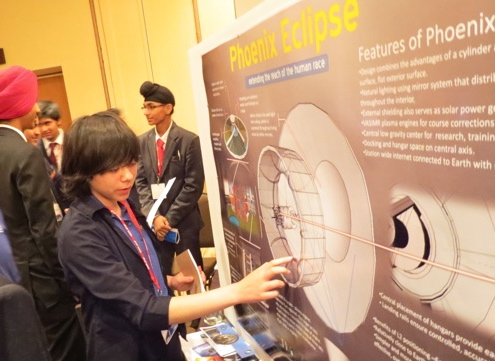
Honey Creek Community School student Laria Reynolds explains the geometry of the space station to a conference attendee. The space station was designed as a combination of a cylinder and a torus shape.
From Cheryl Quinn
Throughout the course of seven months, eighth-graders William Brighton, Laria Reynolds and Alexander Quinn, and seventh-grader Matthew Koziol wrote a 54-page proposal, rich with 3-D sketches and ideas for blocking neutron and gamma radiation from the sun.
The quartet of young scholars from Honey Creek Community School, an Ann Arbor charter school with a population of about 240, entered NASA’s Space Settlement Contest to challenge themselves and earned “Honorable Mention” alongside teams from New York, India and Romania.
The group worked every Friday for three to four hours. And when January came, they added another two to three hours during the week and usually one eight-hour day on the weekend, prior to submitting their proposal by the March deadline.
The group and their parents also were asked to participate in the International Space Development Conference (ISDC) in Washington, D.C., where they created a large-scale poster outlining the details of their space colony, dubbed the Phoenix Eclipse Space Settlement, and gave mini presentations to other students in grades six through 12, business professionals and NASA engineers.
After receiving their Honorable Mention Award at the conference, the Ann Arbor students were invited to the office of Congressman Tim Walberg, R-Michigan, for a Capitol tour.
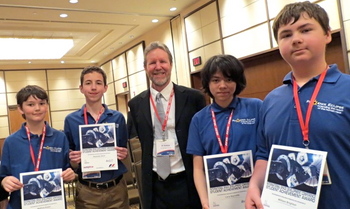
A team of four Ann Arbor-area students, from left, Matthew Koziol, Alexander Quinn, Laria Reynolds and William Brighton, pose with NASA's Al Golbus, center, founder of the contest, after receiving their "Honorable Mention" awards for their NASA space colony proposal.
From Cheryl Quinn
The Honey Creek students also had to consider all aspects of sustaining life in space when designing their settlement and writing their proposal, said Cheryl Quinn, mother to Alexander Quinn, who oversaw the students’ project.
“The engineering of it, the physics behind how do you actually get this thing into orbit, the living in space aspect, what government would you put in place on it, what does it look like — everything,” Cheryl Quinn said. “There was also an agricultural component. The kids studied hydroponics and artificial lights and how to feed these people (in the space colony). They had to think about transportation to and from the space station and communications.
“NASA doesn’t even have it all figured out yet, so it was inspiring to see what these kids can come up with that people in the field didn’t even think of.”
Alexander said the biggest challenge of the project was coming up with a method for effectively protecting the space station from solar radiation.
“Radiation is a pretty bad thing here on Earth and yet we have the Earth’s atmosphere and magnetic field to protect us,” Alexander said. “In space, there isn’t anything like that and, especially over long periods of time, it can be really harmful.”
The plan the students came up with was using denser materials, such as tungsten and lead, to protect against gamma radiation and “slowing down” neutron radiation with boron and polyethylene, Alexander said, adding the group did a significant amount of research and had about two pages of citations in their proposal.
But, “this stuff” — space exploration, sustaining life in space and chemical properties — is not foreign to Alexander.
“I like to read. A lot,” the eighth-grader said with a chuckle.
Right now, he is reading “The Elegant Universe” by Brian Greene, which is about string theory, relativity and quantum mechanics, Alexander said. “It’s a pretty good read.”
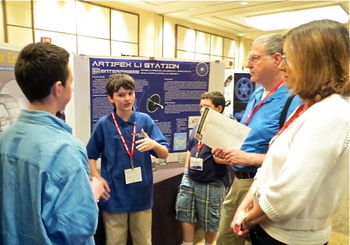
Matthew Koziol, center, explains the intricacies of his team's space station design to conference attendees in Washington, D.C. at the end of May.
From Cheryl Quinn
He said you never know who is learning from you and what ideas may stick unless you are willing to take the risk.
There were about 40 teams that attended the International Space Development Conference in Washington, D.C., Cheryl Quinn said, most of the teams were from India, China, Singapore, Turkey and other countries across the world.
“The students compared notes and had debates. It was really great. … We were all really proud of them,” Quinn said. “It was inspiring for our kids to see these kids that came from all over the world, and showed (our students) they better be sharp on their toes because these (international) kids were very good with English and had very good ideas.”
The Honey Creek group entered a similar NASA contest last year, called the Waste Limitation Management and Recycling Design Challenge. They received an Honorable Mention Award in this contest as well. The challenge, which was for grades five through eight, involved constructing a working model of a water recycling system that could be used in space.
Staff reporter Danielle Arndt covers K-12 education for AnnArbor.com. Follow her on Twitter @DanielleArndt or email her at daniellearndt@annarbor.com.
Comments
LXIX
Sat, Jul 7, 2012 : 11:50 p.m.
Didn't Tim Walberg vote for H.R. 5326 - the CJS Appropriations Bill cutting $1.6 billion in spending? The "S" in "CJS" stands for Science programs like the NASA budget. These are gifted kids. May they live long and prosper on planet Earth.
jns131
Sun, Jul 8, 2012 : 12:14 p.m.
It was part of the Obama tax cut method to fund Obama care. This is why we use the Russians to get stuff to and from our astronauts.
Harm
Sat, Jul 7, 2012 : 7:54 p.m.
Well done, students!
Dave Koziol
Sat, Jul 7, 2012 : 3:09 p.m.
Great job Matthew, Alex, Will and Laria, we are all very proud of your hard work. Thanks so much Cheryl for all your hard work supervising the kids. Thanks to Honey Creek for helping the kids get to DC. And thanks to sewmi.com for the embroidered shirts.
DNB
Sat, Jul 7, 2012 : 1:39 p.m.
Great job, students; I'm sure your parents are very proud of you all. Keep reaching for the stars!
bluetonguedlizard
Sat, Jul 7, 2012 : 1:08 p.m.
Way to go kids!
jns131
Sat, Jul 7, 2012 : 12:55 p.m.
Wow, this is awesome. I know one of the boys from long ago. Did not know he was in middle now. Good luck to all the boys. Maybe one day we might actually see them up there.