

Downtown Opportunities: Selling Ann Arbor's city-owned properties for urban residential development

More Galleries
 The Lunch Room does vegan food in a way that even non-vegans can enjoy
 Images from Dawn Farm's 40th Anniversary Jamboree
 See photos from Kerrytown BookFest
 Images from Michigan's 41-30 win over Notre Dame under the lights
About this slideshow: The slides with comments are the opinions of Doug Kelbaugh, but the actual design proposals for the three sites were done by Kelbaugh's graduate students at the University of Michigan in their design studio course. This introduction slide gives the first of three rationales for a plaza — rather than a park — on the city-owned Library Lot at the corner of Library Lane and Fifth Avenue in downtown Ann Arbor.
-
 About this slideshow: The slides with comments are the opinions of Doug Kelbaugh, but the actual design proposals for the three sites were done by Kelbaugh's graduate students at the University of Michigan in their design studio course. This introduction slide gives the first of three rationales for a plaza — rather than a park — on the city-owned Library Lot at the corner of Library Lane and Fifth Avenue in downtown Ann Arbor.
/calendar/photologue/photos/CWS Slideshow/cache/CWS_slideshow_001_fullsize.jpg
About this slideshow: The slides with comments are the opinions of Doug Kelbaugh, but the actual design proposals for the three sites were done by Kelbaugh's graduate students at the University of Michigan in their design studio course. This introduction slide gives the first of three rationales for a plaza — rather than a park — on the city-owned Library Lot at the corner of Library Lane and Fifth Avenue in downtown Ann Arbor.
/calendar/photologue/photos/CWS Slideshow/cache/CWS_slideshow_001_fullsize.jpg
-
 Second of three rationales for a plaza rather than a park on the Library Lot at the corner of Library Lane and Fifth Avenue in downtown Ann Arbor.
/calendar/photologue/photos/CWS Slideshow/cache/CWS_slideshow_002_fullsize.jpg
Second of three rationales for a plaza rather than a park on the Library Lot at the corner of Library Lane and Fifth Avenue in downtown Ann Arbor.
/calendar/photologue/photos/CWS Slideshow/cache/CWS_slideshow_002_fullsize.jpg
-
 Third of three rationales for a plaza rather than a park on the Library Lot at the corner of Library Lane and Fifth Avenue in downtown Ann Arbor.
/calendar/photologue/photos/CWS Slideshow/cache/CWS_slideshow_003_fullsize.jpg
Third of three rationales for a plaza rather than a park on the Library Lot at the corner of Library Lane and Fifth Avenue in downtown Ann Arbor.
/calendar/photologue/photos/CWS Slideshow/cache/CWS_slideshow_003_fullsize.jpg
-
 Red line is Downtown Development Authority boundary and green line denotes Connecting William Street area where the city and DDA officials are considering future redevelopment opportunities of city-owned properties; rose-colored patches are city-owned lands, primarily parkland.
/calendar/photologue/photos/CWS Slideshow/cache/CWS_slideshow_004_fullsize.jpg
Red line is Downtown Development Authority boundary and green line denotes Connecting William Street area where the city and DDA officials are considering future redevelopment opportunities of city-owned properties; rose-colored patches are city-owned lands, primarily parkland.
/calendar/photologue/photos/CWS Slideshow/cache/CWS_slideshow_004_fullsize.jpg
-
 An award-winning University of Michigan architecture graduate student project showing a plaza in front of a mixed-use building on the Library Lot, which consists of a 15-story residential tower over a 4-story base of retail/restaurants on the plaza and mixed use on floors 2-4. The perspective is looking northeast from the Fifth Avenue sidewalk in front of the library, with Library Lane on right.
/calendar/photologue/photos/CWS Slideshow/cache/CWS_slideshow_005_fullsize.jpg
An award-winning University of Michigan architecture graduate student project showing a plaza in front of a mixed-use building on the Library Lot, which consists of a 15-story residential tower over a 4-story base of retail/restaurants on the plaza and mixed use on floors 2-4. The perspective is looking northeast from the Fifth Avenue sidewalk in front of the library, with Library Lane on right.
/calendar/photologue/photos/CWS Slideshow/cache/CWS_slideshow_005_fullsize.jpg
-
 A raised pedestrian “street” connecting the Library Lot plaza to a park in center of the block and on to Liberty Plaza. This raised “street” bridges over the parking garage entrance/exit lanes, and has residential and office and cultural institutional uses fronting it.
/calendar/photologue/photos/CWS Slideshow/cache/CWS_slideshow_006_fullsize.jpg
A raised pedestrian “street” connecting the Library Lot plaza to a park in center of the block and on to Liberty Plaza. This raised “street” bridges over the parking garage entrance/exit lanes, and has residential and office and cultural institutional uses fronting it.
/calendar/photologue/photos/CWS Slideshow/cache/CWS_slideshow_006_fullsize.jpg
-
 Looking back toward the west, with the green hillside spilling out from the end of the pedestrian “street,” and showing path in foreground that connects to Liberty Plaza. The hillside also would connect to Library Lane to the left and provide a quiet park at the center of the block.
/calendar/photologue/photos/CWS Slideshow/cache/CWS_slideshow_007_fullsize.jpg
Looking back toward the west, with the green hillside spilling out from the end of the pedestrian “street,” and showing path in foreground that connects to Liberty Plaza. The hillside also would connect to Library Lane to the left and provide a quiet park at the center of the block.
/calendar/photologue/photos/CWS Slideshow/cache/CWS_slideshow_007_fullsize.jpg
-
 This site plan shows an approximately 90’x100’ plaza with trees around the perimeter and the ground floor plan, which has retail, eateries and a cultural space such as the Ark. Fifth Avenue is on the left, Library Lane at bottom, and park is in green on right.
/calendar/photologue/photos/CWS Slideshow/cache/CWS_slideshow_008_fullsize.jpg
This site plan shows an approximately 90’x100’ plaza with trees around the perimeter and the ground floor plan, which has retail, eateries and a cultural space such as the Ark. Fifth Avenue is on the left, Library Lane at bottom, and park is in green on right.
/calendar/photologue/photos/CWS Slideshow/cache/CWS_slideshow_008_fullsize.jpg
-
 Another student project, showing view down to plaza on Library Lot from apartments, condos or hotel rooms. Wooden deck for residents in foreground is atop a restaurant opening onto the plaza.
/calendar/photologue/photos/CWS Slideshow/cache/CWS_slideshow_009_fullsize.jpg
Another student project, showing view down to plaza on Library Lot from apartments, condos or hotel rooms. Wooden deck for residents in foreground is atop a restaurant opening onto the plaza.
/calendar/photologue/photos/CWS Slideshow/cache/CWS_slideshow_009_fullsize.jpg
-
 Looking southwest from plaza across Fifth Avenue toward new AATA Blake Transit Center and proposed housing on former YMCA site on William Street. (Fifth Avenue is depicted in the abstract as white.)
/calendar/photologue/photos/CWS Slideshow/cache/CWS_slideshow_010_fullsize.jpg
Looking southwest from plaza across Fifth Avenue toward new AATA Blake Transit Center and proposed housing on former YMCA site on William Street. (Fifth Avenue is depicted in the abstract as white.)
/calendar/photologue/photos/CWS Slideshow/cache/CWS_slideshow_010_fullsize.jpg
-
 The former YMCA site at corner of Fifth and William show with 19-story, 15-story and 4-story residential towers with retail shops and offices along William Street and Fourth Avenue, and shared courtyard in the center.
/calendar/photologue/photos/CWS Slideshow/cache/CWS_slideshow_011_fullsize.jpg
The former YMCA site at corner of Fifth and William show with 19-story, 15-story and 4-story residential towers with retail shops and offices along William Street and Fourth Avenue, and shared courtyard in the center.
/calendar/photologue/photos/CWS Slideshow/cache/CWS_slideshow_011_fullsize.jpg
-
 Another student project with low- and mid-rise housing on former YMCA site, with shared court and daycare center adjacent to Blake Transit Center.
/calendar/photologue/photos/CWS Slideshow/cache/CWS_slideshow_012_fullsize.jpg
Another student project with low- and mid-rise housing on former YMCA site, with shared court and daycare center adjacent to Blake Transit Center.
/calendar/photologue/photos/CWS Slideshow/cache/CWS_slideshow_012_fullsize.jpg
-
 Westward view of William Street frontage, with retail space and grocery store fronting Fourth Avenue. Existing parking garage use beyond, across Fourth Avenue
/calendar/photologue/photos/CWS Slideshow/cache/CWS_slideshow_013_fullsize.jpg
Westward view of William Street frontage, with retail space and grocery store fronting Fourth Avenue. Existing parking garage use beyond, across Fourth Avenue
/calendar/photologue/photos/CWS Slideshow/cache/CWS_slideshow_013_fullsize.jpg
-
 The Ashley and William parking lot, also known as the Kline Lot, is a city-owned property to the west of Main Street that is being examined for potential redevelopment.
/calendar/photologue/photos/CWS Slideshow/cache/CWS_slideshow_014_fullsize.jpg
The Ashley and William parking lot, also known as the Kline Lot, is a city-owned property to the west of Main Street that is being examined for potential redevelopment.
/calendar/photologue/photos/CWS Slideshow/cache/CWS_slideshow_014_fullsize.jpg
-
 Aerial view of student model, looking east over the site to Main Street, the Fourth and William parking garage and beyond. The project is split into two mixed-use complexes by a pedestrian passage that crosses the alley and connects to a new plaza proposed along Main Street.
/calendar/photologue/photos/CWS Slideshow/cache/CWS_slideshow_015_fullsize.jpg
Aerial view of student model, looking east over the site to Main Street, the Fourth and William parking garage and beyond. The project is split into two mixed-use complexes by a pedestrian passage that crosses the alley and connects to a new plaza proposed along Main Street.
/calendar/photologue/photos/CWS Slideshow/cache/CWS_slideshow_015_fullsize.jpg
-
 Looking west through proposed plaza on Main Street to alley and pedestrian passage to Ashley Street. This would be a “pool” of public space as counterpoint to the linear public sidewalk of Main Street.
/calendar/photologue/photos/CWS Slideshow/cache/CWS_slideshow_016_fullsize.jpg
Looking west through proposed plaza on Main Street to alley and pedestrian passage to Ashley Street. This would be a “pool” of public space as counterpoint to the linear public sidewalk of Main Street.
/calendar/photologue/photos/CWS Slideshow/cache/CWS_slideshow_016_fullsize.jpg
-
 A view south along the alley between William Street and Liberty Street, enlivened with shops on the left and residential above.
/calendar/photologue/photos/CWS Slideshow/cache/CWS_slideshow_017_fullsize.jpg
A view south along the alley between William Street and Liberty Street, enlivened with shops on the left and residential above.
/calendar/photologue/photos/CWS Slideshow/cache/CWS_slideshow_017_fullsize.jpg
-
 The same project as seen from Ashley Street, looking north toward Liberty Street, with larger footprint retail below housing.
/calendar/photologue/photos/CWS Slideshow/cache/CWS_slideshow_018_fullsize.jpg
The same project as seen from Ashley Street, looking north toward Liberty Street, with larger footprint retail below housing.
/calendar/photologue/photos/CWS Slideshow/cache/CWS_slideshow_018_fullsize.jpg
-
 This student project shows three towers on the same site, with a wider plaza separating the market-rate residential tower fronting William Street from the moderate-income residential tower to the north. The third tower is proposed as the most affordable housing.
/calendar/photologue/photos/CWS Slideshow/cache/CWS_slideshow_019_fullsize.jpg
This student project shows three towers on the same site, with a wider plaza separating the market-rate residential tower fronting William Street from the moderate-income residential tower to the north. The third tower is proposed as the most affordable housing.
/calendar/photologue/photos/CWS Slideshow/cache/CWS_slideshow_019_fullsize.jpg
-
 Like the housing in all the projects, it is a complex packing of studio, 1-bedroom, 2-bedroom and 3-bedroom units to yield greater interior variety and more varied facade designs. In this case, each tower has a different mix both spatially and in price points or rents.
/calendar/photologue/photos/CWS Slideshow/cache/CWS_slideshow_020_fullsize.jpg
Like the housing in all the projects, it is a complex packing of studio, 1-bedroom, 2-bedroom and 3-bedroom units to yield greater interior variety and more varied facade designs. In this case, each tower has a different mix both spatially and in price points or rents.
/calendar/photologue/photos/CWS Slideshow/cache/CWS_slideshow_020_fullsize.jpg
-
 A model of the project, showing the plaza with the Ark or some other entertainment venue. There is an arcade connection across the alley through to Main Street. Larger footprint retail would front Ashley Street, with semi-private decks for residents above.
/calendar/photologue/photos/CWS Slideshow/cache/CWS_slideshow_021_fullsize.jpg
A model of the project, showing the plaza with the Ark or some other entertainment venue. There is an arcade connection across the alley through to Main Street. Larger footprint retail would front Ashley Street, with semi-private decks for residents above.
/calendar/photologue/photos/CWS Slideshow/cache/CWS_slideshow_021_fullsize.jpg
-
 A photomontage of how the 14-story towers would look from the southeast.
/calendar/photologue/photos/CWS Slideshow/cache/CWS_slideshow_022_fullsize.jpg
A photomontage of how the 14-story towers would look from the southeast.
/calendar/photologue/photos/CWS Slideshow/cache/CWS_slideshow_022_fullsize.jpg
-
 The red line shows the approximate alignment of a possible pedestrian way all the way from the Liberty Lofts and the proposed Allen Creek Greenway up through the Kline Lot across Main Street through to the Fourth and William parking structure, the Blake Transit Center, along Library Lane to Thompson Street, through the Maynard Street parking structure, Nichols Arcade and to the University of Michigan campus. Kelbaugh argues few buildings or properties would have to be purchased to achieve this half-mile pedestrian link, which would provide an interesting east-west alternative to Liberty and William streets.
/calendar/photologue/photos/CWS Slideshow/cache/CWS_slideshow_023_fullsize.jpg
The red line shows the approximate alignment of a possible pedestrian way all the way from the Liberty Lofts and the proposed Allen Creek Greenway up through the Kline Lot across Main Street through to the Fourth and William parking structure, the Blake Transit Center, along Library Lane to Thompson Street, through the Maynard Street parking structure, Nichols Arcade and to the University of Michigan campus. Kelbaugh argues few buildings or properties would have to be purchased to achieve this half-mile pedestrian link, which would provide an interesting east-west alternative to Liberty and William streets.
/calendar/photologue/photos/CWS Slideshow/cache/CWS_slideshow_023_fullsize.jpg


Editor's note: This is the first installment of "Downtown Opportunities," a two-part guest column by University of Michigan professor Doug Kelbaugh, former dean of architecture and urban planning. In this first installment, Kelbaugh offers points to consider as Ann Arbor officials ponder future redevelopment opportunities for four city-owned parking lots downtown. In the second part, Kelbaugh will discuss the potential, as he sees it, for two new public plaza spaces downtown.
Connecting William Street is the DDA study of four city-owned parking lots that are ripe for development. It's very timely as Ann Arbor rides its high quality of life and the information economy to new heights — including downtown building heights.
Most of the city can be "your fathers" Ann Arbor, i.e., leafy and low density. Preserving its beloved character requires keeping its economy flourishing, which means attracting the next generation of knowledge workers, who are more urban.
Fortunately the downtown is coming naturally into the urban century. It may seem counter-intuitive, but the more people who live downtown, the better. It benefits the economy, the environment, climate change, municipal services and infrastructure, not to mention social and public health.

Doug Kelbaugh
Remarkably, in Ann Arbor you can approach a perfect Walk Score of 100, which means everything you want or need is within a short stroll. (Type in your address at walkscore.com, and covet our 98 “Walker’s Paradise” score as residents of the Armory downtown.)
You're in quick walking and biking distance of world-class venues and destinations. And most households can manage with one car, saving of money, hassle and parking space. You can get more done in a day; there's less "overhead" in compact urban lifestyles.
There are other benefits of downtown living, such as the fiscal bounce to the city, which can more easily provide municipal services, as well as maintain a more compact infrastructure. There's a less automobile dependence and higher transit ridership, which cuts AA's energy/carbon footprint and reduces traffic. And there's a vibrant sidewalk life, for all ages and tastes, supporting and feeding off of downtown culture and commerce while building a cosmopolitan community.
So, for starters, the city should prioritize residential development over office space on these four lots. We have plenty of workers downtown — too many come the 5 o'clock rush hour! - but not enough permanent residents. We need as broad a demographic mix as possible — rich, poor and in-between, with a healthy ethnic, racial, age and size mix of households — and, like central cities the world over, some families with children. Downtown can be a 24/7 neighborhood as well as a central business district.
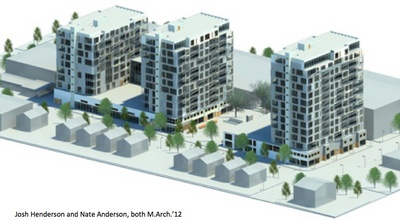
This student project shows three hypothetical towers on the city-owned Kline Lot at Ashley and William, with a plaza separating the market-rate residential tower fronting William Street from the moderate-income residential tower to the north. The third tower is proposed as the most affordable housing.
Courtesy of Doug Kelbaugh
Don't rule out a hotel, as the market may want one, which would help activate the plaza day and night with public and private events like banquets and weddings. And require LEED-certified buildings with solar and green roofs and walls, as well as high-quality architecture.
Our downtown already has lively streets, none better than our prized Main Street. What we lack is true urban plazas — outdoor living rooms for both spontaneous and programmed activities that break and enrich the linear rhythm of our sidewalks. Two small ones would be enough for a downtown of our size. If they're too spacious or too open to the street, they can be too windswept, noisy and empty much of the time. They need a sense of enclosure, with user-friendly buildings on at least three sides that open onto the space, with people and wares spilling into the public realm.
These buildings should not overshadow the space, which want to be sunny as much of the day and year as possible to entice activity, whether art shows in summer or ice sculptures in winter. There are two wonderful possibilities for this kind of plaza in downtown.
Comments
Bill Wilson
Fri, Feb 15, 2013 : 1:58 a.m.
Jamie, The statement(s) I think needs more explanation is/are these: "You're in quick walking and biking distance of world-class venues and destinations. And most households can manage with one car, saving of money, hassle and parking space. You can get more done in a day; there's less "overhead" in compact urban lifestyles." Can the OP explain what these "world-class venues and destinations" are? I think we need those to be identified, before any other discussion occurs.
Jamie Pitts
Thu, Feb 14, 2013 : 1:25 a.m.
Kelbaugh Fallacy #2: A large park will be an empty park. If these plans for concentrating residents downtown play out, there will be enough people downtown to fill the park. This will specially be true if we 1. design it to have attractions and 2. design it to be on the path to getting somewhere. The library, nearby parking lots, and foot traffic crossing over from Liberty will keep the park filled with neighbors and downtown business patrons.
Jamie Pitts
Thu, Feb 14, 2013 : 1:23 a.m.
Kelbaugh Fallacy #1: Small plazas are enough for downtown. If you start with a tiny areas for a public space, you start with fewer options. Why not reserve a larger canvas and have more to work with? If you build different sorts of amenities in a public space that users want, more (and different kinds of) users will come to use it.
Bill Wilson
Tue, Feb 12, 2013 : 3:04 p.m.
Hmmmm... So, you build a large sterile environment with no soul that only the very wealthy can afford, and name the street Library Lane. The next project will be to build a new library eh? The project the voters just told you they didn't want, and the service that technology has rendered obsolete. Maybe, as the voters have mandated, Ann Arbor ought to improve what it already has first, and leave these grandiose ideas for Birmingham and Troy.
Kai Petainen
Tue, Feb 12, 2013 : 3:27 a.m.
Regardless of any opinions (for or against) these ideas.... I think this is a pretty cool project for students. What a fantastic class project. Cool stuff... and I applaud the prof for making the ideas public. (I know a class project that dealt with the dioxane problem in Ann Arbor... but those results were not made public). It would be nice to know if the results of the class project were delivered to Pall and not the public. (that could create an obvious conflict of interest)
Ian
Mon, Feb 11, 2013 : 1:50 a.m.
This just makes me sad because it generally looks great and I know crazy ann arborites will be yelling at city council meetings for years trying to stop it.
L'chaim
Tue, Feb 12, 2013 : 4:10 p.m.
You could be wrong. I think you are stereotyping and misjudging us.
Alice Ralph
Sun, Feb 10, 2013 : 10:46 p.m.
Doug Kelbaugh's introduction of a well-illustrated urban design certainly provides more substantial ideas for public discussion than we have seen for some time. We have seen some of this approach way back during the earlier discussions of promoting more downtown residential development about ten years ago. At that time, we saw interesting ideas including, for example, "point towers" placed and spaced to provide more sun and better connections to pedestrian paths. Now, we see an imagined new development which includes at least two "pools" of plaza gathering space, connected with existing "linear" public space (mostly streets). It shows secondary addresses that enliven the interior of larger blocks that connect the campus area to the proposed Allen Creek Greenway. It shows mostly moderately tall mixed-use buildings with bases that relate to the street and establish human scale. The existing highly-valued character of the area suffers little and may perhaps be better framed and more accessible in this kind of finely-grained approach. At least, this example is one that demonstrates more of a civic sensibility that we have recently seen. Here is something (a lot of things, really) to talk about.
Mike
Sun, Feb 10, 2013 : 6:01 p.m.
The plaza also makes a good place to dump snow when you get a blizzard.................
Veracity
Sun, Feb 10, 2013 : 4:17 p.m.
ONE MAN'S VIEWPOINT -- PART 2 As for a hotel downtown we have one at 101 S. Fourth, built many years ago, and having changed ownership many times but is becoming a blight to the area. Chuck Skelton, a local hotel and hospitality expert and consultant, wrote a scathing denouncement of the Valiant Partners proposed hotel/conference center two years ago because of lack of feasibility. Conditions have not changed since then. Then again imagine the westward view of Main Street from Williams to Liberty Streets if the 14-story, 12-story and 10-story residential buildings are constructed on the Kline's lot. The skyline above the three story buildings holding such landmarks as the Prickly Pear, Gratzi, Connor O'Neill and The Ark will be overwhelmed by the tall buildings immediately behind them. Main Street, itself, will be bathed in shadows most afternoons. And do not forget that for every building constructed the city loses conveniently located and revenue-producing parking lots. These parking spaces will be missed as visitors who mostly drive to Main Street have to search for more distant and less available parking spaces. City Council members who I have contacted were unable or unwilling to name an urgent service or need that would require development on these properties. While the DDA and the city wish to increase revenues from TIF payments expected from construction, no one can predict how much TIF payments will be received and whether these payment will completely replace or hopefully exceed parking fee revenue being generated presently by the four public properties. Before further disfiguring our downtown landscape Ann Arborites should be given the opportunity to express their desire for further construction. Many citizens, like myself, are attracted to Ann Arbor because it does not look like Chicago or New York City and appreciate the openness and lack of crowding that exists downtown.
L'chaim
Tue, Feb 12, 2013 : 4:15 p.m.
(I voted your post up, BTW). I have one aside, prompted by the quote: "And do not forget that for every building constructed the city loses conveniently located and revenue-producing parking lots. These parking spaces will be missed as visitors who mostly drive to Main Street have to search for more distant and less available parking spaces." Promote The Ride, baby! Ride the bus! they can park in any of numerous commuter lots or at the hotels by the highways (where they can stayovernight).
Veracity
Sun, Feb 10, 2013 : 4:14 p.m.
ONLY ONE MAN'S VIEWPOINT -- PART 1 Doug Kelbough provides his own naive and impractical viewpoint which, if implemented will harm the city's finances and destroy the downtown skyline. Concentrating more people downtown will be difficult. First, the cost of owning a condominium or renting an apartment is more expensive because of the high cost of land and construction. The Ashley-Terrace bankruptcy provides a testimonial. Secondly, items sold in downtown stores are pricier due to the higher costs of operating shops. All purpose grocery stores like Kroger, Busch's, Meijer and even Costco require traveling by some sort of vehicle. Also downtown Ann Arbor is neither pet nor child friendly (other than the remarkable Hands-On-Museum). Young families will not consider living downtown because of the lack of parks where children can play and dogs can be walked. Another problem that will face mass residential construction as desired by Mr. Kelbough is the slow population growth anticipated for Ann Arbor by SEMCOG over the next twenty years. It is unlikely that 600 to 1000 or more new residents will arrive in Ann Arbor during the next few years who desire and can afford to live in the new residential developments. These enterprises may even fail (like Ashley-Terrace) eliminating signific TIF revenue for the DDA and the city.
BHarding
Sun, Feb 10, 2013 : 4:11 p.m.
I like the ideas on photos 12 and 13, by Wemda Sum, the low and mid-rise apartments and ground floor retail. But, I don't really know if new rentals are in demand....
annarboral
Sun, Feb 10, 2013 : 2:47 p.m.
The airport property is huge and could sustain a large number of houses & small parks. That would really increase the tax base and the city already owns the property!
L'chaim
Tue, Feb 12, 2013 : 4:08 p.m.
Clearly, annarboral means to suggest that e can build a new downtown, down there. A radically farstastical idea!
Ryan J. Stanton
Sun, Feb 10, 2013 : 2:59 p.m.
The Ann Arbor Municipal Airport is located in Pittsfield Township. Any tax revenues realized from a private redevelopment there (which isn't being discussed likely won't happen) would go to Pittsfield Township.
Nicholas Urfe
Sun, Feb 10, 2013 : 2:27 p.m.
"Fortunately the downtown is coming naturally into the urban century." Naturally? You mean by a DDA that is in the back pocket of out of town developers? Is that "natural"? And now we have umich students assigned to push the agenda - essentially the unlimited resources of a non-tax paying university.