

Current Motor among electric vehicle makers excited about Ann Arbor's new charging stations
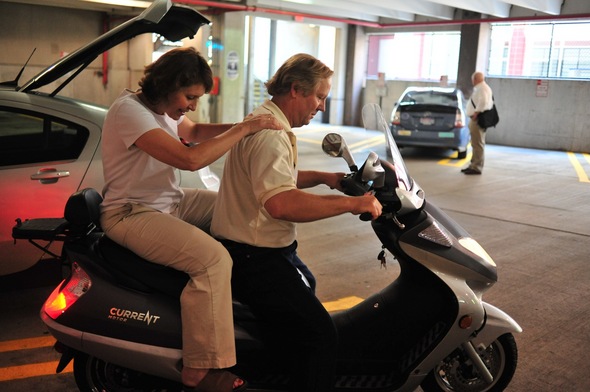
Terry Richards, Current Motor's director of electric vehicle technology, takes Ann Arbor Downtown Development Authority Director Susan Pollay for a spin on Tuesday afternoon after charging at one of the new electric vehicle charging stations in the Forest Avenue parking structure.
Ryan J. Stanton | AnnArbor.com
With its first major showroom opening in downtown Chicago in another month and a half, the company has come a long way from meager beginnings in Scio Township.
"We were in our small shop back then. Since then, we've got 34 of those scooters actually sold and on the road," said Terry Richards, the company's director of electric vehicle technology.
And the company is looking to sell a lot more in the near future.
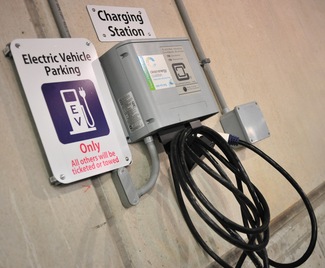
One of downtown Ann Arbor's new electric vehicle charging stations at the Forest Avenue parking structure.
Ryan J. Stanton | AnnArbor.com
Richards was on hand earlier this week as the Ann Arbor Downtown Development Authority and Ann Arbor-based Clean Energy Coalition celebrated the recent installation of 18 new electric vehicle charging stations at parking garages in downtown Ann Arbor.
"We're thrilled to death to see these charging stations," Richards said. "Because now we're going to go back home, we're going to go on our website, and we're going to put out the word that, yes, there are 18 charging stations here in Ann Arbor that these things can plug into."
Ramping up
Until recently, Current Motor designed and built everything in-house, in Washtenaw County. This past December, it moved its research and development center to Pittsfield Township, and it has worked out an arrangement to manufacture its electric scooters through Holt-based Dakkota Integrated Systems, located just outside of Lansing.
"We've started an assembly line up in Lansing," Richards said. "We've got parts for the next 50 vehicles to be built up in Lansing, and that's where we're at so far."
Nik Klopf, customer service manager for Current Motor, earlier this week showed off the company's demo scooters, including a standard model and high-performance model.
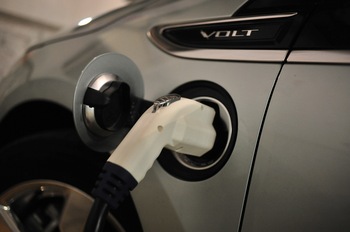
A Chevy Volt was on display, charging on Tuesday at the Forest Avenue parking structure.
Ryan J. Stanton | AnnArbor.com
One of the selling points is a zero-maintenance rear wheel hub motor instead of a messy chain or belt-driven powertrain. And it's easy to charge, taking five hours or less in a standard 110-volt outlet, with an operating cost of about 2 cents per mile on the road.
The high performance model sells for just under $12,000 and the standard sells for just under $10,000, Klopf said. And past the base model, several upgrades are available.
"They also have a new digital dash that has WiFi connectivity so you can link it with your Facebook and Twitter," he said. "And you can check your charge level all remotely on your phone, kind of like you can with some of the Chevy Volts and things like that."
Ann Arbor resident Larry Tuttle, president of the Michigan Electric Auto Association, said his group hopes to see more electric scooters like those designed by Current Motor and other EVs like the Chevy Volt and Nissan Leaf on the road in the near future.
His group is the Michigan chapter of the national Electric Auto Association, which has been promoting EVs since 1967.
At Tuesday's celebration of the charging stations at Ann Arbor's Forest Avenue parking structure, Tuttle showed off his 1994 Chevy S10 pickup truck, which he converted to an all-electric vehicle for about $10,000 and, as he puts it, "a year of weekends."
"There's two parts to growing the electric vehicle business. One is infrastructure, which they're doing," he said, giving credit to the DDA and the Clean Energy Coalition. "The other is promoting the use of electric vehicles by the public. A lot of people are still skeptical, don't understand how they work and how long it takes to charge, and things like that."
Plugging in
Among the many electric vehicles on display inside the Forest Avenue parking structure on Tuesday were a Chevy Volt, a Mitsubishi MiEV, a Nissan Leaf and a Fisker Karma.
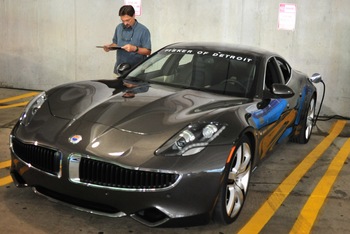
Charles Griffith of the Ecology Center checks out the specs for the 2012 Fisker Karma electric vehicle.
Ryan J. Stanton | AnnArbor.com
"People have discovered them and started using them," Konkle said. "So what you're seeing, for instance, for the Maynard parking structure, is that on May 29 somebody parked and they used about 4.5 kWh of electricity. That's about 50 cents worth of electricity."
On a couple of days, a charging station at the Fourth and William parking structure saw 17 kWh of use, which Konkle said is somewhere close to $2 worth of electricity.
"We don't know if that was one really hungry vehicle or two vehicles. We'll know that by digging deeper into the data," Konkle said. "But basically what we're seeing now is pretty good use at least at three of these, already before the announcement."
Konkle said he suspects the charging stations that are used regularly will end up costing the DDA about 50 cents a day, at a rate of about 12 cents per kWh.
"If we were to come back tomorrow and go to all of them, we'd probably find four chargers being used," Konnkle said. "Eventually, we hope all 18 get used. And then at that point, you're talking $9 a day worth of electricity."
At least for now, the DDA has made a conscious decision to allow members of the public to charge their vehicles for free to encourage more use of the technology.
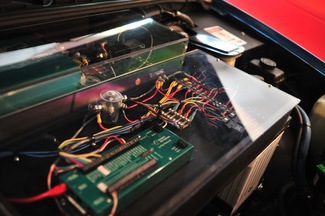
A look under the hood of Larry Tuttle's converted S10 pickup, which he made into an electric vehicle for about $10,000 and a year of weekends.
Ryan J. Stanton | AnnArbor.com
The charging stations, paid for with a federal grant, are Type 2, 220-volt, 30-amp models manufactured by a California-based company called ClipperCreek.
They're able to charge a vehicle five times as fast as plugging into a normal wall socket and are capable of delivering 20 miles worth of electricity per hour of charging.
The average electric car uses 0.33 kWh of electricity per mile, so it costs about 4 cents a mile for electricity at 12 cents per kWh.
That compares to 15 cents per mile for a gasoline-fueled car that gets 25 mpg, based on a fuel price of $3.80 per gallon.
The DDA plans to have a website up in the near future that will feature a map showing where all the electric vehicle chargers are located and which are in use.
View Electric Charging Stations in Downtown Ann Arbor in a larger map
Ryan J. Stanton covers government and politics for AnnArbor.com. Reach him at ryanstanton@annarbor.com or 734-623-2529. You also can follow him on Twitter or subscribe to AnnArbor.com's email newsletters.
Comments
snapshot
Sun, Jun 24, 2012 : 8:56 a.m.
Sp is there free motorcycle and scooter parking in this lot? If so, then the scooters are getting a completely "free ride" at taxpayers expense. Not a bad deal. No road taxes and no fuel costs. Sign me up. At least the cars have to pay for parking.
Dennis Miles
Sun, Jun 24, 2012 : 1:06 a.m.
If you object to all that free refueling for the Fisker Driver, consider the 20 cents cost to refill his battery to full is offset by the sales tax on the cup of coffee he drank while awaiting the battery to charge. Concerning You are all being ripped off by charging you "Gas Tax" for road maintenance. Cars don't wear out the roads, look at how long a residential street lasts. But highways and Truck traffic, there the wear is tremendous. The gas tax should be dropped. in its place a sales tax increase by one cent, that will generate as much funding. but the consumers who generate the truck traffic by buying consumer goods and luxuries will foot the bill and everyone will not be taxed on their medication and groceries so we push most of the tax burden onto the rich and not the poor . As an example , Polk County in Florida adopted a penny for roads 12 years ago and now all the roads have been widened and resurfaced and many bridges or viaducts have been built at bad intersections and traffic flow is improved all through the county from Lakeland to Sebring...(I know, I lived there.)
Arnie
Fri, Jun 22, 2012 : 3:26 p.m.
It is to bad the University of Michigan isn't on board with installing charging stations. They can easily install the stations and charge the user by swiping an m-card or credit card. This would fit nicely with all the other green initiatives on campus and be good for our State's economy. We are suppose to be the leaders and seem to be behind the eight ball on this one?
Paul
Fri, Jun 22, 2012 : 2:42 p.m.
If the DDA and ultimately the taxpayers are subsidizing the charging stations, so that owners of the vehicles can top off at no charge, will they also be adding free gas pumps so we can all top off?
Mac
Thu, Jun 28, 2012 : 4:03 a.m.
If you are paying attention, these stations are in paid garages, so the $0.50 that the average car charging there uses is more than covered by the amount they pay to park in the garage.
mr1125
Fri, Jun 22, 2012 : 7:18 p.m.
I've already explained that the credit card device to collect payment on a charging station is more expensive than just giving the electricity away for free. I think you might need an econ lesson if you think that me supporting incentives for a green technology that will benefit the environmental and economic welfare of the state is "trickle-down" economics.
Craig Lounsbury
Fri, Jun 22, 2012 : 7:10 p.m.
call me cynical because i think the poor sap trying to make a living selling scrap metal out of his beat up 20 year old pickup truck shouldn't have to pay twice as much to fix the roads as the guy in the thousand dollar Armani suit driving a hundred thousand dollar electric car. Then just to kick the poor sap in the rear one more time make him for Mr. Armani Suit's electricity to charge up his hundred thousand dollar car.
Craig Lounsbury
Fri, Jun 22, 2012 : 7 p.m.
are you done dodging the real question? What exactly do you see as cynical? That rich people get free electricity for their expensive cars while poor people fend for themselves? Am i cynical to think that if the electricity is so cheap why don't the people in cars pay for it? Would you like to debate trickle down economics which you are clearly a proponent of?
mr1125
Fri, Jun 22, 2012 : 5:55 p.m.
@Craig Apples and bananas. Electric vehicle charging station is approximately $1k-2k installed. Infrastructure to install a natural gas station is approximately $500k-2m installed and you will very likely never see one installed in a parking garage. Any more "comments" or are you done spewing your cynicism for the day?
Craig Lounsbury
Fri, Jun 22, 2012 : 4:34 p.m.
I'd like a fee natural gas fill up station. Its abundant in the US and fairly cheap.
mr1125
Fri, Jun 22, 2012 : 3:38 p.m.
You, in all honesty, thought the DDA was going to top off your car with gas?
Paul
Fri, Jun 22, 2012 : 3:33 p.m.
Not picking any arguments or fights, just asking a simple question!
mr1125
Fri, Jun 22, 2012 : 3:27 p.m.
Apples and oranges. Gas is an expensive and imported commodity that does nothing to benefit the U.S. and Michigan economy. Many electric vehicles are manufactured in Michigan and the SMALL amount of electricity that the DDA is allotting to EV drivers to support an emerging technology in the short term is peanuts compared to the price of gasoline. In addition, electricity is so inexpensive that the equipment needed to track payment on an EV charging station is more expensive than just giving the electricity away for free. Pick another fight.
xmo
Fri, Jun 22, 2012 : 1:57 p.m.
Why do electric vehicle owners not have to pay for up keep of the roads? Because they do not buy gas, they do not pay for the roads. Most of these electric "things" are very expensive so only the "1% or Rich" can buy them and now we give them the bonus of less taxes and free charging! Talk about not paying your fare share?
mr1125
Fri, Jun 22, 2012 : 6:06 p.m.
@Craig Outrage on the gas tax is premature. How about we wait till there is at least a 1% market share for this new technology before we make EV owners chip in 33% of the road costs? The road tax, like life, is already unfair because all cars get different mpg. EVs aside, the person receiving 10mpg is already paying an un-proportionate amount than the person receiving 50mpg.
Bryan Ellinger
Fri, Jun 22, 2012 : 5:31 p.m.
That is interesting, Craig. My guess about the proportion that vehicle registrations provides was a lot lower. Your comment also illustrates that different types of roads (local, state, interstate) receive different amounts of funding from various sources.
Craig Lounsbury
Fri, Jun 22, 2012 : 3:44 p.m.
Oops. forgot the link http://www.michigan.gov/documents/mdot/MDOT_CitizensGuide2011_346347_7.pdf
Craig Lounsbury
Fri, Jun 22, 2012 : 3:43 p.m.
according to MDOT they get about 1/3 of their funds from registration fees. 1/3 comes from the State gas tax and the other 1/3 comes from returns from the Federal gas tax. So roughly 2/3 of their budget comes from gas taxes. I agree in part with Jeff Frank that "the gas tax as funding source of choice for roads has to be rethought" but in the end it will mean that electric car owners in some fashion need to chip in more than 33% Here is a link to the MDOT funding I quote . Its on page 18 of the PDF
Bryan Ellinger
Fri, Jun 22, 2012 : 3:31 p.m.
Ignoring vehicle registration, Michigan's gas tax pays for 62% of local road (and sidewalk) construction/maintenance (http://www.baycoroad.org/faq.htm). The remaining 38% comes from local and federal sources that EV owners likely pay into through property, income taxes etc. These scooters (and bicycles) cause far less than 38% of the wear on roads that cars and trucks cause. More on the anti-cyclists' fuel-tax argument here: http://www.m-bike.org/blog/tags/fuel-tax/
bhall
Fri, Jun 22, 2012 : 3:09 p.m.
Gas taxes don't pay for the entire cost of roads. Billions from the taxes collected by the US Treasury go each year to pay for roads. Would you like to raise the gas tax to make it a complete user fee?
Jeff Frank
Fri, Jun 22, 2012 : 2:54 p.m.
I think the real point is that the gas tax as funding source of choice for roads has to be rethought, not that electric cars need to be taxed more. As more and more vehicle move off gasoline there will be less and less gas tax revenue to pay for our crumbling roads and bridges... the funding simply has to change.
mr1125
Fri, Jun 22, 2012 : 2:24 p.m.
Other states are supporting electric vehicles through additional incentives because they believe in their future ability to make us energy independent, better our environment, and help our economy. And you want MICHIGAN, the state that probably has the biggest economic stake in the electric vehicle venture, to TAX them more. The wealthy may be purchasing electric vehicles in the short term but they will benefit everyone in the long term.
Craig Lounsbury
Fri, Jun 22, 2012 : 2 p.m.
good points. I hadn't thought about the gas tax they aren't paying.
Craig Lounsbury
Fri, Jun 22, 2012 : 1:15 p.m.
I thought that Fisker Karma looked pretty sharp. I Googled it and they seem to run about $100,000. Justin Bieber got one for his birthday. I guess I can scratch that car off my shopping list.
Craig Lounsbury
Fri, Jun 22, 2012 : 1:26 p.m.
I might add that if i saw a $100,000 car getting charged up on the taxpayers dime I would be offended.
A2Frenchman
Fri, Jun 22, 2012 : 1:05 p.m.
I'd love to see more of these around town!
yohan
Fri, Jun 22, 2012 : 12:14 p.m.
I see Susan Pollay is going for a ride without a helmet. Figures.
Mac
Thu, Jun 28, 2012 : 4:24 a.m.
Considering helmets are sized individually and most people don't walk around with a helmet just in case they get offered a ride on a scooter, I don't know what you expect. Also, since the future organ-donor coalition got the no helmet law passed, it's legal for her to be on a bike without a helmet.
Craig Lounsbury
Fri, Jun 22, 2012 : 4:12 p.m.
so you don't need a helmet in a parking garage because you can never take a spill in a garage? Where else should one assume a helmet isn't a good idea?
mr1125
Fri, Jun 22, 2012 : 2:33 p.m.
They never left the parking garage. Way to find something negative to say about a good event, though. Why is the comments section only used by debbie-downers? It should be called the complaints section. I hope people don't think that the comments section is an actual sampling of Ann Arbor thoughts.
Craig Lounsbury
Fri, Jun 22, 2012 : 1:06 p.m.
nice observation. I suppose her comeback might be that they were just posing for a picture. But thats not what the caption says.