

Concerns about Ypsilanti's ability to pay its way aired as countywide transit talks move along
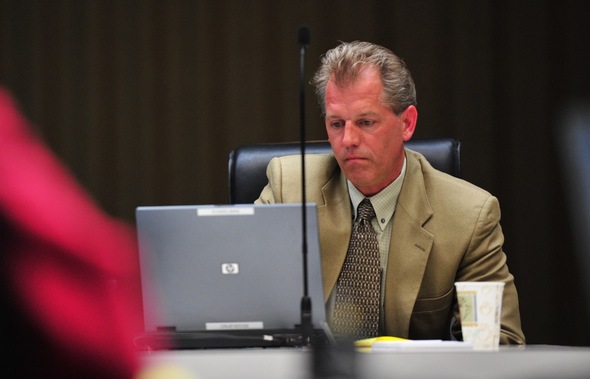
Ann Arbor City Council Member Stephen Kunselman, D-3rd Ward, was one of three council members who came out against a countywide transit agreement Monday night.
Ryan J. Stanton | AnnArbor.com
Ann Arbor City Council Member Stephen Kunselman, D-3rd Ward, repeatedly asked Monday night if Ford could elaborate on what might happen when the contract expires or if it's somehow extended, but Ford said he wasn't ready to give an answer.
"We're talking about that right now, so we're going to be meeting with them to determine how we can work with them to continue the service," Ford said.
Ypsilanti Mayor Paul Schreiber could not be reached for comment.
Ford's comments came as the Ann Arbor City Council voted 8-3 to approve changes to a four-party agreement between Ann Arbor, Ypsilanti, Washtenaw County and the AATA, laying the framework for creation of a new countywide transit authority.

John Hieftje
The Ann Arbor City Council originally approved the four-party agreement back in March, but the Ypsilanti City Council made minor changes to it on May 15. Ann Arbor concurred with some, but not all, of those changes at Monday's meeting.
All four parties must approve the agreement with the same terms and conditions prior to the filing of articles of incorporation for a new countywide transit authority.
Kunselman said he's not sure how Ypsilanti residents, who voted by a 2-1 margin against two city tax proposals last month, are going to afford to pay into a countywide system.
"They can't pay for the services they have now," he said. "A half-mill of increased transit tax will maybe get them to where they want to be, but yet you're talking that they will have more service. Where will that money come from if it won't be funded by the city of Ypsilanti?"
The AATA in late April released a five-year countywide service plan that contemplates a combination of fare increases and new funding equivalent to a 0.5-mill countywide transit tax to pay for the expansion of transit services in Washtenaw County.
The new plan would require $38.3 million in extra capital investments over five years and add $13.3 million to yearly operating costs when all elements are implemented.
The idea is that any new countywide tax, assuming it's approved as the way to go, would be layered on top of the existing transit millages in Ann Arbor and Ypsilanti.
In reference to Ypsilanti's expiring purchase-of-service agreement with AATA, Kunselman asked Ford whether it's an option to have Ann Arbor's millage support Ypsilanti services.
"I'd rather talk to them first and find out what our options are before I would say something that may not make any sense," Ford said.
"We haven't met," Ford acknowledged, noting he'd like to discuss the possible options with Ypsilanti regarding its contract before discussing it in public.
"That's coming up pretty quick, though," Kunselman said, noting the contract expires this month. "So where would the money come from? Because it certainly can't come from the city of Ypsilanti. They don't have the money, as we've seen."
Given the fact that Ypsilanti officials are grappling with millions of dollars in budget cuts, Kunselman said it seems funding continuation of transit services in Ypsilanti would have to come from some other source outside of the city, and most likely Ann Arbor's millage.
"Can you explain that? Is that an option at least?" Kunselman asked Ford again.
"There are options on the table right now and I'd like to meet with them to discuss that before I would say anything here," Ford reiterated.
Hieftje and a majority of council members are excited about moving forward with countywide transit, but three council members remain skeptical. Mike Anglin and Jane Lumm joined Kunselman in voting against the amended four-party agreement.
"My fear is are we putting an undue financial burden on some of these systems, on some of these municipalities, particularly Ypsilanti?" Anglin said.
"I look at this as a situation where Ann Arbor has had a successful dedicated transit system that taxpayers have funded and controlled for decades," Lumm said. "We're being asked to fundamentally change that structure, expand and cede a measure of control."
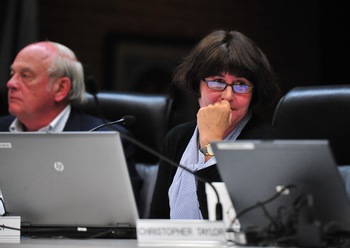
Jane Lumm is concerned Ann Arbor won't have majority control of the countywide transit authority.
Ryan J. Stanton | AnnArbor.com
"The concerns that remain for me have to do with the assumption that this Act 196 countywide authority is the best way to achieve transit in the county," she said. "I'm not convinced that's the case. I think there are more incremental approaches that are less risky."
Council Member Sabra Briere, D-1st Ward, noted that by approving Monday's resolution, the council also was approving the articles of incorporation for a new authority.
If voters approved a new 0.5-mill countywide transit tax, AATA officials estimate the average homeowner would pay an extra $50 a year based on a home value of $200,000.
Lumm said her primary concern is about the equity for Ann Arbor taxpayers, and the fact that while Ann Arbor is providing the majority of the local funding, it won't have majority control of the governing board for a new countywide transit authority.
Briere reminded Lumm that Ann Arbor has seven of 15 members on the proposed board and said the concern that Ann Arbor won't have a majority voice is countered by concerns from representatives of other communities who fear Ann Arbor will dominate.
Kunselman said he's not supporting the plan because he doesn't support a transit tax increase, and he's convinced that's how it's going to get funded.
"I would hope that all of my council members who are supporting this, as we're moving forward, tell the public how you stand on a half-mill transit tax increase, because that's what is going to drive this. There is no state money," he said. "There is no miracle dollar that's going to come and fund countywide transit in Washtenaw County without a transit tax increase."
While that half mill would generate millions of dollars in Ann Arbor, Kunselman said, it wouldn't generate very much in Ypsilanti.
"So they're going to get a lot more service out of a regional transportation service using a donor community like Ann Arbor," he said.
Kunselman noted five or six townships already have decided not to participate in the countywide transit discussions and he predicts more will opt out.
"We know how those townships are," he said. "For those of us who grew up in Washtenaw County, we know that they're very tax-averse in western Washtenaw County."
The changes made to the four-party agreement had to do with a municipal service charge that both Ann Arbor and Ypsilanti collect before passing along their respective transit millage revenues to the AATA. Ypsilanti recently amended the agreement so that both cities would not collect a municipal service charge under the countywide model.
Lumm brought forward a counter amendment Monday night, saying Ypsilanti can do as it wishes with its money, but Ann Arbor should keep its 1 percent service charge.
For Ypsilanti, she said, a 1 percent service charge is not significant because it's only $3,000. But for Ann Arbor, with a higher tax base and higher millage rate, it amounts to $92,000. Lumm won support for her proposal to keep the charge intact.
Ford said the municipal service charge started in 1975 for tax assessment and billing purposes, and since that time an administrative fee also has been added.
"The municipal service fee right now, if we were able to recoup that, that money could go back into service for Ann Arbor," Ford said. "It could definitely be used."
Ryan J. Stanton covers government and politics for AnnArbor.com. Reach him at ryanstanton@annarbor.com or 734-623-2529. You also can follow him on Twitter or subscribe to AnnArbor.com's email newsletters.
Comments
blahblahblah
Wed, Jun 6, 2012 : 4:06 p.m.
Mr. Ford's Monday night quote to Ann Arbor City Council: "There are options on the table right now and I'd like to meet with them to discuss that before I would say anything here," Ford reiterated. Mr. Ford Tuesday night quote to Ypsilanti City Council: "We can work with you and we are willing to absorb the $21,000 loss."" This is a clear, transparent view of how the new county wide system will work. Once in place however, the new county wide authority can make similar decisions behind closed doors.
Alan Goldsmith
Wed, Jun 6, 2012 : 10:03 a.m.
Again, we get a more complete story from the Ann Arbor Chronicle: "Falling property values in Ypsilanti will result in the 0.9789 levy generating fewer dollars, as a budget discussion earlier in the Ypsilanti council meeting revealed. Michael Ford, CEO of AATA, took the podium during the budget discussion at the request of mayor Paul Schreiber. Schreiber told Ford that in FY 2013 Ypsilanti would fall $21,000 short in its payment to AATA, and in FY 2014 there would be a projected $75,000 shortfall. "What would AATA do about that shortfall?" Schreiber asked. Ford responded: "We can work with you and we are willing to absorb the $21,000 loss."" http://annarborchronicle.com/2012/06/05/ypsi-council-re-adopts-transit-accord/ WE? You me US, the Ann Arbor taxpayers Mr. Ford? So $21K you'll pick up the tab? What about $241K? No wonder Council members Kunselman and Lumm were skeptical of your 'statements' about who would be picking up the bill if Ypsilanti couldn't afford to join in. So Mr. Ford is saying property values aren't going to drop more and Ann Arbor won't be covering the difference? And you wonder why people don't trust appointed officials like Ford, with his taxpayer paid private vehicle allowance as part of his AATA position.
bunnyabbot
Wed, Jun 6, 2012 : 4:58 a.m.
It's amazing what a difference reading this article with rose colored glasses on makes....you don't see the little red flags.
Joe Baublis
Wed, Jun 6, 2012 : 1:49 a.m.
Be advised also that the Washtenaw County budget is in peril, and the County is a financial partner in this scheme. The county was already facing prolonged yearly budget deficits, and a massive collapse in revenues, and is suddenly on the hook for the $13 million due to the 2001 county democrats support for the Sylvan Township water project sham, and from what I read never made plans to pay for the new administrative building on Hogback or the 150 employees. That's Ann Arbor's partner in the transit plan. Ann Arbor's other partner - Ypsilanti - is a financial wreck. It seems to me that the Ann Arbor democrats would rather place our tax-payers in jeopardy, rather than admit that their glorious social planning is a failure.
Bogie
Tue, Jun 5, 2012 : 11:42 p.m.
From what I've read on here (by commentators), no bus should let off the gas, while driving through ypsi, and pittsfield twps. I live in ypsi twp, but if they are not footing part of bill- let em' go. That's just common sense.
Vivienne Armentrout
Tue, Jun 5, 2012 : 10 p.m.
Mr. Ford's comment about administrative fees buying more service for Ann Arbor is misleading, since AATA has in fact been diverting Ann Arbor tax money into many ventures that do not directly serve Ann Arbor. The Chelsea Express and Canton Express are paid for partly with Federal and state money, but in part with Ann Arbor taxes. (It was about $100,000 for the year ending Sept. 2011.) Meanwhile, AATA has spent nearly a million dollars (I have not added up the exact amounts recently) on consultants, surveys, and marketing leading to the county-wide plan effort. Again, some of that is from outside sources but in 2011 it was about $400,000 of Ann Arbor tax money.
Peter
Tue, Jun 5, 2012 : 8:16 p.m.
Sorry we're not rich enough to ride your buses, AA city council. We'll try harder, we promise.
Alan Goldsmith
Tue, Jun 5, 2012 : 7:13 p.m.
"Briere reminded Lumm that Ann Arbor has seven of 15 members on the proposed board and said the concern that Ann Arbor won't have a majority voice is countered by concerns from representatives of other communities who fear Ann Arbor will dominate." So why SHOULDN'T Ann Arbor dominate this board? Kudos to Lumm and others who are looking out for Ann Arbor voters---which I thought was their job?
Basic Bob
Tue, Jun 5, 2012 : 7:42 p.m.
Ann Arbor will still have a larger millage than the rest of county, and will use the service more. The make-up of the board is a reasonable compromise that we shouldn't continue to second-guess.
Alan Goldsmith
Tue, Jun 5, 2012 : 7:09 p.m.
"In reference to Ypsilanti's expiring purchase-of-service agreement with AATA, Kunselman asked Ford whether it's an option to have Ann Arbor's millage support Ypsilanti services. "I'd rather talk to them first and find out what our options are before I would say something that may not make any sense," Ford said. "We haven't met," Ford acknowledged, noting he'd like to discuss the possible options with Ypsilanti regarding its contract before discussing it in public. "That's coming up pretty quick, though," Kunselman said, noting the contract expires this month. "So where would the money come from? Because it certainly can't come from the city of Ypsilanti. They don't have the money, as we've seen."" Guess Mr. Ford was too busy hanging with the Fab Five last week to meet with Ypsilanti officials? And if anyone thinks Ann Arbor isn't going to end up footing some of the bill for Ypsilanti, you're wrong. Kudos to the three members of Council actually asking questions. Hopefully after November there will be a few more.
kenUM
Wed, Jun 6, 2012 : 6:16 a.m.
@Alan Unfortunately, we will be supplementing Ypsi's bus service when the new POSA is negotiated. This has been the case for the past several years. Councilman Kunselman and Lumm know exactly where this is headed. Ypsilanti Township for years has refused to pay any increase in the POSA and AATA has allowed them to slide along. Ypsi is in the process of gutting their Police and Fire Departments, but continue to insist on financing bus service, and want to turn what was suppose to be a "temporary" transit tax into a permanent tax.
JB1
Tue, Jun 5, 2012 : 6:59 p.m.
Hopefully someone knows the answer to this...do Ypsi Township and Pittsfield Township pay into the system at all? AATA certainly services large parts of both townships. And, with the "regional" plans it sounds like this service may actually increase.
Vivienne Armentrout
Tue, Jun 5, 2012 : 9:52 p.m.
Yes, both Ypsilanti Township and Pittsfield Township have a current POSA (contract for services) with AATA. Ypsilanti City's millage pays for their POSA, however this year additional service was extended into the Ypsilanti area that is actually being paid in part from Ann Arbor taxes, since the Ypsilanti millage doesn't generate enough tax revenue. This is covered in detail, with tables, in my post http://localannarbor.wordpress.com/2012/03/10/fairness-and-transit-ii/
greg, too
Tue, Jun 5, 2012 : 8:14 p.m.
I know Ypsi Township does not, but there are a good amount of bus stops in the township, especially down Washtenaw. Very strange how that works out.
Basic Bob
Tue, Jun 5, 2012 : 7:39 p.m.
No, we don't, but we should! We are definitely part of the urban core, together representing 25% of the county population. If there is an area ripe for expansion, this is it.
pseudo
Tue, Jun 5, 2012 : 6:51 p.m.
You are right Murf - just confirmed it on the tax bill for our house. Yep, sure enough - we passed a millage, unlike the townships. So, what would happen to that tax if there is no service? hmmmm
Joe
Tue, Jun 5, 2012 : 8:38 p.m.
oops. Misread your comments. my bad
Joe
Tue, Jun 5, 2012 : 8:37 p.m.
Murph and Psuedo: "The idea is that any new countywide tax, assuming it's approved as the way to go, would be layered on top of the existing transit millages in Ann Arbor and Ypsilanti."
Murf
Tue, Jun 5, 2012 : 6:06 p.m.
Am I the only one that knows that Ypsi has an AATA millage? Why would we (Ypsi) need Ann Arbor's millage when we have our own which, as our luck would have it, doesn't quite pay all that AATA wants after the fact? What will become of that millage if there isn't any AATA service?