

Where the sidewalk ends: Clague Middle School wins $180K grant for safer walking, biking routes for students
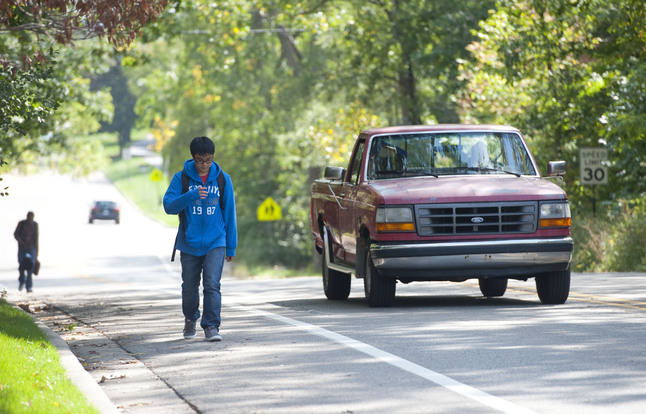
Huron High School sophomore Marcus Lee walks north toward home on the side of Nixon Road just south of Green Road Thursday in Ann Arbor. Nearby Clague Middle School was awarded a grant to install sidewalks along the road to increase safety for students.
Courtney Sacco I AnnArbor.com
Michigan Department of Transportation officials announced recently that Clague Middle School at 2616 Nixon Road won a federal grant for intersection and safety upgrades near the school.
The $180,000 Safe Routes to School grant will fill a major sidewalk gap on Nixon Road just south of Green Road that has forced students walking home to hit the street once the pavement ends.
As budget cuts have forced Ann Arbor Public Schools to reduce the number of bus routes the district can fund, students living within the 1-mile radius of the schools they attend are now strongly encouraged to commute by foot or by bicycle.
But students living in relatively newer neighborhoods on the outer edges of Ann Arbor often find sidewalks end abruptly and many times end up walking in the street on their way to and from school — as is the case on Nixon Road north of Clague.
“If you’re a mom or dad and your child has to walk to school and there’s no sidewalk there and you’re scratching your head, there’s a lot of reasons there,” said Eli Cooper, transportation program manager for Ann Arbor.
The Safe Routes to School program was designed to allow school districts seeking money for safety improvements access to funding without having to compete with general road projects.
The grants are competitive, and volunteer Clague Middle School staff and parents spent about two years surveying parents and working with city engineers to draft a proposal for the $180,000 grant.
The grant is one of six awards MDOT allocated to Michigan schools this month — about $990,000 in all — to help students safely walk and bike to school.
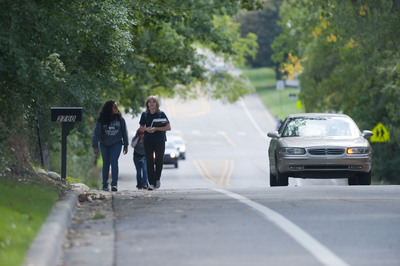
Huron High School students walk north toward home on Nixon Road just south of Green Road Thursday afternoon in Ann Arbor
Courtney Sacco | AnnArbor.com
Clague Middle School Principal Cindy Leaman said students currently walk on a bike path space on the side of the road to get to and from school because a sidewalk on Nixon Road is incomplete.
Though there wasn’t an accident or specific incident that prompted the school staff to seek out the grant, Leaman said she wanted to be able to provide the safest environment for students possible.
City engineers worked with the Clague Safe Routes to Schools Committee for about two years to gather data and collect recommendations for the project, said Jeff Gaynor, a teacher at Clague and a committee member.
"A tremendous amount of effort and cooperation is required in order to get one of these grants," said Kathy Griswold, a former Ann Arbor school board member and former member of the Transportation Safety Committee.
A four-way stop sign controls traffic at Green and Nixon roads. There are pedestrian crosswalks at the intersection, but Leaman said they could be better identified.
Griswold said the intersection is awkward and does not give drivers enough distance to see cyclists traveling in the bike lanes on Nixon Road.
The area has heavy traffic for about two hours in the morning and afternoon as students arrive at school.
“We’re really looking to be proactive,” Leaman said. “As a community we looked at what intersection improvements would make the pathways safer to all.”
At Clague, the staff has been encouraging students to bike and walk to school through an incentives program for about two years. The Safe Routes to School grant also will contribute funds to furthering education programs.
On specific walk-to-school days, Leaman said about 40 percent of the students walk and ride their bikes to school, and the bike racks overflow.
Leaman said she plans to meet with administrators and the city of Ann Arbor Oct. 5 to hash out how to make use of the grant.
“I think it’s been a very collaborative process and I’ve been pleased working with the Safe Routes to School program and the community,” she said.
There is no local match for the project, though the city of Ann Arbor funds the design and construction engineering.
In December 2010, MDOT awarded nearby Thurston Elementary School a similar grant of $160,840 for the construction of pedestrian islands and crosswalk improvements on Green Road.
Griswold said she's thrilled to see the safety improvements that will be made possible by the grant, but said the project is at the very beginning of a number of safety improvements that should be made to streets and sidewalks in Ann Arbor.
"There's a decade of backlog of safety improvement projects," Griswold said.
A Transportation Working Group assembled by AAPS Superintendent Dr. Patricia Green formed this summer with staff from the city, the Ann Arbor Transportation Authority, the University of Michigan and the district.
“We’re involved to help look at where there might be road and sidewalk issues and challenges as the school board is determining the future of student transportation in the context of a school system that’s cutting its budget,” said Steve Powers, city administrator for Ann Arbor.
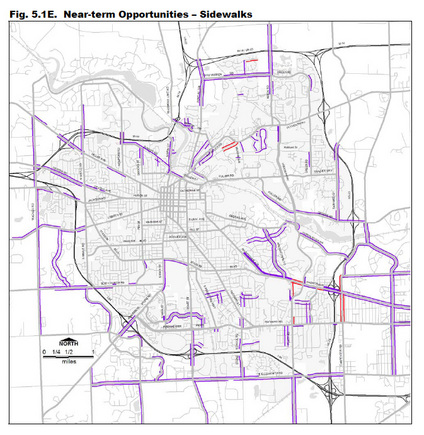
Sidewalk gaps identified by the city of Ann Arbor in its 2007 Non Motorized Transportation Plan.
Courtesy of the City of Ann Arbor
Pre-World War II developments in Ann Arbor had sidewalks installed along every city-owned street. Post-war developments saw a suburban sprawl of residential areas with fewer sidewalks, Cooper said.
“They are reflections of societal values at moments in time,” he said. “Folks are coming to realize sidewalks are an essential part of community.”
Ann Arbor City Council member Sabra Briere said the issue of filling sidewalk gaps and ensuring safe routes to school is one for the entire community to face, not for the city or the school district to deal with separately.
Briere gave an example of students who walk to Wines Elementary on Cooley Street from newly built subdivisions off Newport Road. Students walk on the shoulder of Newport Road and over M-14 to get to school because there is no sidewalk on the road, Briere said.
“There is no safe route,” Briere said. “These students are forced on to Newport Road or they don’t walk — their parents have to drive them. The burden has shifted from the government to the individual.”
Sidewalk gaps have been an unfunded line item on the city’s capital improvement plan for years, and were documented in a 2007 Non Motorized Plan.
The plan’s did not come with a time frame, and many of the sidewalk projects have not been finished, according to city staffers.
Ann Arbor City Council narrowly voted down a resolution in a 6-5 vote Monday night that would have put the city on a five-year schedule to get rid of sidewalk gaps.
“The pace or rate of change is what we need to bring back (to the council),” Cooper said. “Are we making the changes the council expects in a timely fashion?”
Sidewalk projects have been historically difficult to finance, as private landowners are often not interested in financing construction on their property.
“It’s going to be hard to get all the sidewalk gaps addressed, particularly the single-parcel ones where it would fall on a property owner,” said Pat Cawley, project manager for the city, noting that politics often get in the way of construction when the cost of a sidewalk is assessed to a property owner.
The city does not have the funds in its coffers to cover the cost of new construction, and so most of the safety improvement projects to roads and intersections around town are financed through grant money.
A millage Ann Arbor voters passed in 2011 can only be used for sidewalk repairs.
“There is not enough money to maintain the system that we have,” Cooper said. “Even though there might be a safety challenge identified, it competes with general maintenance.”
Amy Biolchini covers Washtenaw County, health and environmental issues for AnnArbor.com. Reach her at (734) 623-2552, amybiolchini@annarbor.com or on Twitter.
Comments
demistify
Sun, Sep 23, 2012 : 9:05 p.m.
The 4-way stop in question is not just Green and Nixon. It is also Dhu Varren, which is offset from Green, creating very dangerous traffic pattern. Traffic from Dhu Varren comes uphill and is screened by big trees, so they cannot see the Northbound Nixon traffic at the offset stop sign, and they have to cross left in front of it if they want to get to Green. This is tricky for cars but is iffier for slower-moving pedestrians. This mess needs a roundabout much more than the Nixon- Huron Pkway one that did get it. The neglect of this traffic problem is harder to solve because the West side of Nixon there is outside the city limits. The missing sidewalks are condo land.
jns131
Mon, Sep 24, 2012 : 11:11 p.m.
You must be one of the higher end condo people because the ones who are on the senior side can't afford increased rates on their associations fees. Hope you don't mind paying them. Less you don't care about the elderly then we know where you stand.
Sarah
Mon, Sep 24, 2012 : 6:48 p.m.
As a homeowner/resident of "condo land" with young children, I say bring on the sidewalks and better crosswalks - and a roundabout at Nixon/Green/Dhu Varren, too.
jns131
Mon, Sep 24, 2012 : 5:50 p.m.
O now we are going to have fun with condo land. Condos and the people that live there? Do not want their association fees going up because of sidewalks. O can't wait to see the fireworks on that one. Can we say impasse?
Basic Bob
Mon, Sep 24, 2012 : 1 a.m.
Dhu Varren should be relocated 100 feet south at the intersection while they still have a chance. A roundabout is still an excellent idea for this location.
sweet_life
Sun, Sep 23, 2012 : 9:25 p.m.
A few years ago, I attended a community forum where city traffic officials presented plans for the Nixon-Huron Parkway roundabout. At the time, they said that the Nixon-Green-Dhu Varren intersection would be next to get a roundabout after the Nixon-Huron Parkway one was completed. I would be very interested to know why nothing seems to be happening on this. It is a very dangerous intersection for pedestrians, cyclists, and drivers.
1bit
Sun, Sep 23, 2012 : 9:16 p.m.
Great point - that intersection is a right-of-way disaster.
jns131
Sun, Sep 23, 2012 : 5:02 p.m.
Now the people who have grass to the road are going to scream because now they are going to loose at least 2 feet of their frontage to a sidewalk. They also have to remember this. Once them get them? They are responsible for them. So if these children who walk em fall? Law suits to the land owners. I would be making the city sign a waiver of any fault what so ever. You folks don't know what you are getting yourselves into. Good luck with a white elephant. We get fined from the township if we don't keep em clear and ice free. Don't sign on if you don't want it.
Thoughtful
Sat, May 4, 2013 : 12:14 a.m.
Jns131- "so there?" What, are you five?
Kitty O'Brien
Mon, Sep 24, 2012 : 8:06 p.m.
jns131 - Just out of curiosity, do you drive a Hummer and frequent the MacDonald's on Plymouth Road?
jns131
Mon, Sep 24, 2012 : 5:48 p.m.
Home owner or not. Let us call it an injunction and there is nothing the city can do about it. Drag it on for years.
Kitty O'Brien
Mon, Sep 24, 2012 : 1:46 a.m.
Would you rather the school children slip and fall in the road? Perhaps land beneath the tires of a car. Furthermore, Clague Middle school has been there for nearly 50 years and the homeowners knew this was coming.
jns131
Mon, Sep 24, 2012 : 12:57 a.m.
I can't wait to laugh in your faces when a child slips and falls and I said told you. You folks are cruising for a bruising on this one. Good luck. Won't find me having one built on my property line. I own it and you can't build on it. So there. Locked in a lawsuit for years and they will have to go around me. So there.
Angry Moderate
Sun, Sep 23, 2012 : 11:22 p.m.
LOL, good luck "making" the city sign a waiver of your obligation to pitch in and care for your neighborhood.
Kitty O'Brien
Sun, Sep 23, 2012 : 8:52 p.m.
I see your point but children's safety trumps snow and ice removal. Besides this is about urban sprawl. They should have considered that when they bought homes so close to town. Move out to the country if you don't want to deal with sidewalk maintenance.
CLX
Sun, Sep 23, 2012 : 4:54 p.m.
I think this is a wonderful thing, but it bothers me to no end that developers choose to skip the sidewalks when they built, and homeowners bought the new homes knowing that the sidewalks did not exist. Both the developer and the homeowners chose the scheme, and chose to save money rather than have sidewalks. Many people I know will not even look at areas without sidewalks, passing on the better price to get a neighborhood with sidewalks. Here, a grant is taking care of the work, and that's great, but I would be very much opposed to any future scheme that has the rest of us paying for developer neglect and homeowners who knew what they were getting when they bought.
MjC
Sun, Sep 23, 2012 : 5:14 p.m.
If you actually take a look at this "neighborhood" you'll see that there are few "homeowners" along the proposed sidewalk route. There is a condos development built in the late 70's. And across the road is a large field of land that has been for sale for years. So you can't blame this on "home owners" who "chose the scheme" or chose to "save money rather than have sidewalks."
xmo
Sun, Sep 23, 2012 : 3:15 p.m.
"The city does not have the funds in its coffers to cover the cost of new construction," Maybe if the city got out of the Downtown Real Estate business it would have some money for public safety and build some more side walks? Instead, pass texting laws, make up new cross walk laws that endanger walkers and spend money on "Green Technology" that has a 30-40 year return on investment!
Jan Tripp
Sun, Sep 23, 2012 : 2:49 p.m.
I'm glad to see this finally happen. This stretch of Nixon is especially dangerous and it is surprising that no one has been hurt. Traffic moves much faster than the posted limits. Try the crossing Nixon at Clague sometime--about half of the cars stop to let you cross. Kudos to the staff at Clague for making this happen. In reading the article it sounds like five years would be moving to fast to fix the sidewalk gaps plus there is no money for new sidewalks. Makes you wonder what the priorities are down at City Hall.
Basic Bob
Sun, Sep 23, 2012 : 2:28 p.m.
"It competes with general maintenance" It also competes with keeping a large balance of unspent street money in the bank. They can afford to loosen the purse strings a tad.
Jeff Gaynor
Sun, Sep 23, 2012 : 2:28 p.m.
Credit for this grant goes to many: teachers - several of whom bike across town to Clague - as well as students and parents who participated in on-line surveys, as well as surveying neighborhood streets and walkways. Bruce Geffen - a veteran teacher at Clague, and Safe Routes to School committee member - has done Yeoman's work setting up bicycle safety programs, and encouraging students to bike or walk to school, greeting them on cold mornings and handing out bike lights and other accessories. Pat Cawley provided invaluable help at committee meetings and in designing the grant bid. And coordinating and rallying the troops, Lily Guzman, from the Department of Public Health, provided continuous and positive leadership. I, truth be told, happened to be the one contacted by the reporter, though I thank "BonoVox," whoever you are - not MY nom de plume by the way, nor my agent - for being in my fan club. However, I believe the key part in that comment was "...our teachers caring deeply about the kids." For we all, indeed, do. And my appreciation to Amy Biolchini, who given a short deadline, instead opted to do thorough research and - while she did not mention everyone involved - wrote a credible and worthwhile article.
63Townie
Sun, Sep 23, 2012 : 2:09 p.m.
It's about time something is being done regarding this chaotic situation.
Katherine Griswold
Sun, Sep 23, 2012 : 2:06 p.m.
"Ann Arbor City Council narrowly voted down a resolution in a 6-5 vote Monday night that would have put the city on a five-year schedule to get rid of sidewalk gaps." "The pace or rate of change is what we need to bring back (to the council)," Cooper said. "Are we making the changes the council expects in a timely fashion?" Ann Arbor wins awards because survey questions do not focus on the basic services that most progressive communities take for granted, such as sidewalks. No one asks, "Does your community choose to allow some school-age children to walk to school in a traffic lane next to parked cars in the dark?" Ann Arbor is a wonderful community with resourceful people and adequate funding. Council chooses to ignore basic services and spend money on staff and studies focused on the future. We need a better balance between present safety issues (police, fire, transportation) and future possibilities.
Brad
Sun, Sep 23, 2012 : 1:14 p.m.
No funds for sidewalks, but always money for bad art. Closing fire stations, yet the DDA skims $4mil/year.
Domey
Mon, Sep 24, 2012 : 11:13 a.m.
What if we paid an artist to make a really pretty sidewalk? Wouldn't that be art by definition?
MaryKat
Sun, Sep 23, 2012 : 1:11 p.m.
It is so sad that the city argues over millions in funding for a train station when our children are walking in the streets with their backs to traffic. Thank God for teachers and private citizens who can be trusted to keep their priorities straight and were not deterred by the two year process to fix a situation that causes a clear and immediate danger to young students every day. Kudos to the Clague community!
Bruce Geffen
Mon, Sep 24, 2012 : 10:20 a.m.
@Basic Bob. You obviously don't know the condition of the other side of the road at that part of Nixon. Sensible shoes, etc. have nothing to do with keeping the walkers safe. This isn't being Nanny Society about this, it is just what is the most common sense for student's safety. If you had been part of this committee and worked the hours that some had looking at all the options, then maybe you would get it.
Basic Bob
Mon, Sep 24, 2012 : 12:55 a.m.
@Bruce, It always amazes me what some people consider impossible. Put some sensible shoes on the kids and it will no longer be "too hard" and "too dangerous" There is a safe way to walk on the side of the road, and there is the other way.
Bruce Geffen
Sun, Sep 23, 2012 : 9:54 p.m.
Basic Bob. If you had read my post above, I explained that there is no way someone can walk against traffic at this part of Nixon Rd on the West side of Nixon. There is NO shoulder to walk on there. The only and safest way to walk on Nixon at this part is on the East side of the road in the bike lane, whether a person is North or Southbound. You just had to throw in that comment about kids being taught by teachers and parents regarding teaching them the proper way. Typical point the finger and blame...
Basic Bob
Sun, Sep 23, 2012 : 2:24 p.m.
Someone should explain to these kids that it is safer to walk facing traffic. There is no cliff, wall, or ravine preventing it. Bike lanes do not protect pedestrians. People walk along roadsides everywhere else without having their backs to traffic, and it does not require government grants, only common sense from teachers and parents to explain what most people learn as small children. The townships knew this when the roads were built. Shameful that the city annexed all this land from the townships and didn't upgrade it then. Clearly this was a snatch and grab to add revenue without providing service.
Bruce Geffen
Sun, Sep 23, 2012 : 1:02 p.m.
@ BonoVox...there were a number of staff at Clague who worked "tirelessly for years" on this project "to make this happen." It wasn't just one teacher. @AAW...people can't walk against the flow of traffic at that point in Nixon Road. There is no shoulder on the other side of Nixon for anyone to walk up against the flow. That is the only way people can walk up and/or down Nixon at that portion.
AAW
Sun, Sep 23, 2012 : 12:13 p.m.
What really needs to be stated here, at school, home etc....is that when walking people are to walk against the flow of traffic. The pictures showing all these students walking with traffic, they can't see someone on there cell phone, changing radio stations or TEXTING. Now I know that someone will say that this isn't safe either, but I believe it is even the law.
63Townie
Sun, Sep 23, 2012 : 2:07 p.m.
There is ZERO sidewalk (only a bike lane) on the west side of Nixon between Green and Traver. Besides, southbound Nixon is not quite aligned where Traver intersects, forcing southbound traffic into the bike lane. What are pedestrians supposed to do, walk against traffic on the west side then have to scurry across Nixon where the sidewalk starts north of Argonne? The intersection of Nixon and Traver is flat-out dangerous, it's about time something is being done.
BonoVox
Sun, Sep 23, 2012 : 11:36 a.m.
Bravo to Jeff Gaynor who worked tirelessly for years to make this happen. This is a great example of our teachers caring deeply about the kids they work with.