

Bus driver, engineer face off in Democratic primary for water resources commissioner
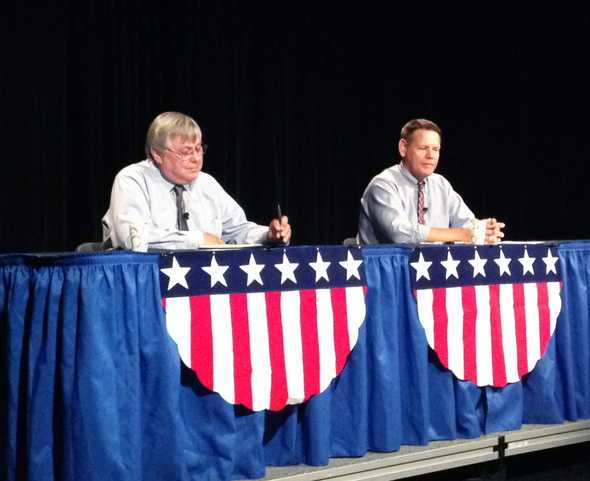
Democratic candidates for Washtenaw County water resources commissioner Harry Bentz, left, and Evan Pratt, right, talk about why they're running for office during a July 9 debate.
Amy Biolchini | AnnArbor.com
Pratt, 47, and Bentz, 61, have diverse backgrounds but find common ground when it comes to some key issues, like recurring flooding issues in west Ann Arbor.
The winner of the election will earn a spot on the November ballot for the office formerly known as drain commissioner. The only Republican candidate is Eric Scheie of Ann Arbor.
The water resources commissioner position will soon be vacated as longtime county employee Janis Bobrin is retiring.
Bobrin has given her endorsement to Pratt, who works full-time for the Spicer Group, an engineering, surveying and planning firm in Belleville.
“I have a passionate interest in protecting our natural resources, protecting our river,” Pratt said. “I agree that focusing on service to the folks that are paying the bills is the top priority.”
During a recent debate hosted by the League of Women Voters of the Ann Arbor area Monday night at the CTN studios in Ann Arbor, Pratt and Bentz spoke about their backgrounds, qualifications and ideals.
Bentz called out Pratt’s potential bias as a businessman, stating Pratt’s county pocketbook easily could be swayed by his business relationships if elected to the office of water resource commissioner.
“Every day we hear about how our political process is controlled by lobbyists, special interests and the revolving door between business and politics,” Bentz said. “I believe that the only thing we can do to regain influence on our government is to have an ordinary working class citizen step up and offer an alternative to the political machine.”
Bentz works as a bus driver for the AirRide. Previously, he was a longtime bus driver for Ann Arbor Public Schools.
“It should not be our platform to hire industry consultants,” Bentz said.
Bentz said he wanted to run against Bobrin in 2008, but an intensive surgery got in the way.
Pratt said he does not want to change the way the current water resources department selects its consultants, attorneys and contractors through the standard request for proposals process.
“I think this position demands someone who’s anything but ordinary,” Pratt said. “I believe having a background with both the engineering side of things and the planning side of things will help.”
Pratt said he has engineered more than 100 water resources projects during the past 23 years in Michigan. He’s also the chairman of the Huron River Watershed Council and serves on the Washtenaw County Planning Advisory Board.
The move from the business side to the policy side is one Pratt said he wants to make because of the opportunity to make a bigger impact in terms of being able to guide the direction of an entire program.
Floods have historically been a problem in the West Park neighborhood in Ann Arbor.
Though he can’t pinpoint the source of the flooding, Pratt said it’s been well documented throughout the past 100 years. Pratt said he lived across the street from West Park for about five years and knows the area well.
“I don’t know if one specific project has caused it but a collection of development in that area,” Pratt said.
Pratt said he’d look to the local residents of the area to provide him with observations to help solve the problems -- but a permanent resolution to solve flooding issues in a part of the city that is a natural floodplain would cost more than $100 million.
Bentz agreed that the cost of a project to address the area's issues would be too expensive to consider.
"The solution isn't going to come from one person," Bentz said, noting the engineering answers to the flooding would likely br easy, but the political answer would likely be more complicated. "The real solution is in controlling the amount of water that goes into the drain."
When it came to top threats to local waterways, Bentz listed invasive species that have entered the area including purple loosestrife and zebra mussels.
From Pratt’s perspective, the number one issue is fracking and the high volumes of water needed to complete the practice. He also listed the trend of privatization of waste water treatment plants as a concern.
Both Pratt and Bentz agreed that it was important for the water resources commissioner to be against the practice of fracking, given the heightened attention to the possibility of the controversial practice coming to Washtenaw County.
“Our role is always to provide expert testimony … and to gather hard data,” Pratt said, noting the commissioner should serve as an expert advocate to educate the public on the matter.
Bentz advocated his local knowledge and independence from the connections in the water resources business as his motivating factor for running for water resources commissioner.
“Washtenaw is my county, I grew up here and lived here all my life,” Bentz said. “I know what the issues are here — water, environmental and political and I have seen mistreatment by our leaders on all of these fronts.”
The change in name of the office from drain commissioner to water resources commissioner is one that both Bentz and Pratt said reflected a shift in the role of the office. Both agreed that water quality is also a responsibility of the water resources commissioner, not just water quantity as in the past.
Amy Biolchini covers Washtenaw County, health and environmental issues for AnnArbor.com. Reach her at (734) 623-2552, amybiolchini@annarbor.com or on Twitter.
Comments
jns131
Mon, Aug 6, 2012 : 4:55 p.m.
Harry was a great bus driver. He cared about his children and the ones he drove. He also cared about the city he lived in. If it is Washtenaw county, I'll vote. But if it is Ann Arbor? I will hope he wins. Great guy and I'll be voting for him.
snapshot
Wed, Jul 25, 2012 : 3:21 a.m.
Good old Ann Arbor and their inaffective credential craze. Engineers are notoriously ineffective communicators while a bus driver has to communicate effectively with across all levels of society, maintain order, resolve conflicts, and in general interact with a the various elements of society on a daily basis. Evan Pratt appears to live in the protected and privlidged world of the politically savvy "Leah Gunn"s" who served for years as a county commissioner and the DDA member and thought nothing of the conflict of interest she created. I'll vote for the common sense bus driver as opposed to the privilidged and politically connected engineer who's been part of the problem, like Leah Gunn. It's time to inject new blood into the system and change the status quo.
Basic Bob
Fri, Jul 20, 2012 : 11:24 p.m.
While I appreciate the public advocacy of the current Water Resources Commissioner and the candidates, their primary responsibility is flood control and erosion, not drinking water safety. It's unclear to me if this office has any legal standing to block any fracking permits, in the unlikely event one is filed in this county. If this were to occur, I would hope to have a better advocate in court than a school bus driver.
xmo
Fri, Jul 20, 2012 : 1:13 p.m.
Since Ann Arbor is a Peace Loving and one of the smartest cities in the US, I know that they will not vote for these Democrats because there is no "Scientific" evidence that Fracking causes any problems! I guess they would rather have us fight more wars for OIL than produce our own! "Both Pratt and Bentz agreed that it was important for the water resources commissioner to be against the practice of fracking, given the heightened attention to the possibility of the controversial practice coming to Washtenaw County. "
Jack Campbell
Fri, Jul 20, 2012 : 10:05 p.m.
Yeah because tracking is used to get oil out of the ground! There is a glut of natural gas on the market right now. Its close to not being profitable to even mine it. Why would you willingly pollute the ground water for it?
Greenradish
Fri, Jul 20, 2012 : 7:49 p.m.
The day before they proved asbestos is a carcinogen, there was no proof it was a carcinogen. The day before they proved cigarettes are carcinogenic, there was no proof they were carcinogenic. People did not start getting cancer from asbestos and cigarettes only after the point that proof had been established. So you see, my dear feather-head, the absence of proof does not make out an absence of harm. If your conviction is so strong about the safety of fracking, I challenge you to have a nice hearty glass of fracking fluid at high noon the day before the election, so that the voters can learn exactly how right you are. That, or just keep your mouth shut when it comes to things you plainly know nothing about.
SemperFi
Fri, Jul 20, 2012 : 4:10 p.m.
So, you're saying that fracking should be allowed, totally unconstrained, until there's a disaster? Then after we have the "Scientific" evidence we can deal with the fallout. I support a more proactive stance when it comes to our health and safety. Fracking a single well requires the use of 2 to 4 million gallons of high pressure water and a variety of chemicals, some of them toxic, to free up the gas or oil. That mix is then, supposed to be pumped out and stored in open-air pits until it can be properly disposed of. There are many opportunities for these operations to have a negative impact on local water systems. There are many concerns to be addressed for the safety of the local communities and our county Water Resources Commissioner should be up to the task to look out for the good of the public who they serve.
justwondering
Fri, Jul 20, 2012 : 12:21 p.m.
Both men seem passionate about their interest in the position. However, it seems to me that this job requires technical expertise and experience in order to evaluate alternatives and solutions to issues as they arise. Evan Pratt appears to be the more qualified of the two for this position. Harry Bentz, no matter how well intended, doesn't appear qualified for what is a relatively technical position. Good luck Evan Pratt!
Leah Gunn
Fri, Jul 20, 2012 : 11:33 a.m.
Evan Pratt serves on the Ann Arbor City Planning Commission. He formerly served on the Washtenaw COunty Planning Advisory Board, but that board no longer exosts. Evan is well versed in all the water resources issues.