

University of Michigan offers alternatives to bottled water but won't consider outright ban
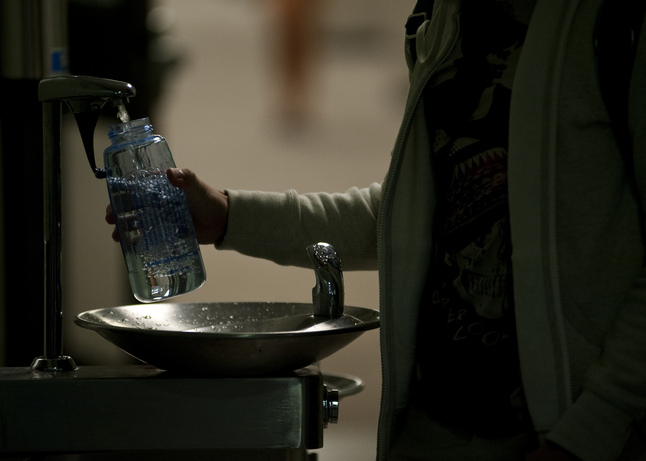
A water bottle is filled using a refill attachment on a drinking fountain at Shapiro Library on Tuesday.
Daniel Brenner I AnnArbor.com
While administrators say they won't comply with the student government's now year-old request that the school ban the sale of bottled water on campus, 42 water bottle refill stations have been installed at U-M and 74 refill attachments have been outfitted on existing water fountains.
"We're not considering a ban," said Andy Berki, manager of campus sustainability. "We’re just working hard on increasing the infrastructure so that people can make a choice."
The school reports that two of its first water bottle refill stations, installed in Mason Hall in 2010, received a combined 270,000 uses in one year.
Also during 2010, the university sold roughly 600,000 bottles of water, according to an assessment conducted by the Graham Environmental Sustainability Institute.
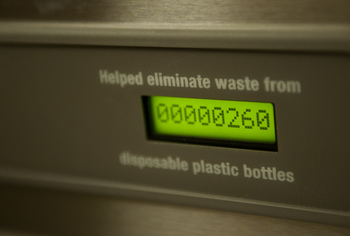
The counter on one of the newly installed water fountains at the Michigan League on Tuesday.
Daniel Brenner I AnnArbor.com
Maggie Oliver, U-M senior and last year's chair of Central Student Government's Environmental Issues Commission, said that since the student government passed the resolution seeking a ban last year, she and other campus activists have met with college departments, university administrators, student groups and athletic department officials to discuss water bottle use on campus.
Oliver worked to get academic units to sponsor refillable water bottle stations —which cost the university about $1,500 a piece— and some did, including several units within the College of Literature, Science and Arts. The student government supplied funds for 18 of the stations. The 74 refill attachments cost between $200 and $300 apiece, but Berki said the more costly stations are preferred by reusable water bottle users.
Berki says the stations "decrease campus waste generated by using disposable bottles" and came to fruition partly because of student input.
The stations are scattered throughout the Michigan Union, academic and administrative buildings and dormitories.
"The university saw a lot more people were carrying around reusable water bottles" last year, Oliver said.
This year, to encourage reusable water bottles, U-M gave out 6,500 reusable water bottles to incoming freshmen.
Oliver also talked with Dave Brandon, U-M athletic director, about allowing empty refillable water bottles inside the Big House.
"The security of the university was just not willing to budge with that," said Oliver, who said officials expressed concern over "the time it would take make sure the water bottles were empty."
Rob Rademacher, associate athletic director in charge of facilities and operations, told AnnArbor.com that empty water bottles would continue to be restricted from the Big House.
"We do not allow empty bottles or containers into the stadium. That policy changed years ago. We have not received any complaints since that policy changed," said U-M associate athletic director for communications Dave Ablauf.
The athletic department has a contract with Absopure Water Company to provide all commercial water products at the Big House, including bottled water and complementary water, served in cups, at the stadium's refreshment station. The current contract has three years left, said Ablauf.
Berki said a ban is not possible because "disposable water bottles are being used for certain things on campus," such as providing alternatives to soda at university events. They're also a source of revenue for the school.
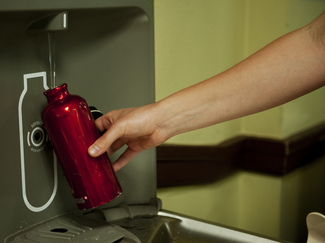
Sara Fitzgerald uses a bottle refill station to get a drink at the Michigan Union.
Daniel Brenner | AnnArbor.com
Berki says U-M is not "supportive of outright bans," but is instead trying to encourage students to choose tap water whenever possible.
"If we provide the infrastructure for refillable water bottles on campus, then people will be able to make choices more easily," said Berki.
Manish Parikh, U-M's student body president, says the student government is still "operating under the ban" but has not "fully confirmed" whether it will actively pursue a bottled water ban this year.
"We will be discussing the Environmental Issues Commission's agenda for the year with the current members and leadership in the coming weeks," he said.
Though Oliver is no longer leader of the commission, she said bottled water has become a big issue and she expects student government to continue its efforts eliminating bottled water this year.
Correction: The article has been amended to note that the gooseneck attachments for water fountains cost between $200 and $300 and not $30 as originally reported.
Kellie Woodhouse covers higher education for AnnArbor.com. Reach her at kelliewoodhouse@annarbor.com or 734-623-4602 and follow her on twitter.
Comments
Doug
Fri, Sep 14, 2012 : 2:42 a.m.
I drink out of fountains and it's free. Never paid for anything that is free.
Thaddeus
Thu, Sep 13, 2012 : 7:34 p.m.
It wasn't that long ago that the apex of a civilized society was essentially free clean, safe, cold "drinking fountains." Those things work wonderfully to quench thirst, refill bottles/ thermoses and don't involve billions of plastic bottles shipped from who-knows-where with far less regulation and oversite than muncipal drinking water.... It seems like common sense would steer people away from regular bottled water purchases when better alternatives are readily available on its own....
Macabre Sunset
Thu, Sep 13, 2012 : 7:01 p.m.
I love the little digital counter with its precious little message. Warms the hearts of the most sanctimonious of the students.
nickcarraweigh
Thu, Sep 13, 2012 : 6:34 p.m.
You know, looking back on it, it's a miracle I survived so many decades reduced to drinking water from, well, drinking fountains. We didn't know any better, I guess.
Suzanne
Thu, Sep 13, 2012 : 6:19 p.m.
I like to know (or at think) that someone inspects my bottled water...have you ever used a fountain at some of the U of M buildings?? Yuck! Old plumbing, green gunk, no thank you!
SalineBob
Thu, Sep 13, 2012 : 5:17 p.m.
When water bottles first came out I thought it was nutty. But the dang things are handy and I drink more water and less other junk as a result. I say make them 10 cent returnables. It worked for that other junk we drink. We might have to put it to a state-wide vote because the politicians these days won't touch this issue with a ten foot pole. And make the bottles with better quality materials if possible so the water doesn't taste like plastic. I'm not fond of drinking fountains--I've read more than once they are teeming with germs. Reusable containers are nice but you have to keep them clean. And you can't enter a stadium with them. Again, 10 cents for water bottles, pop bottles, beer bottles, Gatorade bottles. All similar bottles and cans. I'll pay for convenience and hopefully this would be environmentally okay too.
Machine
Thu, Sep 13, 2012 : 7:58 p.m.
Agreed, the bottle deposit law needs to be extended to cover all the beverage categories that didn't exist when the law was enacted. The law covers beer, soft drinks, carbonated & mineral water, wine coolers, and canned cocktails but not regular bottled water, iced tea, sports drinks, and a myriad of other bottled beverages. If only we could have a deposit law on Starbucks containers because I see those everywhere too.
Nancy
Thu, Sep 13, 2012 : 5:05 p.m.
Fantastic!! Not only will this eliminate unnecessary plastic waste, we will all save money and be healthier if we are using BPA free bottles! What a great idea! I'm glad to see this! Go Blue- Go Green!!
uabchris
Thu, Sep 13, 2012 : 3:55 p.m.
600,000 bottles sold...its all about profits...
Tru2Blu76
Thu, Sep 13, 2012 : 3:53 p.m.
Ban-O-Mania seems to be peaking. Is there a Ban-0-Mania season (similar to West Nile Virus Season) or can we expect Ban-0-Mania to expand to fill the whole year? Now we learn that the U of M "student government" asked for this ban a year ago. Maybe that's where this Ban-0-Mania got its start. Since Fad-O-Mania got its start among students, this makes perfect sense. And of course since President Coleman is "so attuned" to students' thoughts and desires, she had joined them in support of Ban-0-Mania. Brilliant! Next U of M syllogism: Since water bottles leach harmful chemicals into drinking water, then the best thing to do is BAN WATER. Let's have a Dry U of M Campus and avoid accusations of covert boycotts of bottled water companies, shall we? Yeah, that'll work: use government to impose our will on people who have no say in the matter except to comply!
Hmm
Thu, Sep 13, 2012 : 3:35 p.m.
What kind of communistic society are we slowly walking towards? Why do we need to ban any and everything we don't like or approve of? What happened to "Land of the free"??? More bans, more rules, more laws, you can't do this, you can't do that, it's just ridiculous to me how bad things are going.
Billy Bob Schwartz
Thu, Sep 13, 2012 : 6:01 p.m.
I'm kinda wondering what this has to do with communism. Hmm.
xmo
Thu, Sep 13, 2012 : 2:18 p.m.
I have a great idea: Why not put Drinking Fountains in so you don't need a water bottle? Why did people start drinking bottled water anyways? Just to be cool or because they thought the city water had too much stuff in it?
A A Resident
Thu, Sep 13, 2012 : 1:41 p.m.
Why the need for bottles at all? What's wrong with drinking fountains?
Thaddeus
Thu, Sep 13, 2012 : 7:41 p.m.
Nancy - one can however bring their own reusable bottle/ thermos and refill it at drinking fountains/ sinks....
Nancy
Thu, Sep 13, 2012 : 5:06 p.m.
You can't take a fountain with you when you're sitting in class or at your desk working!
G. Orwell
Thu, Sep 13, 2012 : 1:22 p.m.
If U o M does not want people to buy bottles water, U of M should offer CLEAN drinking water free of pollutants like fluoride. Fluoride is a dangerous industrial waste. It is so dangerous that the EPA lists it as a neurotoxin that can damage the brain. It also weakens bones, causes bone cancer and many other illness per the National Institute of Science. Latest Harvard study confirms that it lowers IQ levels. U of M, do you want smart and healthy students?
G. Orwell
Fri, Sep 14, 2012 : 1:30 a.m.
There is no scientific evidence fluoride prevents tooth decay. It's another lie. If you believe drinking toxic waste is somehow good for you, I've got a bridge to sell you.
Thaddeus
Thu, Sep 13, 2012 : 7:50 p.m.
In low levels, fluoride has been shown to be a very effective tool to lower rates of dental decay. At what levels does fluoride cause such detrimental effects that you list....? http://en.wikipedia.org/wiki/Water_fluoridation
G. Orwell
Thu, Sep 13, 2012 : 3:06 p.m.
Correction. I meant to say the FDA, not the EPA.
Heidi
Thu, Sep 13, 2012 : 1:11 p.m.
Okay, not to be that guy, but really? How is this "headline" news of having water bottle refill stations, installed on U of M campus any different that having sinks in public bathrooms? So one water line comes into the building, splits, and gushes out of two separate faucets... Are we really this gullible?
EyeHeartA2
Thu, Sep 13, 2012 : 5:52 p.m.
Yes, we are. Signed, The citizens of the smartest city in the country.
Adam Schubatis
Thu, Sep 13, 2012 : 3:20 p.m.
Larger water bottles often don't fit in bathroom sinks. Refill stations are also placed in high traffic locations where there are no sinks, encouraging people to actually use them.
Ignatz
Thu, Sep 13, 2012 : 12:47 p.m.
I hope that the U will extend this policy to reducing the use of Arbor Springs/Absopure type water in the buildings. There are many instances where 5 gallon bottles are sitting on dispensers within a few feet of city provided potable water. It's a waste of money and fuel.
Albert Howard
Thu, Sep 13, 2012 : 12:47 p.m.
I support Ann Arbor's move to ban bottled water sales from city events. Albert Howard Mayoral candidate
Mick52
Thu, Sep 13, 2012 : 10:15 p.m.
And replace them with what? During hot summer events people need water to stay hydrated.
Guinea Pig in a Tophat
Thu, Sep 13, 2012 : 1:08 p.m.
While the ban went into effect in 2007, I've never seen it enforced.
bunnyabbot
Thu, Sep 13, 2012 : 12:46 p.m.
I'm not a student and don't work at the U. I have a reusable BPA free cup I use that has a lid. So I can put ice in it and also clean it easier as it has a wide mouth. But at home I run the tap water through a filter pitcher before drinking it. I think city water has a weird taste to it unless I filter it first. I make ice cubes with the filtered water as well. Instead of buying pop I got a SodaStream, so I can make my own fizzy drinks and reuse my cup. Although I don't drink as much soda as I use to I use it to make fizzy water with a splash of flavor sometimes.
Ricardo Queso
Fri, Sep 14, 2012 : 12:21 p.m.
Very nice. Now get me a cookie.
kraiford12
Thu, Sep 13, 2012 : 4:45 p.m.
Nice story bro
aggatt
Thu, Sep 13, 2012 : 4:38 p.m.
cool story bro
MIKE
Thu, Sep 13, 2012 : 3:02 p.m.
Great story.
63Townie
Thu, Sep 13, 2012 : 12:42 p.m.
Typical hypocritical UM thinking; consider banning bottled water on campus but don't let football fans bring in their own (even sealed), and jack you over for $4.00 for a 20 oz. bottle inside.
Ignatz
Thu, Sep 13, 2012 : 12:48 p.m.
Those milliseconds it takes to check those bottles add up, you know. ;-)
Dog Guy
Thu, Sep 13, 2012 : 12:38 p.m.
Were U of M what it once was, students would call these water bottle refill stations "Pierian springs." (if not after Petronius or Pope, then Bradbury.)
arborani
Thu, Sep 13, 2012 : 2:25 p.m.
"A little learning . . ."
bunnyabbot
Thu, Sep 13, 2012 : 12:37 p.m.
I'm sure another commentor is talking about chemicals like BPA (Bisphenol A) in the plastic. Look for a label on your refillable bottle that says BPA free. Also, reusing a plastic bottle or aluminum bottle is nice and dandy. But bacteria from your mouth can build up in them, they need to be cleaned on a regular basis, perferably daily. Throw them in the dishwasher when you run it to sanitize it. This especially if you have a cold or sore throught or have are getting or have been sick. But this goes for all drinking cups and even for your pets drinking bowls, if you check your dogs dish after a day you will feel a film on the bowl, gross!
seldon
Thu, Sep 13, 2012 : 12:34 p.m.
Ban bottled pop, then talk to me about banning bottled water.
Mick52
Thu, Sep 13, 2012 : 10:13 p.m.
Go into the landfill? No, they go into the recycle bin. Plastic pop bottles aren't reusable? We re-use them often.
seldon
Thu, Sep 13, 2012 : 12:52 p.m.
Brad: plastic pop bottles aren't reusable either, but I completely agree on extending the bottle deposits to bottled water.
Ignatz
Thu, Sep 13, 2012 : 12:49 p.m.
As far as I know, there's no pop being piped into buildings.
Brad
Thu, Sep 13, 2012 : 12:38 p.m.
Pop bottles are reusable and don't go in the landfill. Hardly the same at all. How about extending the bottle deposits to non-carbonated beverages (like water)? What exactly is the difference other than some CO2 bubbles?
Napalm.Morning
Thu, Sep 13, 2012 : 12:32 p.m.
Can we get some analytical data on the life cycle--design to installation--carbon footprint of the companies manufacturing these rehydration replenishment remediation contrivances (a/k/a "faucets")?
Mick52
Thu, Sep 13, 2012 : 10:11 p.m.
No.
ferdcom
Thu, Sep 13, 2012 : 12:28 p.m.
There are already water bottle refill stations in every building on campus - probably on every floor of every building on campus. What's the big deal. Why do we need more?
cinnabar7071
Thu, Sep 13, 2012 : 4:28 p.m.
Maybe the student can't figure them out, and they need a simpler design. I bet if they put booze in them, they'd figure it out.
Rob
Thu, Sep 13, 2012 : 12:23 p.m.
I think they could still install them inside the stadium, regardless of the policy toward bringing in empty bottles. Can't count the number of times I've refilled purchased water bottles at the drinking fountains...
Rob
Thu, Sep 13, 2012 : 5:06 p.m.
Whoah - I just saw the correction: "The article has been amended to note that the gooseneck attachments for water fountains cost between $200 and $300 and not $30 as originally reported." That's just nuts. I should put in a bid to do it for a hundred apiece.
Rob
Thu, Sep 13, 2012 : 4:59 p.m.
Two reasons - one is simply convenience. It's a pain to tilt a bottle and get it underneath the (often inadequate) stream coming out of a drinking fountain mouthpiece. Having an upright dispenser is much easier. The second is health. I don't think there will be too many kids (and adults) slobbering all over the upright fixture, as compared to the mouthpiece for the fountain. I don't need their slobber (or even a fraction of it) getting into my bottle. Keep in mind - I don't need a big ol' freaking dispenser the size of a vending machine. I'll happily pull for a simple extra-pipe-plus-valve though.
cinnabar7071
Thu, Sep 13, 2012 : 4:26 p.m.
So why do you need a $300 fixture? Don't they have water fountians in the stadium? People with degrees always have to over think things.
EyeHeartA2
Thu, Sep 13, 2012 : 12:12 p.m.
water bottle refilling station = faucet + plus other garbage for the landfill.
EyeHeartA2
Thu, Sep 13, 2012 : 5:41 p.m.
cinnabar7071 for the WIN!! The answer? Not trendy enough.
cinnabar7071
Thu, Sep 13, 2012 : 4:23 p.m.
Rob whats wrong with just filling your bottle from the fountian as it it, I've been refilling my water bottle at the fountian for years, and I don't have a degree. Why the need for a $300 fixture.
Rob
Thu, Sep 13, 2012 : 12:19 p.m.
Here's my take: water bottle refilling station = faucet PLUS small amount of garbage for the landfill MINUS many thousands of plastic bottles, some of which will be recycled, some of which will inadvertently end up in the landfill as well. If faucets are bad, p'raps we stop installing them in new houses and just go to bottled water for those as well? Arbor Springs would sure be happy :)
Rob
Thu, Sep 13, 2012 : 12:08 p.m.
The outdoor ones will be lifesavers during the Art Fair also!
Davidian
Thu, Sep 13, 2012 : 12:08 p.m.
"If you don't agree with it, ban it!" That seems to be the message that many supposedly elite universities in supposedly progressive cities are sending to their studenty bodies and to the world. That's unfortunate.
cinnabar7071
Thu, Sep 13, 2012 : 4:19 p.m.
Caitlin this was a school project, I wonder if she would have done this if she didn't get school credit for it.
Davidian
Thu, Sep 13, 2012 : 4:14 p.m.
@Caitlin: Read the article. "Earlier this year the University of Vermont OK'd a ban on the sale of bottled water on campus. The ban will take effect staring January 2013. Seattle University and Portland University also have banned the sale of bottled water on campus."
Hmm
Thu, Sep 13, 2012 : 3:44 p.m.
Agreed Davidian. It's not the official policy, but that seems to be the answer to everyone's little problems in life lately. It's the students in this case but we all know this mentality is prevalent in many aspects of society not the least of which is the government (state and federal).
Caitlin
Thu, Sep 13, 2012 : 12:56 p.m.
I don't see how that's the case in this situation. The students asked for a ban and the University said they won't consider it.
northside
Thu, Sep 13, 2012 : 11:59 a.m.
Great program. Hope it catches on elsewhere after the success at UM.
cinnabar7071
Thu, Sep 13, 2012 : 4:15 p.m.
Dream on, only the U of M has that kind of money. Everyone else will just have to drink from the fountian, or do what I've always done in the past, filled my bottle from the drinking fountian. I guess the promlem is that that the fountian can only fill it 2/3's. Sounds like they have too much money to me.
kdadnick
Thu, Sep 13, 2012 : 12:15 p.m.
I've seen them at tourist information/rest areas in California....
Kevin McGuinness
Thu, Sep 13, 2012 : 11:32 a.m.
I hope this applies to the football stadium also.
jns131
Sat, Sep 15, 2012 : 3:09 p.m.
You have to buy their water at their prices that only the wealthy can afford. Why they boycotted water into the stadium is beyond me.
Brad
Thu, Sep 13, 2012 : 11:50 a.m.
Dream on.
Sandy
Thu, Sep 13, 2012 : 11:27 a.m.
There is one other problem that is not mentioned here: health concerns. Plastic bottles can leach chemicals into our drinking water. At the UM football games, the water bottles that are mentioned in the article are stored outdoors in the sun. When the plastic heats up, the chemicals are released into the water. These bottles sit in the sun for weeks on end! Being allowed to bring in an empty bottle to use at a filling station would be a much healthier solution.
Hmm
Thu, Sep 13, 2012 : 3:40 p.m.
http://www.scientificamerican.com/article.cfm?id=plastic-not-fantastic-with-bisphenol-a
country boy
Thu, Sep 13, 2012 : 11:23 a.m.
If I feel that using water bottles pollute. I don't use them. If the Libs don't like them, they want them banned. Ask the students to not buy them!
bobslowson
Thu, Sep 13, 2012 : 2:04 p.m.
I knew it was the "libs" fault