

Boarded-up houses on Main Street target of new Ann Arbor effort to demolish dangerous buildings
North Main Street will be a primary target of the city of Ann Arbor's new effort to address blight and rid the city of dangerous buildings, said Mayor John Hieftje.
"That's certainly a focus," he said. "Then again, there are other properties scattered throughout the city. But I know myself and all of council would like to see that area cleaned up."
The Ann Arbor City Council voted 9-0 Tuesday night to authorize a fund of up to $250,000 to secure and demolish buildings the city deems unsafe under Chapter 101 of the city code.
City officials say there are dangerous buildings that are deteriorating neighborhoods, negatively affecting property values, attracting unwanted activities and creating nuisances. And they say owners of the properties are not taking the necessary corrective action.
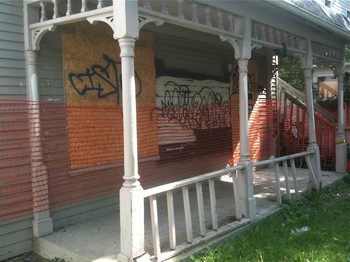
One of the boarded-up houses on Main Street just north of downtown Ann Arbor where a developer plans a new affordable housing project called Near North.
Ryan J. Stanton | AnnArbor.com
The project is now several months delayed. The eight houses at 626-724 N. Main St. were expected to be demolished last fall.
"What we want to do is put the land owner there on notice that this can't go on forever," Hieftje said. "Whether your development goes through or not, those houses need to come down."
Up until now, the city has not aggressively dealt with dangerous buildings as it hasn't had specific funds allocated for such efforts.
"There are many buildings in town — a surprising number — that need to come down, and we haven't had a way to do that in the past," Hieftje said.
But the city is expecting an influx of cash later this year from the settlement of the Michigan Inn lawsuit, a case that involved a dilapidated hotel on the city's west side and a multi-year court battle to get it demolished. The city's settlement from that case is expected to reimburse the general fund for the initial funding of the new abatement program.
Property owners will be invoiced for the city's costs for any actions taken to address dangerous buildings, city officials said. If property owners fail to pay when billed for costs, the city can hit the properties with special assessments to collect the amount owed.
"I'm really excited about this," said Council Member Stephen Kunselman, D-3rd Ward, who worked with the mayor on the issue.
"I worked in a community where this process worked very, very well," added Kunselman, a former township administrator in Wayne County's Sumpter Township.
"I think what we typically find is that most property owners just don't know how to deal with it and so they don't," he said of demolishing old buildings. "And so with the city taking over, it becomes a no-brainer for them and you probably won't find much resistance."
Hieftje noted there is an old gas station at 800 N. Main St. that the city attorney's office went to court to fight, but a judge told the city it couldn't tear it down.
"So that's one we've tried. I don't know why they would have said no to that," he said. "But I'm pretty sure we could move forward on these old houses. We are certainly keeping an eye on the old Greek church there, which has not been used now for many years, and I think the same sort of case would have to be made for the judge on that one."
Hieftje said he's sure every council member will have suggested targets, but high up on his list is cleaning up North Main Street.
"I know that council members in the 1st Ward hear a lot from their residents about the old houses that are there that are due to be torn down soon, hopefully for a new proposal there," he said. "We've certainly given notice to the property owner there that they need to take action or the city is going to take action."
Ralph Welton, the city's chief development official, told council members how the process would work if the city found a residence in bad enough condition to pursue demolition.

Ralph Welton, the city's chief development official, addresses the Ann Arbor City Council Tuesday night.
Ryan J. Stanton | AnnArbor.com
Welton said the process would start with the city sending a letter to the property owner to find out his or her plans are for the building. After that, if the city isn't satisfied, it would invite the property owner to a show cause hearing before the building board of appeals.
"They would then have the opportunity to come in and either indicate that they had plans to rehab this building or demolish it themselves and then the board would vote," Welton said. "If the board votes to demolish the building, they have 20 days to appeal to the district court."
After that, assuming it could, the city would proceed with demolition, Welton said, and the city would pay the initial costs, but the property owners would be invoiced.
"And just to explain to folks," Hieftje said, "one of the things that I've learned is that had Mr. Welton and his team condemned a building and we didn't have a fund to take it down, it then became a dangerous nuisance in the community. And if anything were to happen at that, the city having condemned it would then have a legal problem with that."
Kunselman said the city shouldn't just be focused on houses. He said there are other sources of blight in the community that present a danger.
"We also need to look at out buildings, garages," he said. "There's a collapsed garage on a vacant lot that went to tax foreclosure in my neighborhood. There's a garage right across the street from me with a big hole in the roof and it's getting ready to collapse."
Council Member Sandi Smith, D-1st Ward, asked how much it might cost to demolish one of the houses on North Main Street. Welton said typically $15,000 to $25,000.
Council Member Marcia Higgins, D-4th Ward, expressed concerns the city might run into extra costs dealing with lead and asbestos abatement in older houses.
Council Members Christopher Taylor and Carsten Hohnke were absent.
Ryan J. Stanton covers government and politics for AnnArbor.com. Reach him at ryanstanton@annarbor.com or 734-623-2529. You also can follow him on Twitter or subscribe to AnnArbor.com's email newsletters.
Comments
Rob B
Sun, Sep 9, 2012 : 9:11 p.m.
how does any private and/or non-profit organization receive funding,grants, as well as other money from city government for projects get away with not being held accountable for failed projects? Who pay's for the $250,000 dollars the city now has to pay to demolish those homes, and how can any organization just "give-back" property they once held -TAX FREE, because they couldnt manage a project such as the one they promised for over three years. Tax paying citizens deserve to get some answers!
Left is Right
Fri, Feb 24, 2012 : 2:24 a.m.
Aren't those boarded up houses part of the Master Plan?
Dog Guy
Wed, Feb 22, 2012 : 6:55 p.m.
Demolitions on North Main Street should continue the all-natural green tradition: windstorm, flood, snowload, or undermining by a surfeit of rabid skunks.
Ann English
Thu, Feb 23, 2012 : 12:48 a.m.
Those houses are just east of where the rabid skunks have been found. I know they're on the east side of Main Street. Hope those skunks' descendants stay away from the Water Hill Music Festival in May. Their area's east border is the Ann Arbor Railroad tracks, not Main Street.
Ellis Sams
Wed, Feb 22, 2012 : 5:39 p.m.
The city should borrow money from the public art fund to expand the effort to raze condemned buildings. Consider blight as the antithesis of art. Removing it allows the property to resume the art of life and activity instead of decay. The property tax assessment will increase, and, when the demolition costs are recovered, the art fund can be reimbursed. Political poetry in motion.
Jack
Wed, Feb 22, 2012 : 8:47 p.m.
Nichole - And who is going to do this? Private enterprise can't be forced to buy a property and rehab it. And I certainly don't want to see the City in the real estate business. It has enough to do - and my taxes are already high enough.
Nichole Van Blaricum
Wed, Feb 22, 2012 : 6:02 p.m.
While I agree that something needs to be done with condemned buildings, is razing always the answer? Is there not someway to rehab at least, 50% of these buildings, especially residences, to provide AFFORDABLE housing in the A2 area? The cost and energy consumption on new construction is higher than that of rehabilitation, driving up rental rates....Why not use what we already have?
Nichole Van Blaricum
Wed, Feb 22, 2012 : 4:40 p.m.
Why not rehab the houses for reuse as affordable housing? Save energy, preserves community character, and lowers costs. Seems like a no brainer really.
MIKE
Wed, Feb 22, 2012 : 10:44 p.m.
Put your bid in to buy the property and give it a shot.
Sallyxyz
Wed, Feb 22, 2012 : 3:16 p.m.
"Up until now, the city has not aggressively dealt with dangerous buildings as it hasn't had specific funds allocated for such efforts." How many funds are needed to do this? Does it take hundreds of thousands of dollars to make phone calls, have the "already on salary" city attorney write letters to homeowners and give them an ultimatum, if necessary? If the homeowners don't comply within a specified time frame and either tear down or fix up the property, then the property is taken over by the city and sold, and the new owner can tear it down. End of story. What is the problem with doing the administrative side of this with existing staff? "Actually there's an ordinance in the code for this. As a building official, I can condemn structures," he explained. So why hasn't this been done for many of the existing buildings around town that are clearly uninhabitable and that have been in that condition for year and years? Seems like a no-brainer.
Sallyxyz
Wed, Feb 22, 2012 : 3:03 p.m.
"Hieftje noted there is an old gas station at 800 N. Main St. that the city attorney's office went to court to fight, but a judge told the city it couldn't tear it down." Why? "But the city is expecting an influx of cash later this year from the settlement of the Michigan Inn lawsuit, a case that involved a dilapidated hotel on the city's west side and a multi-year court battle to get it demolished." Why did it take so long? Plenty of old blighted houses around town that have been in terrible condition and abandoned for years. How about the one at the corner of W Kingsley and N 1st, across from Austin and Warburton. That one has been boarded up and covered with graffiti for over 10 years. What's the excuse on that one?
Sallyxyz
Wed, Feb 22, 2012 : 11:48 p.m.
Jack, no one talking about the government coming in and taking private property. There are procedures in place and obviously the city of AA dropped the ball on many of these blighted properties. Property owners have rights, but they also have responsibilities, and those include not to let houses deteriorate to the point where they are dangerous, uninhabitable and/or a nuisance to the city. If the city attempts to contact owners and those multiple attempts fail after a reasonable amount of time, then the city has the right to take over the property and sell it. There are procedures in place, but unfortunately the city of AA has ignored pursuing these properties for many years.
BobbyJohn
Wed, Feb 22, 2012 : 10:35 p.m.
City is buying that house, paying to tear it down and putting in a rain garden
jns131
Wed, Feb 22, 2012 : 9:20 p.m.
This is why Detroit has so many blighted houses. Because they have to contact the original owners or whoever owns the foreclosure to get rid of it. Mayor Bing gives them 3 to 6 months before he sends the back hoe in and tears it down. Gotta hand it to Detroit, it is beginning to look a lot nicer.
Jack
Wed, Feb 22, 2012 : 8:44 p.m.
Sally - It's called property rights. The City doesn't own it. If the laws were rewritten so that the City or State or whatever government agency cited could come in and take your property, I don't think you'd like it.
Goofus
Wed, Feb 22, 2012 : 2:40 p.m.
I think the biggest eyesore coming downtown is that sad abandoned old Greek Orthodox church on N. Main about a block from Kerrytown. When is that coming down? It's pathetic, esp, for a former religious building, to sit that long.
hut hut
Wed, Feb 22, 2012 : 2:39 p.m.
Without "buy in" and help from the City Attorney's office and the Courts there is little that the City bureaucracy can do to take and demolish private property. The City has made several half hearted attempts at solving this problem in the past 30 years. There has been little support from Any of the City Attorneys or the Courts. For the politicians, particularly Hieftje in this election year, this is a chance to get on their soapboxes, but where have they been in the intervening decades? Mr Welton is relatively new to the city but by now should be well aware of how gross mismanagement in the City Attorney's office hampers such an effort. I wish him and his staff well, but we've seen this dog and pony show before.
Terri Walrod
Wed, Feb 22, 2012 : 2:35 p.m.
Does anyone else see the irony of the current (as of this posting) positioning of a story about how the homeless in Ann Arbor are desperately hoping not to be kicked out of their tents in the woods near no potable water source right above a story about empty houses/homes in Ann Arbor? Or in the fact the city is looking at spending huge amounts of money to take these houses down for a developer while there is apparently very little, if any, money available to help those living in tents in the woods?
vaseline
Wed, Feb 22, 2012 : 3:29 p.m.
Posted it before I could. It's also funny some compassionate posters are saying tear these down and let the camp stay
thecompound
Wed, Feb 22, 2012 : 3:24 p.m.
It seems only right that the camp should be moved to one of the most salvageable houses, the donations could be used to fix up the house, get the plumbing working. They wouldn't have to walk in the dark to get to/from jobs, etc....sounds like a win/win, lol.
EyeHeartA2
Wed, Feb 22, 2012 : 2:51 p.m.
People want both gone?
Wolf's Bane
Wed, Feb 22, 2012 : 2:25 p.m.
Urban blight is a real problem and it is clear these properties have fallen through the cracks. Why the city (we, taxpayers) should have to pay for the demolishing of these abandoned properties is beyond me. How about the developer get on with 'developing' or restore these homes and let the occupants of the "take notice" tent city move in? Can't have it both ways.
My2bits
Wed, Feb 22, 2012 : 2:21 p.m.
They are very dangerous. There was a fire in one of those abandoned houses on North Main, the one next to the party store. Can we get an AA.COM report on that? We own a house close by and had complained more than once to the developer about people breaking into that house. Those houses could have been made habitable, but the developer let them sit vacant too long. If the city demolishes a house, bills the property owner and gets paid back by the property owner, or when it sells by the next owner or the bank (if foreclosed) - sounds fine. Can AA>COM update us on why this needs to be done from a special fund rather than the general fund?
Dalex64
Wed, Feb 22, 2012 : 2:08 p.m.
You could use the city art fund to cover the costs of demolition and cleanup if you replaced the house with a piece of public art. Perhaps a garden gnome.
EyeHeartA2
Wed, Feb 22, 2012 : 2 p.m.
How about that shack at the corner of Kingsley and 1st? Nobody has lived there in about 15 years.
EyeHeartA2
Thu, Feb 23, 2012 : 12:27 a.m.
Well thank god for that. I'm glad they aren't doing something stupid with it, like selling it to somebody. We have plenty of money already. You can never have enough rain though, and I'm glad we bought a spot for a garden to grow some.
BobbyJohn
Wed, Feb 22, 2012 : 10:33 p.m.
The city is actually buying that house, paying to tear it down, and then putting in a rain garden. Already a done deal, fully approved
Ricardo Queso
Wed, Feb 22, 2012 : 1:06 p.m.
Millions for fountains, not one dime for blight.
tdw
Wed, Feb 22, 2012 : 1:04 p.m.
I bet A2 could save some money ( like they really care ) if they would allow some one ( by a lottery perhaps ) to go into these houses and strip them first.A lot of them have nice old solid doors , trim , hardware like door hinges, door knobs , flooring etc..that plenty of people would be glad to have.If A2 is so hell bent on being " green " it seems it would be logical.I also wounder if they will even bother taking the copper. I don't know if they already do this or not. Oh BTW there is a place in Ypsi on Michigan ave.That deals in stuff that I mentioned
MIKE
Wed, Feb 22, 2012 : 9:51 p.m.
They could probably do that, if it wasn't private property.
jeanarrett
Wed, Feb 22, 2012 : 8:03 p.m.
I believe in the last article about these houses, that is already being done. I had the very same thoughts as you. And, I'm pretty sure that a place in Ypsi got the bid to take out all of the good stuff. I hope they didn't leave good things behind. I saw the picture too and thought the porch definitely looked salvageable--at least part of it!
EyeHeartA2
Wed, Feb 22, 2012 : 6:24 p.m.
Thanks for the clarification. I thought you were referring some of the other "stuff" that "deals" are made of on Michigan Ave. – Like sunglasses and such.
tdw
Wed, Feb 22, 2012 : 5:31 p.m.
<a href="http://www.materialsunlimited.com/" rel='nofollow'>http://www.materialsunlimited.com/</a>
tdw
Wed, Feb 22, 2012 : 5:06 p.m.
Eyeheart...It's called Materials Unlimited.Near Huron and Michigan ave
EyeHeartA2
Wed, Feb 22, 2012 : 2:53 p.m.
"Oh BTW there is a place in Ypsi on Michigan ave.That deals in stuff that I mentioned" Wait............................................what?
tdw
Wed, Feb 22, 2012 : 1:47 p.m.
Not trying to beat a dead horse here, but look at the difference in cost between hollow core and solid doors <a href="http://www.homedepot.com/Doors-Windows-Interior-Doors/h_d1/N-5yc1vZbuhv/h_d2/Navigation?catalogId=10053&Nu=P_PARENT_ID&langId=-1&storeId=10051" rel='nofollow'>http://www.homedepot.com/Doors-Windows-Interior-Doors/h_d1/N-5yc1vZbuhv/h_d2/Navigation?catalogId=10053&Nu=P_PARENT_ID&langId=-1&storeId=10051</a>
tdw
Wed, Feb 22, 2012 : 1:35 p.m.
Just to add....I can see just by the picture that a lot of that porch would be worth salvaging.And those " American Pickers " buy the kind of stuff that I mentioned all the time.
a2grateful
Wed, Feb 22, 2012 : 12:41 p.m.
Why not just call this what it is: Further city subsidization of the private developer's profit for the N. Main / Avalon project. Otherwise, fine the developer under existing ordinance, tear the buildings down, and charge the developer for demo costs, plus 2% additional municipal art surcharge.
Wolf's Bane
Wed, Feb 22, 2012 : 2:26 p.m.
Meanwhile we have a tent city on the outskirts of Ann Arbor. So illogical.
a2grateful
Wed, Feb 22, 2012 : 1:33 p.m.
It's an interest-free construction loan for an already-city-subsidized private developer, for a combined property that is already off the tax rolls. We won't be surprised when the demo costs are soon forgiven by the city, in further generous donation.
Jimmy McNulty
Wed, Feb 22, 2012 : 1:04 p.m.
"Property owners will be invoiced for the city's costs for any actions taken to address dangerous buildings, city officials said." How is this a subsidization when the city will bill the property owner and will most likely place a lien on the property for any debt outstanding?
blahblahblah
Wed, Feb 22, 2012 : 12:37 p.m.
So if the property is foreclosed upon by the bank, would the bank still owe the assessment? Also, in all fairness to the community, each ward should receive an EQUAL share of this fund. Council Member Kunselman makes a good point about the garages. Many of them do not even have a garage door such as the one at W. Summit and Wildt (small brown house). What's to keep people/kids out of these potentially unsafe structures?
Red Floyd
Wed, Feb 22, 2012 : 1:58 p.m.
Funny you mention the little brown house on the corner of W. Summit and Wildt. 200 W. Summit, to be exact. Back when I was in college, I used to work for the former owner of that house who bought it in 2001. I helped him put a new roof on that garage! Another fun fact... That house has NO interior structure. After having an architect draw up plans, we demolished the entire interior of that house...including the floor joists. If you were to walk into the front or back door of that house, you would literally fall down into the basement (Michigan basement...stone foundation walls, dirt floor). There is LITERALLY NOTHING inside that house that you cannot see from the outside. It's a shell...four walls and a roof sitting atop a dug-out basement.
Brian Kuehn
Wed, Feb 22, 2012 : 12:34 p.m.
Is a separate fund really necessary? Couldn't we just budget a certain amount for demolition of abandoned properties within the appropriate department? If the money is spent, great. Otherwise, it rolls back into the General Fund surplus. As soon as we set up a separate fund, the arguement is going to go along the lines that we can't touch that money for a more pressing need because we have designated it for demolition. Eventually the demolition fund will grow to some large number but we won't be able to touch it except for demolition.
Jon Saalberg
Wed, Feb 22, 2012 : 12:30 p.m.
"Dangerous buildings"? I would appreciate it if the mayor and other power-that-be provide data on how these buildings are dangerous. Sites of crime? People entering the buildings, and injuring themselves due to the dilapidated structures? Ugly? Maybe. Dangerous? Hyperbole.
jns131
Wed, Feb 22, 2012 : 9:16 p.m.
Can be anything from contaminating the water to maybe children getting inside the building and playing in it. To the homeless making it totally unhabitable. A lot of factors go into stuff like this. I know Ypsi is looking into mobile home parks and seeing that the ground water is becoming contaminated because of blight.
Victoria
Wed, Feb 22, 2012 : 2:23 p.m.
well, there has been at least one larger fire in one of the abandoned houses on North Main Street...
gulfstream
Wed, Feb 22, 2012 : 12:17 p.m.
How much to demolish that "non-historic" fence on Madison that blends in nicely with the city property 1/2 a block away?
Brad
Wed, Feb 22, 2012 : 11:49 a.m.
How about that Georgetown Mall? Closed, dilapidated, graffiti-covered and a real eyesore to an otherwise nice area. Certainly moreso than a couple of old houses on Main St. At the rate the "developer" is moving it'll be 2020 before there's anything new there. In the meantime, it continues to bring down the neighborhood and property values. Thanks, Harbor Co.
Carole
Wed, Feb 22, 2012 : 11:46 a.m.
Whoever owns the property should pay to have the homes taken down or the developer who is going to benefit from building there should be responsible. Not the city.
jns131
Wed, Feb 22, 2012 : 9:14 p.m.
That is how it is done in Ypsi and in Detroit. Sometimes the city and townships will sue the owners to get rid of the blight. If the item in question is in foreclosure then the it is tacked onto the land the item on the land was on. So, if you buy it? It gets torn down? You pay for that and the what ever else is being tacked on. Glad to hear Ann Arbor is getting in line with Ypsi and Detroit.
Jack
Wed, Feb 22, 2012 : 8:31 p.m.
Greg M - But will they? Debatable.
Greg M
Wed, Feb 22, 2012 : 12:21 p.m.
From the article: "Property owners will be invoiced for the city's costs for any actions taken to address dangerous buildings, city officials said. If property owners fail to pay when billed for costs, the city can hit the properties with special assessments to collect the amount owed."