

As animal control service study nears end, Humane Society says cuts cannot keep coming
As months of policy and procedural discussions on the future of animal control services in Washtenaw County draw closer to the end of the county’s contract with the Humane Society of Huron Valley, the organization is sending a clear message to county officials.
At the end of a working session of the county Board of Commissioners Thursday night, when commissioners received a preliminary update from the task force on animal control, Mark Heusel, vice president of the Humane Society’s board, made a statement.
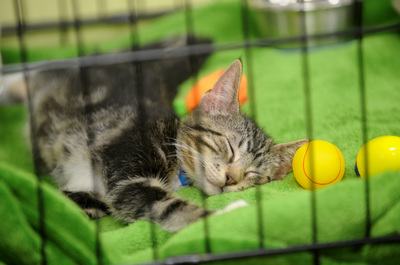
Washtenaw County contracts with the Humane Society of Huron Valley to provide state-mandated shelter for dogs, and to provide shelter for stray cats like this kitten taking a nap at the Humane Society.
Melanie Maxwell I AnnArbor.com
The county has contracted with the Humane Society for 47 years to provide state-mandated services for dogs. At the end of the county’s 2011 contract with the Humane Society for $500,000, county officials re-evaluated their budget and proposed cutting their allocation in half to the organization — but the Humane Society board balked at the low figure.
The two parties worked out a deal for a $415,000 contract to run animal operations for 2012, but the county wanted a better way to evaluate how much it should be paying for the service in the future.
A task force led by the county sheriff was charged with determining the costs of the services provided in the current contract the county has with the Humane Society, while a policy work group led by Commissioner Conan Smith was charged with making a policy recommendation to the county board.
Thursday night, Smith presented three different options to the commissioners to gauge their reactions before final recommendations are made to the board by an October deadline. Present were Commissioners Dan Smith, Alicia Ping, Wesley Prater, Felicia Brabec, Yousef Rabhi and Rob Turner.
The first plan would provide the most minimal services that are required by law:
- Dog and kennel licensing
- Holding unlicensed stray dogs for a period of four business days and licensed stray dogs for seven business days
- Holding dogs, cats or ferrets suspected of rabies for up to 11 calendar days
- Holding dogs involved in cruelty investigations until a judgment is reached
- Euthanizing animals showing symptoms of rabies and at the end of a holding period
- Conducting only the basic, essential animal cruelty investigations
- Medical care to manage only basic symptoms
A second plan, which Conan Smith called “optimal,” would mainly add holding services for cats, as well as the following:
- Door-to-door dog census
- Enforcement of dog and kennel licensing, possibly through the implementation of a future civil infractions ordinance
- A two-week holding period for all animals
- Educational services and follow-ups in cruelty investigations
A third plan would include all of the services of the previous two plans, plus more:
- Cat and exotic pet licensing
- A requirement for a microchip in animals kept as pets
- The holding of all animals until recovered or adopted
Commissioners Ping and Brabec expressed concern about the feasibility of licensing cats, especially in rural areas where farms have many cats running wild on their property.
There were few policy recommendations by the board members present Thursday night, but they asked many clarifying questions.
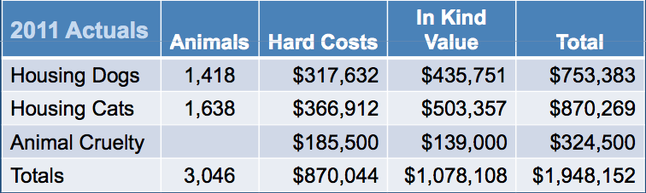
Actual costs incurred by the Humane Society of Huron Valley to house dogs and cats, and to fund animal cruelty investigations, in 2011. In-kind services represent the value of volunteer hours and donations the organization received at no cost.
The Humane Society currently accepts cats and other pets, has no holding limits and provide an educational form of cruelty investigations. Much of the organization’s efforts are made possible even with its decreased budget because of an extensive volunteer program.
Coupled with other in-kind contributions, the county is receiving approximately $1 million worth of free services from the organization, it says
“The HSHV is a good deal,” Turner said.
The Humane Society’s mission and core values have gone above the state-mandated levels of services, making it an award-winning organization with an 85 percent save rate — the highest in the state of Michigan.
County officials have been using Oakland County’s $2.8 million budgeted animal control program as a model. However, the save rate of that shelter is 50 percent, said Jenny Paillon, director of operations for the Humane Society of Huron Valley.
When it comes to the county’s dog licensing program, the purpose is to ensure there is a record of the animal so law enforcement knows if a dog has had its rabies shot as a matter of public health and safety.
County officials state about 11 percent of the dogs in the county currently are licensed, according to metrics used to calculate the amount of dogs per capita.
When county commissioners began discussing impacts of licensing more of the county’s dogs, the talks turned to using the license fees as a revenue stream.
Currently, about 4,000 to 5,000 purchases of a $12 annual dog license and $36 three-year dog license bring in about $52,800 for the county per year. Should enforcement be increased to 18 percent compliance, revenue could be increased to $84,780; an increase to 55 percent compliance would mean revenue of $259,044 — a move Conan Smith said could be a good future funding option for animal control services.
“I would have no problem with increasing compliance, but I am not in favor of adding burdens to pet owners,” Commissioner Dan Smith said.
Countywide dog licensing options were also discussed.
About 65 percent of the stray dogs picked up and housed in the Humane Society come from municipalities that have their own dog license ordinance: Ann Arbor, Ypsilanti, Ypsilanti Township, Pittsfield Township and Superior Township.
The revenue from the licensing programs in those municipalities stays within their local governments, but the county has to foot the bill when dogs from their municipalities wander or are housed during cruelty investigations — something commissioners are adamant about fixing.
The municipalities should have to pay for the animals — at least in part, according to Commissioner Sizemore.
Because of the Humane Society’s award-winning work and cost efficiency through in-kind services, Conan Smith made a strong case for doing away with a request for proposals process for animal control services before the contract with the Humane Society is up Dec. 31.
“The value we receive from the Humane Society for this service is quite extraordinary,” Conan Smith said. “Our best bet is not an RFP, but to do negotiations with the Humane Society.”
Washtenaw County Sheriff Jerry Clayton cautioned the commissioners Thursday that switching to another agency for animal control would disrupt the continuity of services currently in place. Submitting an RFP as a due diligence measure “makes sense,” Clayton said, but stated time is getting tight.
However, due to the wording of the resolution that created both task forces, Commissioners Prater and Rabhi advised that a request for proposals process should be followed.
The animal control task force next meets 3 p.m. Sept 13 in the downstairs conference room of 200 North Main St. in Ann Arbor. The task force is required to submit a recommendation to the board by Oct. 15.
Amy Biolchini covers Washtenaw County, health and environmental issues for AnnArbor.com. Reach her at (734) 623-2552, amybiolchini@annarbor.com or on Twitter.
Comments
Votekeeper
Thu, Sep 20, 2012 : 8:22 p.m.
The Humane Society of Huron Valley is using your emotions to fill their coffers with far more tax money than they deserve for the real services provided. They got $1 million of our money as a gift, and our full faith and credit to bond the $6 million to build. At contract time, they whine and threaten, while our human services agencies have taken far deeper cuts in public funding. From my first hand observation, I seriously doubt that 1,418 dogs were Washtenaw County strays. We know that the organization has been claiming numbers that include dogs from two other jurisdictions they have contracts with. They also bring up hundreds of dogs from Tennessee under a deal with a big pet food company. When a Washtenaw taxpayer needs their help, it is not available. I needed for them to hold a rescue dog until a northern Michigan group could arrange to get the animal. I even asked the animal control Sheriff Deputies to get the animal admitted. They actually told me that even they cannot get strays housed at HSHV now!! I was told to pay for a kennel. And don't even bother to call HSHV about picking up a stray or injured animal. "We don't pick up." Who does? The Sheriff, whose services we also pay for. I think we are getting ripped off by an organization that has become an exclusive club for wealthy donors to feel good about themselves.
Epengar
Sat, Sep 8, 2012 : 6:38 a.m.
I think it's important to note that the Society is spending more money and volunteer time on cats than on dogs. Cat care or management is not required by any of the county's legal obligations, and I don't think county taxes should pay for it. Also, if you divide the hard costs by the number of animals, you'll find that they are reporting the same per animal costs (both hard and in-kind) for both casts and dogs. How can this be? Surely the average dog costs more to take care of than the average cat? I live in Ann Arbor and I license my dog. I wish everybody did.
Treelover
Fri, Sep 7, 2012 : 9:14 p.m.
Please support the HSHV, they along with the sheriff depatment do great work. Please support those that protect those that can not portect themselves!
moai1
Fri, Sep 7, 2012 : 5:48 p.m.
Really, you want to cut a service where you pay less than 1/2 of the real "hard" costs? Think about this - if your neighbor has a cat and is afraid the animal will be put down after a specified holding period, your neighbor may just decide to put the cat outside and let him take his chances. The cat gets bit by a rabies carrying skunk and, because it is oriented toward people - it heads to your 5 year old daughter who then pets the nice kitty, gets bit and ends up with rabies. Or look at the 7 year old in CO who is fighting a case of the plague after encountering a dead animal and the insects around it - do you really want to aid the potential of having more animals on the street that can die in random areas because we are afraid to take them to a shelter that just kills them anyway? This is as serious an issue of public safety as the issue of childhood vaccinations. We cannot be penny wise and pound foolish. Do the right thing - because Ann Arbor should be a Leader of the "right thing"! Any hey, why not allow the shelter to license the animal at adoption (including cats) - and keep 1/2 the proceeds, with the other half going to the county - no new administration needed to handle that one.
Epengar
Sat, Sep 8, 2012 : 6:58 a.m.
You're fear-mongering. Cats do get rabies, but of the 50 human cases of rabies in the U.S. since 1995, not one came from a cat. If rabies in cats was a risk, then we'd have much more to blame the people who feed feral cats without getting them vaccinated. The girl in Colorado got infected by flea bites from a squirrel. Plague is in rodent fleas out west, but has never been found east of Colorado or west Texas. When the county is cutting *human* services, spending hundreds of thousands of tax dollars to board cats doesn't seem like the right thing to do.
Taylor Hulyk
Fri, Sep 7, 2012 : 3:49 p.m.
Anything less than fighting with all we can for the third plan would be a disgrace to our community. We have a facility that is already doing an excellent job of providing these services. If the city could actually pay attention to the ROI of HSHV and still manage to have human compassion, this would not be an ongoing issue. It makes me sick to continue reading these articles that again remind me that there has been no resolution even after months of negotiations.
Tom Whitaker
Fri, Sep 7, 2012 : 3:16 p.m.
I'm appalled that the BOC has spent so much time micro-managing and hacking away at such a critical service being performed by such a capable and accountable organization as the HSHV while happily throwing money at SPARK, with no oversight whatsoever. In fact, they even created a special tax to fund SPARK, with no accountability whatsoever, and Conan Smith even wants to increase the amount. Where is the demand for open books from SPARK? Where is the special committee to pick apart their expenses and recommend cuts? SPARK has seen nothing but increases in funding for years, from the City, County and State, but with nothing to show for it. Time to cut them off and put that money to use on services that actually provide measurable benefits to County residents.
Dilbert
Sat, Sep 8, 2012 : 2:35 a.m.
@Tom: "Take the money from SPARK and give it to HSHV", you might review http://legislature.mi.gov/doc.aspx?mcl-Act-88-of-1913
Tom Whitaker
Fri, Sep 7, 2012 : 9:02 p.m.
Read my post--because I am outraged that SPARK gets a free pass on any accountability, but HSHV is treated as though they were caught stealing from County coffers. Take the money from SPARK and give it to HSHV and two problems will be solved at the same time.
doglover
Fri, Sep 7, 2012 : 8:53 p.m.
Why bring SPARK into this?
aataxpayer
Fri, Sep 7, 2012 : 2:30 p.m.
In an earlier discussion about licensing, the reason for this presumably was to ensure rabies vaccinations and a means for locating a dog's owner. But when I had my dog vaccinated, I was provided with a rabies tag and a number that could readily be traced back to me. To license on top of this seems redundant. What it really seems is an additional tax . The HVHS's new facility wasn't entirely funded privately: part of the land is leased for peanuts from UM (state money) and I believe the county floated a bond for the building of the new facility. Who will pay for the proposed census? What is the legality of this? Will they look through windows to see if there are dogs inside? Will they ask neighbors to provide info about a particular household? Will the census be done when most people are at work?
Ben
Fri, Sep 7, 2012 : 2:07 p.m.
Just a couple of points. 1)the humane society of huron valley is a private non-profit organization that does not receive tax dollars. Your tax dollars do not pay for the shelter. Your tax dollars pay for the county animal control, which contracts the humane society to house the animals. 2)the old shelter was unusable. the building was unsafe for the animals and workers, made proper care of the animals difficult, and was costly to maintain and run. Not to mention, it was shameful for residents of washtenaw to have such an awful home for wayward animals. Your pet might have gotten lost and ended up there. 3)the humane society is trying to negotiate a fair rate at which to house the animals for the county. the county, of course, needs the best value. Price too high? maybe. 50% cut too big? probably. 4)having worked for the shelter, I can say that the shelter and the sheriff's department animal control work together quite well. They are simply two groups trying to do what is right, both with limited budgets.
braggslaw
Fri, Sep 7, 2012 : 1:32 p.m.
Such an agency will always cry poverty.... an not look at improving productivity or efficiencies.
tom swift jr.
Fri, Sep 7, 2012 : 4:18 p.m.
nonsense remark, braggslaw. What is "such an agency"? Such as what? How are they "crying poverty"?. How would you suggest they improve productivity? Do you have anything meaningful to contribute here?
arborani
Fri, Sep 7, 2012 : 2:03 p.m.
HSHV is blessed with a number of faithful - and unpaid - volunteers, who I suspect contribute significantly to productivity and efficiency.
Greg
Fri, Sep 7, 2012 : 1:05 p.m.
1. Seems strange that Ann Arbor seems to have plenty of money for IMHO marginal quality art, but when it comes to something like this claims to have no money. Priorities are wacked by this mayor and his circle. 2. The "nice" building was largly funded by funds raised without taxpayers footing the bill is my understanding. No reason for taxpayers to complain that the building is too nice then that I can see. It didn't cost any more to the public than what it would have for required basics.
Billy
Fri, Sep 7, 2012 : 12:51 p.m.
Look.....didn't the HSHV just spend an EXORBITANT amount of money on their new facility just a few years ago? The facility cost over $8 million dollars......yes most of it was raised funds...but that doesn't excuse or justify poor use of those funds. I've been to the new facility several times and it's a REALLY nice facility. I just question that when they were ALREADY having financial issues for the past decade that they would spend so much money on such a large facility? That alone meant they would raise their daily costs by a LOT....should they not have have accounted for this with all the budget cuts being thrown at them year after year?
kmgeb2000
Fri, Sep 7, 2012 : 1:14 p.m.
Do you remember the old facility? It was really old and insufficiant to meet the demands. You acknowledge it was mostly payed through raised funds so what is your point. Those that donated funds a very pleased with the outcome. Now the BOC needs to get their act together and keep this excellent organization whole. The BOC gave $60K to four manages for nothing other that doing what the rest of the employees have been doing for the last decade - do more with less. But they don't consider that more "responsibility"
CindyY
Fri, Sep 7, 2012 : 11:38 a.m.
Negotiating, in good faith, with the HSHV to provide the organization with a *reasonable* budget to continue their excellent work has always been a no-brainer. It is unreasonable to waste time on an RFP process -- which alternative entity can possibly compete with an award-winning, no-kill shelter that even Conan Smith acknowledges provides approximately $1 million in free services to the community? C'mon County -- cut the navel-gazing & get the job done with the HSHV.
arborani
Fri, Sep 7, 2012 : 5:06 p.m.
Exactly right, jscd91.
jscd91
Fri, Sep 7, 2012 : 3:04 p.m.
I would think most of those killed are either not able to be adopted out b/c of health or behavioral issues, and not just randomly killed. Don't forget not all the animals they intake are perfectly healthy or suitable for human interaction. I think the HSHV's protocol on killing animals (rationale behind when to do this) is sound and in the best interest of both animals and humans. A really sick or aggressive animal needs to be humanely euthanized as opposed to letting them suffer or trying to adopt them out when they are known not to do well with people. A 100% save rate is not realistic or reasonable given the animals they received (sick or non-adoptable).
arborani
Fri, Sep 7, 2012 : 1:56 p.m.
As the article states, the HSHV rescue rate is 85% (compared to, for example, the Michigan Humane Society's rescue rate of about 20%). I would look at the glass as being better than 7/8 full, not less than 1/8 empty.
justcurious
Fri, Sep 7, 2012 : 12:55 p.m.
Aren't 15% killed?
tom swift jr.
Fri, Sep 7, 2012 : 11:17 a.m.
"Currently, about 4,000 to 5,000 purchases of a $12 annual dog license and $36 three-year dog license bring in about $52,800 for the county per year. Should enforcement be increased to 18 percent compliance, revenue could be increased to $84,780; an increase to 55 percent compliance would mean revenue of $259,044 — a move Conan Smith said could be a good future funding option for animal control services." The fallacy here is that this does not reflect the cost of enforcing compliance, which, I suspect, would be more than the revenues brought in. The Human Society is one of Washtenaw County's gems. They do a fantastic job, they reflect the compassion of this community. Slicing services to save money is the cowards way out, how about finding a way to work with the organization to help them secure and raise the funds necessary to do it right?