

Ann Arbor will reap benefits of $150 million grant for high-speed rail from Dearborn to Kalamazoo
(This story has been updated with additional comment from the Environmental Law & Policy Center, as well as Jeff Irwin and Mark Schauer.)
U.S. Rep. John Dingell, D-Dearborn, announced today the state of Michigan will receive $150 million to develop a high-speed rail corridor between Kalamazoo and Dearborn, passing through Ann Arbor, Ypsilanti, Jackson, Albion and Battle Creek.
The funding was awarded through the fiscal year 2010 High-Speed Intercity Passenger Rail Grant Program, Dingell's office said. The U.S. Department of Transportation also announced a second grant for $3.2 million that will pay for planning involved in the project.
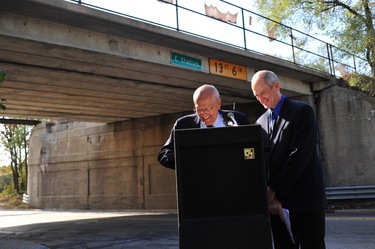
U.S. Rep. John Dingell and Ann Arbor Mayor John Hieftje appeared side-by-side last week to announce a nearly $14 million grant for the Stadium bridges in Ann Arbor. Dingell's office announced more good news for Ann Arbor today.
Ryan J. Stanton | AnnArbor.com
Ann Arbor Mayor John Hieftje said the improvements that will be funded through the grant are a major step forward for the proposed Ann Arbor-to-Detroit commuter rail line project, as well as eventual high-speed rail all the way from Detroit to Chicago.
“The track improvements needed to enable higher-speed rail to run this line are the same ones that have been holding up MDOT’s east-west commuter rail project that we have been working on," Hieftje said, calling the announcement "very good news" for the regional economy.
"MDOT's already put millions of dollars into the commuter rail, and this is the piece that makes it all work," he said. "What the east-west commuter rail has needed is some track improvements in the Detroit area that will allow spaces for the freights and the passenger trains to pass."
Hieftje noted last year's round of federal funding provided money to make high-speed rail improvements in northern Indiana. He said Amtrak already owns the portion of the track from Kalamazoo to Niles, which has been approved for speeds up to 110 miles per hour.
Being able to improve the Kalamazoo-to-Dearborn portion, he said, is one more piece of the puzzle to allow trains to nearly double their speed between Detroit and Chicago.
"This is huge for us," said Terri Blackmore, executive director of the Washtenaw Area Transportation Study. "This will allow this portion of the railroad to get to the higher speed."
Blackmore said the money will allow either the state or Amtrak to purchase a portion of track between Ypsilanti and Kalamazoo from Norfolk Southern and make improvements.
"It's a big win for our state, as well as for the city," Blackmore said.
Eli Cooper, the city of Ann Arbor's transportation program manager, noted the significance of the additional $3.2 million planning grant.
"I think that's as important. When the feds fund plans, that's an indication that they understand that there's more work to be done," he said.
Today’s announcement from DOT follows the announcement in January 2010 that Michigan will be receiving $40 million in high-speed rail funding for train station development.
Dingell has been on the forefront fighting for high-speed rail development in the United States, and was one of the authors of the High-Speed Rail Development Act of 1994.
Dingell said the latest grant will enhance alternative transit options and will help Michigan and the United States compete in the global economy.
"The United States has fallen behind in the development of our transit corridors, witnessing China and Japan take the lead in developing successful high-speed rail corridors," he said. "Rail lines in China, Japan and other countries, have brought added benefits from making communities more livable to attracting new industries and companies. If we are to continue to compete with our neighbors, we must make these critical upgrades in our infrastructure."
U.S. Rep. Mark Schauer, D-Battle Creek, applauded the news today, saying improvements to the 135 miles of track from Kalamazoo to Dearborn will help bring new jobs to Michigan.
"The economic impact of growing our high speed rail infrastructure is tremendous, and this investment will help expand passenger rail capacity, increase the mobility of our workforce, and create more jobs in Michigan for our workers," Schauer said in a statement.
Schauer worked with Dingell and the DOT to help the Michigan Department of Transportation secure the funds. Schauer is a member of the House Transportation and Infrastructure Committee and its Subcommittee on Railroads, Pipelines and Hazardous Materials.
He said the improvements will stabilize the Dearborn-to-Kalamazoo corridor and restore intercity passenger rail speeds to 79 mph, with a plan to eventually reach up to 110 mph.
Washtenaw County Commissioner Jeff Irwin, who is heavily favored to become Ann Arbor's next state representative in Lansing, also applauded the news.
"In order for high-speed rail from Detroit to Chicago to happen, there needs to be a substantial upgrade to the rail infrastructure," he said. "Since that rail infrastructure is the same for Ann Arbor-to-Detroit as it is from Kalamazoo to Dearborn, this means better facilities for commuter rail between Ann Arbor, the airport, Dearborn and Detroit.
"The two concepts feed off of one another and an investment in tracks, signals and stations that facilitates one project is a boost for the other."
The Chicago-based Environmental Law & Policy Center, a group that calls itself the Midwest’s leading environmental legal advocacy and eco-business innovation organization, issued a statement of its own today in support of the grant.
"The state that led America to the ‘Century of the Automobile’ is now moving forward with high-speed trains,” Howard Learner, the group's executive director, said in a statement. "Michigan manufacturers, steel fabricators and parts suppliers are among the biggest beneficiaries of a revitalized rail industry that will 'buy American' and create thousands of new jobs. This high-speed rail development will improve mobility, reduce pollution, create jobs and grow Michigan’s economy. It's part of a structural transformation of our rail system."
The ELPC said the grant is one of several the federal government will announce this week as it rolls out the second round of competitive funding to develop high-speed rail corridors across the nation. Based on Congressional announcements today, the ELPC said, the largest recipients appear to be Florida at $800 million, California at $902 million, and the Midwest, which is expected to receive $230 million for Chicago-to-Iowa City improvements in addition to the $150 million for the Dearborn-to-Kalamazoo improvements.
Currently, the Obama administration has invested $10.5 billion in high-speed rail projects, with an additional $1 billion pledged for each of the next four years. The House Transportation Committee also has recommended including $50 billion for high-speed rail development in the upcoming transportation reauthorization legislation.
"President Obama recently proposed funding increases for high-speed rail as part of $50 billion in proposed infrastructure improvements," the ELPC said in its statement today. "Under that initiative, high-speed rail would be put on an equal footing in the federal surface transportation program. This fundamental policy change would ensure a sustained and effective commitment to a national high-speed rail system over the next generation. Specifically, the proposal calls for the nation to build and maintain 4,000 miles of rail."
Ryan J. Stanton covers government and politics for AnnArbor.com. Reach him at ryanstanton@annarbor.com or 734-623-2529.
Comments
Samantha
Sun, Oct 31, 2010 : 11:50 p.m.
I recommend watching this 6' video by an MD: Dr. David Janda explains rationing and why Dr. Rob Steele must defeat Dingell http://www.youtube.com/watch?v=8HnkxIh62dQ
maallen
Fri, Oct 29, 2010 : 7:18 p.m.
When Dingell created the mess, he needs to be held accountable. There are many others to blame, but it does no one any good here in the 15th District. Dingell is in our district, so he needs to be held accountable. And yes, you do need to stay focus. We are talking about Amtrak here. Not about all these other "subsidies." That's for another day and another topic. In regards to the Amtrak mess, Dingell was part of it, still is part of it, and it needs to stop. He keeps throwing money at it hoping, somehow, someway, it will be fixed. It hasn't been fixed since Dingell has been around. So we need to try something new. Something different since the old way hasn't worked. There's nothing I can do about the other republicans or the other democrats. But Dingell happens to be in my District so there is something I can do about that, and that is not to vote for him. Dingell's old ways don't work in the new economy. We need change. Time for Dr. Steele.
ahblid
Thu, Oct 28, 2010 : 8:48 p.m.
maallen, When the highways were created, we were told that they were for the Military. Don't see many military conveys these days. And the military doesn't need anything more than a 4 lane highway, 2 in each direction. So the users of those highways that have forced us to build 6, 8, 10, 12 lane highways should be paying for that luxury. Next, we subsidize the airlines. Have done so for years. Why aren't they charging more? Collectively the airline industry over the last 40 years has lost more than $10 Billion. That's despite subsidies, things like interest free loans and grants after 9/11, an ATC system that the taxpayers pay for, pilots trained in the military, military technology that ends up in commercial planes. The focus here is that all forms of transit require subsidies to survive. Amtrak is no different. Yes, President Nixon's advisors sold him the lie that they were going to make Amtrak profitable, but that was never a reality. They didn't even try. If they had tried, then the Government would have brought Amtrak all new equipment to start with, instead of giving them the run down hand me downs from the freight RR's. And as long as Amtrak remains a Federally owned corporation any failures remain the fault of the Fed. If the Fed stopped interfering in things, perhaps Amtrak might be able to make an operating profit. But it will never cover its capital expenses. No RR in the world does that. They all run on subsidies of some form. And blaming Dingell isn't going to change that. Especially not when even when the Republicans in control, they continue to subsidize Amtrak.
maallen
Thu, Oct 28, 2010 : 4:31 p.m.
ahblid wrote: "Then I guess we should stop throwing money at the highways too, since we haven't fixed that problem either." Stay focused: When highways were created, they weren't designed to be self sustaining. However, as I have repeatedly stated, when Amtrak was created by the government, it was set up/designed to be self sustaining, meaning it wouldn't need to rely on the taxpayers to bail their operations out year after year. The passengers who ride Amtrak pay a fee to use it. If Amtrak can't be self sustaining then instead of throwing taxpayer money toward it, maybe they should increase their ticket prices? Maybe they should do something else? But obviously throwing more of the taxpayer dollars toward it isn't solving the problem. Years of Dingell throwing our money toward it hasn't fixed it.
ahblid
Thu, Oct 28, 2010 : 3:41 p.m.
maallen wrote: "Wouldn't it be obvious by now to Dingell, that we can't keep throwing money at things expecting it to fix the problem?" Then I guess we should stop throwing money at the highways too, since we haven't fixed that problem either. After all, we're spending 25 times as much on the highways as we are on Amtrak. So if we want to cut taxes and/or the deficit, we'd accomplish so much more by killing the big ticket items first.
maallen
Thu, Oct 28, 2010 : 3:33 p.m.
ahblid, You completely missed the point. Dingell has been throwing money at Amtrak since it began. Stay focused here. I am not denying what the republicans did or did not do. This is about what Dingell has done. Each time the money wasted on Amtrak grows and grows. When does the insanity stop? Wouldn't it be obvious by now to Dingell, that we can't keep throwing money at things expecting it to fix the problem? That's what career politicians, Dingell, likes to do. They think by throwing more money at it, the problem will go away. When Amtrak was created, it was to be self sustainable. It's not and hasn't been since 1971. Throwing more taxpayer dollars at it isn't going to solve the problem. It's time for new ideas. It's time to send someone there who will hold the government accountable. Not someone who keeps doing the same thing over and over.
ahblid
Thu, Oct 28, 2010 : 3:17 p.m.
maallen, And my earlier point is that the Republicans will do the same too, that being appropriate the money to Amtrak. So stop making this a Democratic issue! President Chaney tried to kill Amtrak with that zero dollar budget for Amtrak. The Republican controlled Congress said NO! Twice! Both in 2005 & 2006.
maallen
Thu, Oct 28, 2010 : 2:48 p.m.
ahblid, I understand how "authorization bills" work. But the point you are missing is, if the democrats remain in control, they will keep spending it. CBO suggested to carve 200 million out of their budget. Dingell and the democrats caved and refused to do that. The issue of Amtrak losing money every year since 1971 needs to be fixed. Since 1971, what has Dingell done? He has just thrown more money at it. Under the democrats, besides getting 1.5 billion this year, they got an additional 1.3 billion. What do you think will happen next year? Going on past record of Dingell and democrats, at the minimum spending will be the same as this year, but it could even be higher next year. When does the insanity stop? It is quite obvious throwing more money isn't fixing it. Dingell is part of the problem. He's not the solution Since 1971 he's had chances to fix Amtrak, and has failed miserably. It's time to give someone else the job, who has lived here and is from our community, and to hold our government accountable. Dingell has lived in Washington since he was 9 years old. A lot of things have changed since then.
Mumbambu, Esq.
Thu, Oct 28, 2010 : 2:26 p.m.
@ERM Ghost- you are on fire! Way to be.
ahblid
Thu, Oct 28, 2010 : 1:45 p.m.
maallen, With the utmost respect, which part of "this is only an authorization bill" did you not understand? The Democrats only passed a plan. THEY DID NOT CUT A CHECK! Yes, they did appropriate the first check for this year to Amtrak. But next year Congress must appropriate the second check. And come 2012 once again Congress must actually appropriate the third check. And so on for 2 more years. And each year that Congress takes up the debate on what to appropriate they can decide on an amount that is lower than the "plan" or they can decide to give an amount that is higher than the plan. But Amtrak is NOT GUARANTEED $1.5 Billion for each of the next 5 years. Congress must authorize the actual expenditure each year and Congress does not have to follow the plan!
maallen
Thu, Oct 28, 2010 : 12:37 p.m.
How convenient of you to leave out this: democrats, in October of 2008, gave Amtrak $1.5 billion dollars per year for the next 5 years. And they get an additional $1.3 billion through the American Recovery and Reinvestment act. Doesn't look, sound, or feel like they cut Amtrak's funding at all. It looks, sounds, and feels like they actually increased it! In 2009, the Congressional Budget Office suggested to reduce the funding to Amtrak by $200 million. Amtrak, its unions, and its lobbyists put pressure on Dingell and congress and said it would cease to exist without federal subsidies. Dingell caved and decided to increase their budget.
ahblid
Thu, Oct 28, 2010 : 10:52 a.m.
Maallen, The Bush White House sent a budget to Congress with zero dollars in funding for Amtrak. The Republican controlled Congress said "No Mr. President, this country is going to fund Amtrak." And they restored the funding for Amtrak in the budget that they passed. That left the Bush White with 2 choices, sign the budget or shut down the country. And once again, there is a big difference between an authorization bill and a appropriations bill. The first is nothing more than a plan, a proposal. It's a guideline for the future. But Amtrak receives no money because of that authorization. Each year Congress must look at that "plan" and decide if they actually want to appropriate the funds indicated in the plan, or if they wish to raise or lower then amount indicated in the plan. An appropriations bills actually causes the check as it were to be printed. An authorization bill moves no money.
maallen
Thu, Oct 28, 2010 : 10:14 a.m.
@ahblid said, "Second, it's not just the Democrats that support Amtrak. Back in 2005 & 2006 the Bush White house provided a budget that included zero dollars in funding for Amtrak." Huh? Can you run that by us again? Either the bush white house supported amtrak or it didn't. You say they did, but then turned around and said they gave zero dollars in funding. You are correct, congress authorized that money, aka, gave that money to Amtrak. "It's also interesting to note Amtrak's biggest cuts have actually occured during Democratic administrations; not Republican ones." So, if the democratic administration cut Amtrak spending then how do you explain this: Democrats, in October of 2008, gave Amtrak $1.5 billion dollars per year for the next 5 years. And they get an additional $1.3 billion through the American Recovery and Reinvestment act. Doesn't look, sound, or feel like they cut Amtrak's funding at all. It looks, sounds, and feels like they actually increased it! In 2009, the Congressional Budget Office suggested to reduce the funding to Amtrak by $200 million. Amtrak, its unions, and its lobbyists put pressuer on Dingell and congress and said it would cease to exist without federal subsidies. Dingell caved and decided to increase their budget. This is a program that hasn't been able to sustain itself since 1971. When it was created, it was supposed to sustain itself. It hasn't. So, either we cut the wasteful spending toward this program, or maybe we should just raise the ticket prices so that it becomes self sustainable! Dingell is part of the problem. He thinks spending more money will solve these issues. He's tried the same routine for the past 55 years. It hasn't worked. And another 2 years for him isn't going to make things work either. Time for Dingell to be voted out.
Booradley
Thu, Oct 28, 2010 : 8:55 a.m.
So who of you will be giving up your salary to pay for this Dingell pork project?
Ray D. Aider
Thu, Oct 28, 2010 : 12:30 a.m.
110 MPH? No hobos gonna be jumping that bad boy.
ahblid
Wed, Oct 27, 2010 : 8:57 p.m.
DonBee, It would be great if I could look at the report, don't suppose you've got a link? However, even without seeing that report I can already tell you that it's inaccurate. GAO reports are often written so as to support the conclusions wanted by the requesting Congressmen. I know that it's inaccurate because railroads, subways & buses are funded via the Mass Transit Fund and not from the Highway Trust Fund. As for the highway spending, I do agree that last year part of the funding was indeed Stimulus monies. However, part of it was not. There was an $8 Billion short fall in in fiscal 2008 and a $7 Billion short fall in fiscal 2009. It's that $7 Billion coupled with $27.5 Billion in Stimulus funds that led to the $34.5B. In the just now completed fiscal year, with no Stimulus monies involved the Fed had to transfer $19.5 Billion into the HTF to keep it solvent. Interestingly enough, it was former Republican George Bush's White House that warned the then Republican controlled Congress that they were outspending the income from the HTF. He still signed the bill giving us the spending plan that just expired this past year. http://www.washingtonpost.com/wp-dyn/content/article/2008/09/05/AR2008090503525.html
DonBee
Wed, Oct 27, 2010 : 7:54 p.m.
@ahblid - And according to the Government Accounting Office, more than $78 Billion in Highway Trust Fund money was redirected to non-highway purposes from 2004 to 2008, including railroads, buses, subways, bicycle paths and more. It makes great reading. In FY2009 and FY2010 you can point to the Stimulus bill for the additional funds spent on the highways as "shovel ready infrastructure projects" that enhance employment. It is according to the administration an extraordinary time and required extraordinary measures. In FY2011 (Which started 1 Oct 2010) we are back to pure highway trust fund money from the Federal Government, except for projects that were not really "Shovel Ready" An interesting aside, the same Stimulus Bill that helped rebuild highways, helped rebuild fix the right of way for the NAPA Valley Wine Sightseeing Train. Of that $78 billion that was paid for by user fees (gas taxes, tire fees, etc.) - more than $2.5 billion was spent on bike paths.
ahblid
Wed, Oct 27, 2010 : 7:14 p.m.
Many people have mentioned funding for the roads and airlines in their posts. Here are the facts. Last year, just at the Federal level, this country spent $69.116 Billion on its highways. Of that amount, the "users" (aka, the drivers) paid $34.616 Billion of that amount via the Federal portion of the fuel tax, tire taxes, and other items. The remaining $34.5 Billion came out of the General fund. That represents a 50% subsidy to our highways. Everyone had $112 taken out of their pockets towards the highways without regard to whether or not they actually own a car, much less can drive a car. And seeing as how at least 25% of nation is either too young to drive or now unable to drive due to their age, that's a lot of people who don't own cars. And there are plenty of people living in cities who also don't own cars. Most cities, counties, and states further subsidize the roads & highways.
ahblid
Wed, Oct 27, 2010 : 6:56 p.m.
Maallen wrote: "But thanks to the Democrats, in October of 2008 they gave Amtrak $1.5 billion dollars per year for the next 5 years. And they get an additional $1.3 billion through the American Recovery and Reinvestment act." Let's try a dose of reality here. First, Congress authorized those amounts for Amtrak. But those amounts are not appropriated. Each year Congress must still actually vote to provide those recommended amounts. Second, it's not just the Democrats that support Amtrak. Back in 2005 & 2006 the Bush White house provided a budget that included zero dollars in funding for Amtrak. An interesting choice since Governor George Bush publicly stated that funding Amtrak was a Federal responsability, but that's another discussion. It was the then Republican controlled Congress that said NO! They continued funding Amtrak at levels of $1.3B to $1.4B. It's also interesting to note Amtrak's biggest cuts have actually occured during Democratic administrations; not Republican ones.
DonBee
Wed, Oct 27, 2010 : 5:49 p.m.
@C - Compared to Any of the New Jersey stations, Any of the New England stops or any of the California Stops, it is not very busy. Take a look at maallen's numbers. 1300 riders a day is a good start, but having ridden Washington DC to New York a couple of weeks ago. There were probably 1300 people on the single train I was on and it was the low speed train on that route. I ride trains routinely in Europe, and I have gotten on and off in Kalamazoo. Frankly I am not impressed with Kalamazoo by comparison. I ride to and from Arnheim regularly on the Intercity train - at 9 AM (well after most people have gone to work) the train has 800 to 900 people on board for a 3 stop run (Amsterdam, Utrecht, and Arnheim are the major stops). We need to re-think rail, I am not against rail, but if we want to drive ridership, we need to think about how to do it. The Intercity offers, room to move around, areas for bicycles, quiet areas and tables to read or work at. Most trips take less than 40 minutes. On the TGV with trips running up to 3 hours, there is at the table meal service, two classes of tickets and WiFi on board the trains. We could learn from the Dutch, they have done an even better job with trains than the French or English. In some places there are 8 or 9 sets of rails side by side for different classes of trains. The Dutch stop trains (yes that is the literal translation of the names) stop every kilometer or two, they pick up locals and have lots of room for shopping bags, trolleys and bicycles. The Intercity trains run between major stops. The Stop trains use the same stations, so you just cross platforms to change trains. The TGVs are in the same stations as well, again crossing platforms. Then the trams and trolleys are normally right out the front door as are massive bicycle racks. Taxi stands and buses are also integrated into the stations. None of the bus is across the street, the subway is two blocks down and the taxi stand it on the corner. Places to shop and eat are integrated into the real stations (mostly intercity stops). Many of the village stops are nothing more than a raised platform, you can buy your tickets on the web, in the station or in some cases (this is the part that bugs me) on the train. In most trains you cannot buy a ticket. Trains are great, if they are integrated into the structure of society, there are routes you want to ride and the flow of passengers is going in both directions most days. Short of that, you have issues with keeping the ridership up. Oh, and most European towns are compact, compared to US towns, so it is easy to get around on foot or by bicycle. Most European countries are small enough that a train will get you from corner to corner in a couple of hours or less. Think about the train it would take to go from Miami to Seattle in a couple of hours. Scale has an impact on ridership.
C
Wed, Oct 27, 2010 : 11:19 a.m.
A few clarifications from Kalamazoo: - stunhsif: Pfizer still employs nearly 3,000 people in Kalamazoo - DonBee: The Kalamazoo Amtrak stop is Michigan's second busiest - mallen: Last I checked, roads aren't making money either - C.S. Gass: Bell's cafe is in downtown Kalamazoo, Amtrak doesn't stop at the brewery in Comstock - cinnabar7071: 95% probably use roads, but that usage is likely matched by 95% of the transportation budget
Plubius
Tue, Oct 26, 2010 : 10:21 p.m.
What an absolute waste of money. Anyone who thinks that this will benefit anyone other than the (politically connected) companies who 'win' the contracts and the over-paid union workers who perform the work are seriously kidding themselves.
Mick52
Tue, Oct 26, 2010 : 5:58 p.m.
I question the need. Ed the ghost tell us the train to Chicago is packed, but how critical is the need for this not really high speed train to Chicago? How important is a Det/Chi train? I think $150 mill into local mass transit would work better for and serve more people. Keep in mind that gas prices are rising and will continue. Thus investment in mass transit when you can get it may turn out to be a great idea, but when gas tops $4/gall I would be looking for a train from Chelsea to A2 for everyday commuting rather than a Det/Chi for the occasional shopping trip. Yahoo news has a link to a story on a Chinese high speed train today. It will cruise at 220 mph. Like Ed said, the tracks are far different. So the Dingell/Shauer train, which I hope they take when they leave office is not really a high speed train. Those cost multi billions. http://news.yahoo.com/s/ap/20101026/ap_on_bi_ge/as_china_engineering_marvels_2
fisherman
Tue, Oct 26, 2010 : 2:25 p.m.
This is indeed an exciting development. It is about time that our area has acess to high-speed rail. This is really good news, and many congratulations to Reps. Dingell and Schauer, who really work for their constituents.
Jim Rogers
Tue, Oct 26, 2010 : 1:05 p.m.
150 Mil = engineering firm retainer!
John
Tue, Oct 26, 2010 : 12:41 p.m.
Great news! Infrastructure here in our back yard is beneficial on multiple fronts! Dingell would win easily against his opponent, even without the recent awards, so some here need to get a grip on their "outrage." Also, the award schedules were not determined or set by Dingell, so there's no point blaming him for this pre-election news. More importantly, in competitive grant applications there are both winners and losers, so Dingell could have come up on the short end right before the election. But he didn't. And we need his clout to continue fighting for these types of awards in our region.
Speechless
Tue, Oct 26, 2010 : 11:43 a.m.
The scale of taxation necessary to support road construction is massive. Should anything close to that level of public investment ever be applied to long-distance trains, as well as to various badly-underfunded forms of urban mass transit (commuter rail, buses, trolleys, bike paths/lanes, and pedestrian amenites), we will have overlapping modes of public transport which are ubiquitous and cheaper to use. To get this going, very large subsidizes will be necessary — just as has been the case historically for auto travel. Quoting from a comment further above: "... Gasoline and Diesel Fuel taxes (and for some vehicles - road fees) pay for the roads. Taxes on airline tickets pay for airports and the air traffic control system. Both forms of transportation have enough critical mass that they basically self fund...." While fuel taxes do generate revenue support through proportional usage, they remain tax subsidies nonetheless. Although arguably "self-funding" today, this type of financing mechanism could not have been self-sustaining early in the last century, when automobiles were too few in number to underwrite widespread road widening and paving projects through taxes on vehicle use alone. Units of government had to front big money over a period of time to support and promote increased travel by horseless carriage. Nearly a century later, it's high time we do the same for mass transportation. Other nations have moved forward to build these services on a large scale.
StrongFire
Tue, Oct 26, 2010 : 11:30 a.m.
A good project, but unfortunately sullied by Congressman Dingell's attempts to buy votes as election day approaches.
maallen
Tue, Oct 26, 2010 : 10:21 a.m.
The fact is Amtrak has been losing money. 41 of its 44 routes are money losers. But thanks to the Democrats, in October of 2008 they gave Amtrak $1.5 billion dollars per year for the next 5 years. And they get an additional $1.3 billion through the American Recovery and Reinvestment act. Since 1971, Amtrak has been receiving an operating subsidy because it has never been fully self sustaining! Thanks Mr. Dingell, more wasteful spending. In 2008 it lost $1.1 billion. In 2009, the Congressional Budget Office suggested to reduce the funding to Amtrak by $200 million. Amtrak, its unions, and its lobbyists put pressuer on Dingell and congress and said it would cease to exist without federal subsidies. So Dingell caved. Dingell keeps throwing money at this fiasco! The Michigan Service, which has 3 lines: The Pere Marquette, The Wolverine, and the Blue Water all have lost money. The wolverine lost $14.7 million with 472,393 riders per year. It's only an average of 1,300 riders per day. That is not very much. The Pere Marquette lost $1 milliion with 111,716 riders per year. It's only an average of 306 people per day. Yikes! The Blue Water lost $2.4 million with 136,538 riders per year. It's only an average of 374 riders per day. Wow! We need to cut back on spending and investing on things that don't work! Dingell is part of the problem.
woodsyh
Tue, Oct 26, 2010 : 9:48 a.m.
I'm not sure what % of the tracks that Amtrak owns, but look a little closer.....it's been reported elsewhere that this is for infrastucture to the rail system owned by Norfolk Southern. What that means is that the Amtrak trains will be able go get to their waiting points much faster while the freight traffic will still have priority. The trip time between points East and Chicago probably won't change much. I belive that most high speed rail lines in the rest of the world operate on their own tracks. $150 million is chump change compared to what is really needed to make this a reality. I'm guessing billions. Except in dense urban areas, rail and other forms of public transportaion just aren't economically viable, but we'll save that discussion for another time.....
Larry S
Tue, Oct 26, 2010 : 9:07 a.m.
Criticism is always good. It's the check to make sure we're on the right track. I like to read the comments section on AnnArbor.com because a few people actually have an intelligent response that goes a step beyond repeating the ratings-motivated rhetoric of their favorite talk show host. Amtrak ridership in Michigan has broken records for the 2009-2010 fiscal year. More people are using Amtrak than ever. ( http://www.marp.org/?p=2390 ) As a matter of fact, Amtrak has even added more cars, when possible, to their trains in Michigan and sold out all of the seats. If the Amtrak line between Pontiac and Chicago wasn't restricted by politically-set budget limitations, there is enough demand to add more trains each day and they would also sell out. Another misconception to clarify is the issue of road crossings. I have not looked at the actual appropriation but I gather from this article that most of this money is going to be spent on track configurations such a passing tracks and switches. The intention is to allow capacity for passenger and freight trains to travel between stations non-stop instead of waiting for another train to clear the track before proceeding. In the future, money will need to be spent to design road crossings, crossing signals and tracks signals to allow the train to safely increase its speed safely from 79 mph to 110 mph between Dearborn and Kalamazoo. The section between the Michigan state line and Kalamazoo is already capable of 110 mph. Oh yeah, there's another misconception. The train between Kalamazoo and Dearborn travels at 79 mph unless there is another train blocking the way which is the purpose of this project. Here's a question for the critics: Why do you suppose the Europeans and the Asian nations are building high speed rail systems instead of freeways and airports? Because they looked at the cost and high speed rail between cities is the most cost effective use of their tax dollars. (Yes, ALL transportation projects need tax dollars, it does not matter what country you are in.) You see, European and Asian countries cannot borrow massive amounts of money like the U.S. can and need to be more frugal with money they receive. The U.S. can borrow massive amounts of money because the rest of the world knows how industrious and hard-working Americans are and that we pay back our debts. We will loose this edge over the rest of world if we continue pouring too much of our gross national product on costly freeway projects. Rebuilding I-94 between Detroit and Chicago will cost tens of billions and will only have a useful lifespan of 25 years before it is worn out and outdated. Rail improvements can last a century with proper maintenance.
DonBee
Tue, Oct 26, 2010 : 8:38 a.m.
Gasoline and Diesel Fuel taxes (and for some vehicles - road fees) pay for the roads. Taxes on airline tickets pay for airports and the air traffic control system. Both forms of transportation have enough critical mass that they basically self fund. Airlines added fees to avoid the taxes and keep more of the money themselves, while keeping the advertised fares down. Cars and trucks will have ever increasing milage and use less fuel per mile if the government regulations are followed. That means less money for roads. Most mass transit money comes from the taxes and road fees, it is a set aside from those funds. Some comes from other sources, but since the "Highway Trust Fund" had a surplus 20 years ago, the members of Congress decided that leaving that money sitting around for the purpose it was collected, that they would change the law. Railroads are almost all private, the rights of way, the tracks, the rolling stock is owned by private companies. They don't have a lot of hidden fees. Mostly they move freight, and they do it very well. Burlington Northern in the 1990's on any given day did not know where between 1,000 and 5,000 cars they owned were. Today that number is around 100. Railroads are very energy efficient compared to other forms of transportation, way better than buses - if the train is full. I have riden Ann Arbor to Chicago and back several times. In almost every case there has been a track related delay on the run. Meaning that I could have driven in less time. I think reliability is important to get people on any mass transit. So is comfort and safety. Neither Dearborn nor Kalamazoo is a major passenger hub. Most of the traffic on the weekends will be to Chicago to shop and have fun. Detroit does not have the same pull for people Chicago does. Trains are old technology, even TGVs are now over 25 years old. China is going for even faster trains. Having ridden the Chunnel trains in Europe and from Paris to Amsterdam, I can tell you that you can equal the speed of flight if you need to be in a center city by train at 200 to 300 miles. Even 400 miles is close. But as Top Gear has shown over and over again in Europe, the car, well planned still is faster and more flexible for travel. To get to the point where trains offer what people what for long distance travel we need to re-think them. A grand plan, like the National Defense Highways, could energize the voters and jobs. Even the Tea Party might jump on board a really big idea. After all they endorse smart grid.
Steve Hendel
Tue, Oct 26, 2010 : 8:34 a.m.
@speechless & others: Two points which seem to have been forgotten in these comments: 1. Whether or not roads and road transportation is indeed subsidized by taxes depends on how you define "subsidized." In fact, road users (autos, trucks, etc.) pay a large amount in taxes (state and federal fuel taxes, state license plate registration fees, state sales tax on fuel) more or less in proportion to their road usage; this is over and above tolls paid on roads usually built with debt financing. I wouldn't call those taxes a subsidy for roads any more than my water/sewer bill is a subsidy to the utilities system. 2. Yes. I too have been on the AA-Chicago train when it was crowded, but also when there were numerous empty seats. I'd like to see year-to-year ridership statistics before I give credit to anecdotal evidence about how packed the trains are. In any case, are not the very reasonably priced fares on the AA-Chicago run themselves already subsidized by general tax revenues-not user fees? Just asking.
Speechless
Tue, Oct 26, 2010 : 8:06 a.m.
This is great news and a big step toward providing a real public service on the rail lines between Chicago and Detroit. It's something that's been badly neglected for a long time, while government money subsidized auto travel. The $150 million outlay for this upgrade to high-speed rail amounts to a drop in the bucket compared to tax-financed welfare for road and bridge construction. Roads are "socialist" public works projects that do not pay for themselves (except for turnpikes, maybe), yet over and over we continue to hear the same basic talking point directed at all forms of public mass transit: "... How will my kids pay for my nursing home when they have this debt to repay?" "... Another giant helping of pre-election pork for the public sector. Don't worry, it's only your grandchildren who will have to foot the bill." By taking the above logic only one step further, we should only fund public road repair through bake sale proceeds or Unted Way donations — not taxes. Or live close enough to work and shopping that we can always walk. Oh, and if we actually do care at all about leaving big debts behind for the grandkids, how does public rail travel compare to those little wars in Iraq and Afghanistan, which have soaked up a trillion dollars or thereabouts in federal tax money? Or those ultra-generous federal handouts every year which provide multiple billions to (primarily) underwrite the military budget in foreign lands such as Egypt, Israel, Jordan, Colombia and Pakistan? Maybe these are the best use of tax money ever, and nothing to seriously question?
Martin Church
Tue, Oct 26, 2010 : 7:31 a.m.
This is another 150 million pork barrel project for another Bridge to nowhere. if rail was the saviour of our area we would see an increase of people riding the existing amtrack system from ann arbor to Dearborn and back. But right now the trains are empty. This grant will now allow us to move empty trains at a faster rate. So no income in and a whole lot of money out of our pockets. we can now spend 60 dollars a day to travel from ann arbor to Dearborn. Let's see that's 15600 a year for train travel. hey guess what that is the price of a small car. A car that employs several hundred workers. Thanks Dingell I am still unemployed so we can run empty trains.
Do not taunt Happy Fun Ball
Tue, Oct 26, 2010 : 7:04 a.m.
Just another 'Homer Simpson Mono-Rail' Rail project that, in the end, will take twice as long as expected to finish, cost three times as much as initially projected (try that in the private sector!) and suck four times the estimated operations cost - which will be covered by your tax dollars every year to operate. The plan's projected costs are based on 'what will pass public scrutiny' - not actual costs. But don't get me wrong - I love rails. No one will ride - and you will pay. The Amtrak routes from Chicago to Port Huron and Grand Rapids consume a state subsidy of $7.1 million per year.(2004) The New York Times reports that Greece's Hellenic Railways is bleeding red ink at a rate of $3.8 million per day.(2010) So it will be with this project.
Chase Ingersoll
Tue, Oct 26, 2010 : 6:41 a.m.
High speed rail taste on a Mega Bus budget. I'm skeptical of the economic analysis. I don't see the density of population or employment opportunities that will require daily transportation of workers over these distances to create the demand for tickets at a price that will not require continued subsidization of the operation. Further, the subsidy will come from users of other modes of transportation (cars, buses, airplanes). Historically rail succeeds where there are dense population centers and air and vehicular traffic between these centers has not yet been developed i.e. Europe and Japan. Rail was developed in the US....prior to the development of the auto and interstate system. The money, if even needed, would be better spent on the development of renewable fuel systems and materials and techniques that would improve the the durability of highways.
treetowncartel
Mon, Oct 25, 2010 : 11:42 p.m.
Maybe Mr. Dingle can also get credit for the advent of medical marijuana, and all the fruits of the harvest, the kolas and buds that are sold, can now be referred to as Dingle Berries.
stunhsif
Mon, Oct 25, 2010 : 10:01 p.m.
A last ditch effort by Obama and Dingleberry to pull one out of their "dark side". What an absolute joke and waste of eveyone's money. This one is worse than that road up in Alaska to "no where" folks. Dearborn to Kalamazoo, even Pfizer pulled out of K'zoo. From K'zoo to Chicago the train slows down to 60 mph and no one rides the stupid thing to or from Chicago. Dumb and Dumber for certain! No better reason to get rid of this walking dinosaur/parasite named John Dingell.
a2badger
Mon, Oct 25, 2010 : 9:23 p.m.
The first comment by maallen summarized it best! A week before election day, Dingell announces his latest "$ Pork for votes"; after a similar announcement last week regarding the Stadium Ave. Bridge. What a GREAT guy! The money will come from?....your children, your grandchildren. Dingell & Obama will just print a little more.
Marshall Applewhite
Mon, Oct 25, 2010 : 9:08 p.m.
Hmm.....this idea doesn't seem to make any sense. My car is capable of doing more than 120 MPH, and there are no longer highway speed traps due to the Feds dropping a giant wheelbarrow of money onto state governments. I'll stick to the roads, thank you very much. Marshall=1, Suckers=0.
InsideTheHall
Mon, Oct 25, 2010 : 8:35 p.m.
Boat loads of money and no business plan. Show us how we the taxpayers get a return on our investment. Moving Corn Flakes from Battle Creek to Dearborn faster won't cut it!
David Cahill
Mon, Oct 25, 2010 : 8:30 p.m.
This is indeed great news! Bringing home the money is part of "constituent services". Dingell and Schauer both deserve re-election.
blahblahblah
Mon, Oct 25, 2010 : 8:03 p.m.
Take a look at the bigger $2.5 billion picture here: - $800 million was awarded to FL, bringing the Tampa to Orlando project total up to the $2 billion earmark. Still needs another $300 million. - $902 million was awarded to CA, for a grand total now over $3 billion and $10 billion in CA bonds to be issued. - $203 million was awarded (according to Iowa's governor) connecting Iowa City and Chicago. Oh yeah and $150 million upgrading the lines between Dearborn and Kalamazoo.
AlphaAlpha
Mon, Oct 25, 2010 : 7:26 p.m.
You are reading way too much into a simple statement: the benchmark for high speed rail is 350 mph. If you wish to read more into the post, you are welcome to.
AlphaAlpha
Mon, Oct 25, 2010 : 6:57 p.m.
Eddie - It's nice to know we can rely on you to respond to a tangential, irrelevant, or even non existent point, in a comment. The TGV was mentioned to establish a frame of reference for speed; no facts in that post are incorrect. If you wish to believe that a cited fact is incorrect, you may, but please address those ideas directly, without introducing tangential topics.
Diagenes
Mon, Oct 25, 2010 : 6:38 p.m.
They cannot think outside the box, they are politicians.
DonBee
Mon, Oct 25, 2010 : 6:12 p.m.
Once again pouring money into Roman Cart Tracks! If we really want to change mass transit, we should rethink the railroad from the ground up. Do we really have the right gauge (distance between tracks) - trains have become very top heavy as several storms this month have proven. Do trains that carry only people the right answer? The auto-train on the East Coast is very popular, even though it takes hours to load it. I wonder if we could load it in minutes if it would be even more popular. With the advent of electric cars, auto-trains that are all electric and can charge car batteries becomes an interesting idea. But our government sinks money into an ancient idea. Want to revitalize the economy? Want a real chance to build it all in America? What to put engineers to work? Think outside the box. I dare you to!
YpsiBronc
Mon, Oct 25, 2010 : 5:21 p.m.
BREAKING NEWS.... Dingell announces $200 million federal grant to expand runways at Ann Arbor airport! "Shovel-ready" project to begin soon! Says Dingell, "This infrastructure project is sure to create jobs and generate yet more tax payer revenue for government coffers!" Now I won't have to take the high speed rail to Metro to catch a commercial flight to Chicago!
sh1
Mon, Oct 25, 2010 : 5:06 p.m.
I admit that the timing of Dingell's announcement was shrewd, to say the least, but really cannot understand all the people against investing in mass transit.
jcj
Mon, Oct 25, 2010 : 5 p.m.
This amounts to nothing more than we the people contributing to John Dingell's campaign. Whether we want to or not!
LANDS
Mon, Oct 25, 2010 : 4:59 p.m.
This is great news for part of Michigan, however I would perfer a New Deal style program. Build this rail instead with our unemployed skilled laborers, through a new CCC type of branch, instead of seperate contractors (concerned about profits). I also would be worried that the proposed $'s are too little and I really need to wonder why go half way? Plan to build the whole rail now. On a different topic, I have been waiting for a high speed monorail since I was a kid, load my car on it and zip to Chicago at 170 MPH+. If we don't start to catch our dreams we have done nothing but survive. I know that we can make it a better place to live. Yeah, Great News!
Diagenes
Mon, Oct 25, 2010 : 4:58 p.m.
Vote buying at it finest. America is financially bankrupt and liberals are happy that Mr. Dingell has just borrowed another $150 million dollars from the Chinese. We are spoiled children. Uncle Sam gives us everything we want, when we want it. We only have to ask Mr. Dingell to get it for us. A debt is owed and someday we will have to pay it back. It will come in the form of a lower standard of living, higher taxes and weak economic growth. European is experiencing the economic turmoil that awaits America. It is insane to keep voting in the same crew who keeps repeating the same formula for disaster. Enjoy your train ride. Its heading down the river.
akanajashi
Mon, Oct 25, 2010 : 4:50 p.m.
They are still talking about the high speed rail. When will they actually start the work? Its been more than a year of just talking.
Pika
Mon, Oct 25, 2010 : 4:32 p.m.
This is good news. We elect our representatives to bring home stuff like this. So what if it is timed for the election. A republican would do exactly the same thing given the opportunity and none of the folks complaining here would be complaining. Just sayin.
C. S. Gass
Mon, Oct 25, 2010 : 4:31 p.m.
Wow, yeah, that's cool. I've always longed to spend a day in Dearborn scarfing down Shwarma and Hummus and then minutes later be dumped off at the very doorstep of Bells Brewery in Comstock for a few beer... Wait, NO I HAVEN'T! We have all that right here in Ann Arbor! Here we go again with another federal waste of funds that won't amount to anything other than a big money pit. Does no one remember Amtrak's abysmal balance sheet? No one takes trains! Sure, they're quaint and romantic if you're into that kind of thing. Dingus and the rest of the "we hate cars" crowd have come up with yet another thing to squander the few remaining dollars this country has in it's coffers. And for what reason do we spend this money? To offset the, what's the term for it this week? Climate Change? More like Dingell is, for the first time in forever, seeing a serious challenge to his seat. I for one am not fooled. Nor will I be voting for Mr. Dingell come November. And I used to, by the way. But no longer. To vote for him is to approve of this rail-mounted idiocy, and I don't.
Marvin Gerber
Mon, Oct 25, 2010 : 4:29 p.m.
Hi speed rail systems are only successful financially where there is a high concentration of population. For example, the eastern corridor-Boston,New York,Philadelphia and DC. The subsidy to run this rail system will be like ethanol. It doesn't make sense but it will continue to help gut our economy. If some one wants to live in Ann Arbor and work in Detroit, then live in Detroit. Why should anyone subsidize your commute
Subroutine
Mon, Oct 25, 2010 : 4:25 p.m.
@care2comment: What other type of spending to we need? Where do tax dollars need to go to create conditions for private sector jobs? When they set up a station in Ann Arbor, maybe I'll benefit by creating a company that sells hot dogs by the exit. I'll make money and then I'll hire someone to run that stand while I set up another stand at the station at the next stop. I'll pay taxes on that income and then they can use those tax dollars to pay for expansion, and when they expand I can expand too. See how this logic works?
AlphaAlpha
Mon, Oct 25, 2010 : 4:23 p.m.
"110 mph is not high-speed rail." Just so everyone knows, the benchmark for high speed rail is the TGV: 500 km/h = 350 mi/hr. It's smooth as silk, reliable, and cheap. Just like Amtrack, only opposite.
care2comment
Mon, Oct 25, 2010 : 4:05 p.m.
Politics at its worst: Dingell's in trouble... and voila: here comes a $150 million expenditure of our money (the governemnt never gives something that it hasn't taken away from someone else). Get the big picture folks: we don't need this type of spending. We need real jobs created in the private sector. This is getting the cart before the horse. We need real jobs...and we do that by having the government create conditions that encourage entrepeneurs to start and grow private sector jobs.
jameslucas
Mon, Oct 25, 2010 : 4:04 p.m.
There is one thing Republications are better at then Democrats there hypocrisy when it comes to spending; the only difference between the two is who gets to spend the money, and for what is the money spent.
saskatoonsmoodge
Mon, Oct 25, 2010 : 3:59 p.m.
Yay!
Jim Osborn
Mon, Oct 25, 2010 : 3:59 p.m.
"Dingell has been on the forefront fighting for high-speed rail development in the United States, and was one of the authors of the High-Speed Rail Development Act of 1994." But he wants these higher speed trains to cross through a community without doing so safely. Mr. Dingell and Ann Arbor Mayor John Hieftje ignore this topic and both have publicly dodged this relevant issue. Both want high speed rail and stand on a bully pulpit to announce any news about it, but then they duck and cover when the topic of the safety of this high speed rail is mentioned. One should not be built without the other. Both are using this as an election gimmick. Dingell and Mark Schauer are willing to spend hundred of millions on one, but nothing on the other, nor are they willing to change ineffective laws.
Ryan J. Stanton
Mon, Oct 25, 2010 : 3:49 p.m.
The story has been updated again. Note the addition of comments from Congressman Mark Schauer and the Chicago-based Environmental Law & Policy Center.
johnnya2
Mon, Oct 25, 2010 : 3:49 p.m.
@ Jim Osborn No matter how you feel about crossings, they are not pertinent to the story. I would point out that for the TWELVE people killed in Michigan in 2009, how many were driver error and how many were "design" errors? Guess what, highways are unlit in many rural areas. Would you venture a guess as to how many people were killed due to the world being dark when the sun is on the other side? Here's an idea. When you cross a train track assume a train is coming. With or without signals that is fairly easy to do. As for the rest who call this "pork", the idea of tax dollars from the federal government is to pay for good projects throughout the country. This is a good project. Those who say Amtrak loses money, I would say, the FAA loses money as well. The Interstate Highway system loses money too. I guess you are for more toll roads. Those who pay can use them. I hope you are ready to start stop and start traffic to pay for a road that the true cost will be much higher than the current cost. I would also say that means EVERY road should be a toll road if you are consistent.
Subroutine
Mon, Oct 25, 2010 : 3:47 p.m.
If we could set aside the political debate for a moment and just think about the numbers instead of what your favorite political commentator said today, we might realize that 150 millions dollars is an insignificant number compared to what we pay in federal taxes. Now I realize that amounts like these add up to significant amounts but really, Ann Arbor alone contributes WAY more than this to federal income taxes. 150 million dollars from the Fed basically amounts to the change I give to the donation cans at local gas stations. Just something to think about. See you on the train;)
bugjuice
Mon, Oct 25, 2010 : 3:39 p.m.
I wonder where Dr Doom stands on high speed rail?
CobraII
Mon, Oct 25, 2010 : 3:36 p.m.
A2 votes are expensive
Jim Osborn
Mon, Oct 25, 2010 : 3:35 p.m.
Gates should cover both sides of the roads, and signs should be effect at ALL crossings, not just most. If a safety device (sign or light) is blocked by a large truck, another should be required. Many drivers who die at crossings are not "Stupid" as Thomas claims. He might need to study up on this topic and not repeat the propaganda espoused by the railroads and municipalities in their efforts to avoid lawsuits. He should learn more about crossing designs, especially as train speeds increase. While our roads have changed a lot over the past 50 to 70 years, with median barriers, better traffic signals, improved intersections, signage, road surfaces, and more regulations, our railroad crossings have remained stuck in a pre WW2 time warp. Why not improve them as well to avoid accidents. While our highway death rate keeps falling, why not do the same for crossings?
JSA
Mon, Oct 25, 2010 : 3:30 p.m.
We'll see if this survives the election. I have my doubts. Nothing like trying to buy votes at the last minute.
Randy Dieter
Mon, Oct 25, 2010 : 3:28 p.m.
There is one thing the Democrats are very, very good at..... and that's spending more tax payer's money. Mr. life-time politician, John Dingell, is an expert at that!
Mick52
Mon, Oct 25, 2010 : 3:23 p.m.
Os, in re to the Canton crash, there was a car stopped waiting for the train. There was a crossing gate and it was down. It was clearly a beat the train attempt and I am not laughing. http://abclocal.go.com/wjrt/story?section=news/local&id=6909296
michaywe
Mon, Oct 25, 2010 : 3:17 p.m.
Unbelieveable timing on the part of Representative Dingell! Does the positioning of announcement on your opening page mean you now get ALL your calls returned?! Any wonder why we have another election cycle with CHANGE as the main theme?
sbbuilder
Mon, Oct 25, 2010 : 3:11 p.m.
I love rail. Doesn't matter what goes on it. People, freight whatever. I hate debt. Doesn't matter what kind. State, Federal, whatever. Spending our way out of this recession (depression in Michigan) is suicidal. We can argue this back and forth for the next few days, then it will be time to pull the levers. We'll see about all that wonderful funding after that. I sincerely hope that as many 'programs' as possible get defunded. How about we start with that healthcare fiasco.
Jim Osborn
Mon, Oct 25, 2010 : 3:10 p.m.
Thomas stated "Most have bars, and lights, and stop signs in rural areas. I think safety issues at railroad crossings are mostly due to driver error and general stupidity." Actually, until a year ago, stop signs were not required in rural areas, I lobbied for them. The lighting is not bright, more similar to a dim flashlight that has to be aimed. Drivers sometimes do not see them, resulting in an accident. Meanwhile traffic signals and police cars use bright omnidirectional LEDs that attract attention. Warning signs are gray, matching the sky, and are hard to see, especially for the elderly. "Beating the train" is often a myth spread by railroads and municipalities that do not want to accept blame for poorly designed crossings. Those 5 kids who died in Canton last year most likely were passing a slow moving car and did not know that a train was coming until too late. while you may laugh at tragedies such as this, someday your child or friends of your children could be a passenger in a car and meet a similar fate. Should a moment's mistake that is easy top prevent cause the deaths of five. Europeans have much faster and better railroads but they also have effective crossings. Mr. Dingell has done nothing to improve this situation
Silly Sally
Mon, Oct 25, 2010 : 2:57 p.m.
peg dash fab said "the readers griping about rep. dingell bringing home the bacon..." The timing is just too close to the election for many to see it as anything besides the publicity stunt that it is. Why didn't Dingell do this much earlier? Years ago, not a week before the election.
Sven49
Mon, Oct 25, 2010 : 2:54 p.m.
How timely for those seeking re-election.
Sam
Mon, Oct 25, 2010 : 2:54 p.m.
If it smells like pork, looks like pork, and tastes like pork it IS pork. Would someone please explain where the money for all of these "projects" comes from? Doesn't anyone in this area work for a living or is everyone on the government dole? We have rail, and it is called Amtrack, and it is losing millions daily!
Thomas
Mon, Oct 25, 2010 : 2:52 p.m.
How do you make railroad crossings safer? Station a person at each one to make sure "invincible" proving teenagers don't try and beat the train? Everyone knows (or should know - I believe it's on the driving test) that you don't go running willy-nilly over the tracks. Most have bars, and lights, and stop signs in rural areas. I think safety issues at railroad crossings are mostly due to driver error and general stupidity.
peg dash fab
Mon, Oct 25, 2010 : 2:51 p.m.
the readers griping about rep. dingell bringing home the bacon are the same ones griping about his ineffectiveness in bringing federal tax dollars to the state. it must require quite an effort to squeeze those contradictory arguments into a head the size of a pin!
Forever27
Mon, Oct 25, 2010 : 2:50 p.m.
@mr. Stanton, thank you for that quote from Commissioner Irwin. I'm curious to hear what Mr. Ingersoll has to say about this. His "answers" on the page annarbor.com provides are vague generalizations that have little to do with the questions being asked.
Jim Osborn
Mon, Oct 25, 2010 : 2:45 p.m.
John Dingell has done nothing to make railroad crossings safer, and now he wants to have more trains that travel at an even higher speed. More will now die, especially teens and the elderly. I've spoken with him, and his aides, as well as written several letters. I've also written an Op-ed in the Ann Arbor News on the topic. His response has been mild and ineffective. If Mr. Dingell were serious about improving railroads, and not just getting elected, he would have used his touted influence to pass legislation to change the FRA (Federal Railroad Comm.) and the FHWA (Federal Highway Admin.) into effective agencies. This announcement is nothing more than pre election publicity and not because he actually cares about railroads
Ryan J. Stanton
Mon, Oct 25, 2010 : 2:42 p.m.
Please note I have added these comments from Jeff Irwin to the story: "In order for high-speed rail from Detroit to Chicago to happen, there needs to be a substantial upgrade to the rail infrastructure," he said. "Since that rail infrastructure is the same for Ann Arbor-to-Detroit as it is from Kalamazoo to Dearborn, this means better facilities for commuter rail between Ann Arbor, the airport, Dearborn and Detroit. "The two concepts feed off of one another and an investment in tracks, signals and stations that facilitates one project is a boost for the other."
Thomas
Mon, Oct 25, 2010 : 2:37 p.m.
I think this is fantastic! I hate the freeways. Too many dang people! I'll gladly pay for weekly fares to ride the transit to and from work instead of dealing with too many freakin' cars and bad drivers and wear and tear on my car! Nice job Dingell! Keep it coming!
julieswhimsies
Mon, Oct 25, 2010 : 2:37 p.m.
Fantastic news! It is about time!
jameslucas
Mon, Oct 25, 2010 : 2:36 p.m.
The federal government having debt has been a constant since the beginning; if not for our government debt there probable would not even be a U.S. Constitution, or a federal government.
Cash
Mon, Oct 25, 2010 : 2:33 p.m.
KJMClark, Exactly right. Thanks.
Mick52
Mon, Oct 25, 2010 : 2:25 p.m.
Have some questions. It is going to stop in Ann Arbor, right? Kalamazoo or any other stops? If so, can it be a high speed train? I would think from Dearborn to A2 would require a lot of stopping space because it takes trains a long time to stop. Second, is $150 mill enough? CA is putting in a high speeder from LA to SF and the ballot proposal to pay for it was 9 billion. ( http://www.caltrain.com/projectsplans/Projects/peninsularailprogram/California_High-Speed_Rail_Authority.html ). Looks like we are getting quite the bargain or maybe CA's is speedier. Or are we going to have to pony up some matching funds? What is really going on here? Is this paid for or are we going to have to pay some back. Back to the CA example, if this is not going to cost us anything, great, but if it is, which I suspect, perhaps we should have done what they did, put it on the ballot. I still think that for A2 a better train is a commuter train from Chelsea/Dexter and from Howell/Brighton for commuter to ride in daily, rather than an occasional trip to Chi town. The timing of this is suspicious and I wonder if Dingell really had anything to do with it.
KJMClark
Mon, Oct 25, 2010 : 2:22 p.m.
I posted this about another AA.com letter, but it applies here too. *All* large infrastructure is paid for like that, and it should be. If I'm lucky, I'll be around another 40 years or so. My kids will be around another 70, and their kids will be around 100 years from now (but won't be born for 20 years). These track improvements will probably benefit the region for 100 years, so I use them for 40 years, my kids use them for 70 years, and their grandkids use them for 80 years. So I'm getting 40 years of the benefit, and they're getting 150 years of the benefit. What's wrong with giving them 1/3 of the bill? The country's not broke, the kids are getting most of the benefit, and I suspect they're going to be really happy we made these improvements, just like my parents were really happy their parents built the expressways, and our generation is getting most of the benefit.
Cash
Mon, Oct 25, 2010 : 2:21 p.m.
cinnabar, Feel free to make any contributions you'd like...... I think the address is on your Turbotax form.
Cash
Mon, Oct 25, 2010 : 2:20 p.m.
Pork Barrel....shoe on the other foot http://www.boston.com/news/globe/editorial_opinion/oped/articles/2005/08/04/the_republican_pork_barrel/
zeeba
Mon, Oct 25, 2010 : 2:19 p.m.
110 mph is not high-speed rail. Trains have been able to top 100 mph in the U.S. since 1939. Why is it that other nations have been running trains at 160 mph for three decades now, with China now topping 200 mph, and we're still working with WWII technology? Given the discomfort, luggage limits and security problems of air travel, you would think this nation would be moving full-speed ahead to develop true high-speed rail for medium distance trips. For trips of up to 500 miles, true high-speed rail is comparable to air travel timewise (particularly when check-in and baggage retrieval is taken into account) and is far superior in terms of comfort and luggage-carrying capacity.
MjC
Mon, Oct 25, 2010 : 2:15 p.m.
Wow! What else can we get before election day?
cinnabar7071
Mon, Oct 25, 2010 : 2:09 p.m.
Cash if it's so important then why don't WE pay for it instead of our kids?
jameslucas
Mon, Oct 25, 2010 : 2:06 p.m.
I'm can only hope there wouls be more of this before the November 2nd elections. Thats how representative democracy works, regardless of person or party in power. If representative John Dingell was not looking out for his constituents interest then he should be voted out of office. Representative democracy is the worst form of government except all the others that have been tried. It sound like some here would like a different form of government.
Jake C
Mon, Oct 25, 2010 : 2:05 p.m.
Yeah, I'm sure Democrats have evilly biding their time until
icewalker
Mon, Oct 25, 2010 : 2:05 p.m.
The party of no wants to see a return to the Engler-Bush-Regan days. That's when the roads and other infrastructure started falling apart and fat cat billionaires raked in the dough. Keep fighting John Dingel! We can't let the country fall apart if we ever hope to come back.
Cash
Mon, Oct 25, 2010 : 2:05 p.m.
cinnabar, Once again, We do not have a rapid transit system, thus no one can ride it. Repeat three times.
cinnabar7071
Mon, Oct 25, 2010 : 2:05 p.m.
@cash "Exactly who do you think pays for the roads and highways you drive on??" Cash I'm guessing about 90% of the people use the roads in some form or another, now what % of the people do you suppose will use the rail system? My wild guesss would be less then %5. Nuff said!
Cash
Mon, Oct 25, 2010 : 2:02 p.m.
InsidetheHall, Yes that is a new political trick isn't it? It has never ever been done by a Republican before! Right. Oldest trick has been going on longer than the civil war era. It's great when you live in a state that gains from it....not so good when we didn't during the Bush years. But Texas prospered under him.
cinnabar7071
Mon, Oct 25, 2010 : 2:01 p.m.
@cash "Exactly who do you think pays for the roads and highways you drive on??" Cash I'm guessing about 90% of the people use the roads in some form or another, now what % of the people do you suppose will use the rail system? My wild guesss would be less then %5. Nuff said!
Top Cat
Mon, Oct 25, 2010 : 1:59 p.m.
This is an "investment" in buying votes before an election and nothing more. Our country is seriously broke, our dollar is sinking and we are probably about 1-2 years away from an economic calamity. On Dingell's watch, our deficits have gone from $1.5 billion to $1.5 trillion. This is wasteful and will not contribute much if anything to the recovery of our state.
foobar417
Mon, Oct 25, 2010 : 1:58 p.m.
I think this page has the MDOT application that was successful: http://www.michigan.gov/mdot/0,1607,7-151-11056_54467---,00.html Any idea when the fate of the other proposals will be announced?
InsideTheHall
Mon, Oct 25, 2010 : 1:56 p.m.
This is folly. "Stimulus" funds have been witheld until now so Obama can hand out candy to Congressmen who are in danger of losing their seats. This is happening in many districts across the country. Obama/Pelosi/Reid don't care about jobs or growing the economy. All they care about is saving their political hides. Obama/Pelosi/Reid will get a shave and a haircut on November 2nd. America has seen enough of politics as usual.
Cash
Mon, Oct 25, 2010 : 1:52 p.m.
cinnabar, I don't work in Chicago, but then my work place is my own personal business, not to be posted about here. Exactly who do you think pays for the roads and highways you drive on?? Bwahhaaaa....a lot more expensive than mass transit for sure! So stop driving!
Cash
Mon, Oct 25, 2010 : 1:49 p.m.
5cO, I'm sure your kids built a room on for you. :-) Your concern about an old folks home is superceded by Southeastern Michigan's need to improve it's status to a first rate metropolitan area. Without rapid transit it continues to wither away. This country has always pulled itself up by the bootstraps and now is not the time for people to be weak an fearful. We can and will rebuild America.
Atticus F.
Mon, Oct 25, 2010 : 1:48 p.m.
If I need to go to Chicago, I get in my car and drive there or I take an Amtrak. I really don't see any need to travel there at 120mph. It would be nice to have the infrastucture to have High speed rail through out the country. But I don't know that I would get on a high speed train if I was going to Florida or California.
foobar417
Mon, Oct 25, 2010 : 1:47 p.m.
Investment leads to hoped-for returns that pay off the debt incurred and more. Pretty basic capitalism. Investment in transportation infrastructure usually leads to increased economic activity (and greater tax revenues) which pay off the original debt. Again, pretty basic capitalism. Then again, I suppose in 1950, all the naysayers commenting on this article would have been decrying the "foolish" investment in the national highway system.
cinnabar7071
Mon, Oct 25, 2010 : 1:45 p.m.
Cash get a job closer to home and stop expecting the rest of us to pay your way!
Roadman
Mon, Oct 25, 2010 : 1:45 p.m.
Another pork barrel project from Dingell whose struggling to hang on to his seat. The timing is blatant.
Macabre Sunset
Mon, Oct 25, 2010 : 1:43 p.m.
Great. Another giant helping of pre-election pork for the public sector. Don't worry, it's only your grandchildren who will have to foot the bill.
5c0++ H4d13y
Mon, Oct 25, 2010 : 1:41 p.m.
How will my kids pay for my nursing home when they have this debt to repay?
Cash
Mon, Oct 25, 2010 : 1:39 p.m.
cinnabar701, I don't know how to tell you this...but it's tough to ride something that doesn't exist. The current Amtrak train is not high speed and is nothing like the new transit will become.... and yet the current Detroit to Chicago Amtrak is packed full and ridership grows annually....I know because I ride it to Chicago. It is packed and a lot of cars have been added. So even the current slow train is popular.
Killroy
Mon, Oct 25, 2010 : 1:37 p.m.
Yes, yes, yes, yes, yes, yes, yes, yes, yes, yes!!! Awesome. So happy!
cinnabar7071
Mon, Oct 25, 2010 : 1:34 p.m.
The rest of the year we barely get anything done, 3 weeks before we vote and BAM! Money for a bridge, a new transit center, and now a big ole train nobody rides. BAM! We should hold election more often, then again we are putting all of this on the backs of our kids cause we all know we don't have a pot to piss in or a window to throw it out of.
Cash
Mon, Oct 25, 2010 : 1:34 p.m.
Yippee!!!! This much closer to high speed rail between Ann Arbor and Chicago! This is great news! Our area cannot become a truly vibrant metropolitan hub until we are able to transport people en masse - quickly and safely....and we are now on our way. Thanks Mr Dingell. This is the best news I've had in years! I'm thrilled to see us investing in our own infrastructure....we do so much for other countries it's time to do some building for America.
foobar417
Mon, Oct 25, 2010 : 1:31 p.m.
Government spending on transportation infrastructure is almost always a net gain for the economy. This is a real benefit for the region. If Michigan is going to ever recover, we need to rebuild our infrastructure and facilitate business investment. And yes, the former requires spending tax dollars while the latter requires (among other things) reducing the tax burden on businesses, so it's always a delicate balancing act. However, does anyone really want to live in a country that collects no tax dollars and spends nothing on infrastructure? For the taxes we do pay for federal infrastructure investment, better to invest here than Alaska, which excels at bringing home more federal tax dollars than it contributes. If Representative Dingell or any other office-holder succeeds in directing infrastructure investment here, all the better.
Forever27
Mon, Oct 25, 2010 : 1:18 p.m.
rabble rabble! gummit evil! rabble rabble! politically time! rabble rabble!
tdw
Mon, Oct 25, 2010 : 1:15 p.m.
Wow a new transit center, the bridge now this.There must be a lot of vote at stakes
maallen
Mon, Oct 25, 2010 : 1:01 p.m.
Another slick publicity by Dingell. There will be more of these before the November 2nd elections! The government is doing all it can to help Dingell's campaign out. Once again the government is wasting more money and Dingell is at the helm. When will this spending of our tax dollars stop?