

Ann Arbor Transportation Authority unveils three options for master transit plan
Fred Beltrandi arrived for a meeting at the Ann Arbor Transportation Authority’s business office shortly after his flight from London landed. The price of his ride to Ann Arbor with the Metro Car private ride service — $65.
That service is one of the few options available to Ann Arbor travelers to get to or from Detroit Metro Airport without their personal cars. But that could change — an hourly shuttle bus to the airport is included in each of the AATA's three proposed scenarios being considered in its new master transit plan.
Throughout the next several weeks, AATA officials will meet with residents at 20 community forums throughout the county to seek input on the three proposals. Residents will also be able to access the plans and provide input online.
At the conclusion of the meetings, the AATA board will consider the feedback, select a scenario, and begin work on implementing one of the plans.
“We want people, when they open up this plan, to say ‘Yeah, I suggested this, this is a good idea,’” said Michael Benham, special assistant for strategic planning at the AATA. “We want to hear from the entire community. We want everyone’s fingerprints on this.”
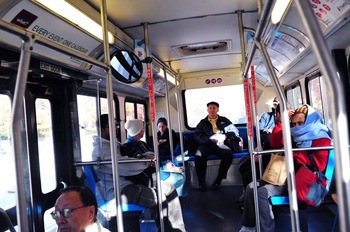
The AATA is soliciting input on several transit ideas under consideration.
The three scenarios call for vast improvements to the AATA system over the next 30 years and are the product of nearly a year of soliciting public input and working with transportation consultants Steer Davies Gleave, the firm in which Beltrandi is a director.
The three plans build on each other — from a more basic option aimed at improving the system's current infrastructure to a more advanced plan that involves using transit to help steer “smart growth” and more compact land use throughout the county.
During their “visioning process," AATA officials found residents expressed concern over several issues:
- Insufficient access to vital transit lifelines.
- An increase in highway congestion.
- Lack of connectivity to support regional economic activity.
- Increased mobility for an aging population.
- A limited amount of appeal in public transportation to those who have the option to use their own car.
Components of each scenario seek to address those issues.
What's still missing is a cost estimate for each. AATA officials said Wednesday that they hope to be able to provide cost estimates for each scenario this week.
The “lifeline plus” option is the most basic and focuses on improving existing service lines and access to the system for seniors and disabled people. The plan calls for five- to 10-minute ride frequency on core routes during peak hours and 20-minute ride frequency on non-core routes during peak periods.
Currently, buses arrive at stops every 20 minutes on core routes during peak hours and every 30 to 60 minutes throughout the rest of the system. The hours of operation would also be expanded. An investment in bus stop improvements would mean more sheltered stops, more information at stops and real-time statuses at busier stops.
The AATA would implement a localized connection service throughout Chelsea, along with a similar service connecting “key destinations” in downtown Ann Arbor. That program would be similar to the former LINK service, officials said.
Disabled and elderly riders would also see hours of the “door-to-door service” extended, and the program would be expanded to include riders countywide.
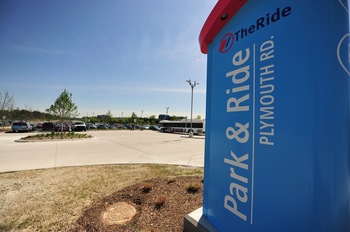
The new park-and-ride lot on Plymouth Road at US-23 has seen heavy use since it opened. More park-and-ride lots could be on the horizon.
The new park-and-ride lot on Plymouth Road at US-23 has seen heavy use since it opened. It offers 260 spaces of free parking.
Also included in the lifeline plus checklist are five new park and ride lots on the edges of Ann Arbor and Ypsilanti; a significant expansion of community and employer led car/vanpool programs, which are now largely connected with the University of Michigan; and 20 miles of new bike paths countywide.
Residents in Dexter and Chelsea would see the installation of transit hubs in their downtown area, which would serve as a “high quality” access point to public transportation.
Benham said officials envision clean transportation centers where people go even when they’re not catching a bus. He said the centers could include some retail or other attractions.
“Traditionally, transit facilities have been a focal point of a community, a place where people not only go to get on a bus or train, but go as a destination for other reasons,” he said. “Our plans emphasize finding opportunities to use transportation centers as a focal point for community, as opposed to just transportation.”
The “accessible county” plan includes everything listed in the lifeline plan and builds on it. In addition to the transit hubs in Dexter and Chelsea, the AATA would also create them in Saline, Manchester, Milan and Whitmore Lake. The express service currently available for riders in Chelsea and Canton would be expanded to include those cities with the transit hubs, and Dexter and Saline would see local circulators like that planned for Chelsea.
Benham said the ridership on Chelsea’s express bus increased by 11 percent last year, and express buses serving the rest of the county’s small population centers are in demand.
“I get requests on a regular basis for that kind of service,” he said “It’s a little frustrating to not be able provide a little bit more service because there seems to be quite a need for it.”
The AATA would seek to further develop a countywide flex-ride program, which picks up individuals at their homes and takes them to a transit line. For example, if someone lived five miles outside Manchester, they could — for a higher fee — use the flex-ride service to get a personal ride to the transit station in Manchester. From there, the person could connect to nearly any point in the county.
Part of that service — and similar ideas for the less urbanized parts of the county — would likely be coordinated with smaller, localized transportation services in each community.
“We would be foolish not to use them. They know the lay of the land already,” Benham said, referring to programs like Chelsea WAVE and Manchester Senior Services.
Under the “smart growth” scenario, all components of the previous two plans would be implemented, along with a high-capacity transit system. That feature would create “high frequency” service along the busiest corridors.
Examples the AATA listed included rapid bus transit, trams or street cars.
The AATA would also look to partner with planned rail lines, such as the WALLY line that would run north-south between Howell and Ann Arbor, and the east-west Ann Arbor-to-Detroit commuter train.
Benham said details on how the AATA might partner with rail lines are not yet available. But creating a backbone of transportation along the lines could significantly increase compact development, which provides countless benefits over sprawl, he said.
“There’s a relationship between compact land use and transit,” Benham said. “Transit will benefit from compact land use … and by the same token, transit encourages compact land use. We like to point to transit as a catalyst for smart development.”
Benham acknowledged the future of rail lines is uncertain, but said inclusion of the lines in the plans is an endorsement and demonstrates the AATA’s confidence that the lines will soon be built.
Other components included in all three scenarios are vehicle improvements and integrated ticketing.
Officials say funding for any of the plans selected would come from a mix of local, state and federal sources.
Tom Perkins is a freelance writer for AnnArbor.com. Reach the news desk at news@annarbor.com or 734-623-2530.
Comments
Ryan Munson
Fri, Jan 28, 2011 : 1:51 a.m.
I think on top of the proposed plans, what needs to happen is a change in behavior (me included) of the average commuter to leave the car behind, especially during the warmer months. It's changing the day-to-day routine and culture of the car for most of us.
RDanzer
Thu, Jan 27, 2011 : 8:50 p.m.
I don't see the problem with buying bus service for the good people of Dexter and so on. We already buy their land from them so they won't develop it. This seems like a natural extension of that policy. Also, I think we should consider buying their groceries and possibly subsidizing their heat. When everyone complains about where these moronic "buckets" of funds come from for our city budgeting process, I hope they can remember this fiasco in the making.
Nick Rebecca V
Sun, Jan 30, 2011 : 5:04 p.m.
A simple solution ! Privatize AATA take 10percent of present budget To help those who cannot afford service return the rest those millions yearly to tax payers !!
MyOpinion
Thu, Jan 27, 2011 : 7:10 p.m.
Something that makes more sense from a regional point of view is a regional rural transportation system. The service is only offered a few times a week with limited options: leaves Manchester at 10am and goes to Ann Arbor Return to Ann Arbor at 4pm Austin, TX has such a plan: <a href="http://www.ridecarts.com/" rel='nofollow'>http://www.ridecarts.com/</a> I see the ridership for this as elderly folks in rural areas that can no longer drive. Not sure who else could live with the limited (but valuable) options.
rusty shackelford
Thu, Jan 27, 2011 : 6:46 p.m.
Just as cattle and cornfields are not practical in the city limits, mass transit is not practical "five miles outside Manchester." I believe buses, etc, are a good tool in a place with sufficient density, but the people of Ann Arbor should not be subsidizing a taxi service for rural dwellers. If you live "five miles outside Manchester," you probably should own a car. Failing that, use the money you don't have to pay in housing costs or property taxes to take a taxi.
rusty shackelford
Thu, Jan 27, 2011 : 6:47 p.m.
And if outside-Manchesterians decide they want a bus system, fine. But they pay for it. Not the people of Ann Arbor. We should pay for our own bus system.
GB
Thu, Jan 27, 2011 : 6:35 p.m.
As a tax payer.. I am not subsidizing "Metro Car". With "AATA" we will be subsidizing it's operation for ever... If the system is not self supporting... it will not get my support. More debt is all I see in this venture!!
Stephen Landes
Thu, Jan 27, 2011 : 5:49 p.m.
A suggestion to A2.com: If you want readers to be able to properly respond to your poll you should consider including a table comparing the alternative plans in your article. If AATA is really smart they would already have such a table available for side by side comparison of their proposals with links to details embedded in the table. If they are not smart it would certainly be easy for you to create such a table and in the process you would create an analytical tool to help you write your article. I find this article somewhat difficult to follow because all the plans seem to be squashed together. When I got to the poll I wanted to go back to sections of the article to be sure I understood the proposals, but I couldn't do that with your article.
Dog Guy
Thu, Jan 27, 2011 : 5:11 p.m.
The $65 lead-in is one of the more expensive rides to Ann Arbor. Nevertheless, this charge includes all costs and a profit for a private ride at your convenience. The provider even pays numerous taxes. AATA would provide hourly service for a few dollars charge at an immense cost to the taxpayers--not even mentioning several hundred thousand more each year for overpaid administrators. The overpaid administrators are, of course, the whole purpose of this proposal. The increased taxes will drive some people out of their Ann Arbor homes, which will be bought, torn down, and replaced by wealthier people who will have no interest in sharing a bus ride with anyone--not even with just the driver of an empty 54-passenger hybrid powered by French perfume. Once again, Ann Arbor will prove to the world that it is the socialist fantasy capitol of the world, the modern nephelococcygia.
John B.
Thu, Jan 27, 2011 : 6:18 p.m.
That is some funny stuff! Where did you learn that? Very entertaining....
average joe
Thu, Jan 27, 2011 : 5:59 p.m.
And guess who paid for that $65 metro car ride. The population that subsidizes the AATA.
Lovaduck
Thu, Jan 27, 2011 : 5:10 p.m.
A bus to the airport would be super, but high speed (or even lower speed) rail service would be even better!
Kafkaland
Thu, Jan 27, 2011 : 5:20 p.m.
Many other cities are doing precisely that. It's very convenient to hop on BART at the SFO airport, or the Metro when arriving at DCA. The Detroit area needs to get its act together and connect the airport to an efficient rail system, from Detroit downtown to the airport and on to Ann Arbor and Jackson.
Rob T
Thu, Jan 27, 2011 : 4:11 p.m.
Complaining about property taxes for transit services that an individual doesn't use is a bit silly. I don't use a car by choice, but I have no problem with paying taxes for the roads that others use and that bring goods to me. I think it's a very good thing that my taxes fund schools, although I have no children. Mass transit offers benefits to all. Indigent riders can afford to get to school and work, choice riders help reduce congestion and emissions, and denser, greener, more interesting development is encouraged.
Rob T
Thu, Jan 27, 2011 : 4:49 p.m.
That said, the frequency of operation suggested in these plans seems unsustainable now. I think AATA would need to build a lot more demand before such frequent service could be justified.
Tom Whitaker
Thu, Jan 27, 2011 : 4:09 p.m.
And speaking of public financing, is anyone else confused by the mixed messages we are getting from local government? On the one hand, they want us to fund over $100 million worth of new parking structures to make it easier for commuters to drive downtown or to the medical center. At the same time, they want us to fund county-wide mass transit and trains. Even in boom times, it would be difficult to fund both. But especially in these times of declining property values, and declining population, why are we planning (and spending) as if Ann Arbor is going to double in size int he next 10 years? If they really think Ann Arbor is going to double in population, then they should be spending money on a new source of drinking water because we are already close to capacity in that critical public service.
Tom Whitaker
Thu, Jan 27, 2011 : 3:51 p.m.
The private sector is serving Metro Airport very efficiently and cost effectively with several convenient options at a variety of service and price levels. Why would we want to push these private businesses out of the market with a tax-payer funded service? It ain't broke, so don't try to fix it--especially with my tax money.
David Cahill
Thu, Jan 27, 2011 : 3:32 p.m.
What percentage of the Ann Arbor (or county) population presently uses mass transit? Exclude U-M students, for their bus use is a separate deal. I expect that the folks who will come out to the scheduled forums are those who already use present system. The AATA will not hear from what I expect is the vast majority of the population that never uses mass transit. And yet these folks will hold the balance of power in any tax vote. Why should someone like me, who has a car and never uses mass transit, support any millage?
kathryn
Fri, Jan 28, 2011 : 12:21 a.m.
I agree with Tom that we cannot afford to subsidize both mass transit and parking structures. I think that within the center of Ann Arbor we should be subsidizing mass transit. We are enough of a city now that we need to start being a place where a person can get by without a car. (Now all we need is a real grocery store downtown.)
kathryn
Fri, Jan 28, 2011 : 12:20 a.m.
I agree with Tom that we cannot afford to subsidize both mass transit and parking structures. I think that within the center of Ann Arbor we should be subsidizing mass transit. We are enough of a city now that we need to start being a place where a person can get by without a car. (Now all we need is a real grocery store downtown.)
Tom Whitaker
Thu, Jan 27, 2011 : 7:41 p.m.
What sarcasm? What I'm saying is that if UM wants to provide for workers to get to work at the medical center, they should use the millions they would pay to build a parking structure and spend it on operating coaches to serve distant areas that have high concentrations of hospital employees. As State and local taxpayers, we cannot afford to be subsidizing both parking structures AND mass transit--whether it be trains or buses, and regardless of whether the taxpayer money comes from the Fed, State, County, UM, or City "buckets."
rusty shackelford
Thu, Jan 27, 2011 : 6:33 p.m.
Right, so, your sarcasm aside, with better transit there would be less need (and less justification) for such a parking structure.
Tom Whitaker
Thu, Jan 27, 2011 : 5:19 p.m.
@Rusty: UM is already gobbling up real estate for parking regardless, including acres of City parkland next to the medical center. If everyone is so gung-ho transit, then use those millions to fund express coaches for medical center workers from Ypsi, Brighton, Chelsea, Dexter, Saline, and beyond. Serve cappuccino to the riders, provide wi-fi and it would be hugely popular with workers. You could fund this service for free to riders for DECADES at the cost of this parking structure.
rusty shackelford
Thu, Jan 27, 2011 : 3:55 p.m.
One reason is that stronger transit is good for the economy. Many lower and middle income workers cannot afford to commute and park into central Ann Arbor (where most bus routes begin and end) by car. The city and it's more affluent residents have made clear that they do not want the less-affluent living within easy walking or biking distance either. Think how much of the appeal of Ann Arbor is based on a continued presence of low wage restaurant and retail workers. They not only contribute directly to our economy, but they also draw the kind of people who can afford to drive everywhere to the town. We've struck the bargain that poor people cannot effectively live near downtown, and commuting and parking is burdensome (though I'm sure some do it). If we want to keep our economy going we need to provide them a way to get to their jobs. On a somewhat unrelated note, many, many, UM workers of all income levels use AATA. If service drops, the U might need to gobble up more real estate for parking.
JSA
Thu, Jan 27, 2011 : 3:05 p.m.
This is nothing but another poorly disguised attempt at a county wide transportation millage that AATA desperately wants to control. They don't care about Ann Arbor's taxpayers. The bureaucrats at AATA just want to control the agenda of transporation in the county and more than that, they want to control the money. Their plans include that never going to happen boondoggle, WALLY. I am sick of AATA acting as if it were a county wide agency though I would agree they are a county wide pain in the posterior.
Halima
Thu, Jan 27, 2011 : 2:44 p.m.
How do you expect us to respond to a poll if we do not know the cost of the different options? The article points out that AATA services have limited appeal to people who have cars - of course! I like and support public transportation. From my location in Ann Arbor, it's a nice walk downtown and in good weather, I do this sometimes, and take the bus back I can also walk back. But if it's cold outside, or I'm in a hurry, I drive my car. We're talking sheer economics here: If I have to wait 15 minutes for the bus, and then 10 minutes is the time I spend on the bus, and pay $1.50 to ride the bus, at my wage rate, that's about $40. Whereas if I don't wait for the bus at all, and drive my car for 6 minutes, plus pay $2 for parking, I'm out $10 including mileage on the car. It's too EXPENSIVE to catch the bus. I only do so as a leisure activity.
Halima
Thu, Jan 27, 2011 : 7:03 p.m.
@Rob T -thanks for your thoughtful reply. I certainly do think that public transportation is important, and I vote for millages for it, because of the reason you cited and because it helps everyone to have efficient transport. My reason for posting was to explain that there's a good economic reason for some people not to ride the bus. But we do need buses, and everyone should know it. Buses are more energy efficient and they also save lives (mile per mile, buses are safer than cars, also walking to the bus improves fitness).
average joe
Thu, Jan 27, 2011 : 5:54 p.m.
Cost? What's that... - AATA doesn't worry about cost, they have millions set aside even as they apply for more & more Federal grants, which I believe are taxpayer dollars.
Rob T
Thu, Jan 27, 2011 : 4:45 p.m.
First, I doubt that you'd have to wait fifteen minutes for the bus. Five minutes would be more reasonable. Second, try working on the bus or while waiting. I use it as a chance to read email, something you can't do while driving. In the end, though, bus service might not be right for you if you're making $80 hourly. Think of it as giving back to people whose time is not as valuable.
MyOpinion
Thu, Jan 27, 2011 : 2:34 p.m.
There is already bus service to the airport; every 1.5 hours via a private company that has a Lansing, to Jackson, to Ann Arbor, to Detroit metro route. The "hub" is a parking lot at a hotel near Briarwood. The service costs $15, which is not cheap, but if you are going to be gone for 3+ days is much cheaper than parking at/near the airport. And, it is cheaper than taxi fare. I use this service when I have long trips, but otherwise drive for the flexibility of arrival time.
Bill
Thu, Jan 27, 2011 : 1:38 p.m.
AATA is definitely missing the big picture when it comes to providing a cheap and safe method of transport to Metro-Airport. Odd too because it could a be a great money maker. I also think it interesting that during so called 'peak' hours, most of the buses I see are in effect half full?! I think a great way to reduce waste would be to purchase a fleet of smaller electric buses and run them based on need on various routes, rather than these giant behemoths that lumber through our city streets half empty spewing diesel or bio fuel exhaust? Also, what about a joint venture between UM and AATA regarding certain routes? I can think of 5 UM professors off the top of my head who would welcome a more expedient and regular transport to the downtown campus.
rusty shackelford
Thu, Jan 27, 2011 : 1:41 p.m.
Not sure which lines you're on. The 4 and 5 were always PACKED when I used to ride them.
Frederick Hammond
Thu, Jan 27, 2011 : 1:27 p.m.
I grew up in New Jersey where mass transit is a way of life. When I moved to Ann Arbor in the late 60s, I was shocked by the lack of mass transit and also the love of the automobile. To be truly considered as a vital metropolitan area, a efficient mass transit system is needed. I've used the AATA on a daily basis for at least 15 years and have had very few complaints about the system. The buses are on time the majority of days, the system is safe, the buses are fairly clean, etc. I feel that the subsidy I pay via my property taxes is reasonable. It seems to me that the people who complain the loudest about AATA very rarely use it. Leave the gas guzzling car in the garage every now and then and give AATA a try. You may be surprised.
rusty shackelford
Thu, Jan 27, 2011 : 1:32 p.m.
It's really good at getting you to and from downtown/central campus. Otherwise, it can be a bit of a pain.
sbbuilder
Thu, Jan 27, 2011 : 1:21 p.m.
Frozen It's not the subsidy, it's the amount. Just what is the appropriate amount of subsidy for a public service? We currently subsidize over 85% of AATA. If any of these plans are implemented, you can bet that subsidy % will grow even more. So, all of you public transport lovers, weigh in here. How much of the price of a ride should be shouldered by the community? How much is too much? I do not believe the AATA has a compelling sale here. They get free money to run their business, and consequently do not have a vested interest in running it efficiently, or returning a comperable amount of service for the money they get. Show me a functional subsidy of, say, 55 or 60%, and maybe I'll take a look at your plans. Other than that, and this is just another way to squander my tax dollars.
rusty shackelford
Thu, Jan 27, 2011 : 1:29 p.m.
Roads, parks, and schools are 100% subsidized, but that doesn't make them ineffective. And like transit, not everyone makes direct use of roads, parks, or schools. I know some people would say that every single public good should be privatized, fee-for-use but that's just not the world we live in. AATA is a governmental entity, not a business, and like most government entities, it's going to operate mainly on tax revenue. Unless you've actually examined their books, your argument that they are running the system poorly is based on nothing.
rusty shackelford
Thu, Jan 27, 2011 : 1:21 p.m.
Also, if he didn't want to pay $65, he could have scheduled one of the many van pools that go between DTW and Ann Arbor, which cost about $15. Hourly bus service to the airport is dumb--this isn't New York.
rusty shackelford
Thu, Jan 27, 2011 : 1:46 p.m.
UM already supplies a service for the students at holidays, breaks, etc--a shuttle for $7. You can hire private shuttles to take you door to door for $15. Then there are taxis and car services. Seems like we've got it covered, especially for a town that doesn't have very high transit ridership in the first place.
Bill
Thu, Jan 27, 2011 : 1:41 p.m.
Have you looked into the need? How many residence and students do you think need regular access to Metro Airport from Ann Arbor?
rusty shackelford
Thu, Jan 27, 2011 : 1:31 p.m.
Finally, he could have just taken a taxi when he got there, like at every airport in the world, and been charged less than $65.
rusty shackelford
Thu, Jan 27, 2011 : 1:20 p.m.
I don't understand why the ANN ARBOR Transit Authority seems so constantly concerned with improving the quality of public transit in Chelsea and Dexter. If those not-at-all dense hamlets want transit, they should pay for it themselves and then the two services can work together for inter-city transportation. Ann Arborites don't need nor want to pay to colonize other cities with our buses. We ought to focus on increased frequency of service on existing routes. We also need to add lines so that people don't have to make transfers downtown just to get a cross town. The spoke system overall is good, but there should be some routes that make it easier to get from say the West side of town to one of the hospitals or north campus--areas that aren't very dense but contain major employers. The "street car" idea may be too costly, but it could be useful since the full-size buses are rarely full except during rush hours. AATA should also institute an "owl" service that runs all night, or at least much later than 10 or 11pm or so which is the current stop time. They don't have to have all the lines running, they could just do what, say San Francisco does, which is basically have a bus route that circuits the entire city, stopping at all major points/streets. It takes longer, obviously, but the option for transit is still there. It would be minimal additional cost, be a big boon to workers on a night shift, help boost the nightlife economy and cut down on drunk driving.
Chase Ingersoll
Thu, Jan 27, 2011 : 1:14 p.m.
MORE EFFICIENT USE OF EXISTING RESOURCES: Why couldn't the existing, licensed airport shuttle buses be organized to cover hourly trips to and from the airport from one or more Ann Arbor locations that would be fed riders by AATA. You've got downtown for those who are already downtown and Briarwood or some other location that can accommodate long term parking. Keep the fares low by requiring the licensed shuttle buses to compete by bidding a rate for the particular scheduled run. Why they could probably even include a pickup at the EMU student center or business school so that Ypsilanti would be covered.
rusty shackelford
Thu, Jan 27, 2011 : 1:22 p.m.
As I comment below, shuttles between DTW and A2 are only about $15 right now, which seems pretty reasonable, and I've never had them mess up and not get me there on time, not pick me up, etc.
frozenhotchocolate
Thu, Jan 27, 2011 : 1:06 p.m.
i just moved to chicago from ann arbor and rode the aata daily. it is a good system. all you people complaining about paying for it and not riding the bus, big deal, you pay for police and dont get arrested. im sick of people complaining about subsidising mass transit, that is how it works on pretty much every medium to large city on this planet. if the majority of people that could own a car did then we would not need buses. if you dont like paying for the bus move to canton and witness youre quality of life plummet.
rusty shackelford
Thu, Jan 27, 2011 : 1:12 p.m.
Ha! Excellent comment, spot on.
Brad
Thu, Jan 27, 2011 : 12:30 p.m.
I already have a "master transit plan". It's called a "car". Yet as a property tax payer I still pay over $300 annually to support AATA. What's wrong with this picture??
L'chaim
Fri, Jan 28, 2011 : 1:25 a.m.
What's wrong with this picture: 1. Your car. 2. Lack of progressive income taxation in our system 3. Inflated and deformed sense of "individualism"
ToddAustin
Thu, Jan 27, 2011 : 5:35 p.m.
As a taxpayer, I'm shelling out big bucks to subsidize your car habit with multi-lane highways, tax breaks for oil companies and car manufacturers, etc. Public transit is a heck of a lot cheaper. It you want your tax money spent more efficiently, spend it on mass transit. Also, your tax monies pay for schools, fire, police, etc. You may not actively or directly use any of them, but you depend on the services provided to support your community, to support the people who work at the stores where you shop, who make sure the child next door has a good education and grows up to pay taxes rather than sit in a prison, etc. etc. etc.
5c0++ H4d13y
Thu, Jan 27, 2011 : 12:01 p.m.
The hospital needs a real transit center.
AlphaAlpha
Thu, Jan 27, 2011 : 11:56 a.m.
Per AATA numbers, users currently pay only about 15% of their fair share of ride costs. How about an option where the riders pay for what they use?
rusty shackelford
Thu, Jan 27, 2011 : 1:23 p.m.
I think we should have to have chips in our cars connected to our credit cards that charge us a fee for every stop light we make use of.
BHarding
Thu, Jan 27, 2011 : 11:53 a.m.
My biggest concern is that as the AATA grows, no matter where the initial dollars come from, the Ann Arbor taxpayers will shoulder a disproportionate amount for the care and feeding of the octopus. The writer uses, as an example, the cost of a Metro Car ride from the airport and that the rider picked it up around midnight. I don't know that someone would want to wait for an hour or more for the imaginary bus to arrive for the 20-minute ride to Ann Arbor. Have airline passengers been surveyed on that question?
rusty shackelford
Thu, Jan 27, 2011 : 1:24 p.m.
Right, why do they keep insisting we should pay so Chelsea and Dexter can have buses?