

Mayor and council members talk about where Ann Arbor has been and where it's going
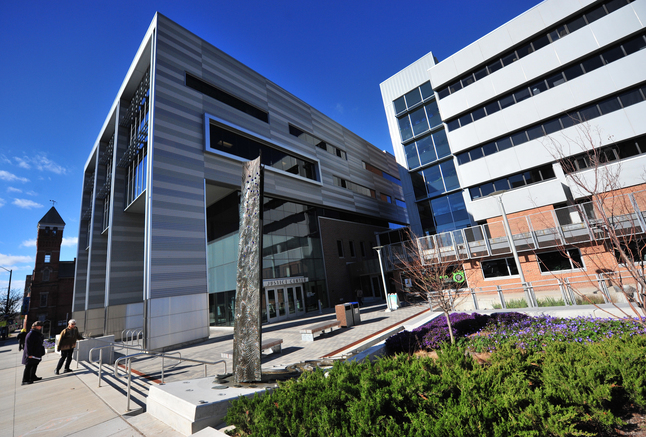
Ann Arbor's new Justice Center, built just a couple of years ago, stands next to the 1963-era city hall that's been upgraded in recent years at the corner of Fifth Avenue and Huron Streets. The rain garden and sculpture, which uses recycled stormwater, are new additions out front. As the city has grown over many decades, city officials believe it's kept its small town feel.
Ryan J. Stanton | AnnArbor.com
"My father came here in '51 and bought a house with a veterans loan. He got out of the Air Force in '46 and went back to school," Hieftje said. "And I was nine months old when they brought me here. I know some townies have accused me of being a carpetbagger."
Hieftje's father started a business called Hieftje's Heating that he owned for many years, and Hieftje never left Ann Arbor except for about 10 years living at a lake north of town in the 1980s.
At a city retreat earlier this week, Hieftje and other members of the Ann Arbor City Council reflected on the city's past, how it's changed over time, and what they believe about its future.
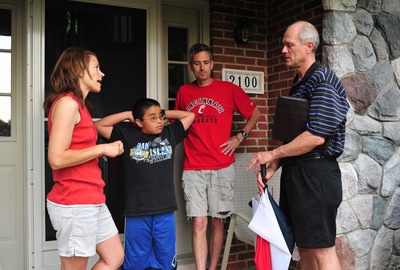
Mayor John Hieftje chats with residents on their porch while campaigning in 2010. He still recalls one Sunday afternoon when he was young and Mayor Cecil Creal, a Republican who served from 1959 to 1965, stopped by his house. Hieftje said he likes that Ann Arbor remains the kind of place where it's not uncommon for residents to get face time with their elected leaders.
Ryan J. Stanton | AnnArbor.com
As the University of Michigan has grown, the town has grown, too, and it's become increasingly liberal. For instance, Barack Obama took about 8 out of 10 votes in Ann Arbor in the most recent election, and 10 out of 11 members of the City Council are Democrats — the exception being Jane Lumm, an Independent.
"I've seen the city gentrified from the time that I've been here," Hieftje said. "It's less affordable now, and I think that's something we can't ever forget. We have to continue to work in that area. We can't forget that we need to make it possible for others to live here who may not have the best of jobs."
When he was young, Hieftje recalled, the apartments near downtown were filled with working people because the shops were all downtown and they wanted to live close enough to walk and bike.
As the student population grew, Hieftje said, more and more U-M students came to town with a lot of affluence and pushed many working families out.
"Not all of our students are rich, but a good proportion of them are," he said. "They didn't used to be. Now they can afford everything, whatever they want, and they've forced the working people out, and very often into other cities. And that's been a problem for the city."
Beliefs about Ann Arbor
Hieftje and other council members were asked during Monday's planning retreat what they believed about Ann Arbor's future, and different opinions filled the room.
"I believe the future of Ann Arbor is bright," said Christopher Taylor, D-3rd Ward. "Accentuating the positive, our indispensable, strategic asset is secure and growing, our community is replete with talent and civic engagement, and the municipal organization is efficient and sustainable."
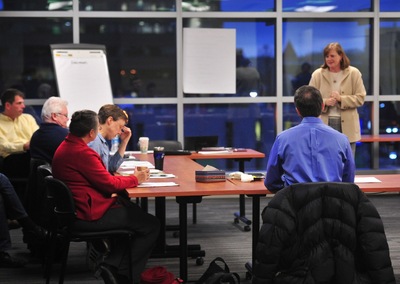
City Council members were asked during Monday's planning retreat what they believed about Ann Arbor's future, and different opinions filled the room.
Ryan J. Stanton | AnnArbor.com
"The U of M is an enduring institution that grows and improves year in, year out, while Ann Arbor reaps the economic and cultural benefits," he said.
For the foreseeable future, Council Member Stephen Kunselman, D-3rd Ward, thinks Ann Arbor will experience what he called "static growth," and it will be lucky to hold on to what it already has going for it.
"And hopefully we won't be cutting," he added.
Kunselman said it's great that Ann Arbor has new housing developments coming, including thousands of new apartment beds in the downtown, many for students, but there's still a number of foreclosed homes and other houses for sale in his lower-income neighborhood on the city's southeast side.
"We still have very little infill development in our neighborhoods, unless you're close to downtown where the money and the action is at," he said.
"So I think there's still that feeling outside on the edges of Ann Arbor that we're not all beneficiaries of the great economic change that's occurring downtown."
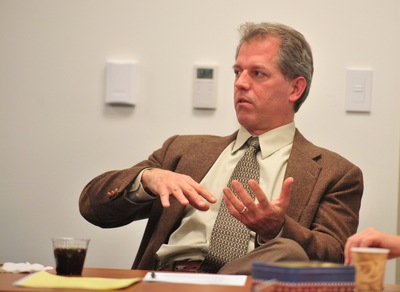
Council Member Stephen Kunselman, who grew up in Ann Arbor in the 1960s and '70s, said he's "the son of hippies" and the attitude of social change that permeated the culture during his childhood remains with him.
Ryan J. Stanton | AnnArbor.com
"Even though the U of M is the No. 1 beneficiary of federal dollars in research and development for public universities, that's drying up," he said, pointing to cuts the U-M Health System is making.
Council Member Sumi Kailasapathy, D-1st Ward, said she questions why the city seems so focused on growth and attracting new development. She said attracting more companies like Google to Ann Arbor should not be a preoccupation and obsession of the city.
Kailasapathy said she grew up in a small village in Jaffna, Sri Lanka, and most of the time she didn't even have electricity. She drew water from a well and used a bicycle to get around.
"Do we have to grow?" she said. "There are a lot of economists who are coming out and saying we don't have to be worrying about 3 percent growth, 2 percent growth, 5 percent growth. Stasis is OK, too. Preserving the quality of life is, I think, much more important."
Council Member Jane Lumm, an Independent who represents the 2nd Ward, said she grew up in a small town in southeastern Pennsylvania.
"I've been here over 30 years, and I'd like to believe that I'm still guided by those core small town kind of values," she said.
Lumm shares Kailasapathy's belief that the city needs to focus its resources more efficiently on core services like police and fire and maintaining roads, not visions of regional commuter rail.
"I do think that folks believe there's a disconnect between city hall's priorities and theirs, and we need to look at the alignment of our priorities with residents' priorities," she said.
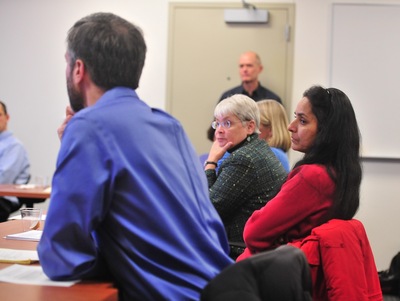
Council Member Sumi Kailasapathy, in red, said she questions why the city seems so focused on growth and attracting new development. She said attracting more companies like Google to Ann Arbor should not be a preoccupation and obsession of the city.
Ryan J. Stanton | AnnArbor.com
Hieftje said investing in transit, including a more advanced bus system and rail to get people in and out of Ann Arbor, is essential to avoid major traffic congestion in the future. Additionally, he and other council members believe making sure people can walk and bike where they want to go is essential as more and more younger people look to give up owning cars.
Council Member Margie Teall, D-4th Ward, said it's inevitable that city officials will hear more from residents who are unhappy than those who think the city is on a good track.
"I believe our city is growing and I believe this is healthy for the city," Teall said, adding she learned that when she went on a trip to Colorado several years ago with the Downtown Development Authority and heard what other cities like Denver and Boulder are doing.
"I believe that change is necessary," Teall said, adding the city benefits when it brings new people to downtown and other parts of the city.
Boasting that Ann Arbor has one of the nation's most educated and engaged populations, Taylor said the city's human capital is a major asset not to be forgotten.
"Our neighborhoods and the residents they reflect are vital," he said. "Our reputation for and history of social justice and decency is widespread and well-earned."
On the other side of the ledger, Taylor said, Ann Arbor is limited by the fact that it exists in an economically and politically challenged state that has hindered its ability to provide services.
"It has systematically diminished support for crucial things such as public and higher education, and it de-emphasizes and under-resources longstanding infrastructure needs," he said.
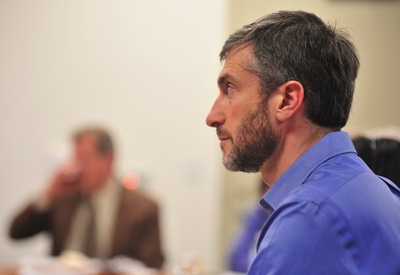
Council Member Christopher Taylor, D-3rd Ward, said Ann Arbor as a community must become more flexible and more open to change, as doing the opposite has the potential to weigh the city down.
Ryan J. Stanton | AnnArbor.com
Taylor said Ann Arbor as a community must become more flexible and more open to change, as doing the opposite has the potential to weigh the city down.
Council Member Chuck Warpehoski, D-5th Ward, said he believes city government can make a meaningful difference in people's lives.
"I believe in an Ann Arbor that works for everybody," he said. "So when we look at our economic development strategy, yes, I want those high-tech jobs, but I also want jobs for pipefitters and machinists and brewers and baristas."
Warpehoski said he had a minor brain hemorrhage a few years back and couldn't drive or bike for a while, and that opened his eyes to the value of living in a walkable community.
"I realized just how close I am — we all are — to being on the other side of that donor-recipient line," he said, adding the city has a role to play in making sure there's a good social safety net, human services programs, transportation options and affordable housing in the community.
Warpehoski said he has a young daughter and he's terrified of where the world is leading for the next generation.
"I'm thinking how do we not just care for the people who are here now, but how do we minimize the damage we're doing to this earth?" he said. "How do we maximize what healing we can do? And how do we create resilience — in terms of our infrastructure, in terms of our economy and in terms of our community — so that whatever mess may be coming at us next, we're able to best adapt?"
Kunselman, who grew up in Ann Arbor in the 1960s and '70s, said he's "the son of hippies" and the attitude of social change that permeated the culture during his childhood remains with him.
"There are very few townies left in this community," he said. "I believe in the future of Ann Arbor because I am a product of its past. I believe that Ann Arbor has changed, has grown, but still has the foundation of a community that was respected worldwide for great social change."
Kunselman said he wished the city had more recreational programs in city parks during the summer that provided opportunities for kids to participate in games like box hockey and kickball.
"It was that interaction with kids of different socio-economic backgrounds that gave me the foundation of greater respect for everybody with differences of opinions," he said of his memories growing up in Ann Arbor. "And it's that diversity of thought, diversity of socio-economic status, that really is what makes Ann Arbor the greatest institution and municipality in the state of Michigan, if not the world."
That small-town feel
Council Member Sabra Briere, D-1st Ward, noted there's been a lot of talk recently about whether Ann Arbor is still a small town. She's lived in Ann Arbor for 40 years, since moving here in 1972 from Indiana, but she grew up in a town that's about one square mile.
"I waded in the river, hunted for snails and snakes, and could be gone for hours without my mother worrying about me," she said. "Just over 2,000 people live in my hometown."
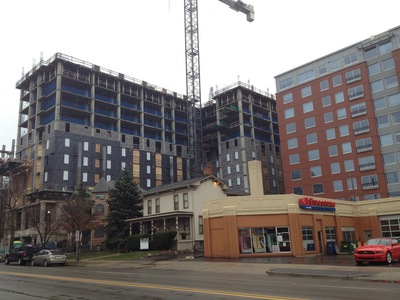
Two new high-rise apartment buildings geared toward University of Michigan students, one already built and one in the process of being built, rise above historic houses and an auto repair shop on Huron Street that has maintained its decades-old look and feel as new development has sprung up around it.
Ryan J. Stanton | AnnArbor.com
But she said Ann Arbor is in an odd position with about 43,000 out of its 114,000 residents being University of Michigan students.
'"To me, that means that many of us don't have lasting ties to our community, and I don't think there's any way to change that," she said.
Hieftje agreed Ann Arbor has kept its small-town feel, despite just about doubling in population during his lifetime. He's been mayor for the past 12 years and is about to eclipse William E. Brown Jr. (1945-1957) as the longest-serving mayor in Ann Arbor's 161-year history.
He still recalls one Sunday afternoon when he was young and Mayor Cecil Creal, a Republican who served from 1959 to 1965, stopped by his house to visit his father. Hieftje said Ann Arbor remains the kind of place where it's not uncommon for residents to get face time with their elected leaders.
"That's the kind of city this is where you can still go talk to the people who are in office and have a conversation with them and express your views," he said. "I like that about our city."
Having been here a long time, Hieftje said Ann Arbor has grown up in many ways. And in a lot of ways, he said, it really hasn't changed.
"We have 14 historic districts in our city, and when you take a look at the downtown, there's only about 40 percent of it that'll ever change," he said.
And when you look at the rest of the city, Hieftje said, there are "wonderful, wonderful neighborhoods" that remain intact.
But he said it's important to keep growing jobs and bringing more residents and more companies like Barracuda Networks to downtown to keep the city's center thriving.
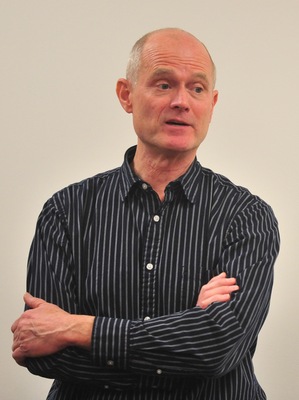
"I look at an Ann Arbor right now that is a more exciting place to be than it ever was before," Hieftje said. "There's more to do than there ever was before. I think it's in many, many ways a better city."
Ryan J. Stanton | AnnArbor.com
Case in point, Hieftje said, Ann Arbor consistently makes national lists for being one of the best places to live for both economic and general quality of life reasons.
"The city is performing at a very high level," he said. "I think we've done really well coming through the worst economic period since the 1930s."
And that's even after losing Pfizer, the city's largest employer and taxpayer, Hieftje said, noting the city lost about 4.6 percent its total property tax revenues when Pfizer went off the tax rolls and ended up in U-M's hands.
"We've bounced back from that," Hieftje said. "The jobs are being replaced. We've downsized government. City government is more efficient now than it's ever been."
Noting U-M's purchase of the Pfizer complex and its more recent decision to acquire the Blimpy Burger property on Division Street, Hieftje and others lamented the fact that the university continues to expand its footprint in the city, taking more and more land off the tax rolls.
"It's an issue that we need to address and it's something I'd like to see council discuss in the coming year," Hieftje said. "Already between the U of M and the other nontaxable properties and the city's parks, 40 percent of the land is nontaxable."
Given that the city still has to keep roads paved and provide fire protection and other services to those non-taxpaying areas, city officials argue that puts a strain on city taxpayers.
"I don't think anybody would argue that the university makes a tremendous contribution to the local economy," Hieftje said. "But as more and more land goes off the tax rolls, I think there's going to be an inevitable impact on the taxpayers in the city."
City Assessor David Petrak said U-M owned 2.39 square miles of land within the city as of October. That's about 8.4 percent of the city's 28.55 square miles.
Ryan J. Stanton covers government and politics for AnnArbor.com. Reach him at ryanstanton@annarbor.com or 734-623-2529. You also can follow him on Twitter or subscribe to AnnArbor.com's email newsletters.
Comments
Rich
Thu, Dec 13, 2012 : 6:14 p.m.
I'm considering leaving downtown Ann Arbor for a town like Saline or Chelsea. It's just too expensive here for me. I work downtown as well, but I can't afford $1400 a month rent, it's absurd! I can take out TWO mortgages for that! So this working class student would much rather rent a nicer house with a yard for half the price and just a short drive away. Rent keeps on going up, it's reached the point of absurdity. I've lived here for 5 years, my rent has gone up every year. The entire city needs to limit raising rent to every six years! Gas,food,education,Internet, utilities, everything goes up up up, yet rarely do wages. You'll lose people like me if the current trends continue.
Tru2Blu76
Thu, Dec 13, 2012 : 5:38 p.m.
First, I'd like to thank AnnArbordotcom for publishing this story. Second, I'd like to say I'm sincerely impressed with many of the comments on his story. At the risk of seeming gullible, I think these two things indicate the level of interest and concern we all have about Ann Arbor. Where has our city been and where is it headed? That's the central question and it's great that a dialogue has been started on this question. I can only suggest (urge, actually) that the dialogue needs to continue before any final conclusions are reached. If we care as much as we seem to, then it's fitting that we continue a list of what we don't want and what we do want - and then start working (with commitment) toward a consensus compilation of the "do wants." Then formulate a practical plan to bring the desired result to fruition. And if the U of M is becoming a burden, then it seems sensible to call on U of M experts as a resource to get us where we want to go - thus compensating in part for the tax burden its existence is creating. Just sayin': citizens + city government + university expertise seems a good formula for success. But the process must continue - not break down into politics and greed / self interest. This is Genius Occupied Ann Arbor: we can do this! :-)
brimble
Thu, Dec 13, 2012 : 5:04 p.m.
When I moved to Ann Arbor a dozen or so years ago, I was impressed by it as a pleasant college town. I still have that basic impression, but, like Jack Eaton, I am disturbed by the failure of Council to establish the priorities and take the steps to maintain that essential goodness. I do worry about the condition of our roads, our water, sewer and stormwater systems, and the capacities of our emergency services and first responders. I do hope that Council will choose to focus on the basics that are essential to every community.
jcj
Thu, Dec 13, 2012 : 4:34 p.m.
I am surprised it took so long for someone to mention Boulder!
Jack Eaton
Thu, Dec 13, 2012 : 4:18 p.m.
There seem to be two basic views of Ann Arbor. One is that we are an award winning, great place to live that needs some attention to maintenance and services. The other view is that there is something fundamentally wrong with the city that requires us to make radical changes including bulldozing buildings to build highrises and modify human behavior to get residents to abandon their cars. The view that acknowledges what is great about this town is concerned that we are letting our services and infrastructure diminish while our government builds one project after another while amassing huge debt. Our neighborhoods suffer storm flooding, but we get a new addition to city hall. Our streets are in poor condition, but our efforts go into "corridor studies". Our safety services do not meet nationally recognized standards, and we plan to close fire stations while we plan to spend more than $3 million on a new Amtrak station. Those who seek radical changes for our town believe that we must embark on a reckless course of demolishing existing buildings to replace them with taller and more densely situated buildings. They seem to think that if we fail to pursue this course, Ann Arbor will become something resembling Flint or Benton Harbor. The simple truth is that since the early 70s, Ann Arbor's population has not grown much in any given year. As mentioned in the article, the population actually declined in the last census period. We all know that the departure of Pfizer and the economic recession hurt employment, too. Before we plan for growth that may not come, we need to address the state of our roads, storm water system, waste water system and drinking water supply. We need to ensure that our existing population has sufficient safety services. We need to address our growing debt load and unfunded liabilities. Taking care of these fundamental responsibilities of government will build the foundation for any growth we may see after we recover recent population losses.
A2since74
Thu, Dec 13, 2012 : 10:22 p.m.
Amen! Perhaps we should view our infrastructure as works of art. To me, a well maintained, well surfaced street in a nice neighborhood is a work of art to be admired and cherished.
aes
Thu, Dec 13, 2012 : 6:39 p.m.
Amen...Jack....amen! You always write with sense and sensibility. And that's why I wrote in YOUR name for Mayor this past election!
bunnyabbot
Thu, Dec 13, 2012 : 4:04 p.m.
As someone who has lived here my whole life I can truely say Ann Arbor has changed and not all that for good. Terrible spending habits, special interests and a distrubing relationship between the mayor, city council and the DDA. Many neighborhood roads are in disrepair, water infrastructure that fails with backups on a regular basis. Programs such as the stupid sidewalk repair forced on homeowners only to see the same sidewalks ripped up and redone and then ripped up and redone AGAIN. Taxes raised, services such as fire and police cut and like someone else said the CC sits around patting eachothers backs. The elitest attitude of Ann Arbor, high taxes and cut in services is exactly why I won't be living here within five years.
Bill
Thu, Dec 13, 2012 : 3:55 p.m.
Apparently the mayor equates quality of ones job with how much money you make, "We can't forget that we need to make it possible for others to live here who may not have the best of jobs."
Robot Charles
Thu, Dec 13, 2012 : 3:20 p.m.
The student high rises will become the biggest mistake of the century for Ann Arbor. Young professionals do not want to live near students(I know I am one). And if the city is ever to become more than a place that contains the U of M, then we need young working folks downtown. Either we make it a nice energized place to attract workers or we let it go to the student housing developers. Also Ann Arbor is no Denver and in fact it's no Boulder.
uabchris
Thu, Dec 13, 2012 : 3:16 p.m.
I think the city should try to preserve the immediate downtown houses and neighborhoods that are outside the historic districts. This gives A2 its charm. We should learn lessons from other cities like my hometown in Birmingham, Al where most of the Victorian homes and historic structures have long since been knocked down all in the name of progress. Now its all commercial and lost its original charm like every other strip mall. Once they are gone...they can never be replaced!
Rich
Thu, Dec 13, 2012 : 6:26 p.m.
Those building are all junk. Falling apart, used student housing. I've worked at a few restaurants downtown, if you saw some of the leaks, mold, and dilapidated parts of the buildings I've seen, you'd change your mind quickly, especially considering that some of those places prepare food. Add in the fact that A2 deems every building "historical" (they are not), and the building permits are some of the biggest pains in the ass, you're looking at a city that despises new building and growth. Mix that in with 40% of the city being tax free, there's a huge problem looming ahead.
Dog Guy
Thu, Dec 13, 2012 : 3:05 p.m.
Thank you, Mr. Stanton, for your photo of the Just-us Center. I have forwarded it to a friend in Japan who said that neither architecture nor sculpture could be passive-aggressive.
Vivienne Armentrout
Thu, Dec 13, 2012 : 2:45 p.m.
I think the mayor probably meant that 40% of the taxable value has been removed by the UM. That is different from the absolute land area. It has been noted that our parks occupy a greater acreage than the UM (I don't have the figures). Of course all public land is nontaxable. But of that which is developed and has taxable buildings on it, the UM keeps on consuming more.
Vivienne Armentrout
Thu, Dec 13, 2012 : 4:59 p.m.
LXIX, those are interesting figures. It would be good to see an analysis with all these figures in place. I have an old document from the UM with some other interesting figures. The UM is required to submit a report to the State of Michigan each year in regard to their fire coverage. From 2009 (includes purchase of the Pfizer property), UM listed over $2 billion in assessed value (buildings). That is approximately $1 billion in taxable value. I don't have time right now to figure out what the tax yield would be today from that. The same report listed 31.27 million square footage in those buildings. More have been built since then. I'd like to see AnnArbor.com follow up on these figures to give us a true picture of the taxes we surrender by virtue of UM's special status.
Vivienne Armentrout
Thu, Dec 13, 2012 : 4:44 p.m.
Ryan, I was referring to this quotation from the mayor: "Already between the U of M and the other nontaxable properties and the city's parks, 40 percent of the land is nontaxable." You appeared to correct him with your later information, "City Assessor David Petrak said U-M owned 2.39 square miles of land within the city as of October. That's about 8.4 percent of the city's 28.55 square miles." I was intending to back the mayor up, not to say he misspoke.
LXIX
Thu, Dec 13, 2012 : 4:14 p.m.
According to wikipedia the UM campus is 3,177 acres. 712 acres in buildings alone. It is unclear about the actual size inside the city limits. Total UM land holding is 20,965 acres including the arboretum and presumeably the outlying botanical gardens, observatory, etc. Ann Arbor has 167 parks containing 2,089.66 acres. That would be less land than the UM campus.
Ryan J. Stanton
Thu, Dec 13, 2012 : 4:09 p.m.
Actually I don't think the mayor misspoke. Due to land occupied by U-M and other tax-exempt entities, city officials have said for the last few years (usually in the context of discussions about a city income tax) that about 40 percent of all property in Ann Arbor is off the tax rolls.
LXIX
Thu, Dec 13, 2012 : 2:07 p.m.
"I believe that change is necessary," Teall said It is called entropy, Margie. Like what roads and pipes experience in time. The remedy is "planned change" using resources modified by intelligence in time. Both are expensive items. World resources are limited. Growth adds even more entropy and maintenance cost. Overpopulation without an equal intelligence growth becomes the core problem. Sumi Kailasapathy got it right when she denounced growth and said "Preserving the quality of life is, I think, much more important." Especially if its in a wealthier, less-populated place, than Sri Lanka. She knows better than most council members about unbridled growth consequences. So, Ms. Teall. Tell us about your DDA boondoggle to that city of change - Boulder Colorado. BC - the A2 wannabe (Origin of the clueless A2 crosswalk law). Nicer place with fewer people and lots more money. Population BC 99k A2 114k per capita income BC $37,720 A2 $32,734 price owner-occupied Home $353k A2 $235k people below poverty BC 13.1% A2 21.5% [ref= http://quickfacts.census.gov]
Steve Hendel
Thu, Dec 13, 2012 : 1:47 p.m.
A great article, but I feel that two statements made by the mayor deserve special attention: 1. "Not all of our students are rich, but a good proportion of them are," he said. "They didn't used to be. Now they can afford everything, whatever they want," Your honor, how do you define "rich" and where is the statistical data to back up this statement? 2. Additionally, he (the Mayor) and other council members believe making sure people can walk and bike where they want to go is essential as more and more younger people look to give up owning cars. Again, how do you define "look to give up" as opposed to actually "give up," and where is the hard data to support this claim?
jcj
Thu, Dec 13, 2012 : 4:30 p.m.
HB11 Or misconception!
HB11
Thu, Dec 13, 2012 : 2:13 p.m.
Not every comment needs to be backed up with statistics. Sometimes it's observations that form a perception.
Brad
Thu, Dec 13, 2012 : 1:43 p.m.
Rah! Rah! Downtown! Barracuda!! "Hieftje said Ann Arbor remains the kind of place where it's not uncommon for residents to get face time with their elected leaders." Here in the 4th ward we're just happy when our representatives show up to the council meetings.
B2Pilot
Thu, Dec 13, 2012 : 1:37 p.m.
I agree with Kunslem's assessment; you leave the downtown "campus" area and the neighborhoods are suffering. The westside association seems to benefit from their location and connections in city hall but the rest of the city has/is being neglected, while Heijte is busy remodeling the downtown. And I disagree with his assesment that the downtown is better than it was. AND the picture of that piece of 'art' at the beginning is the symbol of what is wrong with city hall 750K for that !!!!!
A2since74
Thu, Dec 13, 2012 : 3:09 p.m.
I agree too. Ann Arbor is a great place to live. This does not absolve the city from making good use of our tax money. Since we now apparently have a surplus of funds, perhaps the roads and streets be taken care. A good example is South Seventh by Lawton School. This is in Ward 4, Margie Teall's and Marcia Higgins' stomping ground. It was resurfaced only a few years ago, and is a total mess. I would post some dramatic pictures if I could only figure out how to do it!
Jon Wax
Thu, Dec 13, 2012 : 12:53 p.m.
1. was recently in the pfizer building. a couple things: holy god is that a huuuuuuuge waste of space. legalize mj and turn that place into the budweiser of mj. tax it and ship it out by the ton. the place is a giant indoor grow room. challenge the feds by renting out space, cheaply, to growers. have the city own it. if the feds want to prosecute, try throwing the city in jail. 2. traffic is not what it was. traffic, to me is an indicator of a "small town" vs "city". you want a small town feel? drive through salem. oops, you blinked? you missed it. slightly larger is south lyon. if you yawn while driving through downtown, you miss it. here in the deuce? traffic is nuts and it seems folks have lost the art of driving. or they just suck at it. can't really tell. but every day feels like a "football saturday" trafficwise now. 3. everything else feels about the same: food joint closes, food joint opens. shop closes, shop opens. as long as the kids are here with their parents credit cards on go-mode, a2 will be fine. 4. it's "locals". not "townies". 5. this article reminds me of all the shenanigans that pittsfield township board tries to pull making itself look good. they spin numbers pretty well, too. Peace Wax
Stephen Lange Ranzini
Thu, Dec 13, 2012 : 12:24 p.m.
@1bit: Speaking of data, in 1999, the city had debt of $119 million, more cash on hand than that and a hugely overfunded pension fund. According to the 2011 city audit report (CAFR), the city has a total of $207 million of cash and short term investments, of which $134 million is in the "government activities" separate account ("bucket") where the general fund bucket is included and $73 million is in the government enterprise bucket, which includes all the businesses the city owns (sewer, water, waste, etc.). See page 21. The city's total debt (both long term and short term) was $306.5 million. See page 22. This sum does not include the pension fund deficit mentioned in the article, which was $57.6 million. See page 79. Of note, the article does not mention the healthcare retirement fund liability, which is another debt, and was $170 million. See "UAAL" on page 77. The sum of all debt at that time (June 30, 2011) is therefore $534.1 million. However since then, the $100 million waste water treatment plant construction started and a $100 million bond floated to pay for that. So, $119 million of debt became over $600 million of debt over the past 12 years, and on a net of cash basis, the city went from having no net debt to over $400 million today. We are a wealthy city but the current trend is unsustainable!
1bit
Fri, Dec 14, 2012 : 1:14 a.m.
Thanks, Stephen. Hopefully the tide is turning...
Jay Thomas
Thu, Dec 13, 2012 : 7:36 p.m.
119 to 600 million in a dozen years? One name comes to mind: Hieftje! It's only unfortunate people don't connect the dots....
HB11
Thu, Dec 13, 2012 : 2:10 p.m.
No one wants to address the unsustainable pension funds.
Goober
Thu, Dec 13, 2012 : 12:04 p.m.
We are going down the poop tube as a result of irresponsible spending, chasing the wrong issues/priorities and never ending legacy costs. The legacy costs alone will eventually kill the city as it has to other cities. Our leaders have shown that they will not listen or learn!
1bit
Thu, Dec 13, 2012 : 12:02 p.m.
It's nice that everyone had a chance to share their anecdotes and beliefs. It's part of the "vision" thing of leadership. What would be better now is to actually do the boring part of poring over real data, real trends and develop attainable goals and plans based upon them. A meeting about "what makes Ann Arbor so great?" seems like a quintessential Ann Arbor thing to do.
motorcycleminer
Thu, Dec 13, 2012 : 11:23 a.m.
Le grande hug fest on 5th ave.... entertaining to watch the " birds of a feather " all pat each other on the back.....