

Ann Arbor schools to spend $7.81M on energy improvements
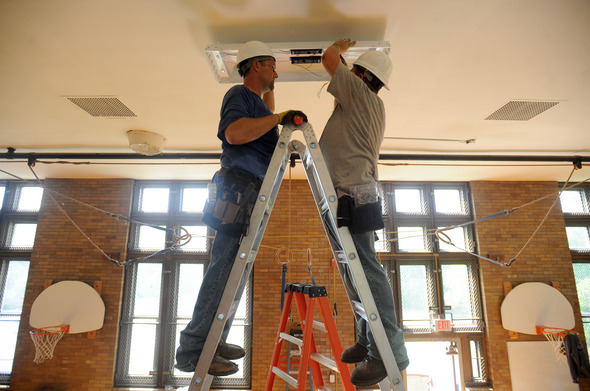
Electrician Craig Baker, left, and apprentice electrician Branden Fosgate of Pebernat Electric work on installing new energy-efficient lights at Angell Elementary School as a part of an energy savings capital improvement project throughout the Ann Arbor Public Schools.
Angela J. Cesere | AnnArbor.com
Ann Arbor earmarked the nearly $8 million in April to complete the fifth phase of an energy savings capital improvement program that the district has been involved in for a number of years.
Johnson Controls, Inc. was awarded the contract for the work. Every building within AAPS will see some improvements through the plan, said Randy Trent, executive director of physical properties for AAPS.
In addition to the nearly $700,000 in annual savings, Phase 5 is expected to generate a one-time savings of $200,000 to $400,000 via a rebate through DTE Energy.
The projects began on July 1 and will be completed in December. Because of their timing, AAPS should see a savings of around $500,000 for the 2012-13 school year, officials said.
With school districts being forced to tighten their belts due to budget constraints and reductions in per-pupil funding, many are looking for ways to upgrade equipment and cut energy costs.
Ypsilanti Public Schools' Board of Education heard a presentation Monday from Dragonfly Solutions, a company specializing in energy efficiency, to implement a similar energy savings program at YPS. If the board approves it, the company said Ypsilanti could achieve additional revenues of $4.6 million in the first 12 to 24 months.
On Tuesday, the Saline school board also authorized its superintendent to enter into negotiations with Energy Education Incorporated for an energy savings contract.
For Ann Arbor, Trent said electricity accounts for the largest single portion, about a third, of the district’s energy bills. A large portion of the Phase 5 energy capital improvement projects will be electricity-related.
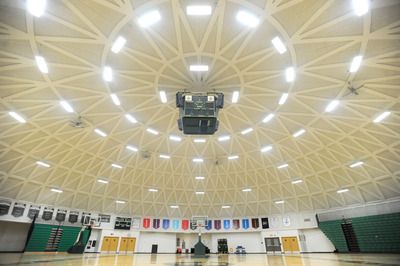
New, brighter, more energy-efficient lighting was installed recently in the Ann Arbor Huron High School gymnasium as part of new upgrades happening district wide.
Angela J. Cesere | AnnArbor.com
The district will install more than 10,000 feet of additional pipe insulation throughout 28 buildings and 780 night set-back thermostats in 19 schools, Trent said. It will repair the air control systems in 19 buildings and replace 1,100 steam traps in 10 buildings, he added. Steam traps are automatic valves that allow for the passage of condensation while containing or preventing the passage of steam.
Trent said he and others in the physical properties department at AAPS meet annually with building leaders to discuss which upgrades, improvements and repairs are needed for that particular school that year.
“We try to prioritize what people are looking for,” he said. “The trick is to balance our limited resources and get the district running as efficiently as possible.”
Controlling electricity costs and setting the temperatures in buildings after hours so the district isn’t running 24 hours per day is important in minimizing expenses, he said.
Most of the district’s money for capital improvement projects now comes from the sinking fund Ann Arbor Public Schools’ voters approved, rather than a capital improvement budget or a line item in the general fund, as was the norm when Trent started with the district in 1984. This is because of recent budget constraints and funding reductions from the state School Aid Fund, he said. The $7.81 million for the Phase 5 energy project will come from 2004, 2005 and 2010 sinking fund monies.
Trent added the district's utility budget — for gas, water and electricity — is now about $4.9 million, compared with about $5.4 million in 1984. Next year, the budget will be $4.7 million, he said.
“And the district has grown tremendously, like we now have a new high school,” he said.
There is a separate maintenance budget that is used for small items and quick fixes, such as painting, repairing a sink or a toilet or replacing a light bulb, Trent said. That fund also is shrinking.
Big items, such as air conditioning units, roofing and flooring replacements, are paid for out of the sinking fund, Trent said.
Replacing some boilers, hot water pumps and air conditioning units also will be among the Phase 5 energy capital improvement project. Additionally, the project will include installing high-tech liquid pool "covers" at six of Ann Arbor's swimming pools.
A sinking fund is a limited property tax, Trent said, that is considered a "pay-as-you-go method" for addressing building remodeling. He said state law allows a district to levy up to 5 mills for no longer than 20 years. Ann Arbor's sinking fund levies 1 mill and was approved for five years.
"It is more like a bank account where you can access the money on-hand to pay for projects as they are completed," Trent said. "The district will not pay interest for the money used," as opposed to a bond.
Danielle Arndt covers K-12 education for AnnArbor.com. Follow her on Twitter @DanielleArndt or email her at daniellearndt@annarbor.com.
Comments
Basic Bob
Fri, Aug 17, 2012 : 1:51 a.m.
Seriously, we went through this in 1973. Orange stickers on every single light switch reminding us to turn off lights when we leave the room. Thermostats turned down to 68 all day long. This should cost about $50. And everybody bring a sweater.
jns131
Sat, Aug 18, 2012 : 1:01 a.m.
I could not agree more. Wear layers and take em off it need be. Otherwise, don't expect me to turn up the heat.
J. A. Pieper
Fri, Aug 17, 2012 : 8:26 p.m.
Sometimes the classrooms are around 55 degrees in the colder months, yes, we learn to dress for work in layers. Then there are times it is 92 degrees in the classrooms in the colder months, and we have the door open, or windows if there are any. BET this never happens at the Balas building!
Roger Kuhlman
Fri, Aug 17, 2012 : 1:44 a.m.
Is what AAPS is doing really any big deal? Does it save the school district overall any money to reduce energy usuage when you figure in that AAPS is spending close to $8 million to implement this plan. Also it all very well and nice to say we will be saving so and so in the future. How certain can we be about these savings. What happens if these predicted savings do not pan out. Is there any accountability and consequences for failures. I have to say it is very easy to play with public monies and make grandstanding feel-good political moves when significant amounts of your money is not at stake and you never have to pay a penalty for risky management moves that turn into costly public failutres.
LXIX
Fri, Aug 17, 2012 : 1:19 a.m.
Per the A2 Energy Commision there also exist a variety of money-saving programs for residents and for business, too. Limited time only. http://www.a2energy.org
J. A. Pieper
Thu, Aug 16, 2012 : 4:29 p.m.
Will there be any energy savings expected from the Balas building? What is the temperature set at for this building? ( winter & summer) The schools themselves have seen the cuts in temperatures, it can be at 55 degrees when teachers enter a building in the morning. The heat comes on right before the students enter, but it does not mean that it will be comfortable. There is no consistency in the heating, even on one hallway! Anyone who complains about fans, come spend a day in AAPS classrooms, we desperately need them for everyone's comfort. Once you visit your child's classroom, go visit Balas, and feel the total comfort they enjoy. Some may indicate that the Balas building has no windows and they need to have air on (set at what temp?). There are building that also have no windows that open, yet the air is set at a very high temp. I am willing to assume that energy savings are not as stringently applied where the administrators work each day, unless it is related to lighting only.
Dog Guy
Thu, Aug 16, 2012 : 6:51 p.m.
In the early 1950's, I enjoyed watching Wally Cox on television as Mr. R. J. Peepers dealing with many of the same administratively perpetrated annoyances you endure. I have borrowed heavily from his Mr. Peepers character in teaching science (but without appropriating the name).
Macabre Sunset
Thu, Aug 16, 2012 : 4:01 p.m.
It seems like, and maybe this is just poor writing, but most of the "savings" comes from the assumption that a human being cannot turn down a thermostat at night. If that's the case, then maybe a better solution would be to privatize services, as I'm sure turning down the thermostat is something a contractor can handle. If it really is $8 million to gain $700k a year in savings and update facilities that have to be replaced every once in a while anyway, then it makes sense. I'm just getting the sense that this is more government fuzzy math to appease the masses. On the LED question, are there any long-term studies on whether these things are worth the initial infusion of cash? Again, in theory it makes sense and it seems like there's potential for LEDs to have a huge impact on the energy world, but do they provide enough light at a reasonable cost?
salineguy
Thu, Aug 16, 2012 : 3:30 p.m.
There is a bit of a distinction between the physical changes being made in Ann Arbor as capital improvements and the 'consultants' that are likely to come into Saline, analyze data and make recommendations to improve efficiency. Physical changes that actually reduce costs are a good thing - although some would (approriately) question the ROI time frame - recommended 'behavioral' changes that can 'save' money (beware of consultants preaching cost aviodance and booking it as hard savings) is a bit different. Behavioral changes and cost avoidance recommendations don't require a formal bidding process like actual physical plant work would Will not judge until I see the Saline proposal, but just sounds too good to be true if you read the glowing reviews on Energy Education Inc.'s website. I will be watching, however.
CLX
Thu, Aug 16, 2012 : 3:20 p.m.
I'd love to know what the standard is for setting the temperature in the winter. We keep our house at 64 degrees. When my kids go to school, they suffer from the heat - over 80 degrees in many of the classrooms. I know that older buildings are inconsistent in the heat from room to room, but I have never been in a school that was not excessively warm. So maybe turn down that temp to save some money??
jns131
Fri, Aug 17, 2012 : 1:26 p.m.
We keep ours at 65 during the winter. I agree, keep the classroom cool. If not? Then the children will fall asleep. There is nothing wrong with keeping an area cold Why waste energy and the money when keeping the buildings cool is better energy saver then wasting tax payer money.
ChrisW
Thu, Aug 16, 2012 : 3:56 p.m.
I take it you are of Nordic descent?
dogpaddle
Thu, Aug 16, 2012 : 2:49 p.m.
@sh1 and others who believe you have the right to decide what may or may not be brought into a professional employee's "office" or workplace: As a former high school teacher, let me tell you that unless these improvements completely take care of comfort completely across each building, I have to disagree with taking away the right of a teacher or other employee to bring what they need to make their environment where he or she spends most of their awake life comfortable. My former classroom ran the gamut from way too cold (for me and my students) to way too hot and some places in the same building on the same day had the opposite problem. Yes, while fans are no big deal to energy efficiency, portable heaters are (as well as a danger). But let me tell you, they were necessary at times. I personally never had a mini fridge in my room and at times had a donated hand me down microwave from a nice parent which was also a distraction/disruption. Please keep in mind that a high school or middle school teacher barely if at all has time to run to the bathroom during the short passing periods, let alone run to a community fridge or microwave in the staff lounge and barely has time to get to lunch by the time the class before lunch clears out and to be back before the class after lunch comes in. Really, the point I'm making is that I find it deplorable that just because you are a taxpayer, you think you have the right to control what your community teachers may or may not have in their workplace. How would you like it if we the public monitor what you do in your workplace? We all have bosses for that. Yes, as a taxpayer, you and me both have a huge say-so (or should) in how our school district spends our tax dollars including improvements in energy efficiency. And, yes, every employee should make every effort to go green and save the district money where it can (as everyone should be doing). Ideally, yes, in a perfect world, classrooms would be an ideal temp. Hope thi
arch
Fri, Aug 17, 2012 : 12:47 p.m.
I absolutely believe that the district and the taxpayers have a right to set rules about what is allowed in classrooms. In fact the majority of businesses do have rules (prohibiting personal appliances and sometimes down to how many personal pictures are allowed in a cubical). Most employees understand that their employers own the space they work in and live with it, but teachers consider it "their" personal territory and think that they can do anything they want. Kids make it through the day with an ice pack stuffed in their lunch bag and I'm sure teachers can somehow live without a mini-fridge that uses electricity 24/7. By the way, in my summer inspections in another district, I often found a mini-fridge, left plugged in for the summer, with one item inside.
dogpaddle
Thu, Aug 16, 2012 : 3:17 p.m.
My apologies, sh1. I misinterpreted your comment. Thus more than one right answer on some tests. :)
sh1
Thu, Aug 16, 2012 : 2:59 p.m.
You assume incorrectly that I don't think teachers should be able to bring in these items. I am especially concerned about prohibiting fans since most of our classrooms are not air-conditioned.
ChrisW
Thu, Aug 16, 2012 : 2:41 p.m.
This is a good way to transfer sinking fund dollars to the general budget. And, let's face it, energy costs never go down - even with natural gas prices at historic lows my DTE bill is up over last year.
Dog Guy
Thu, Aug 16, 2012 : 12:55 p.m.
"Most of the district's money for capital improvement projects now comes from the sinking fund Ann Arbor Public Schools' voters approved," Other than in Ann Arbor, "Sinking fund" refers to a debt-reduction fund. Does AAPS use this term to sound classy or to taunt homeowners in tax-foreclosure?
johnnya2
Thu, Aug 16, 2012 : 1:31 p.m.
"In modern finance, a sinking fund is a method by which an organization sets aside money over time to retire its indebtedness. More specifically, it is a fund into which money can be deposited, so that over time preferred stock, debentures or stocks can be retired. Sinking funds can also be used to set aside money for purposes of replacing capital equipment as it becomes obsolete." Read the last sentence, and get an education. Only in the conservative world does saying something that is wrong become a fact.
sh1
Thu, Aug 16, 2012 : 12:35 p.m.
Danielle, can you check into the rumor that teachers who bring in their own appliances from home, such as mini-fridges, microwaves, and fans, will no longer be able to use them in their classrooms as part of this savings?
Beth
Thu, Aug 16, 2012 : 3:18 p.m.
I hope that's not true! As a teacher myself, I know how badly needed fans are. A fridge can also be important - not just for storing the teacher's lunch (as another poster mentioned, there's often not time to make it to the common room) but also for storing class snacks in the younger grades. If we ask parents to send in healthy snacks - cheese sticks, yogurt tubes, fruit, etc. - rather than junk food, we need a place to keep those items cool until snack time. The teachers' lounge fridge tends to be too full, and too far away.
arch
Thu, Aug 16, 2012 : 1:01 p.m.
Microwaves and fans are no big deal, but refrigerators (especially ancient, mini-fridges brought from home) are 24/7 energy wasters. I hope that they are being eliminated, since I'd much rather have my tax dollars spent on instruction.
db
Thu, Aug 16, 2012 : 11:30 a.m.
There are credible industry standards for estimating future energy savings from these sorts of capital expenditures. There are, of course, estimates (until we invent time travel, or crystal balls, that's all we've got, guys). What cannot be denied is that these will save money in the long term; the only question is the exact length of payoff. That's not a bad thing.
RUKiddingMe
Thu, Aug 16, 2012 : 11:13 a.m.
One thing that I think would be really awesome is if someone wrote these "expected" and "predicted" savings, refunds, etc. down, and then checked in the time frame mentioned to make sure that things are as they were expected. For instance, make sure that in the first year they DID get $200,000 to $400,00 from DTE. And in a year, make sure the electricity costs WERE $699,359 less than years previous to the improvements. Then make sure the same is true the NEXT year. These are easy things to check and verify, and yet I get the feeling that a lot of expenditures in this city are based on predictions, assumptions, and expectations, with no real follow through or accountability when things turn out to not be so.
Sparty
Fri, Aug 17, 2012 : 2:30 p.m.
Have you ever seen a natural gas or electric bill go down year over year on a long term basis ? LoL
RUKiddingMe
Thu, Aug 16, 2012 : 3:22 p.m.
johnny, I think you have some very good examples of complicating factors, but overall I think one can still measure the actual vs. stated benefit over time, even if it's estimations. The differences in weather, for instance, are easily incorporated into such an analysis; DTE provides several ways to view theses types of things on the average residential consumer's bill. A lot of of those factors can be distilled down to price per Kwh, how many kwh were used, etc. I agree nothing's going to be 100% accurate, but there's certainly a "did this save as much as we thought it would, and did it not cost more than we thought we'd spend." I don't think any serious consumer, whether it be an average resident or large business, makes investments like this with absolutely no payoff analyses and/or monitoring.
johnnya2
Thu, Aug 16, 2012 : 1:28 p.m.
No, there is no sure fire way to calculate all this. I will list MANY reasons why 1. What will he price of electricity be in 2017? Can you tell me? People can project. THAT is what a budget does (which is where the $699k number comes from). 2. Do you know what the weather will be like in 2013? Maybe you missed it, but this summer was unseasonably warm. This leads to a larger than normal AC usage, which means more cost. WIthout the upgrades those costs would be even more, but there is no accurate way to monitor these things exactly 3. Other unknown variables, such as schools closing for snow days, then needing to be open longer int he summer, or damage to a school which means general repair and maintenance will need to use utilities more than expected ( or less). A window may get broken and allow heat or cooling to escape. Budgets are just that. They are predictions based on past performance. There is no 100% sure fire way to say what it saved.
Barzoom
Thu, Aug 16, 2012 : 10:30 a.m.
Hmmmm. Spend 7.81 million to save 699000 per year. Eleven years to recover investment. One wonders who looks at these things.
Sparty
Fri, Aug 17, 2012 : 2:32 p.m.
Have you ever seen those natural gas and electric bills not trend up on a long term basis? Duh
RUKiddingMe
Thu, Aug 16, 2012 : 2:45 p.m.
johnny, there are things that go into decisions besides [Money now] - [Money Saved]/Time. Following your logic, I'm an idiot for not tearing my house down and building a more energy efficient one. As I stated, I wasn't saying that this is a dumb idea, I was just saying that it's not automatically brilliant just because someone says the words "this'll save money in the long run." For one, we should make sure it actually WILL save money in the long run (again, it seems lots of things get done based on glib assumptions and sales pitches with no followthrough; e.g. recycling program), and for another, there IS such a thing as spending too much for too little. I think your statement that you'd gladly pay millions for a 20 year payoff is a little shortsighted; it assumes nothing will go wrong or need to be redone within 20 years. How old is the library they want to tear down?
johnnya2
Thu, Aug 16, 2012 : 1:21 p.m.
@RUKIDDINGME, Many of these things would need to be done on a piece meal basis anyway. People spend THOUSANDS to put new insulation in their home. What do you think the payoff time is on that? I would gladly give somebody $7.81 million for a 20 year $700k return. If you think that is unwise, then you are a math failure, or just being ridiculous for some political reason.
sh1
Thu, Aug 16, 2012 : 12:34 p.m.
Where would we be in 11 years if we don't do this?
RUKiddingMe
Thu, Aug 16, 2012 : 11:08 a.m.
Aprty, I get the impression you're trying to make the point that those things have about the same rate of return, or are done strictly for energy savings. When I got a new roof, it was because of leaks, and after I did the math that fixing spots over the course of several years would leave me with the same problem. I doubt that if people were getting new water heaters, furnaces, etc., and the only reason was energy savings, they would be heedless of the length of time for ROI payoff. I'm not saying the schools shouldn't do this, I'm just saying your argument wouldn't be a justification for it.
Sparty
Thu, Aug 16, 2012 : 10:46 a.m.
Don't know. What's your ROI on a new roof, new attic insulation, new water heater, new furnace, new kitchen appliance, new windows, new siding, etc.?