

Ann Arbor school board candidates sound off on transportation, athletics and communication
- Previous coverage: Ann Arbor school board candidates clash on vision of leadership
Two candidates running for the Ann Arbor Public Schools Board of Education have entered the final push prior to November’s general election.
Dale Leslie, a former Ann Arbor businessman, has challenged current board President Deb Mexicotte for her seat, a four-year position.
Mexicotte is the only school board member up for re-election this year. She has served on the board since 2003 and as president for the past three years.
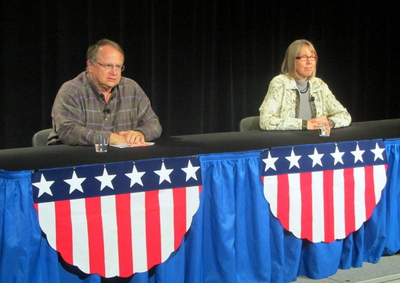
Candidates for Ann Arbor school board, Deb Mexicotte, right, and Dale Leslie, at a debate put on by the League of Women Voters Oct. 9.
Danielle Arndt | AnnArbor.com
With persistent budget challenges and declining revenue in recent years, Ann Arbor school leaders have explored tough questions about how to maintain learning and extracurricular opportunities for students, adequate class sizes and transportation with fewer dollars overall.
Last year, the school board cut $3.84 million and used $6.04 million from the district’s savings in order to balance its $188.5 million budget. It also relied on $6 million in revenue from Schools of Choice, Medicaid reimbursements, Gov. Rick Snyder’s “Best Practices” and proposed funds to offset teacher retirement costs.
But despite that, Ann Arbor's financial officials already have predicted another budget shortfall similar to the $17 million it experienced last year for 2013-14.
As programs and services that parents, teachers and students care about are placed on the chopping block, criticisms of the district are brought to light. And a lack of transparency and communication typically are at the top of that list.
In addition to managing the affairs of the district and providing administrative oversight, the current school board recently committed to taking on a greater advocacy role in legislative reform.
Influencing how K-12 education is funded in Michigan and finding additional sources of revenue were two of Mexicotte’s top three priorities in her platform for re-election.

Deb Mexicotte
“Taking it all out, to then put it back in, and having to justify what is given will ensure that we are better able to fund classroom priorities first,” she said.
Mexicotte added maintaining and increasing the district’s partnerships with groups like the PTO Thrift Shop; the sports, choir and band boosters; and the Ann Arbor Public Schools Education Foundation also is “incredibly important.”
She said while advocacy and “being a politician for the school district” always has been part of the traditional role school trustees play, times are changing and the current funding situation calls for advocacy on a greater level.
“It is clear that the traditional ways we have worked with Lansing, the traditional ways we have talked with Lansing and the way we have interacted with our county peers — other school districts and civic organizations — are not sufficient any longer,” Mexicotte said. “The difference is … 18 years ago (before Proposal A) … school boards had a lot of control over how they met their communities’ needs.”
Leslie’s standpoint on the funding problem is the solution lies more locally. He would advocate for more fundraising drives by the district and, in particular, in the area of athletics and extracurricular activities. He said AAPS has “gotten too big” in the extras it funds and he would support making the athletic department budget self-sufficient.
“…We have more sports than any school district in the state. ... Even bowling became a varsity sport. And although the more diversity we have, the more people participate. Every time we add a sport, we add another expense,” Leslie said.
AAPS has looked at reducing some of its athletics to club sports in recent years. Lacrosse was downgraded to a club sport this fall for a savings of $93,000. Also this budget cycle, the board prohibited using general fund money for voluntary non-league tournaments and sporting events — a savings of $58,000.
Mexicotte said AAPS has cut athletics in other years as well, and implemented pay-to-participate fees fairly recently.
“One of the things this board has done, that I agree with, is we don’t want to go back to the same place every single year. If we make a big adjustment in athletics, we don’t want to look at athletics the next year. That community needs to adjust,” Mexicotte said. “We need to look at the unintended consequences, if there are any.”
Mexicotte said this is the same stance the board has taken on transportation — although, she has begun to question whether “tinkering around the edges” on this issue is the best way to go, she said.
AAPS administrators proposed eliminating transportation entirely during this year’s budget discussion in April as a way to reduce spending by $3.5 million. Other lesser cuts to transportation also were weighed, such as eliminating high school busing ($545,000).
“It’s money we’re not mandated to spend,” Mexicotte said of providing busing to students. “But I certainly would not support (eliminating transportation) without a heavy, heavy heart or without understanding how integral it is … to that social justice, access piece. … If students can’t get to school, you can’t teach them.”
This summer, Superintendent Patricia Green established, at the request of the board, a cross-government working group to analyze the future of transportation within the district. Mexicotte said this was the right approach to dealing with this complicated issue, adding she wants to be certain the district fully understands “what we’re tossing over the edge and what we’re maintaining to do it.”
Leslie’s stance on busing is clear: eliminate it in the city limits.
Leslie raised his children about a block from where he grew up on Greenview Drive in downtown Ann Arbor. When he was attending AAPS, he walked to school or rode his bike, he said. When his children attended, the bus picked them up to take them to Slauson Middle School.
“To Slauson!” Leslie said. “Not having a bus didn’t hurt me. It didn’t hurt a number of kids. … Back in my day, the only people that rode the bus were the ones that lived in the rural areas.”
Leslie’s top two priorities if he is elected would be fixing the trust issues on the board and creating a district policy for hiring local, prevailing wage contractors.

Dale Leslie
Leslie said he would engage the schools, the business community and the labor community in a conversation about how to partner to support one another.
Discussions about prevailing wage and hiring local contractors have been heated recently among current school board trustees, with about a third of the board in favor of drafting a board policy, a third against it and a third undecided. Mexicotte said the board intends to address the issue at an upcoming Committee of the Whole meeting.
On the topic of communication and transparency, Mexicotte had much to say. She said as a community, Ann Arbor has a “hunger” for information.
“I want every last piece of information. I want it when I want it, how I want it; I want to understand it and I don’t want to wait for it,” she said. “And why should I wait more than 24 hours for it?”
She said the district should have a 24-hour response time with parents and the community, “unless there is a really good reason not to.”
Mexicotte said she and other school board members have pushed in the past for a “beefed-up” communications department. AAPS has just a single director of communications, whereas other districts elsewhere Ann Arbor’s size have at least four, she said.
“Communications is something I don’t think we’ve ever been that good at,” she said. “And, yes, it is that important that I have pushed for it. Others have, too. We've said, ‘Tell us how to make it work better.’ But no administration has ever come to us saying, ‘Let’s add 4 FTEs to communications.’”
In these economic times, when cuts are threatening the classroom, it’s a “tough sell” for the board and the community to really make communications a priority, despite it needing more attention, Mexicotte said.
Leslie said the district has several new administrators and Green is entering her sophomore year.
“So accepting that, I’m willing to watch how (Green) develops in reference to her duties (in communication and transparency) and not be too quick to judge on what she does or doesn’t do. But I am expecting some improvement,” Leslie said.
He added it bothers him less that the district is not communicating with the public than it does that the district is not communicating with its staff. He referenced the Pioneer High School math teacher who spoke out at two school board meetings about the hiring of Pioneer's new principal as an example. He said it appears district administrators should have done a better job of talking to teachers and building leaders in this instance.
Leslie, to emphasize the importance he places on communication, launched a school visit "blitz" last week. He said he plans to arrange an on-site appearance at each of the district's buildings prior to Nov. 6.
To learn more about school board candidates Leslie and Mexicotte, as well as other candidates on the Nov. 6 ballot, visit MLive and AnnArbor.com's 2012 Voter Guide.
Danielle Arndt covers K-12 education for AnnArbor.com. Follow her on Twitter @DanielleArndt or email her at daniellearndt@annarbor.com.
Comments
a2edu
Sun, Oct 21, 2012 : 2:57 p.m.
Really Deb ? . . . 4 new Balas communications administrators? But you're right on one account: it "would be a tough sell." That's because your idea to hire (yet again) more administrators is just plain crazy. You lost my vote when you tone-deafly voted to hire Ms. Green at an outrageous salary. But the real irony here is that you have paid an outrageously high price for a Superintendent who has been a horrible communicator . . . perhaps the worst I've seen in my 18 years of AAPS teaching. Want to increase communication, Ms. Mexicotte? Don't hire more administrators. Instead, find a Superintendent who can communicate with the parents, faculty and staff of AAPS.
jns131
Sat, Oct 20, 2012 : 1:10 p.m.
Cut administration costs in half or more and leave transportation alone. Vote this woman out of office. There are children and parents who do not drive and these children will have to stay home if nothing else. Vote for a new board in November. This one sucks. Deb? You lost my vote when you said transportation over administrations. Balais is too top heavy as it is.
Jack Panitch
Sat, Oct 20, 2012 : 11:14 a.m.
This one isn't close at all. One candidate's entire candidacy is a knee-jerk reaction. The other candidate is a proven, effective leader with vision, energy and a record of tireless, selfless service on behalf of our kids.
say it plain
Sat, Oct 20, 2012 : 2:26 a.m.
This is a tough one for me... I'm not too enthralled with Mr. Leslie's apparent stance on busing (there is a lot that is different in the world today from when he was a kid!), for one... But I do not think that Mexicotte has been effectively leading or even merely effective on the School Board, and I think fresh people with fresh ideas are sorely needed at AAPS! I do agree that AAPS needs to be better at communicating, but we don't necessarily need to hire any more people for that to happen! All they'd be are mouthpieces for the central office... We need to *change the overall culture* to one of trust and transparency, and Mexicotte can only be held responsible for it actually seeming to get *worse* during her tenure...
Swimmer
Fri, Oct 19, 2012 : 3:45 p.m.
"Not having a bus didn't hurt me. It didn't hurt a number of kids. … Back in my day, the only people that rode the bus were the ones that lived in the rural areas." Did passengers in cars wear seatbelts, "back in your day", Mr Leslie? Did cyclists wear helmets? And just how much traffic was on the roads "back in your day"? Things change, safety issues change. And even if it were safe for all the students in the city to walk to their school, that is not realistically going to happen. Cutting bussing will increase the traffic and danger in the school drop off zones which are already stretched beyond capacity and very dangerous places for our children. Yes, eliminating transportation would cut the AAPS budget. So would eliminating all text book and bathroom tissue purchases. The end does not justify the means.
Orangecrush2000
Fri, Oct 19, 2012 : 12:52 p.m.
Vote Leslie. In my opinion, Mexicotte is kind of a "do nothing" board member. Not happy with the current state of affairs in the district. Leslie's a successful businessman. He knows what he's doing. We need a change, to people who know what to do, and know how to do it.
NewYorkerinAA
Fri, Oct 19, 2012 : 1:43 p.m.
Is he? Last I heard his dad's company closed long ago.
Karen
Fri, Oct 19, 2012 : 12:37 p.m.
Ms. Mexicotte has been the school board president for several years. She is the reason the system is the way it is. Anyone who doesn't think it is a good idea to hire 3 more administrators while not having a clear plan to cut spending should vote for the other guy. If Ms. Mexicotte has a "heavy heart" about getting rid of her favorite "social justice" progrems then perhaps the job is too much for her now, and she should step down and let someone else take over.
a2edu
Sun, Oct 21, 2012 : 2:46 p.m.
Amen. Mexicotte has got to go.
aamom
Fri, Oct 19, 2012 : 12:10 p.m.
Mr. Leslie's top priority is hiring local contractors and fixing trust issues on the board? That's fine to have on your radar as issues, but really your top priority? As a parent, I don't see my child (or anyone's child) reflected in either of those priorities. Ms. Mexicotte also has priorities that seem to be more about the board than children, but I do like the idea of more advocacy to change funding at the state level. Proposal A has to go.
T Wall
Fri, Oct 19, 2012 : 11:46 a.m.
PLEASE GIVE DALE LESLIE YOUR VOTE...I have known Dale since the 60's when we both attended Slauson Junior High. Dale would be the perfect fit for our School Board. He will make a positive difference for our children and his business experience is desperately needed. Dale will bring more communication and transparency to our School Board. Our Ann Arbor Schools needs Dale Leslie. Make a smart educated vote for Dale Leslie.
DonBee
Fri, Oct 19, 2012 : 10:37 a.m.
Ms. Mexicotte's Answer - add more administrative overhead. Cut bussing and services to students. The $17 million shortfall is an increase in costs, not a drop in revenue. The way the contracts are structured in the district there will be a shortfall every year unless AAPS gets a 3 to 5 percent ANNUAL increase in revenue after inflation. The board and the administration set it up this way, and it will be an annual exercise. $7 million can come from getting administrative overhead back to 2007 levels (the oldest budget still available online) and cutting the general fund transfer to athletics. Another $500-700,000 can come from transferring the day care to private hands - it was supposed to be self funding, but it is not. None of these costs are mandated by law.
jns131
Sat, Oct 20, 2012 : 1:12 p.m.
Mexicotte is the answer to keeping administration salaries and cutting everything else. Cut spending in Blais. Consolidate this waste of space.