

What's next for transportation in Ann Arbor schools? New group to suggest solutions
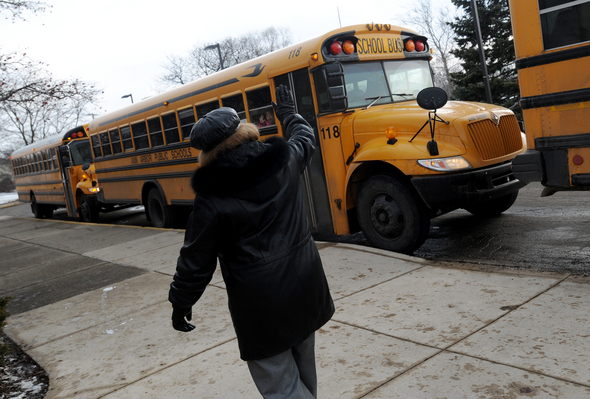
An administrator waves outside Thurston Elementary School as students leave on buses after transportation cuts and route changes in 2010-11. After multiple years of cuts, the district is organizing a community transportation committee to analyze the future of busing in the Ann Arbor Public Schools district.
AnnArbor.com file photo
According to the resolution drafted by President Deb Mexicotte, the board has been concerned that its “transportation decision-making to date has been driven primarily by the increasing demands on (its) operational fund budget, in the face of the decrease in support for public education at the state level,” as well as the rise in energy costs and retirement contributions.
The transportation committee, or “administrative working group” as it is being dubbed since it would fall under the direction of Green and her administration, would be charged with analyzing the district’s current transportation model and developing a short-term and long-term plan for transportation within Ann Arbor Public Schools. The plans would be similar to those that exist for technology.
The purpose of the group is to call all of the stakeholders to the table — students, parents, administrators, board members, city leaders, police and the Ann Arbor Transportation Authority — to “deal with some very specific issues that the district and the community need to come to terms with,” in the words of Board Secretary Andy Thomas.
Thomas said the conversation of the committee needs to center around what the impact of further reductions or the complete elimination of busing would be. He said the group should study and determine the student population that would be most affected by large-scale cuts, how traffic around neighborhood schools would be impacted and what the environmental and safety repercussions of such cuts could be.
“It does appear to bite off a pretty big chunk,” Thomas said of the board’s detailed request. “But I would emphasize we should do what we can to keep it on a very tight timeline… because I think it is very likely (these busing issues) are going to be coming up again in budget discussions next year.”
AAPS proposed a number of cuts to busing for the 2012-13 school year, including eliminating transportation to the high schools or entirely. However, the board recently shied away from such large-scale cuts in favor of more study and a deeper conversation about transportation as a whole and where the district sees itself going with busing.
The administration made its budget recommendation to the board Wednesday night outlining some smaller transportation-related reductions for a total estimated savings of about $697,228. This would include changing Skyline High School’s start time by 15 minutes to eliminate using a second fleet of buses for the school, combing bus routes for Bryant and Pattengill elementaries, reconfiguring Ann Arbor Open school’s busing system, eliminating mid-day shuttles between Community High and the comprehensive high schools and cutting funding for the 4 p.m. buses for after-school programs at the middle schools.
Vice President Christine Stead has been the only board member to suggest placing eliminating high school busing back on the table. She said last year when this potential cut was discussed, administrators reported about 30 percent of potential bus riders at the high schools actually chose to ride. She inquired about an updated percentage and Deputy Superintendent Robert Allen said he would get back to her.
Many trustees said that while AAPS is avoiding the heavy-handed transportation cuts this budget cycle, they are concerned about next year.
Trustee Simone Lightfoot said the transportation working group should look at the sustainability of busing from a variety of angles, such as how long the district can keep funding busing, the geographical and logistical aspects and the financial aspects.
Trustee Susan Baskett said her biggest concern with launching a busing committee is she wants community members to feel welcome to bring their thoughts, comments and questions freely and openly to the discussions and to not feel like a placeholder on an agenda-driven task force.
The resolution approved Wednesday gives Green the prerogative to either conduct the working group through one of the district’s existing busing-related committees, such as Transportation Safety or City/Schools. Or Green may elect to compile an entirely different set of individuals, the resolution states.
Per the resolution, the administration would report back to the Board of Education with updates on regular intervals. The committee also would be asked to present a thorough report with its findings and recommendations to the board in January 2013.
Mexicotte said she hopes this method of submitting a formal request to the administration detailing what sort of information and action the board would like to see from them can be used more in the future.
“I really like the wording of this and the clear direction we have been given and also the flexibility,” Green said of the request for the transportation work group. “I’d like to go at this not with a road map, but with a compass. Because I think all the stakeholders that we bring together will need to help develop the road map on this.”
Green added the busing topic has momentum now, so she intends to begin moving quickly on this task.
Staff reporter Danielle Arndt covers K-12 education for AnnArbor.com. Follow her on Twitter @DanielleArndt or email her at daniellearndt@annarbor.com.
Comments
AAPS Student
Wed, Jun 13, 2012 : 10:12 p.m.
Every other high school starts at 7:45, why is Skyline the only one that will start 15 minutes earlier?
Yuxuibbs DiNozzo
Fri, May 25, 2012 : 1:11 a.m.
"changing Skyline High School's start time by 15 minutes" forwards or backwards 15 mins?
AAPS Student
Wed, Jun 13, 2012 : 10:09 p.m.
As a student at Skyline high school, the start time would be 15 min earlier. So 7:30 instead of 7:45. It would be better if it started at 8 instead, it is hard enough to get to school on time now.
Danielle Arndt
Fri, May 25, 2012 : 4:39 a.m.
Yuxuibbs DiNozzo, thank you for your question. They are moving it forward by 15 minutes, so school would start earlier, at about 7:25 a.m. instead of 7:40 a.m.
Soccer Mom
Thu, May 24, 2012 : 11:08 p.m.
Stop eliminating the high school bussing! It has already been a complete inconvience as I personally transport my children to and from high school because our bus stop was eliminated this year. The previous neighborhood we resided in, has no AATA bus service because it is too far out. The students out there are currently still on the high school bus route. If high school bussing is completely eliminated, the majority of those students (as well as others) will have no way to get to school at all. Eliminating high school bussing will result in more students dropping out of school. Cut the administration salaries NOW!
jns131
Fri, May 25, 2012 : 2:36 p.m.
That is what I have been saying all along. I also keep saying this too. Close Clemente save money on the busing by eliminating that as well. Send them to Stone School. Then the hi school busing and et all will be saved.
jns131
Thu, May 24, 2012 : 2:36 p.m.
Close Clemente and end the busing to that school. Most of those children live near Stone School. Next? Reinstate the choir money we lost because the board chose a school of no value over the value of an art education. AATA can get to Stone. They cannot get out that far to Clemente. You need a school bus to drive them to Meijer and drop them off at that AATA stop.
Milo Jones
Thu, May 24, 2012 : 2:25 p.m.
I'm a Skyline High School student. I would just like to go out an say I'd prefer not to have A 40 minute walk to and from the bus stop every morning. Every year, my bus stop has moved farther and farther from my house. It's not fun, especially when it's 0 degrees out in a few inches of snow. I have to walk across a golf course, and it doesn't get cleared of snow. One of the roads I walk on is plowed in the middle of the night and is turned into a sheet of ice. Its also in a developing neighborhood. So I travel through a construction site to get to the bus as well. I'm just saying, busses are supposed to help you get to school, not make it harder. They need more busses and more stops.
jns131
Thu, May 24, 2012 : 10:06 p.m.
Massachusetts does have paid busing. If you want to go to public school and need transportation? The parents pay upwards of $500 a child. This is what they ended up doing because of cost.
Les Gov
Thu, May 24, 2012 : 4:58 p.m.
@Milo...I've been on a lot of long walks myself in the winter. Nothing like walking in 30 below weather to get to a class....no fun...... You should keep in mind that a lot of kids across this country don't have any bus service. The good news is you have some bus service, for now. Of course your Mom/Dad always have the option to hire private transportation to reduce your walk. The real issue here is....should the public pay for the school's bus service? Or, should each household be responsible for getting their children to school? It isn't going to be very far in the future before schools can no longer afford the cost of the buses, the cost of fuel, the cost of maintenance, the cost of drivers....and most of all...the liability costs.....schools will be forced to end busing. Parents that want their kids on a bus will have to contract outside of the school to get that service.....it will happen...the question is when...
jns131
Thu, May 24, 2012 : 2:37 p.m.
Hate to say it, either walk or do mine does. Take a public bus to school. Yes, there are two transfers but it is much easier then walking in the rain.
A2James
Thu, May 24, 2012 : 12:32 p.m.
The first thing "on the table" should be high-level administrative pay cuts. If they are willing to ask students (the people they work for), the parents who pay taxes to sacrifice even more, and teachers to cut back, then they should lead by example and be willing to work for a little less.
AAPS Student
Sun, Jul 8, 2012 : 1:02 a.m.
Amen! Could not have said it better myself
jns131
Thu, May 24, 2012 : 2:38 p.m.
Totally agree. Cut Balais.
jmac
Thu, May 24, 2012 : 12:17 p.m.
Very pleased to see that the transportation issue may be addressed through a transparent process that will include the entire school community / stakeholders. I am rushing my 16 year old daughter to driving school in case the busses but that still leaves the problem of adding another car + insurance which isn't cheap. Hope this committee gets off the ground and we hear about their progress as it moves along.
DonBee
Sat, May 26, 2012 : 1:05 a.m.
I doubt it will be resolved or transparent, given the history with the prior transportation report, or the skyline process or even the recent budget meetings.
jns131
Thu, May 24, 2012 : 2:39 p.m.
Mine starts driving at the end of June. I too can't wait until she starts driving as well. We don't mine public buses, but getting up early to drop her off at one on the way to work is at best tiring.
towncryer
Thu, May 24, 2012 : 11:44 a.m.
Seems like from the last few AAPS articles, Ms. Baskett and Ms. Lightfoot are finally seeing through all the b.s. with their concerns. The emperor has no clothes.
jns131
Thu, May 24, 2012 : 2:40 p.m.
I'd like to know what she really sees in that mirror and who her tailors really are.
A2comments
Thu, May 24, 2012 : 10:43 a.m.
Would Iike to see the resolution, hope it specifies what regular updates means and when they will be received. I hope in Jan 2013 we won't see an inadequate report or a request for an extension.