

Ann Arbor officials temporarily suspend footing drain program in response to neighborhood concerns
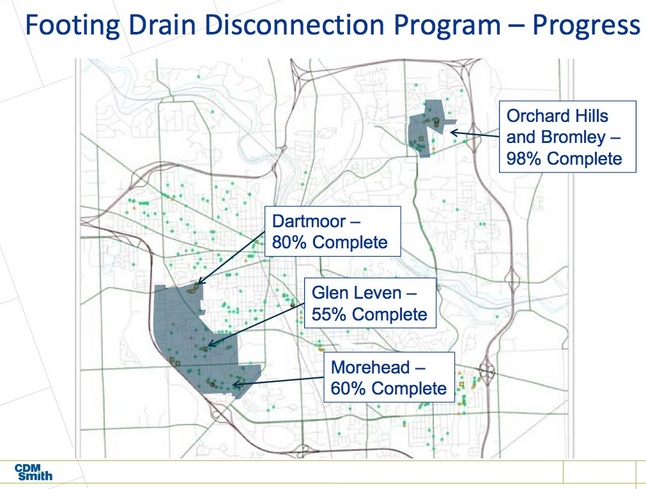
This map shows progress on the city's footing drain disconnection program, focused on five areas of the city. The city is temporarily suspending FDD work in the areas identified as Glen Leven and Morehead, which includes the Lansdowne neighborhood, after several residents raised concerns about the program.
Courtesy of CDM Smith
City Council Members Marcia Higgins and Margie Teall, both Democrats representing the 4th Ward, brought forward the resolution Monday night to take a closer look at the effectiveness of the FDD program after several residents have complained in recent months.
The resolution passed 11-0.
The city now plans to pause FDD work in two areas that are referred to as "Glen Leven" and "Morehead" while city officials thoroughly review the program.
Morehead is the city's designation for the larger area including the Lansdowne neighborhood. Glen Leven includes adjacent areas north of Scio Church Road in the same general vicinity.
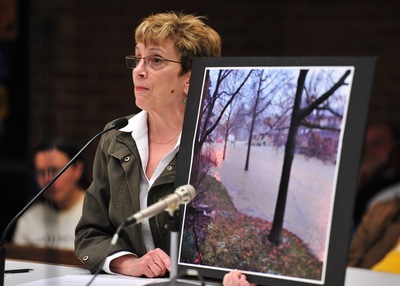
In this photo from April, Ellen Fisher shows Ann Arbor City Council members a photograph of the flooding that occurred in front of her home on March 15. She said she was mandated to participate in the city's footing drain disconnection program, resulting in more water being added to an already inadequate storm sewer system. "We were flooded again just a year later," she said.
Ryan J. Stanton | AnnArbor.com
Over the last 11 years, about 2,200 homes in Ann Arbor have had FDD work done and sump pumps installed to divert flows away from the city's sanitary sewer and instead to the stormwater drainage system. About 300 more homes were working through the process before Monday.
Ann Arbor officials credit the FDD program for helping to ensure the city's sanitary sewer system doesn't become overwhelmed during storms or lead to sewage backups in basements.
But in heavy rains when some neighborhoods have flooded and the city's stormwater system has been overwhelmed, some residents have complained the sump pumps the city has made them install are ineffective and water ends up cycling back in and flooding their basements.
"Some of them feel they should be allowed to opt out, and they feel this is not a correct way for the city to proceed," said Council Member Mike Anglin, D-5th Ward.
"They had dry basements, never had water in them, and now they're asked to participate in something that may cause them to get wet basements."
While the FDD program appears to have worked in other areas of Ann Arbor, Mayor John Hieftje conceded Monday night there's something different about the greater Lansdowne area.
"There's more to look at here because of the historic drainage issues," Hieftje said. "I'm in favor of taking a step back and really studying the problem because this area does appear to be different than the other areas, and so it is wise to go slowly here."
The city has held multiple meetings in recent weeks to talk with residents about the FDD program and larger neighborhood flooding issues. Higgins said there will be another community meeting at 7 p.m. Oct. 11 at Lawton Elementary School, 2250 S. Seventh St.
The City Council acknowledged when passing Monday's resolution that the FDD program's current focus area has encountered "unique, historical, creek-bed patterns and overland stormwater drainage issues" that have impacted the implementation of the program.
They also acknowledged communication between residents and the city needs improvement and vowed to have a weekly update posted to the city's FDD website.
While the program is suspended, city staff is expected to analyze issues related to the local stormwater system to improve stormwater drainage and conveyance, and address the existing surface flooding that residents are experiencing in those neighborhoods. The city's staff also is expected to hire one or more consulting firms to review and adjust certain aspects of the FDD program, including consideration of other means for achieving removal of footing drain flows from the sanitary sewers and a review of other technical issues.
Staff also is expected to investigate subsidizing the cost of equipment associated with improving homeowner confidence in the program and further study the "air gaps" provided for sump pumps, a feature that's described on one local resident's blog called "Ann Arbor Underwater."
The city also is planning to conduct a robust survey of FDD participants to find out more about homeowner satisfaction and the effectiveness of the program.
Craig Hupy, the city's interim public services administrator, said citizen-initiated footing drain disconnects still will be allowed during the moratorium.

Craig Hupy, the city's interim public services administrator, at a recent neighborhood meeting concerning the city's footing drain program.
Ryan J. Stanton | AnnArbor.com
The program, which started around the same time as the FDD program, is intended to hold the sanitary sewer system harmless from new development.
The city selectively chooses the neighborhoods where it wants to enforce the FDD program and then gives homeowners notice of the steps they must take. For homeowners who want to opt out, there's a $100-a-month charge tacked onto their water and sewer bill.
The city's consultants estimate the average cost for the in-home FDD work and discharge line running to the street is about $4,118 per home. The homeowner contracts directly with the plumbing contractor, but payment for the work is entirely covered by the city.
Some residents have adamantly protested going through with the sump pump installations for fear their basements might flood. Some even have threatened to sue the city.
Hupy clarified the opt-out process, saying residents are given a 90-day notice to comply. If they don't, they're no longer eligible for city funding for FDD work, and they're hit with the monthly penalties, which Hupy said is a situation a limited number of homes are in right now.
"Some of those have been there for a number of years, so there is no time limit as far as we're concerned as a utility how long they remain in that status," he said.
City officials said in late August they were about 55 percent complete with planned FDD work in Glen Leven and 60 percent complete in Morehead.
Council Member Stephen Kunselman, D-3rd Ward, asked Hupy when he thought the FDD program might come to an end. Hupy said the five areas the city initially targeted were intended to be only the start of the program, which was expected to last "tens of years."
"Our last major backup was in 2000, so we're only 12 years away from the last major basement backup," Hupy said. "The five study areas that we started to tackle are only 50 percent of the identified problems. We have another 50 percent to tackle within the whole city."
Hupy added, "We're not quite 50 percent of the way through the issues. I would say we've done the easier 50 percent because they're clustered."
Anglin asked Hupy for his best argument why the remaining homeowners who have dry basements and no flooding problems currently would want to go through with the FDD work.
"Well, the case that is made is this is being done to prevent sanitary sewer backups," Hupy said. "And when we don't do this, we continue to have a risk of a repeat of a 1998 or 2000 event where we had hundreds of homes with sanitary sewage in their basements."
Hupy showed slides of the historic alignment of Malletts Creek underneath where homes were built decades ago near Lansdowne. City officials now argue the flooding that occurs there is partly the result of poor planning and bad development decisions of the past.
Hupy said the additional review work council is asking for likely will cost seven figures but it's already planned for in the city's capital improvement plan and will be paid for out of sewer utility funds. He said it will require getting a consultant hired and doing flow monitoring once rains come in the spring.
"It would require us replicating the monitoring that was done in 1998 and 2000 and looking at the actual impacts of the FDD removals in the system itself," Hupy said.
Hupy said the city has been monitoring footing drains as they have been disconnected, including a certain sampling of sump pumps in various homes. From that, he said, the city has been able to extrapolate data about what kind of removals it's seeing throughout the system.
"But we haven't gone back and looked at it from the system down to see if we can confirm those numbers," he said.
Previous story: Ann Arbor launches citywide analysis of stormwater system in response to neighborhood flooding
Ryan J. Stanton covers government and politics for AnnArbor.com. Reach him at ryanstanton@annarbor.com or 734-623-2529. You also can follow him on Twitter or subscribe to AnnArbor.com's email newsletters.
Comments
Vince Caruso
Fri, Sep 21, 2012 : 7:19 p.m.
Seems prudent to suspend and determine the reasons for flooding homes. Seeing the 1947 photos overlay on the street is very telling. Why would we allow homes to be built in a creek bed. I would hope a solution could be found. The one option being discussed is placing a large holding tank for the sewage and stormwater in a down stream location. Which neighborhood wants that? Keeping fresh water out of the sanitary sewer, that must be treated, and contributes to sewage overflows into the river should be a major concern, as not doubt, are the homes flooding. The FDD has worked very well in other areas of the city and was a program adopted by the state after AA proposed it. No sewage overflows into the Huron is an EPA target being imposed on AA for good reason.
grye
Thu, Sep 20, 2012 : 4:57 p.m.
When our house had the footings disconnected and the sump pump installed, we were advised to have a backup system. However, even the backup system was not guaranteed to work. I had the contractor install the sump slightly lower and had a floor drain installed next to the sump. This drain is connected to the sanitary sewer. Should the pump fail and the water rise over the top of the sump, it will flow into the floor drain and out to the city sewer where all footing water went in the past. This is perfectly legal since my other floor drain in the basement go to the sanitary sewer.
Ryan J. Stanton
Thu, Sep 20, 2012 : 4:44 p.m.
If any of you who have commented on this story saying your basement was flooded after you had a sump pump installed, and want to talk on the record, email me at ryanstanton@annarbor.com
aes
Thu, Sep 20, 2012 : 4:35 p.m.
Years ago, we were part of the original required sump pump installation in the Dartmoor area. As soon as the installation was complete, our heretofore-absolutely-dry basement started to become moist along the walls, and the water increased gradually every day. When we complained to "the powers" at City Hall, they sent an engineer to televise the drainage system, but no solutions resulted. After a while, following further phone calls, "the powers" stopped answering us completely, apparently having been told by the city attorney not to speak to us. We have since moved, and I am not sure what happened subsequently, but the whole experience left a very bitter taste and a very bad feeling about how some people in the city government treat its citizens.
Jack Eaton
Thu, Sep 20, 2012 : 4:06 p.m.
Residents in the Lawton School neighborhoods are organizing a group to address concerns about the storm water flooding and the impact of the footing drain disconnect program. If you want to learn more, please visit their web site: http://www.a2underwater.com/ or search for Ann Arbor Underwater on facebook. If you have had the footing drain disconnect and sump pump installed or have been contacted by the City about having it done, that neighborhood group wants to hear from you: http://a2underwater.blogspot.com/2012/09/we-need-information-from-homeowners.html The temporary moratorium on footing drain disconnects is exactly that -- temporary. The problem of separating storm water from the sewage system, the problem of using sump pumps to pump storm water into an overwhelmed storm water system and the problem of surface water flooding need to be addressed. This neighborhood group intends to bring the concerns of residents to the process of addressing these problems.
jcj
Thu, Sep 20, 2012 : 3:09 p.m.
Hieftje said. it is wise to go slowly here. WHAT? When has the Mayor EVER gone slowly?
Think!
Thu, Sep 20, 2012 : 1:54 p.m.
Does anyone else feel like the film "Idiocracy" was actually a documentary?
a2grateful
Thu, Sep 20, 2012 : 1:45 p.m.
Said "insanity" is key component of folly. . .
Janet Neary
Thu, Sep 20, 2012 : 1:17 p.m.
I am concerned by the idea that we will pay "seven figures" to replicate the monitoring work that produced the recommendation for the footing drain disconnect in the first place. Please assure me that we won't be hiring the same consultants. (?Insanity is doing the same thing over and over and expecting different results.")
Brad
Thu, Sep 20, 2012 : 12:25 p.m.
Question - why does it require a pump for the (disconnected) storm water but not for the sewage?
EyeHeartA2
Thu, Sep 20, 2012 : 1:35 p.m.
You pump the water out from your footings (and the sump) and onto your lawn. Then the water goes back from your lawn into your footings and sump and the process repeats. That is, until your sump pump fails for some reason. Then your basement just fills up with water.
Unusual Suspect
Thu, Sep 20, 2012 : 1:05 p.m.
I believe it's because the storm water system is above most basements, while sewage is lower. So it needs to be pumped up to that higher level.
lynel
Thu, Sep 20, 2012 : 11:54 a.m.
"The city selectively chooses the neighborhoods where it wants to enforce the program..." In 2003 my home was one of those selectively chosen for the FDD program. Yes our taxes paid for the installation, however I was responsible for a backup system and battery. Every time we lose power it runs on the backup battery. Oh, and when we lose power for any length of time, guess what, the battery goes dead. Three times I have had to lug the 55 pound battery to Murray's to get it recharged. It takes an hour for the recharging if I happen to be the first one in line. Meanwhile my sump pump is not working! The City sends me a postcard every year reminding me to have a plumber inspect my Whole House Check Valve, there's another $200.00. I will be at the Oct 11th meeting at Lawton.
Alan Goldsmith
Thu, Sep 20, 2012 : 11:37 a.m.
So did Teall or Higgins ask any questions during the Council session or was it left up to Anglin and Kunselman to speak up for residents of the neighbor and 4th Ward?
a2grateful
Thu, Sep 20, 2012 : 11:26 a.m.
Isn't the result impressive for a neighborhood/area when an effective attorney is a resident and participant in your neighborhood group? Good job, SW a2, at fighting the folly.
Alan Goldsmith
Thu, Sep 20, 2012 : 11:38 a.m.
The 4th Ward certainly doesn't have effective representation on CIty Council and it appears Teall almost losing the last primary election was a wake up call for at least showing up for meetings.
Lizard
Thu, Sep 20, 2012 : 11:21 a.m.
$100.00 a month tacked on to water bill until you disconnect! Kind of sounds like extortion.
lefty48197
Thu, Sep 20, 2012 : 10:41 a.m.
Storm water should NOT drain into the sanitary system. Sump pumps are the prescribed method for handling storm water runoff. Treating storm water in the water treatment plants is a waste of money.
a2grateful
Thu, Sep 20, 2012 : 1:42 p.m.
Wow, Hans Masing . . . Very sorry to hear!
Hans Masing
Thu, Sep 20, 2012 : 1:10 p.m.
A sump pump won't work in my house, where the 'basement' is a slab at ground level, and when these storms came through there was 20 inches of unhandled storm water flowing around my house. This *never* happened prior to the disconnection process beginning. Now it's happened three times in three years.
jmac
Thu, Sep 20, 2012 : 12:22 p.m.
Agree with a2grateful. Sump pumps work if they have somewhere to pump water where water will actually drain and move away from residences. These can be stormwater drains and tunnels, creeks, underwater rivers/creeks, etc. It sounds like the sump pumps in these neighborhoods are pumping water into stormwater drains that aren't working and the city needs to fix that before demanding that people buy into this system - or pay $100/month more on their utility bills!!!!
a2grateful
Thu, Sep 20, 2012 : 11:32 a.m.
Agree. And, storm water should NOT drain into resident basements, or cause lakes in city streets. Sump pumps are the prescribed method for handling storm water runoff, ONLY WHEN storm water has a drainage absorption path, and that the municipal storm water system is adequate.
vida
Thu, Sep 20, 2012 : 10:36 a.m.
My home was affected in 2000 after the city forced us to install a pump. It flooded twice that spring and I had to replace carpet etc...to a beautiful finished basement that had never seen water before. The city's response was, "You need to buy yourself a whole house generator to keep everything going in cases like this - heavy rain, power outages - so the pump can continue to do it's job." Ridiculous!! I want to get rid of my pump. So, now I have to pay to do that.
Ryan J. Stanton
Thu, Sep 20, 2012 : 4:45 p.m.
If you want to talk on the record, email me at ryanstanton@annarbor.com
smokeblwr
Thu, Sep 20, 2012 : 1:42 p.m.
I have a backup to my backup battery in case the first one gets drained. A car battery will also work in a pinch. It is a pain in the butt thinking about it and trying to be prepared.
lynel
Thu, Sep 20, 2012 : 12:51 p.m.
smokeblwr, people did by backup batteries. The problem is when the power is out for any length of time.
smokeblwr
Thu, Sep 20, 2012 : 12:20 p.m.
Or get a backup pump (every sump system should have one) that runs on battery or water power. However, every sump pump system will fail at some point unless diligent maintenance is performed so the risk is actually greater to homeowners of getting water in their basement. Just not the poopy water.
lynel
Thu, Sep 20, 2012 : 11:45 a.m.
vida, my comments would read just like yours. Let's go to the Oct. 11th meeting and demand to have our footing drains hooked back up!!
Karen
Thu, Sep 20, 2012 : 10:26 a.m.
"It would require us replicating the monitoring that was done in 1998 and 2000 and looking at the actual impacts of the FDD removals in the system itself" You mean they haven't been checking since 2000 whether the program actually does what it is supposed to? What are we paying these people for?