

Ann Arbor officials taking hard look at city's public art program
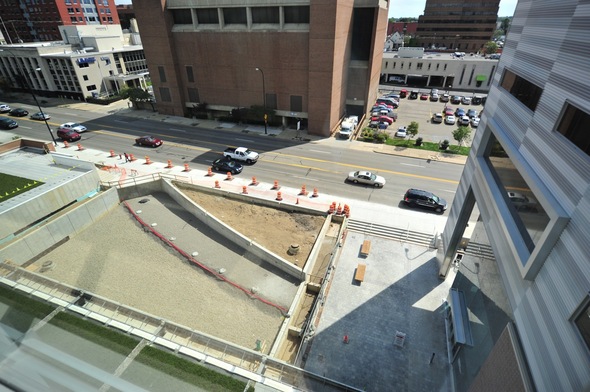
Work continues in the plaza area in front of Ann Arbor's city hall where a German artist's sculpture is expected to be installed in the next month. The $750,000 piece is expected to start close to Huron Street and follow the west edge of a new rain garden toward the main entrance of city hall. The focal point of the piece is a standing bronze sculpture with blue glass pearls that light up in computerized variations as stormwater from the building circulates over the sculpture's surface.
Ryan J. Stanton | Ann Arbor.com
Only a portion of that money has been spent, while nearly $1.7 million remains set aside and waiting to be put toward future projects, according to records obtained by AnnArbor.com.
So, what's the city getting for its investment? Not enough, according to several members of the Ann Arbor City Council who are raising concerns about the program.
"I would be willing to consider eliminating it altogether," said Council Member Sabra Briere, D-1st Ward, one of four council members who fought unsuccessfully to reduce funding for public art in the last round of city budget cuts.
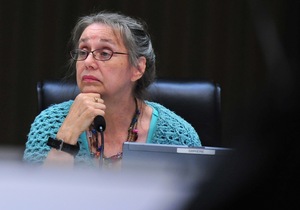
Ann Arbor City Council Member Sabra Briere
Ryan J. Stanton | AnnArbor.com
The city's public art program has come under attack multiple times in recent years. Each time, a majority of council members have agreed public art is an important economic development tool and contributes to quality of life in Ann Arbor, and so funding has been maintained.
But even those on council who have defended public art in the past are starting to raise questions about the program's effectiveness.
For how much money has been dedicated, Mayor John Hieftje said recently he's concerned the city hasn't seen more results. He's calling for a thorough review of the program with hopes the city can strengthen it and see a profusion of new art.
Though many projects have been discussed, the Public Art Commission has delivered on just two art installations in four years: a $750,000 sculpture being installed in front of city hall (somewhere north of $400,000 has been spent so far), and a $15,000 installation in West Park that included two orange-colored tree sculptures.
"They seem to be focused on large-scale, permanent installations," Briere said. "If I were going to devise a public art program, I'd be looking for opportunities to create interactive art or temporary art that is a creation by the people of Ann Arbor."
City officials said a little more than $76,000 has been spent on administrative expenses for the program to date.
Tracing the money
Under an ordinance approved by the City Council in 2007, 1 percent of the budget for all city capital projects — up to $250,000 per project — is set aside for public art.
AnnArbor.com recently asked the city for records showing all source funds for the public art program over the last four years. Those records show $539,000 has come from the city's street millage, $40,000 from the parks millage, $907,000 from the city's sewer utility, $367,000 from the water utility, $60,000 from the stormwater utility, $38,000 from the solid waste fund and lesser amounts from the airport and energy funds.
Additionally, $250,000 is earmarked for public art as part of the Ann Arbor Municipal Center project budget. The city plans to put art in the lobby of the new police-courts building.
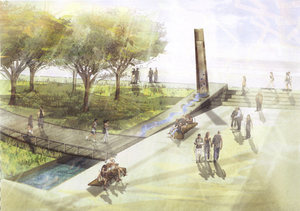
An artist rendering of the Dreiseitl art sculpture being installed in front of city hall. The artist is expected in town later this month to do final testing on the lighting.
Courtesy of City of Ann Arbor
The city has a general fund budget that includes $79.1 million in spending this year. That's after trimming millions in costs, including 30 police and fire positions in the last two years. City officials face another multimillion-dollar shortfall in the general fund in the next year.
The city's spending on public art at a time when it's making deep cuts to public safety has angered some residents. But the mayor and other city officials argue the city's public art money legally can't be tapped to pay for general fund items like police and fire.
The city's money, they say, is separated into different "buckets," and one bucket can't be drained to fill another. Even if the art program were disbanded, they say, the monies would go back to the funds from which they came — parks, streets, utilities, not the general fund.
Total city spending across all funds is $314 million this year, and $334,660 — or 0.1 percent — of that is going to public art, records show.
Relatively speaking, that's a drop in the bucket and none of the source funds are hurting because of it, said Sue McCormick, the city's public services administrator.
"The ordinance is very specific that these percent for art monies aren't a free-for-all," she added. "They have to serve the purpose of the fund. And when I take a look at the budgetary impact, it is 1 percent of the capital investment, so it's a very small percentage."
Still, multiple council members told AnnArbor.com this week it's hard to stomach the amount of money being channeled to public art when the city is raising utility rates, streets are in need of repairs and funds like solid waste are showing deficits.
"These are significant issues," said Council Member Stephen Kunselman, D-3rd Ward. "There's way too much money that has been diverted from the rightful purposes."
Kunselman said he's not convinced the use of dedicated millage or utility funds for public art is legal and he's waiting for the city attorney to issue a written opinion on the matter.
City Attorney Stephen Postema said his office has reviewed the Percent For Art Program and he's not aware of anything illegal about what the city is doing. In fact, city officials point out many cities across the country have percent for art programs.
McCormick stressed because all public art projects must serve a purpose somehow related to the source funds, no money is truly being diverted from its rightful purpose. For example, that's the case with the sculpture soon to be installed in front of city hall, which is using utility funds.
The piece by German artist Herbert Dreiseitl is expected to start close to Huron Street and follow the west edge of a new rain garden toward the main entrance of city hall. The focal point of the piece is a standing bronze sculpture with blue glass pearls that light up in computerized variations as stormwater from the building circulates over the sculpture's surface.
As for the $500,000-plus in street millage dollars now in the public art fund, McCormick said the city is talking about a couple of different ideas for street-related art projects.
"I know the Public Art Commission has talked about doing something in conjunction with the Stadium bridges project," she said. "They also have looked at doing something with the entrances to the city, which are generally either right-of-way or median types of projects."
Kunselman, however, thinks voters are losing trust in the city with such large transfers to public art, and he thinks it'll be tough to get the city's street millage renewed in November now.
Evaluating the program
In light of his concerns about the public art program, Hieftje recently nominated Council Member Tony Derezinski to join the Public Art Commission. Derezinski, D-2nd Ward, has attended one meeting so far and is expected to report back to council what he finds.
"I think the Percent For Art Program is a very good one and it has a great purpose," said Derezinski, who has fought twice to protect funding for the program.
Derezinski said he's going to look for ways to improve the processes of the commission. He also wants to take a look at whether the city's pubic art ordinance is too restrictive and eventually have a thoughtful discussion about the program at the council table.
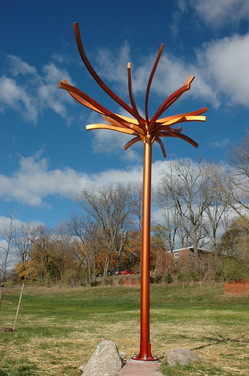
One of two metal tree sculptures installed in West Park using parks millage funds channeled through the public art program.
Courtesy of City of Ann Arbor
"I'd like to see art throughout the city," said Council Member Christopher Taylor, D-3rd Ward, expressing a viewpoint shared by others on council who want to steer the commission in a new direction.
Taylor said he still thinks a thriving public art program is good for Ann Arbor. But he also said he recognizes there's a substantial balance in the public art fund and he's open to reconsidering whether too much money is being set aside.
Commenting on the fact that there's a $500,000-plus balance of street millage money in the art fund, Taylor said that strikes him as a lot.
"Streets are obviously critical to the city and we should reflect upon whether that's the best use of that money," he said.
Council Member Stephen Rapundalo, D-2nd Ward, said he's still a strong supporter of public art and doesn't want to see the program eliminated. But he agrees the council needs to have a thoughtful discussion about the program's effectiveness and its funding.
"I think the mayor and all of us have been frustrated in that we know there's a sizable amount of funds sitting there and that hasn't really been translated into outcomes and products," he said. "I imagine some of the opposition to public art is because people haven't seen what the dollars have brought in, because the dollars literally haven't been expended."
Asked whether she thinks the Percent For Art Program has been successful, McCormick said that's up for the City Council and the public to judge.
"Do I wish we had more public art? Absolutely," she said. "Do I think the commission has some challenges to really move forward and get more public art out there? Yes."
Briere recalled it was at her first meeting in 2007 when the council approved the Percent For Art Program. In hindsight, she said, the council didn't have enough information.
Fearing the sculpture in front of city hall could become more of a public urinal than public art, Briere said she thinks Ann Arbor should look to other cities for inspiration.
"In Calgary, they have incorporated public art into the bus stops by creating clear canopies where you're standing and there's engraved text on the inside, so when you stand there waiting you can read poetry," she said. "In Milwaukee, they had small sculptures affiliated with bridges, but the sculptures were relevant to the story of Milwaukee, so there was a purpose behind them.
"They weren't just stuff. They told a story. That was interesting."
Ryan J. Stanton covers government and politics for AnnArbor.com. Reach him at ryanstanton@annarbor.com or 734-623-2529. You also can follow him on Twitter or subscribe to AnnArbor.com's e-mail newsletters.
Comments
Charlie Brown's Ghost
Tue, Sep 6, 2011 : 1:35 a.m.
The solution to this is to stop voting for people just because they have a "D" next to their name.
Dug Song
Tue, Sep 6, 2011 : 12:51 a.m.
Sadly, this is the kind of thing that drives away the quiet gems in our community, like Forest Juziuk: <a href="http://www.annarbor.com/entertainment/forest-juziuk-profile/">http://www.annarbor.com/entertainment/forest-juziuk-profile/</a> From his exit interview with Mark Maynard: <a href="http://markmaynard.com/?p=15341" rel='nofollow'>http://markmaynard.com/?p=15341</a> "There was a period of time last year that I was deeply upset by the city of Ann Arbor. The city spent something like $700,000 on 200 garish directional signs telling tourists where the Power Center is. At the same time, University of Michigan paid the city only $800,000 for fire department services. Meanwhile, they built a new city hall & laid off cops and firefighters every week. The parking meters? Chicago Reader did several great articles on the dirty shenanigans pulled by Mayor Daley and their meters. And Google? How many jobs did they actually create in the area to keep the real estate deals and otherwise that they scored?" :-(
bornblu
Mon, Sep 5, 2011 : 9:58 p.m.
The Free Online Dictionary defines art as: "Human effort to imitate, supplement, alter, or counteract the work of nature. 2.a. The conscious production or arrangement of sound, colors, forms, movements". My recommendation would be to utilize the money in this bucket to fix, repair, or replace existing sidewalks that are dangerous, and unasthetic to our sight. I would guess it may also meet Sabra Briere's vision of an "opportunity to create interactive art, created by the people of Ann Arbor". At least it would be an altered work of nature, by way or using forms, that would provide the most appreciation to the largest number of people, both to use and see.
Elaine F. Owsley
Mon, Sep 5, 2011 : 7:48 p.m.
My mother used to have one of those orange tree things like they put in West Park in the back yard. She used it to dry clothes on ropes strung between the arms. No, wait, it was made of wood.
say it plain
Mon, Sep 5, 2011 : 3:52 p.m.
@RonGranger said: "Some act as though the $550K per year would turn Ann Arbor into Shangri-La if only it was put into sewers and potholes. I contend it's a drop in the bucket and you'd never notice the difference. The problem is the city's execution on the art fund has been badly flawed for years and they refuse to acknowledge it." Right, so we want the city to stop futzing around ineffectively considering which sculptures float their boats the best... Given the state of our city and the cut-backs in services we've had, we want to see their best efforts made to fix up the broken bits of AA before they stick orange metal trees in the middle of a park ( it's already *got* trees to look at for goshsakes!)... We might not notice the difference, but given that I can't drive across town to shop, use parks, etc., without destroying my car --and this is when the roads are clear of the ice and snow that AA has been notably *terrible* compared to other towns at clearing!--I'd prefer the money dedicated to art-fund management and acquisition go to even only one more snowplow or one more paving machine. I'm not looking for Shangri-La; I'm just looking to escape the 'third world' bombed-out-seeming landscapes I have to drive on and I don't understand why the city can find it acceptable to have *any* money sitting anywhere but force us to live with this sort of thing for so long! I like art, I really do. But when it starts seeming like the city's perpetrating some kind of theater-of-the-bizarre performance-art expecting you to negotiate the potholes all year except for the snowseason when they let these fill with ice and don' t bother clearing for days, you get a little 'arted' out! You start feeling stingy about those 'drops in the bucket'. Now, the city is about to ask us to approve *more* money for the streets they never seem to fix despite having money in their buckets already. Kunselman is wise to worry that it will not fly with voters!
buildergirl
Mon, Sep 5, 2011 : 3:23 p.m.
I like public art and am not opposed to having some nice displays but so far it just isn't working. A few fake trees and a big whatever in front of city hall. There is way too much money being collected and not used when so many departments are hurting. I would be in favor of reducing the funding since the projects are so few. We have a public art administrator making a decent salary and benefits, what exactly is he/she doing?
SonnyDog09
Mon, Sep 5, 2011 : 2:28 p.m.
I'll believe that city officials have actually taken a "hard look" at the issue when they actually do away with the program. Until then, this "hard look" nonsense is just a smokescreen that is designed to fool a few gullible voters. It's only talk.
Stephen Landes
Mon, Sep 5, 2011 : 2:10 p.m.
All of the money in all of the funds is accessible for all of the spending necessary to maintain our city. That some people argue the money is in "untouchable" separate funds is simply a blind that allows City Council and the Mayor to have their play money to allocate without real accountability; all they have to say is "gee, the money is restricted so it HAS to be used for this purpose". To which I say "Nuts". In truth we have a $340 million budget, but we only get to allocated less than 25% among the priorities of the citizens of Ann Arbor. Time for us to completely rewrite the financial structure of Ann Arbor,do whatever we need to do to eliminate all the restricted funds, and start holding our elected officials accountable for the way they spend ALL of our money. I'm sure someone will reply to this comment by writing that these funds are legally created and we'd have to move heaven and earth to change things. Fine, but that is what we elect these people to do -- move heaven and earth to accomplish what is needed to meet the expectations of our citizens. Just a side thought: if an emergency financial manager were to take over Ann Arbor's financial management I'll bet that person would very quickly find a legal way to access those funds to keep high priority services running in the city and the obligations paid. Our elected Council and Mayor ought to be just as aggressive in clearing up the mess they have created.
Ron Granger
Mon, Sep 5, 2011 : 2:49 p.m.
The sky is not falling. Most of us like Ann Arbor just the way it is. Maybe a few minor tweaks. We like our parks. We don't want our green belt turned into strip malls simply because it will lower taxes or make some developer a quick buck. We do Not want to be Livonia, Canton, or Dearborn, or any of those other strip mall, real-estate development fixated towns. We do not want a Snyder-esque takeover of OUR town - "Time for us to completely rewrite the financial structure of Ann Arbor,do whatever we need to do to eliminate all the restricted funds, and start holding our elected officials accountable for the way they spend ALL of our money" - NO, thankyouverymuch. "Just a side thought: if an emergency financial manager were to take over Ann Arbor's financial management I'll bet that person would very quickly find a legal way to access those funds to keep high priority services running in the city and the obligations paid." ----- Ummm... Sure, there are those who would *LOVE* to sell off our parks to their corporate buddies for short term gains. There are those who would love to conver the Arboretum into a private golf course. Fortunately, in Ann Arbor, I think we'd burn them at the stake by the pale moon light, as we sang songs and enjoyed their liver with a nice Chianti.
Ron Granger
Mon, Sep 5, 2011 : 12:40 p.m.
Anyone worried about $550K/year for art is distracted - they should be asking why the city is giving away valuable park property to the University, and building them a parking structure on our dime.
Ron Granger
Mon, Sep 5, 2011 : 12:37 p.m.
With the art fund, we have the chance to see something nice from our money. Some act as though the $550K per year would turn Ann Arbor into Shangri-La if only it was put into sewers and potholes. I contend it's a drop in the bucket and you'd never notice the difference. The problem is the city's execution on the art fund has been badly flawed for years and they refuse to acknowledge it.
golfer
Mon, Sep 5, 2011 : 11:16 a.m.
you should look real real real hard.
Alan Goldsmith
Mon, Sep 5, 2011 : 10:28 a.m.
"I'm amazed that Mr. Postema can say that he "he's not aware of anything illegal about what the city is doing." The Bolt decision has been well discussed and it clearly indicates that user fees cannot be diverted to other purposes than the service for which they were collected (i.e. water utilities)." Which is yet another reason Mr. Postema would make a horrible judge if he still has any plans for a higher political office.
Doug Coombe
Mon, Sep 5, 2011 : 7:34 a.m.
Your polling is incredibly leading. We all live in a university town, want to try to use your brains a little more instead of going for hits?
grye
Mon, Sep 5, 2011 : 5:25 a.m.
Fiscal responsibility. Does anyone on the city council understand that terminology?
Roadman
Mon, Sep 5, 2011 : 3:55 a.m.
Marc Boosnstra of the Washtenaw County Republican Party and Jim Hood, Jr. of the Ann Arbor GOP should be jumping all over this topic and getting heavy hitters locally in the GOP to back the Republicans that are trying to get elected to City Council in November. Hood himself almost beat Marcia Higgins in the Fourth Ward the last time the Republicans ran a nominee in the Fourth Ward and Jane Lumm, albeit with no party designation, has an excellent chance at beaing Rapundalo this fall.
Mick52
Mon, Sep 5, 2011 : 7:46 p.m.
Roadman, I do not think there are any republicans still in Ann Arbor. It's easier, cheaper, and better living beyond the Twilight Zone.
Sparty
Mon, Sep 5, 2011 : 2:36 a.m.
Hmmmm.... Maybe the Mayor and city council are waking up to the furor they have created and realize their positions are finally at risk. While I'm a democrat, I will no longer just base my vote on party at the city level because of their ineptitude, particularly the Mayor. Let's hope some qualified, sane democrats challenge some of the more radical council members!
xmo
Mon, Sep 5, 2011 : 2:11 a.m.
Why not start a "Free Public works" program which city artist provide art for the city in return they get some their name on a plate so that they can add it to their resume? The city get art, the artist get some publicity and everybody wins!
Joe Kidd
Mon, Sep 5, 2011 : 1:57 a.m.
A couple weeks ago I almost called A2PD to report a drunk driver weaving back and forth on w/b Miller. I thought it odd since it was so early. Then I realized the driver was not drunk he was weaving to avoid the carnage. I was doing it too. Hence I will consider it artistic driving. I cannot believe with the condition of the streets, half a million has been siphoned off to "art." This type of practice is a great example of what happens when amateur politicians with social agendas gain local govt seats. The social agenda issues are placed higher on the list of essential services than critical services like police and fire safety, streets and water and sewer service. Projects like public art are strictly non essential. To have millions unspent when employees are being laid off is simply embarrassing.
Mick52
Mon, Sep 5, 2011 : 7:43 p.m.
Maybe Ann Arbor should put a lot of crosswalks on those streets in tribute to the "stop for people in, near and approaching the crosswalk" ordinance. Since traffic on those streets has to drive so slowly to avoid damage to a car it will be easy to cross.
say it plain
Mon, Sep 5, 2011 : 6:12 a.m.
lol, I drive like that on Miller too, sorry to say, and I don't drink at all! On stretches of Huron, much of Dexter, and various other places on the west side one might wish for the chance to weave a bit, but it would do no good anyhow, because the gaping craters in the pavement are more evenly distributed. Let's get a 'pavement artist' to come and patch all that up, maybe in some artful color scheme. We can call it a mural maybe! The money's apparently available, some of the art-funds were skimmed from the streets funds, so please please please city, why not?!
A2Realilty
Mon, Sep 5, 2011 : 1:37 a.m.
Please make sure that any art that is funded is fire proof and not easy to steal. At least it won't be at risk as the fire and police departments are depleted.
tdw
Mon, Sep 5, 2011 : 9:25 p.m.
I bet two copper trees could fetch a pretty penny
KJMClark
Mon, Sep 5, 2011 : 1:20 a.m.
Unfortunately, the time to fund public art is when revenue is increasing, and we're in one of those rare times when revenue is falling. We should have been funding public art from the mid 80s to 2007 or so - that was 20 years when we could afford it. The problem is that as soon as we drop the ball, everyone will forget to start the program back up again. And the point to public art is civic pride. There's another opinion piece today saying we should make the entrances to town more attractive. Agreed. If you care about things, you should want to take care of them and make them better for people in the future. But function over form - we have to be able to afford to keep things working before we think about making them look good. Right now, that means spending the money just to keep things working.
Les Gov
Sun, Sep 4, 2011 : 10:46 p.m.
Can we please call the "Ann Arbor's Percent For Art Program" what it really is?? The "Anti Local Artist Tax"!!! If anyone would like proof that this is an "Anti Local Artist Tax" all one has to do is calc the percent of the money that has been spent on artist outside of Washtenaw County vs. in the county.
oldgaffer
Sun, Sep 4, 2011 : 8:36 p.m.
I am in favor of public art in an up economy where the art is well chosen. The new city hall is the ugliest building in town and the folks in charge are spending money like drunken sailors and have demonstrated poor taste in selecting public art.
Vivienne Armentrout
Sun, Sep 4, 2011 : 8:07 p.m.
Thank you for the excellent reporting on this subject. I've been railing against this program for a couple of years now. (See <a href="http://localannarbor.wordpress.com/2009/11/30/for-arts-sake/" rel='nofollow'>http://localannarbor.wordpress.com/2009/11/30/for-arts-sake/</a> and <a href="http://localannarbor.wordpress.com/2009/11/30/money-for-arts-sake/)" rel='nofollow'>http://localannarbor.wordpress.com/2009/11/30/money-for-arts-sake/)</a> I'm amazed that Mr. Postema can say that he "he's not aware of anything illegal about what the city is doing." The Bolt decision has been well discussed and it clearly indicates that user fees cannot be diverted to other purposes than the service for which they were collected (i.e. water utilities). Mr. Kunselman asked some very pointed questions about this over a year ago and Mr. Postema has yet to answer them publicly. I'm glad that at least some council members are taking a second look.
andralisa
Sun, Sep 4, 2011 : 7:22 p.m.
Clearly it has not been well managed and there has been no real imaginative use made. What a shame when you look at cities like Portland Oregon that have used money for public are effectively, interactively and over time. Ann Arbor puts up two copper trees in the park? What is the point of that? They will not draw families to take photos with them, they provide no shade, and they are so sparse as to go unnoticed. I do not know who is in charge or lending their artistic advise but they need to be replaced with people that are at least aware of how the public sees and uses art in public places. What a shame and waste of tax payers money.
MikeyP
Sun, Sep 4, 2011 : 6:11 p.m.
So... Tree City USA spent hundreds of thousands for two dead-looking fake trees? I mean, for all the ridicule the fountain gets at least it will look nice (based on renderings, IMHO)... but just now seeing the photo of the "tree art" in this article, yeah, that's pretty ridiculous. Tons of real, beautiful trees surround these barren fake ones. Good use of money there brain trust! That, and they put them into one of the city's 157 parks, which themselves are publicly funded manifestations of "natural beauty" that everyone cites as what makes this city so gosh-darn special and the draw it is. Even if you buy into that malarky then why would you put the other "draw" to the city (public art, lol) inside the first draw? I mean, wouldn't it make sense to spread out the "draws" to the city instead of clustering them together? Hey, where's the public art in the median of S. State St. near I-94? I mean, if we're trying to "draw" saps, er, I mean citizens, to Ann Arbor can't we at least put the art where it'll draw them in? I don't even know where West Park is, I've never been to it, never seen these fake trees and couldn't drive someone there to see them this instant in order to "lure" them in if my life depended on it! Here's an idea, why don't we do something SMART for once? Put your precious public art where visitors can see it and get all inspired or whatever the heck your goal is. Hey, there's lots of real-estate in the middle of those round-abouts you're putting everywhere, fill them with art! Maybe visitors will even notice it there! That or put up some big obnoxious signs pointing to where the elusive "public art" is maybe.
Anonymous Commentor
Mon, Sep 5, 2011 : 2:15 p.m.
MikeyP, here's the back story regarding the West Park sculptures. It may help you understand that art installation. <a href="http://www.annarbor.com/news/local-artist-sees-his-concept-come-to-life-in-west-park-sculptures/">http://www.annarbor.com/news/local-artist-sees-his-concept-come-to-life-in-west-park-sculptures/</a>
MikeyP
Sun, Sep 4, 2011 : 6:17 p.m.
Oops, noticed that we didn't spend hundreds of thousands on the fake trees, just a mere $15,000 to hide fake trees in a park surrounded by real trees. Well, that's much better... sort of.
Craig Lounsbury
Sun, Sep 4, 2011 : 6:04 p.m.
How about if the city set up a voluntary art fund. Instead of creating an "art bucket" and diverting tax money from its intended use to an art slush fund for hideous "orange trees" we let the citizens individually fund art to their personal willingness by writing a personal art bucket check. (forgive me Miss Cooper for that run on sentence) Let the citizens step up to the plate. I'll bet it will be "over funded" in no time.........or not.
bunnyabbot
Sun, Sep 4, 2011 : 5:54 p.m.
OMG it's worse than I thought, in 4 years they've only spent money on a reallllllllllllly over priced fountain and two orange trees as well as "administration" costs. Disband it, send the money back to streets and utilities. We need pot holes filled and downtown streetlights on more.
Mr Blue
Sun, Sep 4, 2011 : 5:40 p.m.
I suggest that instead of buying big art or putting all decisions in the hands of a small elite committee, that there be a competitive grant process for funding public art and events by local artists and arts groups. Reinvent the AAPAC as a grass roots committee to distribute not only money from the fund, but invest in 415 W Washington as a location for public events and help facilitate artists and arts organizations in creating new public events like FestiFools.
Mr Blue
Sun, Sep 4, 2011 : 5:20 p.m.
The problems are really not caused by the committee, at least not at the administrative level. The problem lies at the council and mayoral level and occurred at the inception of the Percent for Art. No plan, vague guidelines, little public discussion and a pile of money led to some stupid and publicly derided decisions. The problem at the committee level is that they are political appointees, appointed by politicians who think more of how it plays politically than artistically. They are so stuck in the conventional art status quo that they are prevented from being creative in their approach. I venture that the mayor and some council people would like to think that they are "artistic" but know little of cutting edge inspirational creativity that appeals to the broad public. Committee members are constrained by their elite, status quo arts backgrounds and wanting to serve the vision of their political masters instead of being creative in their thinking and action. Politically and bureaucratically, it's the preservation of power and control in the hands of the same politically and socially connected group of people. It's only a little incestuous. With the best of intentions, the committee was hastily formed after the Percent for Art program was approved by council yet there was little public input and discussion and no follow up oversight by council. Ann Arbor needs to differentiate itself from what other cities with Percent for Art programs do. Begin by seeking grass roots local input outside of the elite and insular "art community" that is heavily connected and influenced by the UM. Follow up by FACILITATING and helping local artists and and groups achieve their public art goals instead of dictating from on high But without seeking new voices and thinking creatively about what Public Art is, what it means and how can we do it differently, I hold little hope for anything but the status quo mess and infighting.
ArgoC
Sun, Sep 4, 2011 : 4:32 p.m.
I'd like to know more about the internal dynamics of this public art commission and why the group is having such a hard time 1) getting anything done 2) picking things that the public will like.
Mr Blue
Sun, Sep 4, 2011 : 4:04 p.m.
Sabra Briere's observation that "I'd be looking for opportunities to create interactive art or temporary art that is a creation by the people of Ann Arbor." is what should have been done from the git go. No more public art by decree of a small insular committee. Disband the AAPAC and start over. Public Participation. This premise has never been in the mix of discussion of how we support "Public Art". It should have been a leading premise for how Ann Arbor supports public art. Ann Arbor needs to find its own niche in the "public" arts and not attempt to copy what other communities do. Murals are nice, but they've been over done.Public sculpture is nice, but prone to high maintenance costs and vandalism. Even then, a million dollar piece of art in out of the way places (Huron Pkwy) or in poor locations (Justice ctr) or self consciously out of context location (palm trees in West park) is a waste. Ann Arbor seems to be a "local events" kind of place. Festifools, and FoolMoon are the kind of outdoor public events that encourage public participation. Even the Green Fair is a of creative event. To me, this is the public art niche that Ann Arbor can fill. Similar to Grand Rapids, but low key, non commercial, locally inspired outdoor events. In a public park (West pk bandshell). Closed streets and not just Main St. Use some of the money from the Percent for Art to develop 415 W Washington as a PLACE for Public Art demos and events. The Art Fair is not an arts event, it's a commercial event. Local creative public arts events should be de-commercialized and the city should find the ways and the money to help and FACILITATE local artists and arts groups FACILITATE public arts events instead of funding a small elite group of political appointees decide what they think is best for everyone else. How many people attend these events? How much more revenue do they bring to the city? I bet far more than what yet another fountain in front of yet ano
Nephilim
Sun, Sep 4, 2011 : 3:10 p.m.
They also want to use some of the public art money on the new stadium bridge, when it is built. Oh...you mean the one you couldn't afford? The one you had to beg the government for money for? The one thats supposed to cost a whopping 25 million or some ridiculous amount like that? At least they got squandered funds from all of us to put up some cool artistic features that won't have any public input. Awesome!
just a voice
Sun, Sep 4, 2011 : 3:09 p.m.
Having funds go for public are it important. But we need to pass a law saying that 60% of the money has to be spent on local artist ONLY, 30% on artist in Washtenaw county, and the last 10% can be away from the area. Put that money almost entirely back into the community. Also that way its not such a exciting international search that anyone feels so important about, but rather a local initiative.
retiree80
Sun, Sep 4, 2011 : 2:48 p.m.
Sue McCormick quote, " Total city spending across all funds is $314 million this year, and $334,660 — or 0.1 percent — of that is going to public art, records show. Relatively speaking, that's a drop in the bucket and none of the source funds are hurting because of it, said Sue McCormick, the city's public services administrator." As the public services administrator - you'd think that McCormick would be more concerned with City infrastructure and safety. How about putting the so - called "drop in the bucket" money into the Stadium bridge or bring some police and fire fighters back to work! The City "decision makers" are irresponsible and this is not laughable ANYMORE!
wait.think
Sun, Sep 4, 2011 : 2:47 p.m.
With all the talk about 'urinals' - maybe the Art Money should be used to build beautiful, city-maintained RESTROOMS. Some of my favorite tourist towns have gorgeous, landscaped, clean PUBLIC restrooms, that divert the costs (maintenence, water usage) from individual shop owners. How many times have you been told 'No, we don't have a public restroom', which I am pretty sure is technically against the law... Unless your old downtown business has been grandfathered in. Any mom shopping downtown with a child has been told NO. Public restrooms are needed. Maintenance = a job, with security. While most people don't like to publicly discuss body function, we all do it. Even Ann Arborites... But you could blame it on the tourists.. Or invading Ypsilantians.
Ron Granger
Sun, Sep 4, 2011 : 5:05 p.m.
Trade art for toilets? No way. There are plenty of places to "go" in Ann Arbor.
Len J Sunday
Sun, Sep 4, 2011 : 2:39 p.m.
Jane Lumm Candidate, City Council 2nd ward Dave Parker Candidate, City Council 3rd ward Eric Scheie Candidate, City Council 4th ward Stuart Berry Candidate, City Council 5th ward Ann Arbor School district candidates Larry Murphy, Ahmar Iqbal Contribute and vote for above. Get some voices of reason in the council.
bedrog
Sun, Sep 4, 2011 : 2:39 p.m.
As an artist ( limited edition bronze sculptures...most sold via private commissions rather than from exhibited 'inventory') i reluctantly sort of agree with those lamenting monies spent on public art when infrastructure and public service sectors are so sorely strapped. Historically some of the best ' public art' ( i.e. art viewable by the public) was funded by private donors ( be they pharoahs, caesars, medicis or popes) and some of the worst is from committees in charge of public funds....( not always a valid statement , but often enough). Like other responders, in a time of economic stringencies i'd rather have a fireman or policeman etc. to respond to a crisis (on a well paved street) than some committee's idea of what's arty-trendy.
1bit
Sun, Sep 4, 2011 : 2:38 p.m.
What is art? What is beauty? I think we want both in our city, but they are not necessarily the same thing. I think the percent for art program should be the percent for art AND beauty program. I like having art around the city: thought provoking pieces, whimsical pieces, or reflective pieces. Art stimulates and is a reflection of creativity. It stimulates pride in ones community. Beauty, on the other hand, is also essential. This includes functional beauty (e.g. sidewalks and streets that are in good condition, efficient lighting) as well as aesthetic beauty (nice signage, entryways to our city, well-kept parks). We want both and need both as a city. We need leaders who know the difference and who have the will and creative vision to make it happen. We need leaders who realize that art and beauty are not necessarily expensive. I worry that some of our city leaders (and, in particular, the mayor) have lost the will or ability to prioritize spending as other commenters aptly note.
Jim S.
Sun, Sep 4, 2011 : 2:25 p.m.
Could we allow couches back on porches, and then institute a couch fee to fund an art program? A bit of ying and yang.
Go Blue
Sun, Sep 4, 2011 : 1:53 p.m.
Vote! One word with a huge impact. Our officials have avoided important issues by hiding behind cell phone bans, idling penalties, parking rate hikes, tax increases, etc. and the time has come for change. Key issues should be dealt with first (police, fire, streets, etc.) and what is important to the voting public is what should be the priority, period. Our officials choose to ignore the will of the voters, then the voters need to vote.
Ronald K. Dankert
Sun, Sep 4, 2011 : 1:47 p.m.
I might feel more optimistic about the public art program and efforts to beautify the City, if i could just get by the ugly profusion of weeds each summer in the boulevard medians along Washtenaw Avenue from US-23 to the E. Stadium intersection, and South State between I-94 and E. Eisenhower Parkway. There's some sort of disconnect apparent when major entrance arteries to Ann Arbor are ignored, while we put up more art in more obscure places. Many thanks to the lady, I'm sure an unpaid volunteer, who cleaned the median beds at E. Stadium and Washtenaw on some of the hottest days of this summer. R.Dankert
Sparty
Mon, Sep 5, 2011 : 2:46 a.m.
Amen!
Mike K
Sun, Sep 4, 2011 : 3:37 p.m.
Amen Ronald!!!
racerx
Sun, Sep 4, 2011 : 1:32 p.m.
Tone death. That's all I can say. How can the city serious say that funding isn't coming from the general fund? $539K from the street millage? Has any council person driven in the west bound right lane of Huron between Stadium and Main St? $907K from the sewer system? Wasn't there an article recently that homeowners basements were flooded with raw sewage due to a water main break and these homeowners sued the city to no recourse since it showed that the city wasn't liable? $367K from water? This might explain a near average of 5% a year in water rate increases. Vote these members out, including the mayor. Bring in people who are good stewards of the public's money, fund the essential elements of city government, and listen to their citizens. Seems pretty simple. Unfortunately not to these simple minds.
Ron Granger
Sun, Sep 4, 2011 : 1:25 p.m.
Poems on glass at bus stops are not art. I think the many hours I have spent waiting at city bus stops qualifies me on this subject. Please do not squander our art dollars on bus stop "art". If you want to decorate the bus stops with art, get local volunteers to do it. I pale to think of how much this commission would blow on such a project. Add to it that the majority of the Ann Arbor public would never see the bus stop poetry because they avoid all things associated with buses.
jcj
Sun, Sep 4, 2011 : 8:10 p.m.
Bedrog I fully agree that using tax payer funds is not the way to go when it comes to art. And I agree that because it is so subjective public funds should not be used. My point was only that I know what I like in "art" , but I am not going to be the judge of what is art.
bedrog
Sun, Sep 4, 2011 : 3:42 p.m.
@jcj...its precisely because 'art' IS so subjective that very scarce public money maybe shouldnt be spent on a few peoples idea of what constitutes worthy art. see my comment below for further amplification of how some of the historically best art in public was privately financed/commissioned. ( although that also opens the door to truly lousy vanity projects....just as " art by committee". risks trendy but transient crap.
jcj
Sun, Sep 4, 2011 : 2:41 p.m.
BTW The one thing we are qualified to do is let our elected official know what we want our tax dollars spent on. And for many in this town it is NOT art at this time! Have you ever experienced hard economic times in your house? When the decision is pay the bills or go to a concert did you pay the bills?
jcj
Sun, Sep 4, 2011 : 2:39 p.m.
"Poems on glass at bus stops are not art. I think the many hours I have spent waiting at city bus stops qualifies me on this subject." What qualifies any of us to say what is art? There are many forms of "art" that I do not enjoy but to someone it is art. That's like saying blues is not music.
aes
Sun, Sep 4, 2011 : 1:23 p.m.
Public safety before public art!!!
Ron Granger
Sun, Sep 4, 2011 : 1:21 p.m.
I fully support public art, and the funding set-aside. However, this program has been very poorly run. They've blown a huge portion of *our* budget on a court/police/cityhall building installation. People hate going to police and court buildings. We associate them with everything bad about taxes, government and authority. Don't squander our art dollars in government buildings. This art commission has ignored the public and they have ignored the requirement to hold meetings for public input. They seem to view the public's role in the art process as a mere formality which must be checked off a list. Did they ever have the mandatory annual public meeting? Did we ever get to see the consultant's contract that the city was trying to keep secret? If I had my way, the entire committee, and the consultants would be replaced. We would probably lose some good participants, but major changes are needed. The fiasco of the German artist clearly demonstrates that. And those art trees in West park? Those are really mediocre. Look to Seattle's Olympic Sculpture Park for a much better example. Of course that art is selected by a real museum, the Seattle Art Museum, and not a government committee. <a href="http://www.celebratebig.com/pacific-northwest/seattle-olympic-sculpture-park-seattle-art-museum/olympic-sculpture-park-seattle-art-museum-split-roxy-paine.jpg" rel='nofollow'>http://www.celebratebig.com/pacific-northwest/seattle-olympic-sculpture-park-seattle-art-museum/olympic-sculpture-park-seattle-art-museum-split-roxy-paine.jpg</a>
utownie
Sun, Sep 4, 2011 : 1:18 p.m.
McCormick says it's a drop in the bucket and none of the source of funds are hurting because of it. Get a clue, sue. Those of us who pay taxes in the city are hurting. Is anyone listening? We could pay lower sewer rates, or basements that do not flood because of lack of city planning over the last several years. You took money out of roads funds? huh?
timjbd
Sun, Sep 4, 2011 : 12:56 p.m.
Another poll choice might be to have the art budget integrated with the capital projects budget so that there is an artistic component integrated with all capital projects. Engineers usually only concern themselves with structural integrity and that sort of thing. Perhaps requesting artistic ideas for each project to be paid out of the art budget? Everyone remembers crossing this bridge: <a href="http://europeforvisitors.com/venice/images/rialto.jpg" rel='nofollow'>http://europeforvisitors.com/venice/images/rialto.jpg</a> This one: <a href="http://www.southeastroads.com/south_carolina001/i-026_eb_exit_101b_01.jpg" rel='nofollow'>http://www.southeastroads.com/south_carolina001/i-026_eb_exit_101b_01.jpg</a> Not so much.
timjbd
Sun, Sep 4, 2011 : 4:04 p.m.
But my point was that they don't have to be hideous: <a href="http://www.weitzmanstudios.com/images/highways_bridges/Heritage_embankment.jpg" rel='nofollow'>http://www.weitzmanstudios.com/images/highways_bridges/Heritage_embankment.jpg</a> <a href="http://www.weitzmanstudios.com/images/highways_bridges/Heritage_shield.jpg" rel='nofollow'>http://www.weitzmanstudios.com/images/highways_bridges/Heritage_shield.jpg</a> Just using my friend Steven as an example of how a little art can vastly improve something normally mundane at best. If you drive past any typical city in the US, you're not likely to remember it or take note of it being something worth checking out because they have nice overpasses. But if you drive past Wichita, KS you might: <a href="http://library.wichita.edu/finearts/Murals%20Southeast.htm" rel='nofollow'>http://library.wichita.edu/finearts/Murals%20Southeast.htm</a> Then you might think to yourself that Wichita might be worth checking out next time through. I think that sort of thing could distinguish Ann Arbor and would be worth it in the long run.
timjbd
Sun, Sep 4, 2011 : 3:45 p.m.
It's just a photo of your typical hideous highway overpass. Drive up 23 to Plymouth Rd. and you'll see three of them. All hideous.
Urban Sombrero
Sun, Sep 4, 2011 : 1:11 p.m.
Your second link isn't working for me. It says, "403 Forbidden".
glenn thompson
Sun, Sep 4, 2011 : 12:50 p.m.
I do not support the present Ann Arbor program for public art for several reasons. First, it is art selected by committee. That means for the members of the committee to agree the art must be 'safe'. Another term for safe art is boring. Second, it is often very expensive because one way toward consensus and safety is to select a recognized name. The Dreiseitl fountain is a perfect example. Mr D is a recognized name, ironically as a landscape architect, not as sculptor. It think the 'fountain' will have a very architectural or engineering look. The flashing LED's will evoke the image of flashing neon lights that our city prohibits in signage. I believe that the city has sufficient patrons that public art can be supplied by donations, as in the case of the U Hospital programs. Minimal stipends could be given to cover the cost of materials in the case of murals or other large installations. The city should just include display space in its buildings or park areas. If the building includes large meeting rooms these should have the option for use as performance space. These are the basic, expensive items, that few patrons or artists can afford. Rotating displays in the public space would be much more interesting than $1 million for one fountain.
Mike K
Sun, Sep 4, 2011 : 12:43 p.m.
Move to second tdw's motion... lol. I think our community would get more from well manicured roadways, walkways, parks and green space than we would from one single piece of public art. Why not make the whole city a piece of public art by maintaining our city's existing assets? What is the impression one gets when they drive down an overgrown poorly maintained roadway?
Elaine F. Owsley
Sun, Sep 4, 2011 : 12:39 p.m.
When times were tough in France years ago, Marie Antoinette said it best - "let them eat cake". We are down to a point where every dollar counts and those things that need doing should come before this kind of artsy nonsense. I say "Let them draw pictures".
tdw
Sun, Sep 4, 2011 : 12:29 p.m.
I think that Ann Arbor should spend oh... lets say $250,000 for a consultant on this issue.Isn't that the way it is supposed to be done ?
Ron Granger
Sun, Sep 4, 2011 : 1:35 p.m.
Don't forget that the consultant's contract should be secret and the city should refuse to disclose it... Like the art fund consultant's.
Stephen Lange Ranzini
Sun, Sep 4, 2011 : 12:23 p.m.
What the City's new Police/Courts building ("The Roj Mahal"), the new underground parking structure we didn't need ("the Big Dig"), and the Dreiseitl Art Sculture ("the Hurinal") all have in common is vast overspending on items of questionable need. On the other hand we have the third worst roads of any city in the state. We have insufficient police and fire protection. We have 58 separate dedicated accounts ("buckets") with $254 million in them. We have multiple millage votes scheduled to raise taxes. Times are tough. Be fiscally responsible. Drain the buckets!
Ron Granger
Mon, Sep 5, 2011 : 2:39 p.m.
If the roads seem too rough for you, maybe you're driving too fast and should slow down. If you don't want to slow down, stick to the highway. Or go to a car-centric city like Dearborn, Livonia, etc.
Charley Sullivan
Mon, Sep 5, 2011 : 7 a.m.
KJM: However one parses the data, we have miles roads (and in absolute and not comparative terms, too) that need improvement. A little less pedantry perhaps the next time you lose a wheel rim on a ridiculously huge pothole?
KJMClark
Mon, Sep 5, 2011 : 12:58 a.m.
No, we don't have have the third worst roads of any city in the state. Please look at how they calculated that, and stop saying that, since it's not true. We have the third highest number of miles rated lower than fair. That doesn't compare our number of well-maintained roads to not adequately maintained roads. That's like saying that of three high schools, school C has the highest number of dropouts per year. But wait, school C also has four times the number of students of the other two schools. Compared to the number of students, the dropout rate isn't bad at all. But you're saying since school C has the highest dropout rate (and Ann Arbor has the third highest miles of problem roads), school C is the worst.
Urban Sombrero
Sun, Sep 4, 2011 : 12:48 p.m.
I really want you to run for mayor. Your comments always make so much sense and you're very educated on all the issues.
DennisP
Sun, Sep 4, 2011 : 12:22 p.m.
I find it interesting that the percent for art program can take monies intended for projects, roads, and other programs and divert it into a slush fund (which is what this is beginning to sound like it will evolve into). But, if they end the program, there is no way those monies can revert to a general fund purpose "legally". I can understand that some of it is funded by bonds, but I'd think that you can just as easily earmark a percent of project monies for public safety or a sinking fund for future maintenance, lighting, whatever as you can for "art". I love art. But, it is a luxury in these times. Even if it can't be used for other purposes, it should be restored. Why are they taking $540,000 from road funds where the roads and walks are in desperate need of repair? A welcoming and less arrogant city council could draw upon its many connections to businesses and industry leaders to donate some art for the city. If the UM can do it (and it does it big time), you'd think the City could. But, the arrogant Council wishes to redefine the increasingly pervasive role of local government to say what should be here, what can be there, who can build it and who should own it. Don't be misled by all this current talk. The Council is only visiting this issue to make an end run around criticisms of the fund that will come when the new art is installed or instilled or inspired or whatever... And, I agree, the art should be produced locally and have some nexus with the City and the region. I consider those glass historical site markers with engraved photos of an earlier Ann Arbor to be attractive artistic glimpses of history and a public value. Things like that would enhance the Ann Arbor experience.
Craig Lounsbury
Sun, Sep 4, 2011 : 12:21 p.m.
"McCormick said the city is talking about a couple of different ideas for street-related art projects. "I know the Public Art Commission has talked about doing something in conjunction with the Stadium bridges project," she said. Could these people possibly be more clueless? To help Sue McCormick understand that 1% is something I suggest we cut her pay 1% every payday till she gets it. 5 paydays 5%.....
racerx
Sun, Sep 4, 2011 : 1:37 p.m.
Wasn't a majority of the funding for the Stadium bridge from the government, TIGER, grants? So, how can the city suggests that since the art funding has to be related from the funding source? Sick.
timjbd
Sun, Sep 4, 2011 : 12:49 p.m.
I think that is one of the few good ideas related to the public art budget.
Carole
Sun, Sep 4, 2011 : 12:19 p.m.
I believe the art fund should be eliminated with the funds being returned to those categories they were taken from -- it seems to me that those departments are in need of funding to assist with repairing the streets, concerns with the sewage systems, etc. Question: Over and over, it is reported that funds can not be taken from one category to help fund another--how then was it okay to vote to take money from the street, park, etc. and set up an "art department" in the city. If they voted it in, they can vote it out, which seems to be the desire of the citizens of AA at this particular time when funds are tight.
Sparty
Mon, Sep 5, 2011 : 2:56 a.m.
@Kimclark: Hopefully we will have that citizen poll with the next election and you'll see what citizens think of the mayor and his cadre of city council supporters!
KJMClark
Mon, Sep 5, 2011 : 12:33 a.m.
Um, no, we don't really know what the citizens of AA think. We know what the self-selected commenters at AA.com think. We'd need an actual properly done poll to find out what the citizens think.
Urban Sombrero
Sun, Sep 4, 2011 : 12:10 p.m.
I don't care how much art a city has, if your infrastructure is crumbling, your city is a failure! It's disgusting to me that funds are being diverted from necessary things like street repair for art. It's pathetic when you practically blow a tire every time you drive around town because of all the pot holes in the road. But, oh! We have art! Thank goodness for that! (Sarcasm.)
Brad
Sun, Sep 4, 2011 : 12:09 p.m.
"Even if the art program were disbanded, they say, the monies would go back to the funds from which they came — parks, streets, utilities, not the general fund." You mean it would go back to the places that were originally approved by the voters? We certainly wouldn't want that. At least some of the councilmembers are getting a clue. Now would be a great time for everyone to contact their representatives (and I use the term loosely) and let them know what they think about their street millage dollars being spent on art instead of the crumbling streets. E-mail council TODAY.
Halter
Sun, Sep 4, 2011 : 11:54 a.m.
Not for nothing, if you are going to incite your readership with these types of polls, it then behooves you to show up at council meetings to present the results.
Sparty
Mon, Sep 5, 2011 : 2:58 a.m.
How about an election instead? Would that suffice?
KJMClark
Mon, Sep 5, 2011 : 12:31 a.m.
Maybe they could commission a real poll instead of asking their usual malcontent commenters?
observer
Sun, Sep 4, 2011 : 11:54 a.m.
why not let the citizens vote on an issue like this.....hire back the laid off police and fire officers, but that makes too much sense for the over educated city council.... they would use it to expand their green belt........
David Cahill
Sun, Sep 4, 2011 : 11:51 a.m.
I'm confused. If not more than $250,000 per project is supposed to be spent, how come the Dreiseitl project costs $750,000?
Macabre Sunset
Sun, Sep 4, 2011 : 10:05 p.m.
In other words, the bladder was full.
timjbd
Sun, Sep 4, 2011 : 12:48 p.m.
"Captured" is the right word. I think people would be more supportive if the art budget were integrated with other capital projects to give bridges, roadsides, sidewalks, etc. an artistic flair. Everybody loves looking at a beautiful bridge. The stadium bridge could be a real showpiece or.. it could be another eyesore like the one currently in place.
Ryan J. Stanton
Sun, Sep 4, 2011 : 12:15 p.m.
$250,000 is the limit on what can be captured for art from an individual project, not how much can be spent. On most capital projects, the 1 percent is channeled to a pooled public art fund. The Dreiseitl project is tapping the large accumulation of utility funds that have built up in the pooled art fund.
huh7891
Sun, Sep 4, 2011 : 11:07 a.m.
This is like talking to a brick wall. They ask for the public/tax payer input , get the results and when it's not what they want to hear , they ignore it. Police and Fire depts are suffering, roads are falling apart yet the city wants to scatter art around town. What a joke.
KJMClark
Mon, Sep 5, 2011 : 1:29 a.m.
If you really are an Ann Arbor resident, contact your council members or the mayor. You can spout all you want behind a pseudonym on AA.com, and they should ignore you. There's no particular reason to believe most of the people commenting here actually live in Ann Arbor city limits. Even the "poll" is a bit of a joke. Umpty percent of AA.com readers voted X - so does AA.com limit its readers to verified Ann Arbor residents? Of course not. Does AA.com even verify that there's only one userid per person? No, all they know is everyone has an email address and wants an ID here. I would hope my councilmembers ignore most of what goes on here. If you want them to listen, email, call, or write them and give a real address.
Chip Reed
Sun, Sep 4, 2011 : 10:48 a.m.
The "trees" in West Park" are quite eye-catching, to be sure. However, it would have been nice if they actually provided some shade, as the old wooden-type trees do.
Mr Blue
Sun, Sep 4, 2011 : 5:27 p.m.
I find their design prosaic and their location self conscious. The money would have been better spent on real shade trees. This is tree town, not fake tree town.
golfer
Sun, Sep 4, 2011 : 10:34 a.m.
come on. i am not a public official. i am a person who lives in ann arbor. pay taxs every year. since the money is hard to come by. i watch what i spend it on. if i do not need it i do not buy it. well here is one thing i would not buy. come on, we have more need than art. art is nice. but more police would be better on campus. show us you got some even a little smarts.
Alan Goldsmith
Sun, Sep 4, 2011 : 10:27 a.m.
1. "City officials said a little more than $76,000 has been spent on administrative expenses for the program to date." I'm guessing this figure is incorrect, the city is low-balling the true amount and it's likely double that. 2. "Those records show $539,000 has come from the city's street millage" But we need an INCREASE in the street funds new 'sidewalk' millage in November because our roads are a mess? 3." Multiple council members said they think the Public Art Commission has focused too heavily on the city hall sculpture project over the last few years..." Why not a word from my Council rep Margie Teall--who actually still supports the Per Cent program totally without reservation AND was on the subcommittee that actually came up with the ugly German urinal for the new Justice Building? Has she changed her tune and apologized for any of her part in this ongoing fiasco? 4. ""Streets are obviously critical to the city and we should reflect upon whether that's the best use of that money," he said." Ah, yet another 'Oh we screwed up and now I'm really sorry and we have to fix it because this is embarrassing' moment from Council rep Christoper Taylor. The trick is to figure out how to do things right the first time and not fix things AFTER they are broken. 5. "Derezinski said he's going to look for ways to improve the processes of the commission. " How about not letting members of the AAPAC sit in committee meetings and discuss/repair and spend my tax dollars for repairing their OWN City installed artwork, which happened at the last meeting? That might be a good start. Lol. 6. "Fearing the sculpture in front of city hall could become more of a public urinal than public art..." Too late--it looks like one, why not get at least SOME practical use for the $1 Million mistake? I saw someone using one of the DDA Mainstreet flower planters for this purpose a couple of weeks ago. Didn't the money come partially from
Goober
Sun, Sep 4, 2011 : 10:27 a.m.
Based on their track record, I have no faith at all that our city leaders will make the right decision on this matter. I can only wait until a coming election to vote in new representatives who can change this experience of tax, spend and waste.
CityFF
Sun, Sep 4, 2011 : 10:23 a.m.
Far more then 30 positions have been lost in police and fire. Both departments are close to half strength.
Goober
Sun, Sep 4, 2011 : 10:23 a.m.
During these times of economic challenges, public art expenditures need to be suspended. If and when better economic times return, the money should be spent on American made art. There are far too many talented artists in this immediate area to ignore.
jcj
Sun, Sep 4, 2011 : 8:19 p.m.
Phillip I will concede that. However the FAP's primary goal was to employ out-of-work artists. Do you see the city of A2 spending these funds on out of work artist?
Phillip Farber
Sun, Sep 4, 2011 : 4:56 p.m.
@jcj Some of the greatest 20th Century works of art were publicly funded through WPA programs.
jcj
Sun, Sep 4, 2011 : 2:33 p.m.
"There are always economic challenges. With that way of thinking, we would never have public art or beauty." This particular economic challenge we are in by all accounts is the worst since the great depression. What would the reaction have been to these kind of expenditures or hoarding back in the 30"s? Anyone that even suggested it would have been out of office in a heartbeat! Secondly to suggest we would not have beauty without public art is off the wall foolish!
Ron Granger
Sun, Sep 4, 2011 : 1:29 p.m.
There are always economic challenges. With that way of thinking, we would never have public art or beauty. "American made art only" suggests that American artists need affirmative action. I don't like *how* the German artist was selected for City Hall, but I don't think there should be rules about the nationality of the artist.
Arieswoman
Sun, Sep 4, 2011 : 10:20 a.m.
It sure seems to me like I can go to the Museum to see art. Use this money to hire more police officers or firemen/women! Come on now. In this economy use some common sense! Of course, that may be asking too much of our city fathers!