

Ann Arbor officials doing 'whatever it takes' to resolve fence fight with homeowner
Louis Breskman's battle with the city of Ann Arbor sounds a little like the story of David and Goliath, but the homeowner says he's not expecting to slay the mighty giant.
He believes he's out-matched against a deep-pocketed city government with a team of professional attorneys.
But how much has the city actually spent fighting the guy who caused a fuss last summer by installing a split-rail fence on his property in the Old West Side Historic District?
As far as pay for city employees goes, somewhere in the range of $1,500 to $2,000 is a good guess, according to Assistant City Attorney Christopher Frost, who estimates he has spent about 50 hours working on the case and defending the city's position.
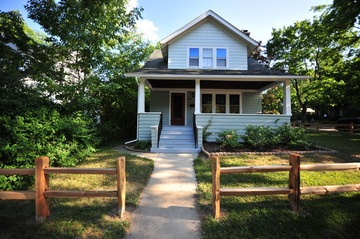
This is the fence that caused a fuss in a historic district on Ann Arbor's Old West Side.
Ryan J. Stanton | AnnArbor.com
But, city officials point out, they're not in the business of buying fences for people, and they have a legal obligation to enforce the rules of the historic district.
Arguing split-rail fences in front yards are incompatible with the historic character of the district, the city's Historic District Commission last July ordered Breskman to remove the fence.
Breskman, who installed the fence without a permit, said he asked the city to at least help pay for the removal, but the city refused, and Breskman eventually appealed the decision.
That took the case before an administrative law judge in Lansing this past fall where sworn testimony was heard from both sides. A settlement still hasn't been reached.
"These administrative appeals are typically comparable to the initial stages of a civil trial, involving legal and factual research, briefs, witness preparation, and a court hearing," Frost said. "An average time for this type of work would likely be around 50 hours, which is probably a reasonable estimate for our office's time spent defending this appeal."
Based on salary records reviewed by AnnArbor.com, 50 hours of the assistant city attorney's time is worth nearly $1,400 — before considering the cost of employee benefits and other overhead charges the city would factor in if billing a third party for services rendered.
That's also before adding in several hours spent on the case by the city's planning staff, including City Planner Jill Thacher who went to Lansing to testify. City officials can identify at least seven hours that Thacher spent working on the case.
Factoring in all city staff time, $1,500 to $2,000 is probably a fair total estimate of the salary costs to defend the appeal, city officials said.
"It's one of those things that, on the face of it, seems ludicrous — why can't the guy put up a fence, and why would the city contest it in court? — but you have to look deeper," said Mayor John Hieftje, who sees both sides of the issue.
"If you choose to move into a historic district, then you're acknowledging you're going to live by the rules of the historic district," he said. "That's the way it is."
Ann Arbor takes historic preservation seriously, with about 1,800 properties included in 14 historic districts throughout the city.
Wendy Rampson, the city's planning manager, said the city is legally bound to defend the rules of the historic district and doesn't have much latitude to let things like a non-conforming fence slide, though there is some discretion on the HDC's part.
"We're obligated by state law and the city ordinance to uphold the decision of the HDC, so that's why our attorneys spent time going before the administrative hearing judge," she said. "We do enforcement on an as-needed basis. We do whatever it takes to resolve the issue."
Rampson said a number of nearby residents tipped city officials off to the fact that Breskman was installing a non-conforming fence without a permit last summer. She said the city issued a "stop work" order when the fence was half-installed but it was ignored.
"They, on their own, opted to proceed and finish the fence — over a stop work order," she said. "So there was that preliminary opportunity for the property owners to make it right."
Hieftje said the City Council legally couldn't intervene if it wanted.
"Not everybody understands that the City Council cannot legally overrule the Historic District Commission, so maybe we don't have a choice on this particular one," he said.
"People really respect their historic districts," added Hieftje, who lives in a 1912 house but not in a historic district. "And if you look at property values in historic districts, they tend to be higher than outside historic districts, so people have a lot of investment there."
And many residents in those districts, he said, want the rules strictly enforced.
Ryan J. Stanton covers government and politics for AnnArbor.com. Reach him at ryanstanton@annarbor.com or 734-623-2529. You also can follow him on Twitter or subscribe to AnnArbor.com's email newsletters.
Comments
WLD1
Fri, Aug 3, 2012 : 3:45 a.m.
First of all the city of ann arbor did not spend any money on this. The attorneys, clerks, assistants etc... would have been paid for those hours whether or not they were working on this case or talking on the phone with their spouse.
Joe_Citizen
Mon, Jan 30, 2012 : 6:37 a.m.
it's a fence and it has style let it go!
Autumn Smith
Sat, Jan 28, 2012 : 9:26 a.m.
LOL. The City of Ann Arbor should be more worried about their crooked police department.
Joe
Fri, Jan 27, 2012 : 7:56 p.m.
I think this particular fence tastefully compliments the property in an elegant fashion. That said, I can see the need for an ordinance to prevent an ugly vinyl fence from being erected.
TAG
Fri, Jan 27, 2012 : 6:33 p.m.
With Breskman's irresponsibly in failing to stop work when the violation was specifically brought to his attention, he should not expect any financial relief from the city.
TAG
Fri, Jan 27, 2012 : 6:37 p.m.
Perhaps, Breskman should be reimbursing the city (and the rest of us tax payers) for the city's expenses.
Wilford John Presler IV
Fri, Jan 27, 2012 : 5:03 p.m.
Hut... You should just take up a collection and buy this poor guy a lilly white bread picket fence . (With the sanction and approval of the City of Ann Arbor and following all of the rules ,laws, ordinances, regulations guidelines,standard operating procedures whims, and/or suggestion of said City of Ann Arbor as well as the sanction and approval of all of the City of Ann Arbor's Historic District Committee and following all of the rules ,laws, ordinances, regulations guidelines,standard operating procedures whims and/or suggestion of same said Ann Arbor Historical District Committee). .... I will help dig the post holes "fer thet purty seder split rael wun...."
Tru2Blu76
Fri, Jan 27, 2012 : 4:53 p.m.
On the city's side: the historic district rules actually spring from Free Market principles - there's a market for homes which have historic significance. That significance is defined by the historic district - by consensus. Freedom of choice: BEGINS with the decision to buy or not buy a house in a historic district. If Mr. Breskman didn't know what he was buying, then the question becomes whether or not he cared or even thought to check on these details. Now, he not only failed to follow well-known procedures (getting a permit to build), he wants the historic district to renege on the promise to ALL OTHER buyers and let him keep his unlicensed, inappropriate fence. Those who now "cleverly" criticize the criteria for fences in historic districts ought to learn this: the research done on houses of different eras is considerable and far exceeds personal opinion. Opinions are "free" and worth every penny. If you don't like the deal offered, go find another deal.
Tru2Blu76
Sun, Jan 29, 2012 : 3:10 p.m.
@Dcam, sorry to be late replying, you know these comment sections "age" overnight. :-) So you're reporting that the commission acted out of something like "taste" or "vision" instead of history-based standards? I'd like to know the source you've used to come to your conclusion. If true, then whatever "charter" or "mandate" for the district: it should be altered to eliminate such opinion-based decisions. Unfortunately for those like Mr. Breskman, violating well-known, established ordinances (getting a building permit) doom such projects as this fence. Amateurs playing in high stakes markets learn this lesson 1000s of times a year.
Dcam
Fri, Jan 27, 2012 : 11:42 p.m.
As I recall, the commission was of the opinion that that type fence wasn't proper for the area, regardless of the fact that other examples could be shown to exist within a short distance, and the fact that that type fence certainly existed within the time-frame of the buildings when new. It was a personal opinion that said the fence was non-conforming to the commission's taste, thus, illegal. There's no law regarding fences, outside biased opinions.
Faith Bulemore
Fri, Jan 27, 2012 : 4:52 p.m.
Nearly fifty percent of Americans make less than $30,000.00 per year. A lot of cities and townships are filing for bankruptcy. Come on people get real. This is just to stupid. Lets get our priorities straight. The money wasted on this spat could help shelters and warming centers or any number other charitable organizations.
Lets Get Real
Fri, Jan 27, 2012 : 4:29 p.m.
The number of comments speaks to the core of the UNREASONABLE over-reaching arm of the government & its interference into every ounce of our lives. Louis is new to town & probably to home ownership. He thought: wooden fences are historic; he was IMPROVING his property; he was taking a proactive action to keep disrespectful, lazy pedestrians from wearing a path across his lawn; he was moving into a town where friendly people live in neighborhoods where people help one another & liberal means tolerance in the community. Enter: bully government. Wrong! Error! Bad! Horrible offender! Even though an understandable mistake, REASONABLY easy to negotiate & fix between REASONABLE people. But this is the government-nothing is REASONABLE. They strong arm the citizen-who pays their salary-because they can. On the subject of salary, where does one hire an attorney for $30 an hour ($1500/50hrs)? Or is it with egg on their face: for all of the publicity, for how they are spending your money, & for how UNREASONABLE they are, they are minimizing the cost? Isolated story? Ask small businesses being harassed by the vindictave County Treasurer. Ask how much time they spent on staff & attorney(s), falsely accusing, then finding in discovery they can't collect on an outrageous sum estimated using UNREASONABLE, flawed assumptions. Ask emerging businesses, driven from Ann Arbor by the city's dealying tactics in the approval process. Even the best start-up plan can't estimate the excessive costs incurred, paying for lease/mortgage, utilities, retainers, etc. while waiting to gain approvals, while being unable to take in revenue to offset the expense while they wait. The arrogance of the ruling elite in Ann Arbor & Washtenaw County believe they can tax & spend, using the money to punish & control anyone who doesn't conform. Welcome to the liberal definition of power: control - In the name of the "greater good" "for the people".
Tesla
Fri, Jan 27, 2012 : 4:13 p.m.
Good lord how embarrassing for Ann Arbor. Just leave the residents alone and move on to issues that are actually important. FFS
Brad
Fri, Jan 27, 2012 : 3:49 p.m.
The third poll option should have been "I'm sitting on the fence on this one"
Lets Get Real
Fri, Jan 27, 2012 : 4:53 p.m.
Good one!
hmsp
Fri, Jan 27, 2012 : 3:19 p.m.
@Jimmy McNulty It's even more surprising than that! In another part of the article, it says, "50 hours of the assistant city attorney's time is worth nearly $1,400." So the assistant city attorney makes LESS than $28 per hour!
Tony Livingston
Fri, Jan 27, 2012 : 3:01 p.m.
Why is this getting so much press? Everyone with property on the Old West side has had to conform regardless of how idiotic the policies are. This is nothing new.
f4phantomII
Mon, Jan 30, 2012 : 4:34 p.m.
I'm pretty sure the building department would have worked with him, if he had bothered to pull a permit. Violating the stop-work order calls Mr. Breskman's reasonableness into question.
Lets Get Real
Fri, Jan 27, 2012 : 4:48 p.m.
It was news to Louis, who chose Ann Arbor for its liberal and tolerant reputation, moving here from Philadelphia. You can bet the real estate agent 'overlooked' disclosing the "idiotic policies", or at least minimized them, given the desperate economic climate of few home sales. Further evidence trust in individuals can be so misplaced. Why didn't anyone work WITH this man to REASONABLY guide him - not the seller, or the agent, or the neighbors, or the city. Much more satisfying to exert power and take the adversarial position: wait until the "bad, horrible deed" is done, then punish. Very welcoming, don't you agree?
hut hut
Fri, Jan 27, 2012 : 3 p.m.
Something is missing in this article. The facts. Here are the rules of Ann Arbor historic districts. <a href="http://www.a2gov.org/government/communityservices/planninganddevelopment/historicpreservation/Pages/FREQUENTLYASKEDQUESTIONS.aspx" rel='nofollow'>http://www.a2gov.org/government/communityservices/planninganddevelopment/historicpreservation/Pages/FREQUENTLYASKEDQUESTIONS.aspx</a>
hut hut
Fri, Jan 27, 2012 : 3:21 p.m.
By your reasoning we should stop enforcing the traffic laws because it's not a big deal to occasionally run a stop sign or speed on a residential street. No big deal. I only do it once in a while, so why spend the money to give me a ticket?
hut hut
Fri, Jan 27, 2012 : 3:19 p.m.
The FACTS of what the historic district laws are and what they mean. The link is to the rules and explanations of the law. But don't bother reading the law, because it gets in the way of your opinion. <a href="http://www.a2gov.org/government/communityservices/planninganddevelopment/historicpreservation/Pages/FREQUENTLYASKEDQUESTIONS.aspx" rel='nofollow'>http://www.a2gov.org/government/communityservices/planninganddevelopment/historicpreservation/Pages/FREQUENTLYASKEDQUESTIONS.aspx</a>
hail2thevict0r
Fri, Jan 27, 2012 : 3:13 p.m.
What do you mean? It clearly says that what he did was against the rules....the rules you just posted. I just don't think it's worth it, for the city, to fight such a silly violation that could have been resolved $1000 ago.
iamwrite
Fri, Jan 27, 2012 : 3 p.m.
We build fences in Ann Arbor to keep out the illegal immigrants. ^^the above is sarcasm, since the city of Ann Arbor does not have its priorities right^^ For those of you who do not like split rail fences in Ann Arbor, please realise that South East Michigan is an rich agricultural area. Please thank a farmer today for your breakfast, lunch, and dinner. Otherwise, you are more than welcome to move back to NYC.
iamwrite
Fri, Jan 27, 2012 : 3:02 p.m.
"a rich agricultural area", no an needed. *Grammer Police
havefun
Fri, Jan 27, 2012 : 2:49 p.m.
So he didn't get a permit and defied a stop work order. I'm really surprised that so many people are supporting this guy. Can you imagine what this town would look like if people could do whatever they wanted to their homes and yards? If he gets away with this, it seems only fair that I would get to take some "creative liberties" on my future home projects. If it turns out work permits are optional, I'll be kicking myself for the money I've spent on work permits in the past. Is there any chance the city can sue this guy for court costs? It seems clear to me that he doesn't have a legal argument and he's just wasting taxpayer money. At the very least he should have to pay some fines for not getting a permit, disregarding the stop work order and being a general pain in the butt. I know its a matter of opinion, but I go by that fence several times each week and I don't think it looks right in that neighborhood. If I were a neighbor, I would not be happy.
Dcam
Fri, Jan 27, 2012 : 11:48 p.m.
It seems to me that Ann Arbor developed quite nicely for about 190 years, before city hall and unelected busybodies began sticking their noses in everybody's business.
swcornell
Fri, Jan 27, 2012 : 7:28 p.m.
A build permit? A split rail fence isn't built. It's put together like Tinker Toys. Do you need a build permit to dig a hole and drop a log into it?
My2bits
Fri, Jan 27, 2012 : 4:18 p.m.
Thanks for pointing out the obvious to those who seem to miss it: This guy is the one causing all the problems. His neighbors want the city to enforce the rules.
hut hut
Fri, Jan 27, 2012 : 3:03 p.m.
I suppose you'd like wiggle room in the law when prosecuting and sentencing embezzlers or pedophiles. Maybe those car are not in violation of the law? Why not tattle the guys with all the cars in his yard and find out?
jcj
Fri, Jan 27, 2012 : 3:01 p.m.
"Can you imagine what this town would look like if people could do whatever they wanted to their homes and yards?" Do you really believe they are enforcing other ordinances in other parts of town? There is a family on Walter that have so many cars (not all of them running) that it looks like a mechanic's business!
hail2thevict0r
Fri, Jan 27, 2012 : 2:57 p.m.
So believe that there is no wiggle room in the law and that every violation of any sort should be prosecuted with the courts maximum effort?
hail2thevict0r
Fri, Jan 27, 2012 : 2:42 p.m.
So where's the cutoff line here? There are different levels of "illegal" or "against the rules" within our society. A speeding ticket is treated differently and less resources applied to enforcing a single violation than say a murder case. At what point does our government consider enough money spent is enough - or are we OK with breaking the bank to enforce a fence law? I see the need to enforce the rules - but there's a reason we don't have the FBI going after speeders. IMO this is a little overkill when the city could have just settled to pay for the deconstruction of the wall and saved us all a lot of money.
hail2thevict0r
Fri, Jan 27, 2012 : 6:16 p.m.
No, I'm just saying there are more important things to enforce out there. I'd rather this money go to improving the fire department for all of us rather than hassling some homeowner over a fence. When you're in an economic depression - it doesn't make a whole lot of sense to fight a homeowner over an illegal fence and spend well over twice the cost of the fence removal to do so.
hut hut
Fri, Jan 27, 2012 : 3:15 p.m.
By your reasoning, the city shouldn't prosecute anything because it would be spending money just to prove a point... Like obeying the laws that apply to everybody.
hail2thevict0r
Fri, Jan 27, 2012 : 2:46 p.m.
Furthermore, I'm not sure how OK I am with the city spending tax dollars to just "prove a point".
rusty shackelford
Fri, Jan 27, 2012 : 2:39 p.m.
Ryan--very thorough story on an epicly MEGO topic. Whoever edits this thing--you have 2 competent news reporters, this guy and Woodhouse. Is this REALLY how you want what amounts to 50% of your newsroom spending his time?
hail2thevict0r
Fri, Jan 27, 2012 : 2:35 p.m.
I wonder what the penalty is if the residents just simply refuse to take it down or pay any fine placed upon them?
Brad
Fri, Jan 27, 2012 : 3:20 p.m.
It would be condemned and removed by the city at the homeowner's expense. If they didn't pay that the city could put a lien against the property. They aren't exactly in a strong bargaining position here.
hut hut
Fri, Jan 27, 2012 : 3:07 p.m.
That's called anarchy. They might as well try to secede from the Union. It is billed by the City Treasurers office like any other billing. Like any other deadbeat, lack of payment results in prosecution. It could eventually get tacked onto the tax bill as delinquent, then prosecuted.
B2Pilot
Fri, Jan 27, 2012 : 2:24 p.m.
looks nicer than that tree condo on madison near 2nd that someone built- I only say that because i know it was not built for kids but the the 'adults' that live in that house.
breadman
Fri, Jan 27, 2012 : 2:19 p.m.
I just made a cheese ball for the city to use with there whine!! Where do I deliver to? I do not see anything wrong with a little fence in a yard like that...
hut hut
Fri, Jan 27, 2012 : 3:08 p.m.
Mr Breskman is the one doing the whining.
hut hut
Fri, Jan 27, 2012 : 2:18 p.m.
What is the relevance to this issue of what a public attorney is paid to prosecute (illegal fence, no permit, working over a stop work order)? It's only relevant because Mr Breskman says it is and Ryan Stanton reprinted Mr Breskman's opinion. What people are paid to enforce the law is irrelevant to the facts and has no bearing whatsoever on the facts. It's only being used to distract and make a political case against government workers and alleged overbearing enforcement.
snacks
Fri, Jan 27, 2012 : 2:11 p.m.
To Mike D. what about the old decayed home in that area, or the people don't keep up their homes are you going to take them to court. I agree he could have followed proper protocol and got a permit. As far as I see it's look like a very historic fence compare to the one across the street. Leave the guy alone and move on.
Roy Munson
Fri, Jan 27, 2012 : 2:09 p.m.
Funny how the left wing extremists in city government can give a guy like this grief about a fence, but then allow Fred Sanfords all over the place to trash the neighborhoods with their junk piles.
hut hut
Fri, Jan 27, 2012 : 2:19 p.m.
I wasn't aware that Fred Sanford lived in Ann Arbor. Junk piles are not illegal and do not require permits.
gofigure
Fri, Jan 27, 2012 : 2:02 p.m.
Seems to me last year when this first became a "relevant" issue, the homeowner stated he put the fence up to keep people from walking across his lawn. My tongue in cheek suggestion is: He should tear down the fence and call city hall (or the Historic District Commission) every time someone walks across his yard. Bet after a few weeks of that, they'd let him put his fence back up. Sounds like people need some cheese and crackers to go with their "whine".
hut hut
Fri, Jan 27, 2012 : 2:20 p.m.
Namely Mr Breskman, chief whiner in this case.
buildergirl
Fri, Jan 27, 2012 : 1:50 p.m.
When will people learn. Pull a permit. It's the law. If you hire someone to do work for you make sure they pull the permit in their name. You will have more leverage if they do not do it correctly and you know they are properly licensed and insured because they cannot get a permit from the city if they are not.
Diane
Fri, Jan 27, 2012 : 1:45 p.m.
Sp;it rail fences have been around for a L-O-N-G time. Get over it!
Greg M
Fri, Jan 27, 2012 : 2:39 p.m.
So have building permits.
hut hut
Fri, Jan 27, 2012 : 2:21 p.m.
They belong on farms and out in the country. Anywhere else they look silly and contrived. Mr Breskman has a city lot, not acres of pasture.
hut hut
Fri, Jan 27, 2012 : 1:09 p.m.
I want to be grandfathered out of the traffic laws that came into effect after 1973 because I drive a car made in 1972. I own a gun that's about 85 years old. I want to be grandfathered out of all gun laws that have been passed since the First World War
Wilford John Presler IV
Fri, Jan 27, 2012 : 4:34 p.m.
As if any of this applies, but feel free to use an irrelevant quote from someone famous to make a political statement.
Joe_Citizen
Fri, Jan 27, 2012 : 1:07 p.m.
If it is a free country, then why is it such a big deal??...
Ron Granger
Fri, Jan 27, 2012 : 4:53 p.m.
Joe, would you mind if I keep some hogs next door to your city home? They're hogs, so they like to lie in their own mud. It can be stinky.. But it's a free country! Also, I am thinking of running a natural gas line to the garage. The city says it must be buried 18" and inspected. They even say I need to leak test it by demonstrating to the inspector that it can hold a certain amount of overpressure for a certain amount of time. They want me to get permits. Would you mind if I just use a garden hose for the gas line? I don't think it will be a fire hazzard. I loves me a free country!
hut hut
Fri, Jan 27, 2012 : 1:27 p.m.
"A government of laws, and not of men." John Adams second president of the USA.
hut hut
Fri, Jan 27, 2012 : 1:03 p.m.
Mr Breskman, Win some, lose some. Stop whining.
Homeland Conspiracy
Fri, Jan 27, 2012 : 1:03 p.m.
I have an idea....leave him alone!!!
Homeland Conspiracy
Sat, Jan 28, 2012 : 1:55 a.m.
Not the same thing at all, but nice try
hut hut
Fri, Jan 27, 2012 : 1:24 p.m.
The leave me alone the next time I run a stop sign.
Diane
Fri, Jan 27, 2012 : 12:58 p.m.
What about those who didn't move into a historic district, the historic district came to them? They should be grandfathered out of some of these stupid rules.
hut hut
Fri, Jan 27, 2012 : 1:06 p.m.
They're not grandfathered out of some of the rules. but whatever was there at the time that the historic district was first designated is grandfathered in.
pseudo
Fri, Jan 27, 2012 : 12:41 p.m.
The city has attorneys on staff for a wage. Those attorneys made a decision on steady income and benefits -vs- being in a private law firm. This homeowner would have to pay for law firm at law firm prices to get representation. Apples and oranges and yet the homeowners assertion about unlimited budget is correct. and, I did look a little deeper Mr. Mayor - how many of the houses in your historic districts are now rented out? How many are empty and how many have been for sale for a long time? Historic districts have their downside. I certainly wouldn't purchase a house in one and add that rigmarole to my decision-making about my home. Might as well live in a condo complex with a homeowners association...who needs that drama.
Greg M
Fri, Jan 27, 2012 : 2:38 p.m.
"how many have been for sale for a long time?" From personal experience... none.
foobar417
Fri, Jan 27, 2012 : 2:19 p.m.
Why does it matter what you would do? Not every living situation is for everyone. Historic districts have been shown over and over to maintain their property values. The Old West Side in particular is doing just fine relative to surrounding neighborhoods. Personally, I choose to live in this one because it's convenient to downtown, well-connected to public transit, near lots of trails, within walking distance of good schools, family friendly, and charming. And a *lot* of that is due to the fact it's a historic district. Personally, I have no interest in living in a McMansion in a former cornfield that is less likely to holds its value than my house. Does that have any relevance to your choices? Of course not. You can think I'm dumb and I can think your dumb, but we all have to follow all applicable rules that apply to where we live.
average joe
Fri, Jan 27, 2012 : 12:36 p.m.
This homeowner should have done it the right way & tried to get a permit first, then this wouldn't be in the news. I do find it odd that, according to the city's planning manager, "the city is legally bound to defend the rules.....", and "We're obligated by state law.....", and they (appropriately, perhaps) spend money on attorneys & city staff to defend those rules. But just this past week, the city approved spending city resources to support the ACLU to argue against the law of the state in regards to domestic partner benefits.
jcj
Fri, Jan 27, 2012 : 1:28 p.m.
Mike Do we need to go down the list of all the city ordinances that are NOT enforced in this town? Having said that. A permit should have been applied for. It would have been denied more than likely. However city officials really get their backs up when the average Joe citizen challenges their authority.
Mike D.
Fri, Jan 27, 2012 : 12:47 p.m.
I take it you are not a lawyer. Lobbying against a law you believe to be unconstitutional is fundamentally different from just disregarding a law because you don't like it. My understanding is that the city will abide by the anti-gay-benefit law even if it doesn't like it, until such time as it is overturned or judged by a court of law not to apply to the city.
Craig Lounsbury
Fri, Jan 27, 2012 : 12:25 p.m.
headline: "Ann Arbor officials doing 'whatever it takes' to resolve fence fight with homeowner" thats a bit misleading. The city has a hard stance that the fence will come down period. A more appropriate headline would read "Ann Arbor officials doing 'whatever it takes' to get homeowner to remove fence" "Based on salary records reviewed by AnnArbor.com, 50 hours of the assistant city attorney's time is worth nearly $1,400 — before considering the cost of employee benefits and other overhead charges the city would factor in if billing a third party for services rendered.' a third party is billed...ME/WE/US. Where do you think the city gets its money? Do they print it at city hall? Employee benefits need to be factored in because they exist and we ultimately pay them.
Craig Lounsbury
Fri, Jan 27, 2012 : 2:28 p.m.
I will add that I appreciate a spirited discussion and understand that reasonable people can see issues differently. I'm good with that, I don't expect everyone to see things like I do. What bothers me is the so called "straw man" argument where some argues something I never said as though I did.
Craig Lounsbury
Fri, Jan 27, 2012 : 1:41 p.m.
huh? what did I compare anything to? No I don't think we should pay Mr. Breskman's health insurance. And yes I do think we should pay benefits to the assistant city attorney. I am merely pointing out that because we do pay benefits to the assistant city attorney they need to be factored in to the theoretical cost of his time for the sake of discussion. Its a point of accuracy Hut Hut, nothing more. I like accuracy. Tell me Hut Hut, how can one NOT factor in the cost of benefits when putting a dollar amount on his time?
hut hut
Fri, Jan 27, 2012 : 1:14 p.m.
How much of his own time has Mr Breskman used in this self inflicted fiasco? I suppose you think that the city should pay Mr Breskman's health care premium? And we pay for worker benefits when we buy a car of a loaf of bread. What's your point other than to make an irrelevant comparison?
michal poe
Fri, Jan 27, 2012 : 12:20 p.m.
If the man went to get a permit, as he legally should have, they probably would have denied that kind of fence, and there would be no issue. The fact that he also finished the fence after a stop-work order is also telling. And then to ask that the city pay for taking it down? Also people who renovate houses in those districts get tax breaks etc., so it makes for a very, closely monitored neighborhood.If I lived in that historic district, I would want it to appear historical. There shouldn't be any surprises here......unless it is found that HDC has a lot of 'discretion' cases in the past. Everybody should play by the same rules.
Forever27
Fri, Jan 27, 2012 : 12:04 p.m.
If the homeowners in the neighborhood are that upset about the rules they've put in place by making their district historical, then they can start a petition to eliminate the historical designation and will be free to build whatever fences they want. Provided they get the proper building permits (those are required everywhere, even in rural townships).
pseudo
Fri, Jan 27, 2012 : 12:40 p.m.
some townships - not all and townships don't enforce fence ordinances either
Mike D.
Fri, Jan 27, 2012 : noon
Ryan Stanton, your logic is flawed. Saying it's "ironic" that the city is spending more to fight the illegal fence than it cost the homeowner to build it is like saying it's "ironic" that we spend more to apprehend and jail car thieves than it would cost to just buy them all new cars.
joe.blow
Fri, Jan 27, 2012 : 11:58 a.m.
This is getting stupid. Sounds like the real issues is that this dude found a period appropriate fence, but the AA elite are offended that it's a farm style fence. Bet this was an issue 140 years ago, but they would have handled it a little quicker, actually the quickest draw would have won and it would be over. Yes, he should have got the permit, but I doubt they could have stopped this style of fence.
hut hut
Fri, Jan 27, 2012 : 2:58 p.m.
@joe You're wrong. Please go to page 2-1, of this City PDF and read the law. <a href="http://www.a2gov.org/government/communityservices/planninganddevelopment/historicpreservation/PublishingImages/A2_HDC_%20GUIDELINES_2008-05-01_.pdf" rel='nofollow'>http://www.a2gov.org/government/communityservices/planninganddevelopment/historicpreservation/PublishingImages/A2_HDC_%20GUIDELINES_2008-05-01_.pdf</a> If you read the article you might notice that the Ann Arbor Planning officials cite Federal guidelines. I suppose that you know more about the law than they do. Federal guidelines for historic districts are the law. The State of MI enforces those lows and the Ann Arbor HDC is required to abide by the same laws. It's obvious that you have no clue about the laws governing historic districts . Go here if you want all the facts about Ann Arbor's historic district. <a href="http://www.a2gov.org/government/communityservices/planninganddevelopment/historicpreservation/Pages/FREQUENTLYASKEDQUESTIONS.aspx" rel='nofollow'>http://www.a2gov.org/government/communityservices/planninganddevelopment/historicpreservation/Pages/FREQUENTLYASKEDQUESTIONS.aspx</a>
joe.blow
Fri, Jan 27, 2012 : 2:38 p.m.
Federal guidlines? Really, I don't think so. He found a period appropriate fence, that's not disputed. What is disputed is if that fence was in AA at the time.
hut hut
Fri, Jan 27, 2012 : 1:20 p.m.
You're wrong. It has nothing to do with "stopping" anything. The issue is that there are Federal guidelines for historic districts that allow certain kinds of fences. If Mr Breskman had done his due diligence he would have been told that the fence he wanted to do was not in accordance with those Federal guidelines. The issue has to do with Mr Breskman openly and willfully breaking the law and then whining about it when he was caught and lost the appeal.
Mike D.
Fri, Jan 27, 2012 : 12:03 p.m.
Yes, I am offended, and it is not 140 years ago. We agree on the facts, at least. :)
Mike D.
Fri, Jan 27, 2012 : 11:54 a.m.
Let me see if I understand the homeowner's logic: I should be able to build an illegal, out-of-character farm fence in a historical neighborhood, despite a stop work order, and then the city should pay to tear it down and build me a more expensive, conforming fence. I like this logic. Better yet, I know how to deal with my unreliable plumbing: I would tear down the whole house, put up a historical tee-pee in its place, and then have the city pay to build me a brand new house that meets historical standards. Brilliant!
cette
Fri, Jan 27, 2012 : 3:33 p.m.
.wir haben mitgemacht.
Forever27
Fri, Jan 27, 2012 : 12:02 p.m.
exactly. This whole situation is not about some overbearing government or an infringement on liberties. the guy lives in the city, in a historical district no-less. You need to follow the rules. it's not that complicated.
cinnabar7071
Fri, Jan 27, 2012 : 11:47 a.m.
As stupid as this is the rules were in place when they bought their home, so follow them. The is the reason I live in the township, basic freedoms!
cinnabar7071
Fri, Jan 27, 2012 : 3:57 p.m.
Right on tegel, I have rules where I live (Township), but they're rules I can live with.
tegel
Fri, Jan 27, 2012 : 12:55 p.m.
I've heard many stories about rules imposed by home owner's associations in the 'burbs. Govt does not have a monopoly on restricting freedoms.
Mike D.
Fri, Jan 27, 2012 : 11:47 a.m.
The fence is indisputably out of character for a residential neighborhood from this period. It is a farm fence, not a residential fence. More important, these homeowners knowingly and flagrantly built it in defiance of the city's orders. Now they are whining that they have to take it down. They get no sympathy from me. The world will be a better place without that tacky, illegal fence.
cette
Fri, Jan 27, 2012 : 3:16 p.m.
wow, too much.... flagrantly, flagrantly, fragrantly people bully one another on the most frivolous of things....
average joe
Fri, Jan 27, 2012 : 12:11 p.m.
"The world will be a better place without that....fence" ? Really.
Forever27
Fri, Jan 27, 2012 : noon
@joe.blow, the tackiness of the fence makes no difference. It could have been the most aesthetically pleasing fence ever constructed by mankind and it still would in violation of city ordinance. GET A PERMIT BEFORE YOU BUILD A FENCE. it's not that complicated.
joe.blow
Fri, Jan 27, 2012 : 11:56 a.m.
You think the world really cares? Tacky is an opinion. It is disputed.
Jimmy McNulty
Fri, Jan 27, 2012 : 11:34 a.m.
"As far as pay for city employees goes, somewhere in the range of $1,500 to $2,000 is a good guess, according to Assistant City Attorney Christopher Frost, who estimates he has spent about 50 hours working on the case and defending the city's position." So, if ONE city attorney spends 50 hours on a job, he is only paid between $30 and $40 per hour? Sounds pretty cheap, even for a 2nd tier attorney. I'm sure the city has spent much more on this than that.
joe.blow
Fri, Jan 27, 2012 : 11:52 a.m.
Yes, but this is government work. Which means they estimate to make it sound the way they want. Later this year, they'll ask for more financial allocations because they've used more of their budget than expected, but won't admit it was for projects like this.
Alan Goldsmith
Fri, Jan 27, 2012 : 11:32 a.m.
So the issue here is...an 1880s fence is less historic than a 1920s fence, with both more historic than a 1950s fence and all three way way more historic that a 2012 fence. And installing solar panels on Old West Side homes, which have been approved by City...I forget exactly which houses in the 1920s were sporting those? Maybe noted History expert John Hieftje can enlighten us on this lost piece of Ann Arbor's past? The point is the City can compromise when it fits their politically correct vision. And 1880 is less important that 1920.
aamom
Fri, Jan 27, 2012 : 7:10 p.m.
Craig I'd see your point if the homeowners constructed the fence as a means of opposing a law they felt violated their rights. They didn't. They just didn't bother to check the rules in their neighborhood and made an expensive mistake. Chalk it up to a life lesson, albeit an expensive one.
cinnabar7071
Fri, Jan 27, 2012 : 3:52 p.m.
Craig these people entered into a agreement when they bought the property, signed their name, now its a matter of personal character whether they honor their word. That and the court of law. So many places to live in Washtenaw county why move somewhere and fight with the community.
jcj
Fri, Jan 27, 2012 : 1:14 p.m.
Forever27 Wrong! Do you think he would be required to tear the fence down IF it conformed to Historic commission rules? No he would not. He would be required to pay the permit cost and possibly a fine. The issue is both the lack of a permit AND a nonconforming fence. I agree with Alan the historic commission can and does allow non-conformance when it is PC.
Craig Lounsbury
Fri, Jan 27, 2012 : 12:17 p.m.
Forever27 Its not "end of story". There have been other rules in history that trample peoples rights, Rosa Parks broke a rule. What many of us are arguing is the bigger issue of whether the laws/rules are morally corrupt. Nobody argues he broke them. Nobody argued that Rosa Parks didn't actually move to the front of the bus either.
Forever27
Fri, Jan 27, 2012 : 11:59 a.m.
no, the issue here is that a guy lives in a historical district and built a fence without a permit. Even if he weren't in a historical district he would be subject to fines and possibly be forced to take it down. It's simple, there are rules, he didn't follow them. end of story.