

Ann Arbor hopes Plymouth Road flood-damaged embankment will be restored by fall
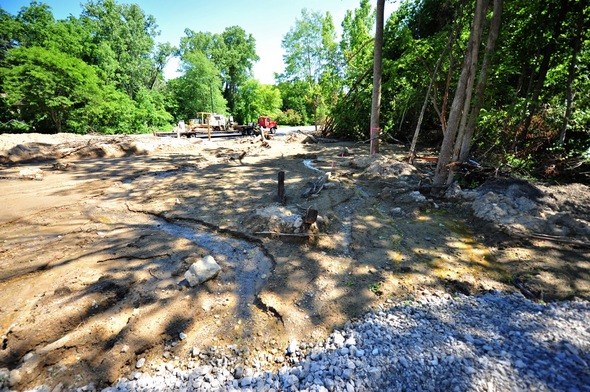
Ann Arbor officials are working with a consultant and the Ann Arbor Railroad company to plan a major restoration of a state-regulated wetland area where an embankment collapsed under heavy rains in May. The project is expected to be finished this fall.
Ryan J. Stanton | AnnArbor.com
The tracks have been repaired, and the embankment rebuilt with new stone in place. But piles of woody debris and dirt linger in a gaping area that was noticeably greener before the May 25 storm took its toll, and it might be a while before it looks that way again.
"It doesn't look great," acknowledged Nichole Woodward, utilities engineer for the city, one of multiple city staff members assigned to work on restoring the area.
Ann Arbor officials say the city is planning to spend, at a minimum, tens of thousands of dollars to complete restoration work in the area, and that includes restoring state-regulated wetland habitat on the north side of Plymouth Road, at the foot of the embankment, and part of Traver Creek and a playground area on the south side of Plymouth Road.
The city is has hired Conservation Design Forum, a civil engineering and landscape architecture consultant with offices in Ann Arbor, for about $19,000 to draft designs for the work to be done. The city is partnering with the Ann Arbor Railroad company.
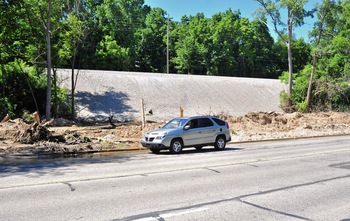
The area where the embankment collapsed along Plymouth Road after a May storm is noticeably bare compared to its much greener surroundings.
Ryan J. Stanton | AnnArbor.com
"At this stage, we are going to be working with a consultant and the railroad company to do a restoration for the wetland that was destroyed," Lawson said.
Woodward said CDF is on an expedited schedule to get the designs done. Once that's complete, city staff will review them and apply for permits from the state. Once permits are in place, the city will hire a contractor to follow through with the required restoration work.
"We're still in the early stages," Woodward said. "We're just now getting under way. We want to have substantial construction completed by fall. However, that is going to be contingent on state permitting, but that is what we are working with as a schedule."
Lawson said the city is being required by the Michigan Department of Environmental Quality to complete the restoration. She said the city didn't receive any violations as a result of the collapse.
The embankment originally was constructed in the 1930s, but poor design isn't to blame for the collapse, Lawson said.
Instead, an unusually wet spring, road runoff and high groundwater combined to take a toll on the earth, she said.
"There's been no finger pointing, there's been no blame put on this," she said. "It really was an act of nature. With the quantity of rain we got, the soils were just saturated."
A new drainage pipe running underneath the newly rebuilt embankment was installed in the last month. Lawson said that's one of the precautionary measures being taken to avoid another collapse. She said the city also is closely studying the hydrology of the area.
"Our design intention is that it won't happen again," she said. "We're certainly making sure we can take any precaution we can now to prevent it from happening again."
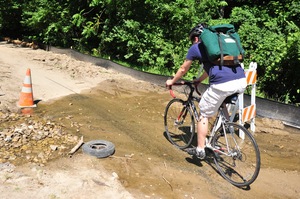
A cyclist braves through a closed area of the sidewalk along the south side of Plymouth Road where sediment washed over into Traver Creek.
Ryan J. Stanton | AnnArbor.com
As far as what types of species will be planted to replace the vegetation that washed away in May, Lawson said that level of detail hasn't been decided. But whatever is planted likely will match what's already in the area, she said.
"We are going to take a look at aerial photos of what was there," she said, adding it could take a while to make it look the same way again. "Growing big tall trees doesn't happen overnight."
Lawson said the project is extensive from the standpoint that there's going to be a lot of sediment removal, but the actual planting of materials shouldn't disrupt traffic.
"Our hope and goal is that we can have the wetland restoration completed by this fall," she said. "But it might not be until spring before all of the plantings are done."
Ryan J. Stanton covers government and politics for AnnArbor.com. Reach him at ryanstanton@annarbor.com or 734-623-2529. You also can follow him on Twitter or subscribe to AnnArbor.com's e-mail newsletters.
Comments
Ann English
Mon, Oct 24, 2011 : 11:03 p.m.
You call attention to our unusually wet spring. What about our unusually snowy February? All that snowmelt from it could have contributed to the collapse.
leaguebus
Mon, Jul 4, 2011 : 2:13 p.m.
This is an Ann Arbor railroad grade that collapsed, why doesn't their insurance company pay all the city costs associated with the landslide?
David Cahill
Mon, Jul 4, 2011 : 1:39 p.m.
Thanks for the map! It really helps.
bunnyabbot
Sun, Jul 3, 2011 : 6:40 p.m.
"The scene alongside Plymouth Road northeast of Maiden Lane in Ann Arbor remains an eyesore more than a month after a massive rainstorm caused an embankment failure..." How dare they take more than a month (but less than two) to get this done! It's a total outrage.
Homeland Conspiracy
Sun, Jul 3, 2011 : 5:42 p.m.
$19,000 to draft designs for the work to be done. WOW!!! What are they using gold paper? I bet the work will cost BILLIONS!!!
David Cahill
Sun, Jul 3, 2011 : 2:39 p.m.
AnnArbor.com, it isdifficult to visualize the various parts of this project because of the unusual alignment of Plymouth Road and Traver. How about linking a satellite map to the story?
Tony Dearing
Mon, Jul 4, 2011 : 2:44 a.m.
David, I added a map. Hope that's helpful.
Silly Sally
Sun, Jul 3, 2011 : 12:30 p.m.
"and that includes restoring state-regulated wetland habitat on the north side of Plymouth Road, at the foot of the embankment," How silly, and a waste of taxpayer money. The north side was dry, and now it has a badly needed drainage pipe that dumps out water. But it never was a wetland as intended in the original law. This is governmental over reach, turning any puddle into a protected wetland. It would be nice to have a proper creek, or to extend the pipe under Plymouth Road. But calling the NORTH side of Plymouth Road a wetland? That is a silly stretch - and wrong. What is next, calling parts of Huron Road that do not drain after a rain a wetland?
johnnya2
Sun, Jul 3, 2011 : 5:49 p.m.
Yes, Silly Sally is the "expert" on wetlands and THE LAW. Tell you what, why not give us all YOUR credentials on this matter. Until you do, you have ZERO credibility. I also love those who say " as intended in the original law". I guess you drafted the law and knew every intention of the people who voted on it as well.
MjC
Sun, Jul 3, 2011 : 12:19 p.m.
I'm not an expert on any of this, but while we're waiting wouldn't it make sense to install a temporary silt fence to stop the water running on to Plymouth Road?
xmo
Sun, Jul 3, 2011 : 11:50 a.m.
I hope this is restored in my life time! "Once permits are in place" in Business Friendly Ann Arbor this should take a while especially since WETLANDS are involved!
Epengar
Mon, Jul 4, 2011 : 2:18 a.m.
Read more carefully. The permits in question come form the state, not the city. Maybe you should grind your axe elsewhere.