

Ann Arbor City Council delays approval of AATA countywide transit agreement
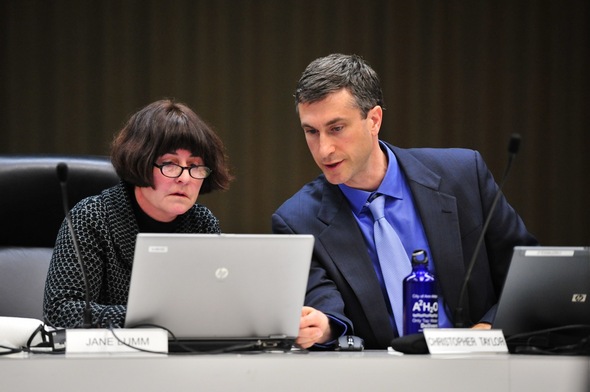
Ann Arbor City Council Members Jane Lumm and Christopher Taylor talk over a four-party agreement for the expansion of the AATA during Monday's meeting. The council postponed taking any action on it.
Ryan J. Stanton | AnnArbor.com
But that didn't stop council members from discussing the issue for nearly three hours and asking several questions of Ann Arbor Transportation Authority CEO Michael Ford.
Council Member Jane Lumm, a 2nd Ward representative who has been hesitant about the AATA's countywide push, said she wanted to wait until after funding recommendations from the AATA's financial task force and a five-year countywide service plan are completed.
"It feels like ready, fire, aim — not ready, aim, fire — without having the specifics of the funding plan and the five-year program," Lumm said.
The countywide expansion of the AATA — an agency chartered in 1969 by the city of Ann Arbor — has been talked about for more than two years.
AATA leaders now are approaching the cities of Ann Arbor and Ypsilanti, as well as Washtenaw County, asking them to enter into a four-party agreement that's seen as the first step toward creation of a new countywide transit authority replacing the AATA.
The council decided Monday to postpone consideration of the four-party agreement until Jan. 23, when it also will hold a public hearing on the issue.
Lumm said there still are too many unanswered questions. She tried unsuccessfully Monday to postpone consideration of the agreement until April, but only Stephen Kunselman, D-3rd Ward, and Mike Anglin, D-5th Ward, backed her on that.
Council Members Marcia Higgins, D-4th Ward, and Sabra Briere, D-1st Ward, were absent.
Ford encouraged council members to move the process along and expressed concern that delaying consideration of the four-party agreement that long would be a problem. He said the reason the AATA is asking for council support now — before the five-year plan and funding recommendations are out — is to get the city's buy-in upfront.
"We've got work to do, sure," Ford said. "But it would not make sense, in my mind, to come to you after all this is done."
"What's the rush?" Kunselman said, asking Ford whether there's any desire to get a countywide transit millage on the November ballot.
"Nobody's trying to jam anything down anybody's throat," Ford responded, telling Kunselman any decisions about a millage will be up to the countywide transit authority board.
Lumm told Ford she still wanted more details.
"I hear what you're saying, and I know you mean well," she said. "But we're being asked to consider a fundamental restructuring of our public transportation system."
Mayor John Hieftje suggested at one point that Lumm might be better informed if she wasn't new to council and had attended previous meetings.
Lumm took offense to Hieftje's comments.
"I've been trying to do my homework," she said. "And, frankly, I feel that was a little bit patronizing, Mr. Mayor."
Council Member Christopher Taylor, D-3rd Ward, responded to Lumm's "ready, fire, aim" comment, arguing it unfairly suggested a lack of thought on the AATA's part.
"I think it's useful to make very clear that AATA and all members who are interested in this have worked very hard over a long period of time to put together a diligent, transparent, open, methodical process," he said.
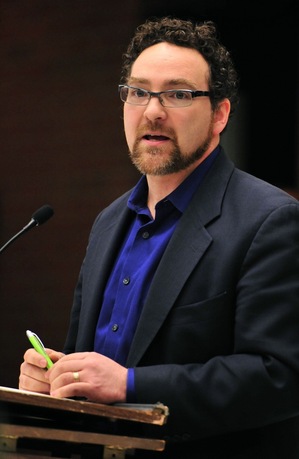
Conan Smith addresses the Ann Arbor City Council Monday night, speaking in favor of the countywide transit initiative.
Ryan J. Stanton | AnnArbor.com
"We've spent over 18 months listening to concerns and the needs of the county, and we've engaged thousands of people in the process," Ford said.
Ford reminded council members that a special task force made up of local financial experts is working to provide funding recommendations.
"The task force is comprised of some of the most prominent and knowledgable business people in the community and also in the state," he said.
A countywide millage isn't guaranteed to be part of the equation, but it's one option for funding the countywide expansion of transit services.
The most-talked-about scenario involves layering a new 1-mill countywide transit levy on top of the 2 mills Ann Arbor residents currently pay for AATA service. That equates to a little more than $100 in additional taxes for the average Ann Arbor homeowner.
The city of Ypsilanti also has a 1-mill transit levy that pays for AATA services and would be transferred to the new authority under terms of the four-party agreement.
Ford stressed the four-party agreement does not create an operational countywide authority or obligate Ann Arbor to participate, nor does it jeopardize the city's transit services.
Rather, Ford said, it simply outlines a process to follow.
After more public input, Ford said, an unincorporated countywide transit authority board is expected to publish a five-year service plan and ask the county to file articles of incorporation.
After that happens, each municipality in the county, including Ann Arbor, will get to decide whether to participate or opt out. At that point, Ford said, the new countywide authority would exist as an entity with no assets, while AATA service and assets would remain in place.
"If taxpayers approve additional transit funding for local and countywide service, then the process will continue to move forward," he said, noting that's when the Ann Arbor and Ypsilanti transit millages would be transferred over to the new authority.
The council voted 9-0 Monday night to approve an amendment to the four-party agreement offered by Taylor. It gives Ann Arbor voters additional say in the countywide expansion.
"This amendment is intended to give Ann Arbor voters control over the disposition of the Ann Arbor millage," Taylor said. "If the voters of Ann Arbor choose to transfer it by way of approval of the new funding authority, then that's their decision and that's the way it shall be."
But if Ann Arbor voters fail to approve funding for a new countywide authority — even if a majority of county voters favor it — then the city maintains the right to withdraw from the agreement without penalty, veto any attempt at termination of the current transit operation agreement with the AATA and refuse to transfer the city's millage to the new authority.
Ford said he had no problem with that.
Kunselman said he was concerned the 15-member countywide transit authority board being contemplated includes only seven representatives from Ann Arbor. He said he'd like the city to have at least eight voices at the table since it's likely to pay a majority of the costs.
"We're creating an authority that takes away Ann Arbor dominance, so to speak, because we only have seven members on this proposed board," he said. "So we are giving up something. Ann Arbor is the one that's giving up in this new authority."
Kunselman also expressed doubts that a countywide transit millage would win approval from county voters given the state of the economy and the financial situation facing some municipalities like the city of Ypsilanti and Ypsilanti Township.
"I think we all know the city of Ypsilanti is having some significant financial problems," he said. "There's talk of an emergency manager in the years ahead … and obviously they are also going to have to go to their voters for additional millages just to keep their city afloat."
Adding a new countywide transit millage into the mix only further complicates matters, Kunselman said.
He asked why instead of going through the process of forming a new countywide authority the county doesn't just ask voters to approve a countywide transit millage and then use that money to contract with the AATA for service to the outlying townships.
Michael Benham, strategic planner for the AATA, said that wouldn't allow individual municipalities the opportunity to opt out, but the Act 196 incorporation process does.
Out of 27 cities, villages and townships in the county, four have declined to participate in the AATA's countywide discussions so far: Salem, Saline, Sylvan and Bridgewater townships.
Hieftje praised the AATA for the work it has done to seek public input on proposed service improvements as part of the countywide expansion.
"I know the responses I've seen at public meetings where this has been presented were extremely enthusiastic," he said.
Council members heard from a handful of community residents Monday night, including Conan Smith, chairman of the Washtenaw County Board of Commissioners.
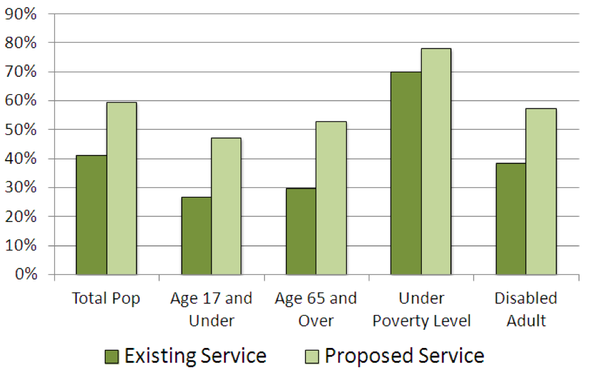
A look at the percent of Ann Arbor residents within a five-minute walk of high-frequency transit services both before and after proposed service improvements.
Courtesy of AATA
He said the county will be considering the four-party agreement in a couple of weeks and wants to partner with Ann Arbor on expanding transit services.
"I hope you'll give fair and robust consideration to this four-party agreement and let us all — as a larger Washtenaw community — take a walk down a path together that helps the AATA realize their bright future," he told council members.
Lumm said it seemed apparent from Monday's discussion that even council members remain confused about what's being asked of the city.
Anglin also expressed hesitations.
"The finances of this seem to be quite complicated," he said. "Right now the AATA is kind of simple: We pay our millage, other jurisdictions join in, there's a service provided."
He brought up the fact that a number of other transit modes, including rail services, are being contemplated. He said that's a concern.
"Buses can easily be rerouted. Rail can never change — it's set and that's it," he said. "You collapse perhaps with rail. That could be our stumbling block of the future: We planned it, we built it, and no one took it. It's an extremely expensive way to go."
Ford gave a presentation in which he said the proposed improvements include significant increases in services along key corridors and connecting routes.
"The bottom line is that Ann Arbor residents will see faster, more direct, more frequent service that is available early and later in the evenings and on weekends," he said. "With more routes having higher frequency, more residents will have access to services that run more often."
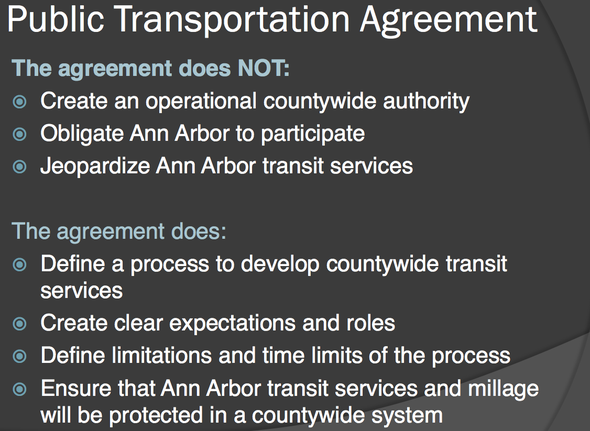
An explanation by the AATA of what the four-party agreement the City Council is being asked to vote on does and does not do.
Ryan J. Stanton covers government and politics for AnnArbor.com. Reach him at ryanstanton@annarbor.com or 734-623-2529. You also can follow him on Twitter or subscribe to AnnArbor.com's email newsletters.
Comments
Stephen Landes
Tue, Jan 10, 2012 : 9:16 p.m.
To those who have a hammer every problem looks like a nail. I'm sure the AATA Board and associated "thinkers" believe that what they are proposing is exactly what our City and County needs. The reason for that is that they are in the business of providing bus transportation -- that's their hammer -- so no matter what the transportation/access issues are in the County expanding the bus system is THE solution. Those of us on the outside of the discussions see something else -- increasing the footprint of AATA increases the money flowing through their hands and money is power. Add to that the loss of accountability that a new transit board will provide (minority control for Ann Arbor, who knows how the members will be selected because they won't be ELECTED) and AATA will have a very nice slush fund of money they control. Sounds like a county-wide version of the arrangement we have Ann Arbor between the city council and the DDA. We do not need more of this unaccountable government sprawl and increasing taxes. We can AT LEAST wait until the funding plan is developed and made public before jumping in to an agreement. Let's not sign up to something illegal like the Fuller Road Transit station on park land.
Mick52
Tue, Jan 10, 2012 : 5:51 p.m.
I can't leave here without adding that in all my years in the area (since the 70s) what I have found is that the best thing about AATA is the bus drivers. They have always be very nice, helpful and great at their job. Even though it must be kind of exasperating when people keep asking them, "What bus to I take to get to _________________." Keep up the good work and thanks for your great service.
pbehjatnia
Tue, Jan 10, 2012 : 5:35 p.m.
Hieftje is an emperor with no clothes. If he had a wardrobe he would not have a need to be patronizing to anyone. Remember that next time you decide to vote him into office.
Goober
Tue, Jan 10, 2012 : 6:40 p.m.
The majority of voters love the mayor and most of city council. The only way the mayor will lose this office is if he decides not to run again.
Mick52
Tue, Jan 10, 2012 : 5:31 p.m.
I can't believe with all this work the AATA has been doing that they do not have the funding plan ready before asking the city to jump in. Is that not the most important point? Before I vote for it I would want to know the level in service in my western Washtenaw location. I do not want to subsidize the rest of the county if I don't think the options I have are worth the new taxes. That includes what the fee would be and if any other fee benefits will change. I do not ride the bus much but I might and I don't mind paying for it but I don't like a proposal with holes in it.
JSA
Tue, Jan 10, 2012 : 5:20 p.m.
You are aware that AATA commissioned a survey be conducted. The survey was about as biased as can be. What is even better is that those that took the survey were paid to do so. I have my first two dollars and am waiting for the other side. Oh, by the way, the survey was conducted by a firm in Columbus, Ohio. So much for local spending, but Columbus, Ohio? Makes you wonder doesn't it.
racerx
Tue, Jan 10, 2012 : 5:10 p.m.
So the mayor doesn't get his way for "busutopia" and calls out council person Lumm. Even my 6 year old nephew has better manners than this!
hut hut
Tue, Jan 10, 2012 : 4:54 p.m.
I'll be on board when the other communities ante up with their own transportation millage.
Peter Eckstein
Tue, Jan 10, 2012 : 4:25 p.m.
The immediate question is why there should be a rush to vote on a very complicated proposal (and document) before there is any specific plan for what new services would be provided, how much they would cost, and how and by whom will those costs be paid. AATA is obviously very anxious to move ahead, but they will be among the beneficiaries of all that additional money, most of which will undoubtedly be coming from taxpayers. AATA plans to be able to answer these questions within a couple of months, so why not wait for their proposals before giving them the green light? No harm in continuing the discussion at the next Council meeting, but to vote on the agreement at that time would be irresponsible. Obviously it is a good idea to hold a public hearing at the next meeting, but there should also be one (or more) after the spending and funding plans are on the table. Two particular heroes of the evening. Jane Lumm for raising some of the tough questions and standing steadfast in the face of pressure, and Ryan Stanton for an excellent job of capturing the highlights of a very long and sometimes confused meeting.
G. Orwell
Tue, Jan 10, 2012 : 4:23 p.m.
The 15 member countywide transit authority will be made up by those that enthusiastically supports the AATA expansion. So, once the power is transfered to them, they will do everything possible to expand the service to the maximum extent. Just as the DDA is increasing parking fees without any oversight or accountability to voters. If Ford gets what he wants, it will be more bureaucracy gone wild at our expense.
Mick52
Tue, Jan 10, 2012 : 5:37 p.m.
Seems like too many people to function efficiently.
bunnyabbot
Tue, Jan 10, 2012 : 4:12 p.m.
"He recalled his decision to get rid of his car in 2008 and said it's been a challenge getting to points beyond Ann Arbor, including his offices in Ypsilanti and Ferndale where he works as executive director of the Michigan Suburbs Alliance" well he should have thought about that BEFORE getting rid of his car. Other people do not owe him non car options when he CHOSE to get rid of his car.
B2Pilot
Tue, Jan 10, 2012 : 5:21 p.m.
Scary and he is the CHAIRMAN of the road commission ! I would laugh at the absurity of his situtaion but he is the CHAIRMAN of the road commission! Buy a bike for cryin out loud
mtlaurel
Tue, Jan 10, 2012 : 4:41 p.m.
Europeans keep a small/fuel efficient car.AND they walk/bike /take buses/subways. When articles talk about the public transport in other countries, do we naively think that means people do not own cars? A midwesterner who thinks not owning a car will make their life easier is not thinking properly. A blended approach to our choices will move things forward. 1. carpool one day a week 2. park and ride on occasion 3. reduce personal use of your car by bundling tasks on certain days 4. walk furthur to get to the bus stop a few times a week. Ridding ourselves of cars when the cars are getting more efficient is not going to happen.
Veracity
Tue, Jan 10, 2012 : 3:57 p.m.
The AATA has an operative deficit of over $1 million now. Michael Ford's report includes many expansions in services but does not estimate the costs nor provides sources of revenue. Usage fees will only pay a fraction of the costs. Already the WALLY is expected to generated at least $1.9 million annual operative deficit at this time. In order to remain financially solvent the 4-county transit authority will have to obtain special assessments and millages. Ann Arborites will likely pay disproportionately for services that will not directly benefit themselves. Also hidden among the details is the probability that Ann Arbor funds folded into the 4-county transit authority will be used to pay for recommendations by the Washtenaw Corridor Improvement Authority. Money will likely be provided by grants, TIF deference or outright exemption, and public-paid land improvements for developers. Where are the reliable feasibility figures to support the projections in the Ford report?
rosewater
Tue, Jan 10, 2012 : 3:56 p.m.
My vote is NO, what benefit will I have in Saline?
Ron Granger
Tue, Jan 10, 2012 : 3:45 p.m.
If Ann Arbor residents are paying for Most of the system, then they should have Most of the votes on the council. 7 out of 15 seats is not adequate.
Brad
Tue, Jan 10, 2012 : 3:23 p.m.
So then I'll be paying another $100 or more per year to not ride the bus to a wider variety of destinations? Where do I sign up for that??
G. Orwell
Tue, Jan 10, 2012 : 3:14 p.m.
Looks like a big power grab by Ford and Heiftje is supporting it. The establishment really wants to expand public transit while making personal transit more and more expensive and difficult (raise parking meter rates and enforce the stupid and dangerous pedestrian crosswalks). Eventually forcing people to take public transit, bike and walk because it will become too expensive to drive into the city. Just as London, England has done. All in the name of sustainability. Based around a big lie. I would support more public transit as long as it is beneficial and necessary. But not if it forced upon us through this UNELECTED transit authority.
Vivienne Armentrout
Tue, Jan 10, 2012 : 3:08 p.m.
I found Conan Smith's reference to his commute to Ferndale rather curious. The Ann Arbor - Washtenaw County transit system is supposed to be for our region, not all of Metro Detroit. Is he suggesting that this plan will make it possible for an easier commute for him? Mr. Smith is wearing several hats here, Ann Arbor resident, chair of the BOC, executive director of the Michigan Suburbs Alliance (which has several Metro Detroit suburbs as clients), and member of the organizing board for the regional transit authority for SE Michigan that his wife's proposed legislation has put into motion. Perhaps he had on a different hat than he meant to grab on the way out the door.
hut hut
Tue, Jan 10, 2012 : 3:28 p.m.
He has as many hats as he does faces.
B2Pilot
Tue, Jan 10, 2012 : 2:26 p.m.
Council members heard from a handful of community residents Monday night, including Conan Smith, chairman of the Washtenaw County Board of Commissioners. He recalled his decision to get rid of his car in 2008 and said it's been a challenge getting to points beyond Ann Arbor, including his offices in Ypsilanti and Ferndale - maybe you should figure that out Mr. Commisioner -Are you kidding me! And your the county commisioner -This gets worse by the day here. What about listening to the 10's of thousands of other residents? Thank goodness for Jane Lumm, Stephen Kunselman, Mike Anglin. A glimmer of common sense Can't understand why the city council is so ambitous to model Ann Arbor and Washtenaw county into Detroit and Wayne county??
justcurious
Tue, Jan 10, 2012 : 2:18 p.m.
Who paid for that fancy water bottle in front of Mr. Taylor? Or did it come out of the Art Fund?
hut hut
Tue, Jan 10, 2012 : 2:51 p.m.
You're not helping. That bottle is a free giveaway or for a nominal cost to the user, from the A2 Utilities dept.
a2grateful
Tue, Jan 10, 2012 : 2:06 p.m.
"Mayor John Hieftje suggested at one point that Lumm might be better informed if she wasn't new to council and had attended previous meetings. . ." Translation: "Poor, stupid woman. You are dumber than your constituents (like that's even possible). How DARE you question our backroom agreement for sake of your desire for so-called facts? Get back in line, NOW! Trust us, go powder your nose, and we'll take care of it."
Seriously?
Tue, Jan 10, 2012 : 1:59 p.m.
Council member Marcia Higgins, D-4th ward, was absent. Again! Those of you in the 4th ward who re-elected this ghost in the last election should be ashamed!
Goober
Tue, Jan 10, 2012 : 6:34 p.m.
Are we saying that she should stay all of the time, not just most of the time?
hut hut
Tue, Jan 10, 2012 : 4:52 p.m.
She would have had to cast a vote that we would beat her with. No vote, beatings anyway.
Veracity
Tue, Jan 10, 2012 : 3:37 p.m.
How would her presence had helped? She is in the Hieftje camp.
justcurious
Tue, Jan 10, 2012 : 2:19 p.m.
Her absence yet again is amazing! Keep pointing it out.
hut hut
Tue, Jan 10, 2012 : 1:57 p.m.
John Hieftje, you owe Jane Lumm a public apology.
Bill
Wed, Jan 11, 2012 : 8:24 p.m.
Great point, a public apology given both in writing and at a televised council member. It's time the mayor stops acting like a child and tries to be an adult.
Goober
Tue, Jan 10, 2012 : 6:33 p.m.
The place down below will freeze over before the mayor sheds some attitude, ego and offers any apology.
bunnyabbot
Tue, Jan 10, 2012 : 4:04 p.m.
totally agree, it was beyond rude, that just shows you how much this is part of HIS agenda.
thinker
Tue, Jan 10, 2012 : 1:46 p.m.
I don't see much of an increase in Ann Arbor residents within a 5 minute walk of existing services and proposed high- frequency transit services. Enough to justify the expense? What is the total AATA usage per diem now? How does this expense break down per person? Is there any real proof usage of AATA services will increase? Is council merely waiting until all the brouhaha dies down, then will force it through?
xmo
Tue, Jan 10, 2012 : 1:46 p.m.
"Mayor John Hieftje suggested at one point that Lumm might be better informed if she wasn't new to council " This is the same guy who blamed Global Climate change for flooding in parts of Ann Arbor. Beam me up Mr. Scott!
annarboral
Tue, Jan 10, 2012 : 1:45 p.m.
This is all a complete waste of time. The answer is "NO" to any new taxes. Why should I support a service I don't use. Why can't public transportation support itself with usage fees based on costs?
bunnyabbot
Tue, Jan 10, 2012 : 4:41 p.m.
hut hut, while I see your point I do understand annarboral. Why INCREASE the tax burden to A2 residents when the AATA system doesn't even support itself as is. They've cut back routes b/c they can't afford to run at that level. So why ask for more money and expand when they haven't been a sound investment up til this point.
hut hut
Tue, Jan 10, 2012 : 2:01 p.m.
Even if you don't use public transit, you benefit from it. People who can't or don't drive cars, don't add to traffic congestion. They are also able to get to jobs and pay taxes. And if you are ever unable to drive, for whatever reason, and you don't have any support system to help you, how will you get around to the doctors, grocery etc?
Top Cat
Tue, Jan 10, 2012 : 1:32 p.m.
"Ford encouraged council members to move the process along and expressed concern that delaying consideration of the four-party agreement that long would be a problem." Translation....Let's rush this through before the Public catches on to what we are doing.
JSA
Tue, Jan 10, 2012 : 1:31 p.m.
No one wants this thing but the mayor and his cronies and the request to give Ann Arbor a majority membership of the proposed board demonstrates once again that Ann Arbor's politicians and bureacrats intent to stick it to the rest of the county. Kill this thing once and for all.
hut hut
Tue, Jan 10, 2012 : 1:14 p.m.
I'm all for improved and expanded mass transit, but what's the rush, Mr Mayor? AATA's been around since 1969, this discussion has been underway for a couple of years and only now are we finding out the facts and making an effort at forward planning. What's the rush Mr Mayor? IS the agenda yours and your toadies on council or the 99%'ers? Like everything else you've proposed, it's easier for you ram it down our throats than it is to seek consensus based on facts and not pie in the sky.
braggslaw
Tue, Jan 10, 2012 : 12:40 p.m.
My God stop the madness and kill this proposal
RUKiddingMe
Tue, Jan 10, 2012 : 12:33 p.m.
Kudos, Ms. Lumm. Please maintain constant vigil and don't be intimidated by the foolhardy, wasteful, and lax council members. The more people are asked to show due diligence or justification, the more they will despise you; one of the curses of being a GOOD steward of our dollars and trust. Your "ready, fire, aim" is dead on, although I'd lean more towards "Fire, maybe ready, then try to aim but by then it's obvious the money was wasted, mismanaged, and/or stolen." Much like with the Fuller Transit Station project, which at this point smacks more of intentional wrongdoing/something illegal going on than simple mismanagement. Please stick with it, Ms. Lumm. The people tired of having their money wasted and trust abused are behind you.
yohan
Tue, Jan 10, 2012 : 12:21 p.m.
cette - well said, this is empire building, plain and simple.
cette
Tue, Jan 10, 2012 : 12:08 p.m.
It's called empire building...more money, more staff, more demands to be fulfilled. Seriously, Ann Arbor should not shoulder this alone, it should be a county wide cost run by a county entity. I would vote no on this. This benefits out county much more, and they need to pay into it up front, not AA.
jcj
Tue, Jan 10, 2012 : 11:57 a.m.
Mayor John Hieftje might be better informed IF HE would listen to the community instead of his little herd of sheep on council!
Bill
Wed, Jan 11, 2012 : 8:21 p.m.
Unfortuantely the communities doesn't agree with the mayor on many issues so why would he listen to them, afterall, the citizen simply pay his salary and expenses not to mention his art projects!
Goober
Tue, Jan 10, 2012 : 11:35 a.m.
Once again, the mayor and city council show their true colors. This is embarrassing. I am surprised that they did not ram this trough as they do with other projects. They continue to show a lack of visionary leadership, continue to work on pet projects and waste hard earned tax payer money. At least one new voice questioned the rest of the group.
jns131
Tue, Jan 10, 2012 : 11:26 p.m.
Remember City Place and what was once there. German town. City council, yes, at its finest.
Alan Goldsmith
Tue, Jan 10, 2012 : 11:33 a.m.
"Council members heard from a handful of community residents Monday night, including Conan Smith, chairman of the Washtenaw County Board of Commissioners." Maybe with the money Mr. Smith saves not owning a car, he can now pay back the tax dollars he owns the County for expenses he shouldn't have received. Does Mr. Smith have a conflict of interest with his day job as executive director of the Michigan Suburbs Alliance and his 'public service' job representing his district and the County? AnnArbor.com should look into this issue.
Alan Goldsmith
Tue, Jan 10, 2012 : 11:28 a.m.
"Mayor John Hieftje suggested at one point that Lumm might be better informed if she wasn't new to council and had attended previous meetings. Lumm took offense to Hieftje's comments. "I've been trying to do my homework," she said. "And, frankly, I feel that was a little bit patronizing, Mr. Mayor."" Why is Mayor Hieftje such a hater when is comes to the democratic process? Why does he dislike open and transparent discussion of this major shift in how Ann Arbor tax dollars are going to be spent? Has he denounced Joan Lowenstein's recent field rant about anyone not in lockstep with Hieftje's actions over the past several years? If the Mayor wants to be Dick Cheney, fine with me. Just not when it comes to running our city.
Bill
Wed, Jan 11, 2012 : 8:19 p.m.
The mayor shows no respect for anyone not in step with his ways. I agree with Ms. Lumm although I would say it was "very" patronizing rather than a "little bit" as Ms. Lumm stated.