

Ann Arbor businesses to get help financing energy upgrades under new $4M program
Ann Arbor business owners looking to make energy efficiency upgrades on their properties soon will have a new option for financing the costs.
The city's new PACE program — standing for Property Assessed Clean Energy — is getting read to roll out, making available an estimated $4 million in its first phase.
"The program is pretty much ready for prime time," said Mayor John Hieftje, who believes it will be a boon to economic development and job creation in Ann Arbor.
Qualifying businesses will be able to borrow money for energy efficiency projects ranging from $10,000 to $350,000 and then pay back the loans through special assessments.

John Hieftje
The city is contracting with the Clean Energy Coalition to implement new community energy programs, including PACE.
Ann Arbor officials fought for the passage of the state's new PACE law, which was signed by former Michigan Gov. Jennifer Granholm last December. State Sen. Rebekah Warren, D-Ann Arbor, sponsored the legislation that made it possible.
The new law gives local governments authority to issue revenue bonds to pay for upgrades on private commercial property, ranging from high-efficiency furnaces that can cost a few thousand dollars to solar-panel systems that can cost tens of thousands of dollars.
Property owners are responsible for repaying the loans from their local governments over a period of several years through special assessments added to their property tax bills. Barrott said the length of the assessments would be either five or 10 years.
City officials said the PACE program is being set up so the estimated energy savings must be greater than the cost of the special assessment — meaning it'll be an immediate cost savings for the property owner.
The way the state law is currently worded, it only applies to businesses, but Ann Arbor officials hope it can be expanded to residential properties.
Barrott said Ann Arbor's PACE program will help fund projects ranging in cost from $10,000 to $350,000, including any work that fits into the following categories:
- Energy analyses
- Insulation, weather sealing
- Lighting
- Heating, ventilation and air conditioning
- Energy Star appliances
- Doors and windows
- Cool roofs
- Solar photovoltaic, thermal and water systems
- Geothermal
- Combined heat and power systems
- Biomass thermal
The City Council voted back in March to establish a $482,800 loan loss reserve fund — using federal energy grant dollars — to be used in conjunction with the PACE program.
"Essentially, when we go out for a bond … we estimate that we can leverage the dedicated amount to loan loss reserve about 10 to 1," Barrott said. "So we're expecting to be able to raise about $4 million in funding for Phase I. It might be less. We don't know yet."
Barrott said 27 states have passed PACE legislation allowing local governments to establish energy financing districts. She said several cities like San Francisco and Berkeley now have programs up and running, and more are considering implementing them — including Oakland County, Sterling Heights and Highland Park in Michigan.
Barrott said there's a strong case for a PACE program. It creates jobs, keeps money in the local economy, supports economic development, reduces energy use and energy costs, increases or maintains property values, and reduces greenhouse gas emissions, she said.
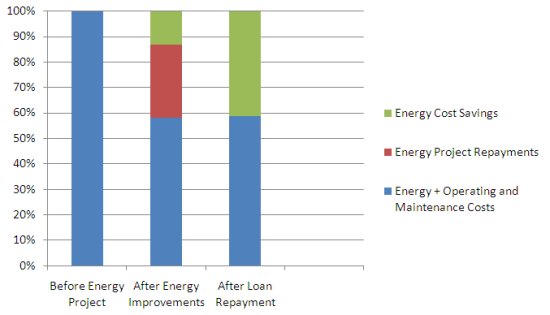
Participation in Ann Arbor's new PACE program will be limited to projects that demonstrate energy savings greater than their costs, so the costs to a business before, during, and after the PACE assessment will resemble the chart shown here
"If you assume that you could increase the energy efficiency by 20 percent in every building, you would have an additional $26 million circulating in the economy per year," she said, noting that would save 164 million kilowatt hours of energy, or the equivalent of 39 Barton Dams.
Barrott provide council members with a summary of the results of a PACE program started in Boulder County, Colorado. She said the program has helped finance 598 projects totaling $9 million — creating 85 short-term jobs, $5 million in earnings and $14 million in economic activity in the county alone. Outside of the county, it created 41 short-term jobs, as well as $2 million in additional earnings and $6 million in economic activity, she said.
"Participants have saved so far $125,000 in utilities," she said, noting again the idea is the annual savings will be greater than the annual costs of the assessments.
Ann Arbor now has PACE applications available at www.a2energy.org. The application fee a business must pay is $554, which includes technical review, title search and recording fee.
Among the requirements for a business to apply is that it must be current on its property taxes, mortgages and utilities and it cannot be in bankruptcy. Also, the proposed energy improvements must be less than 20 percent of the state equalized value of the property.
A resolution stating the city's intent to establish a PACE program, including setting of boundaries for the financing district, is expected to come before the council next week. A public hearing and a formal resolution establishing the program is expected to follow on Oct. 3.
The city expects to officially launch the program sometime within the fourth quarter of 2011. For more information, visit the city's website.
Ryan J. Stanton covers government and politics for AnnArbor.com. Reach him at ryanstanton@annarbor.com or 734-623-2529. You also can follow him on Twitter or subscribe to AnnArbor.com's e-mail newsletters.
Comments
BobbyJohn
Tue, Sep 13, 2011 : 3:46 p.m.
Sounds like there is some promise to the program, although it would probably be better to be run by the county or even the state so there would be some economy of scale for the government entity running the program. However, if businesses want to save money simply and without cost, try simply turning off OUTSIDE lighting during daylight hours. Walked down State Street yesterday on a sunny day, and about a third of the businesses had exterior lighting on that served no purpose and was just wasteful of both money and energy. And, it is consistently so. Also, many businesses leave their doors wide open while Air Conditioning is going full blast, and even though it feels refreshing to passers by, it is a large waste of energy, in effect air conditioning the outdoors. Perhaps if enough of us pointed this out to businesses, and told them that we prefer to shop at establishments that are more energy conscious, the store owners might adapt to being more ecologically aware.
Somewhat Concerned
Tue, Sep 13, 2011 : 2:17 p.m.
If every single business in Ann Arbor used the city's special break for them to reduce their electricity consumption by 20%, it wouldn't make a dent in the supply-demand situation in the electricity market in which prices are set. The businesses will save money but the price to residents will not move 35 cents. The market is too big to even feel the effect. This sort of claim reminds of the "justifications" routinely trotted out for tax breaks to businesses or special welcomes and treatment to visiting steamfitters: get an economist to conjure a multiplier to apply to the known dollar effect, and get whatever number you want to claim is the benefit.
EyeHeartA2
Tue, Sep 13, 2011 : 1:51 p.m.
What happens, not if, but when, the business goes under prior to paying the loan back? Who gets stuck holding the bag? If it is such a good deal for the businesses to invest their money this way, why do you need the governments help? $9,000,000 in Boulder to save $125K, never mind. I answered my own question. No good business person in their right mind would go for that one. Lucky the goverment is willing to "help".
Chase Ingersoll
Tue, Sep 13, 2011 : 1:49 p.m.
While I am against government subsidizing of private property, this is the type of project that can benefit the whole, and that includes the residential market. Also, as long as the businesses themselves are the ones to determine where they will gain the most from the expenditures, the program will result in saving them money and reducing demand for power, especially at peak periods. I have already forwarded this article to a friend in Canton, at a Cold Storage Warehouse that has monthly electricity bills of $30,000.00. last year we ran simple calculation on the cost of replacing the Mercury Vapor lighting throughout the warehouse with LEDs and the company proceeded to get three bids between $130k and $175k. The payback was going to be 3-5 years just on the consumption of electricity for lighting and this was without the calculation of what would be saved from the LEDs producing less heat. BENEFIT TO ALL: simple supply and demand. If the commercial demand for electricity is reduced, there will be more supply on the market and a reduction in the rates to residential consumers...that is of course unless bureaucrats and corporatists step in and rig things. WHY NOT RESIDENTIAL CUSTOMERS: it would cost far more to manage small residential projects (...oh, I want to replace the bulbs in my house with LED lighting), the energy savings would be less and the payback would take longer as compared to 5 and 6 figure commercial projects. ANOTHER ISSUE: will the energy upgrades be taxed as business chattel? People who don't own businesses, may not know that the Municipalities annually tax "business property" in their jurisdiction. This is not the land or building, but rather computers, machinery, and equipment. It is likely that these energy improvement would be classified as "equipment" and the businesses would be subject to annual taxes on the value of that upgrade. This is another reason for the City offering this to businesses rather than ho
Somewhat Concerned
Tue, Sep 13, 2011 : 1:21 p.m.
The city is offering a special financing program to businesses so they can reduce their energy bills, but not to residents so they can lower their bills. Thanks Mr. Mayor.
Ryan J. Stanton
Tue, Sep 13, 2011 : 5:20 p.m.
State law doesn't extend PACE programs to residential properties yet. That's much to the dismay of the mayor and other local officials. Your concerns would be better directed at Fannie Mae and Freddie Mac. Here's some background: <a href="http://www.nytimes.com/gwire/2011/09/06/06greenwire-recent-court-ruling-favors-white-house-backed-31917.html" rel='nofollow'>http://www.nytimes.com/gwire/2011/09/06/06greenwire-recent-court-ruling-favors-white-house-backed-31917.html</a>
xmo
Tue, Sep 13, 2011 : 12:45 p.m.
This is a pretty big assumption "If you assume that you could increase the energy efficiency by 20 percent in every building" All of these energy saving products never seem to meet expectations for example: Solar Panels usually take a lot longer than five or ten years to pay for themselves. Is this Voodoo science/economics?