

HIV on the rise among young, black gay men in Washtenaw County
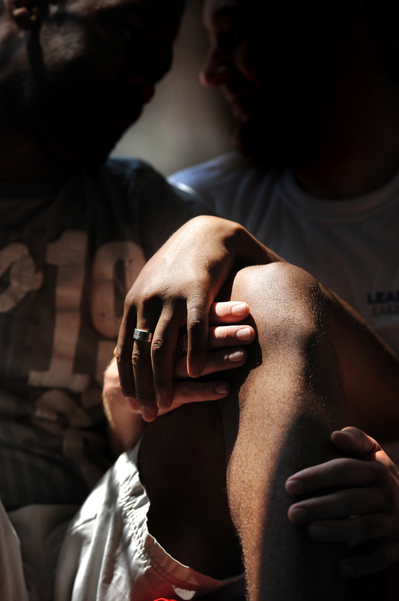
These two young men from Ypsilanti are among a growing demographic of new HIV cases among young, homosexual black men in Washtenaw County.
Melanie Maxwell | AnnArbor.com
It’s been a long road to the point where 21-year-old Ypsilanti resident Jake Stanford is able to smile and say “it’s not over” when talking about living with HIV.
Stanford found out he had HIV about a year ago - sending him into a spiral of confusion, then shame, and finally acceptance.
Stanford is among a growing demographic of new HIV cases in Washtenaw County and across the country: black, homosexual men age 15 to 29 years old.
The percentage of new HIV diagnoses in black individuals is about 48 percent in 2011, which is greater than the racial breakdown of Washtenaw County’s population — about 12 percent to 13 percent black.
Black gay and bisexual men now account for one in four new HIV infections in America, according to a new report by the Black AIDS Institute.
“It’s unfortunately been consistent among the HIV epidemic,” said Laura Bauman, epidemiologist for Washtenaw County Public Health.
But analysts familiar with HIV data trends say it’s not that young, black homosexual men engage in riskier sexual behaviors than their white counterparts.
Rather, experts say the demographic has more limited access to tests and educational materials, and there's also a negative social stigma amongst the community in which they live.
A young man's story
Stanford found out he had HIV in March 2011. After donating blood, he got a call from the Red Cross informing him he needed to speak with a doctor.
Though he knew the Red Cross was going to test his blood, Stanford was not prepared for what was going to come next: a diagnosis of HIV.
In the doctor’s office, Stanford said he was numb. On the drive home he began calling his closest friends to break the news - and on the second call, the gravity of the situation began to sink in.
The second wave of emotion hit when Stanford told his father.
“My dad said, ‘It’s not over … you can still live your life,’ ” Stanford said.
The third and strongest wave hit when he was sitting in his apartment. A close friend came over - and she didn’t have to say more than two words before Stanford said he broke down.
The initial depression hit Stanford hard - he stopped going to classes at Washtenaw Community College and dropped out of his favorite activity, a hip-hop dance group.
After being rejected several times by potential partners because he was open about having HIV, Stanford said he found a partner who accepted him for who he was.
Stanford met 27-year-old Cameron Harper, of Ypsilanti, while at work. The two had a strong emotional connection — so strong that Harper willingly contracted HIV from Stanford after the couple started dating.
"It's a gift that I know someone that will stick around," Stanford said.
By the numbers
Data from local, state and national agencies show the number of new HIV diagnoses is on an even keel. In Washtenaw County, that rate has even declined over the past three years.
However, the demographic of the new cases is shifting.
In the past six years, the portion of new HIV diagnoses in Washtenaw County among male individuals who seek sexual contact with men has been growing. In 2005, it was 70 percent. In 2011, it was 86 percent.
“What continues to jump out at me is the number of young men under the age of 30, and almost all of them are MSM,” Bauman said.
- Read the 2011 report from Washtenaw County Public Health here: WC_HIV_trends_2011-2.pdf
MSM is a technical label to describe gay and bisexual men, as well as those that don’t embrace those terms but exhibit the behavior.
Nationwide, the trend is one government agencies have noticed.
Young and adult men who seek male sexual contact appear to the sole transmission category in which the number of HIV diagnoses has increased from 2007 to 2010, according to the Centers for Disease Control and Prevention.
Of 544 individuals living with HIV in the county as of 2010, 62 percent are men who seek male sexual contact, according to the Michigan Department of Community Health 2010 state profile. In Michigan, that statistic is 53 percent.
The trend of new HIV cases also has been shifting younger.
Among males and females between the age of 15 to 19 years old, there has been a 10 percent increase in the number of new HIV diagnoses from 2007 to 2010.
In the same time period, there has been a 33 percent increase in the number of new HIV diagnoses among males and females 20 to 24 years old.
Washtenaw County has the fourth highest rate of HIV infection statewide, according to the most recent data from the Michigan Department of Community Health.
The portion of new HIV cases that are attributed to intravenous drug use in Washtenaw County are extremely low, a trend epidemiologists are happy to see.
“There’s some good news in these numbers, but there’s still a lot of work to be done,” Bauman said.
Access and behavior
Though people phrase it in different ways, one of the major limiting factors that keeps black gay men behind closed doors when it comes to HIV is acceptance - both on behalf of the individual and the community.
There’s a sort of shame and secrecy that goes with being homosexual, Stanford said.
Rather than being able to go out and talk and hold hands on a date in public, Stanford said many men his age simply skip the date because it’s too stigmatized and go right to the bedroom.
For Stanford, he said it started with tensions in high school.
The pressure to conform makes many afraid to come out - something Stanford said he experienced himself while in high school in the Lincoln Consolidated School District in Ypsilanti.
Stanford said he was usually careful to use protection when he had sex most of the time, but he knew he was putting himself at risk.
The program Stanford said helped pull him out of his slump was “It’s Not Over” - a program coordinated by the HIV/AIDS Resource Center (HARC) in Ypsilanti.
HARC provides HIV and AIDS related services to Washtenaw, Jackson, Lenawee and Livingston counties.

Leon Golson
The program was pulled together by gay and homosexual men, Golson said. “They felt there was no safe venue or tool to work through ‘deep uglies.’ ”
There need to be more positive affirmations about being a gay male, Golson said.
“Michigan is not one of the states you think about when you think gay-friendly,” Golson said. “When you feel good, it’s easier to do what you do to keep yourself healthy."
There’s a sort of internalized homophobia among gay black males, Golson said.
There’s no protection in Michigan to keep from being fired for being gay. Same-sex couples also can’t marry, share insurance benefits or tax deductions as heterosexual couples.
“We’re struggling with what the world says about us,” Golson said.
Men often deal with the resulting low self-esteem by over- or under-compensating by engaging in riskier sexual behaviors, Golson said.
The lack of self-esteem and fear of being judged for being gay means many young men keep quiet about their status, Golson said.
Ernest Hopkins, chairman of the National Black Gay Men's Advocacy Coalition, wrote in a 2012 report compiled by the Black AIDS Institute on the state of AIDS among black men in America.
"While black men are at the front of the line when it comes to need, they remain at the back of the line when it comes to services ... The AIDS crisis among black gay men is a problem for black America as a whole."
- Read the report here: State of AIDS among black gay men in America 2012.pdf

Jose Bauermeister
Although black and Latino young men are engaging in the same activities as their white counterparts, Bauermeister said more resources have been invested in reaching the white part of the community than the black or Latino side.
“They’re not doing anything different than their white social counterparts, it’s that their social condition (i.e. racism and homophobia) may put them more at risk,” Bauermeister said.
Black and Latino young men are more likely to live in an urban environment, Bauermeister said, and black men are more likely to be subject to racial discrimination and homophobia.
“That can create problems with how people seek medical care and how open they are about treatment,” Bauermeister said. “It’s hard for people to be asked to use condoms when their social environment doesn’t make it friendly to do that. HIV is stigmatized, so having a conversation becomes much more difficult.”
Most recently, Bauermeister and his team are surveying black and Latino young men that have sex with men in the greater Detroit area, including Washtenaw County.
The intent of the study is to look at HIV prevention in a broader way beyond individual decision-making - from sex education, church programs, Internet relationships and HIV testing availability to homelessness and homophobia issues in the community.
“It became very clear that there were bigger issues like transportation and access to care,” Bauermeister said.
Place matters
Though there are certain ZIP codes in Washtenaw County where the majority of individuals with newly reported cases of HIV live, analysts state the location is less of a contributing factor and more of a social description.
There are four ZIP codes in Washtenaw County from which the majority of new HIV cases are reported - 48108 and 48103, which lie mainly to the south and west of the Ann Arbor city limits; as well as 48197 and 48197, mainly in Ypsilanti Township - analysts stress that they’re not causal attributions but markers of socioeconomic standing.
Rent is cheaper for a single young person in those parts of the community, though living here may mean there’s less access to a bus system that would transport the person to resources like HARC.
Those areas tend to be lower-income, Bauermeister said. People also tend to seek out sexual partners that are closer in proximity.
University students who are tested use their local ZIP code address - and the central Ann Arbor ZIP codes are not among the parts of the county where new cases are concentrated. People who move to Washtenaw County who have HIV aren’t counted in the number of new cases and go fairly unreported.
Access to resources like HARC and the health department are often a major deterrent for some, as business hours and transportation availability make the process difficult when a person has to juggle their work schedule, Bauermeister said.
A person also may be consumed with securing their social well-being - like finding a job and a place to live - and aren’t necessarily worried about their health, Bauermeister said.
“There are bigger social realities that are tied to our sexual behaviors,” he said.
Tightened belts
The importance of the continued work of agencies like HARC can’t be quantified until it stops working.
“Public health is the silent success,” Bauermeister said. “Unless we’re not doing our job, no one praises public health.”
And that job could be hampered sooner rather than later.
The CDC has recently changed its funding formula for HIV and AIDS programming, Bauermeister said. As there are more new HIV cases being reported in the southern U.S., that’s where more of the money is going.
“Some of the money used in Michigan to keep people safe will soon be lost,” Bauermeister said. “So some of these strategies will be scaled down. The question remains, what happens then?”
HARC's funding comes from the federal level and is administered by the state.
In order to reach areas of the county where people may not have access to effective transportation to testing services, the van provides on-site tests for HIV and other sexually transmitted diseases.
HARC’s outreach van recently reached the end of its lifespan -- and so the organization had to start scrounging for donations.
The organization recently was able to raise enough funds to buy a new van. In terms of the total effectiveness of the organization, Golson said he’d love to see more.
The current main location of HARC is a small suite inside a building in an office park at 3075 Clark Road in Ypsilanti. Though the organization has an office in Jackson, the two locations serve four counties.
HARC has a staff of 15 people and relies on volunteers for many of its services and events.
Golson said he’d love a more accessible building, the funds to have counselors and therapists on site, as well as offering a full range of STD services and a physician to help people with their T-cell count.
Currently, their outreach occurs at university clubs, pride events and at two bars, specifically Necto on Liberty Street in Ann Arbor where HARC organizers said they see the most new faces.
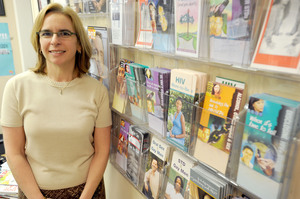
HARC President and CEO Jimena Loveluck stands by a wall of pamphlets about HIV and AIDS at the HARC office in Ypsilanti in June 2011.
Angela J. Cesere | AnnArbor.com
Loveluck said HARC targets its funding to areas where they’re likely to have men who have sex with men. HARC also does special testing initiatives in conjunction with national HIV awareness events, and uses the StatusSexy campaign to encourage men to get themselves tested.
The office also does events in conjunction with Spectrum groups at University of Michigan and Eastern Michigan University, Loveluck said.
Washtenaw County public health authorities state the number of new HIV cases will likely continue to surface.
Bauman, epidemiologist for the health department, said the younger generation of gay men now view HIV as a manageable disease.
“They didn’t see all of their friends die,” Bauman said.
The number of new cases that continue to surface each year “would probably only come down if we get a good vaccine” even with good sex habits, Bauman said.
There are numerous drugs available on the market available for HIV patients - ones strong enough that individuals don’t have to check in with their doctor every month. For Stanford, he said his medication has reduced his doctor's visits down to every six months.
Bauman said the cocktail of medicines needed to live with HIV and AIDS come with the added expense of side effects and cost.
Stigma goes on
Stanford and Harper, who have now been dating for 10 months, said they've been very selective with whom they've shared their HIV-positive statuses.
Harper said most of his family and friends are in the dark.
"I don't know how people are going to react," Stanford said. "I don't want things to change ... and I don't want to be treated as diseased."
For now, they have each other.
"It's not a death sentence like it used to be," Stanford said of HIV. "I'm an ‘everything happens for a reason’ kind of person."
Amy Biolchini covers Washtenaw County, health and environmental issues for AnnArbor.com. Reach her at (734) 623-2552, amybiolchini@annarbor.com or on Twitter.
Comments
Detourdoggy
Fri, Jul 27, 2012 : 1:51 a.m.
If it is preventable then we should stop making excuses for bad behavior.
Detourdoggy
Fri, Jul 27, 2012 : 1:50 a.m.
some of you people amaze me with all the excuses you have for poor judgement.......That is why we are in the mess we face in this once great country.
JRW
Thu, Jul 26, 2012 : 11:39 p.m.
Engaging in risky behavior is a choice, and not a good one.
JRW
Thu, Jul 26, 2012 : 11:37 p.m.
"There are four ZIP codes in Washtenaw County from which the majority of new HIV cases are reported - 48108 and 48103, which are in Ann Arbor Charter Township directly to the south and west of the Ann Arbor city limits; as well as 48197 and 48198, which is Ypsilanti Township - analysts stress that they're not causal attributions but markers of socioeconomic standing." 48103 and 48108 also include the city of A2. 48197 is also in the city of Ypsilanti. Why is this not mentioned in the article?
Tom Todd
Thu, Jul 26, 2012 : 9:45 p.m.
Willingly is the only problem I have,how is that different then someone with an Assault rifle.
Basic Bob
Thu, Jul 26, 2012 : 5:10 p.m.
"Place Matters" Zip codes 48108 and 48103 do not cover Ann Arbor township, which is north and northeast of the city. Although these zips stretch into Pittsfield and Scio townships, nearly all of the modestly priced single-friendly apartments are within the city. They are well-covered by bus service, you might need to take a transfer downtown. Many of these cases are inside the bubble.
Angry Moderate
Thu, Jul 26, 2012 : 5:32 p.m.
People in that area can also get to Spectrum Center at U of M. Not sure if they provide testing for non-students though.
cinnabar7071
Thu, Jul 26, 2012 : 5:10 p.m.
I remember when Herpes was scary, that was enough to get us to wrap it up.
Macabre Sunset
Thu, Jul 26, 2012 : 4:45 p.m.
This would have been a better article without all the mumbly moralizing. My sympathy goes out to the community, but it is engaging in riskier behavior, and that's what the hard statistics show. This takes place because of social pressures and a lack of education, but, ultimately, at some point a person has to take responsibility for his own behavior. Not everything is everyone else's fault. I'm also tired of the blanket assumption of racism where the problem is more economic status. I've reached a point with A2.com where I'm pretty much deaf to claims of racism.
Will Warner
Thu, Jul 26, 2012 : 9:50 p.m.
"I'm also tired of the blanket assumption of racism where the problem is more economic status. I've reached a point ... where I'm pretty much deaf to claims of racism." Welcome to the club.
Macabre Sunset
Thu, Jul 26, 2012 : 5:21 p.m.
That's a good way to look at it, but I wish the mainstream media wasn't so consistently the purveyor of this garbage.
Unusual Suspect
Thu, Jul 26, 2012 : 5:05 p.m.
I recently decided to live my life without concern for the daily accusations of racism based on things like disagreement with the President (or his Attorney General), my dislike for real racists like the The Justice Brothers, stating that I believe we should control our borders, pointing out that the 9/11 terrorists were Islamic even if I at the same time genuflect and qualify that with a statement that I know those who hold that extreme view of Islam are extremely rare, and whatever other cause, person or group who wants to throw that moniker around at anybody or anything with which or about which my opinion differs. I've decided I just cant live my life looking over my shoulder for people with that level of hate, and trust that those who know me remember who I am.
Roncerz
Thu, Jul 26, 2012 : 3:43 p.m.
I love the post about getting HIV being like obesity! Thanks for the laugh; that is a good one! Obesity is not an infection. Obesity alone does not cause death. There are a lot of obese people who exercise regularly, have excellent heart health and blood pressure, good cholesterol and are very active. There are people with HIV like this as well, but for how long? Obese people do not have to take fistfuls of medications several times a day to keep a virus from killing them. It's so sad that this individual allowed himself to be infected. It's nice they had a "connection" but if he truly cared for or loved that man, he would never allow him to be infected. You have to remember that the human brain is not fully developed into adult brain until minimum ages 25-26 years. That is a fact. These young men are acting impulsively, are not yet mentally adults with fully functioning executive functions, and it is negativley impacting them and the community for decades to come.
Unusual Suspect
Thu, Jul 26, 2012 : 4:55 p.m.
Roncerz, I'll give you a little English language lesson. The comparison is followed by the qualifier, "in that," meaning the comparison being made is limited to the statement that follows it (in this case, that they can both be avoided by making good decisions). After I posted that, I thought about making posting another comment explaining that, but I decided not to because I figured readers here would be able to figure that out on their own.
Elijah Shalis
Thu, Jul 26, 2012 : 2:04 p.m.
I don't know why my comments were deleted. I am an out gay male and know how this all goes down. Sometimes Ann Arbor.com really practices censorship and refuses to look into the reality of situations. Growing up in this city turned me into a Republican and it took me living outside of it to come back to being a Democrat. You guys really take things way too far. I can't repost my comments because you will just delete them.
kraiford12
Thu, Jul 26, 2012 : 3:45 p.m.
Your statements are often off-topic or contradictory. Hard to follow your line of thought sometimes, just saying.
annarboral
Thu, Jul 26, 2012 : 1:33 p.m.
Now ask yourself who will end up paying for this unfortunate mans incredibly poor decision making? I feel sorry for this person, it's tragic, but why do the taxpayers have to spend enormous sums for informed bad decisions?
Sparty
Thu, Jul 26, 2012 : 8:17 p.m.
Good point ... is riding a motorcycle without a helmet any less of a poor decision ? Who pays when an accident results that causes traumatic brain injury ? Tax payers.
rm1
Thu, Jul 26, 2012 : 4:55 p.m.
That was supposed to say "heart disease". Auto-correct, not watched carefully enough, strikes again?
rm1
Thu, Jul 26, 2012 : 4:53 p.m.
"Now ask yourself who will end up paying for this unfortunate mans incredibly poor decision making?" Under the Affordable Health Care Act, as it will no doubt be fine-tuned and improved, when we all in the insurance pool, we will, on standard insurance principles, all be paying for each others' healthcare, for heath disease, Alzheimer's, diabetes, cancer, HIV, injuries to helmetless riders of motorcycles, or whatever.
Angry Moderate
Thu, Jul 26, 2012 : 3:34 p.m.
Elijah - people "willingly" get infected because they know that taxpayers have to bail them out. Resources are limited. If we spend $100,000 on someone's AZT, that is $100,000 that we can't spend on something else that is important--perhaps treating people who got a disease or injury other than "willingly."
Elijah Shalis
Thu, Jul 26, 2012 : 3:05 p.m.
Are you suggesting that the government not pay for the meds which would result in people dying? These meds are expensive
Mike
Thu, Jul 26, 2012 : 1:59 p.m.
We the people/tax payers are on the hook for everything. There is no person responsibility and we have a safety net for everything and everyone.............all we need is for you to give a little more............
Ariel
Thu, Jul 26, 2012 : 1:24 p.m.
I don't understand why anyone would willingly contract HIV or allow someone else to willingly contract HIV.
Unusual Suspect
Thu, Jul 26, 2012 : 1:11 p.m.
I think there is a lot of undue drama surrounding HIV, even though it's really not much different than obesity in that it can be avoided by making good decisions.
cinnabar7071
Thu, Jul 26, 2012 : 12:46 p.m.
If only we knew what caused this and how to prevent it.
cinnabar7071
Thu, Jul 26, 2012 : 2:06 p.m.
simone some people close to Obama think we know where aids comes from.. http://www.youtube.com/watch?v=PvL9dLeDcSU
simone66
Thu, Jul 26, 2012 : 12:52 p.m.
We know how to prevent it. But what is the historical biological origin of HIV, is a mystery.
a2citizen
Thu, Jul 26, 2012 : 12:43 p.m.
"...it's that their social condition (i.e. racism and homophobia) may put them more at risk," Bauermeister said..." Whew. I thought he was gonna blame Reagan.
AAProgressive
Thu, Jul 26, 2012 : 12:56 p.m.
Reagan did almost nothing to stop the spread of HIV since it was mostly infecting gay men in the 1980's.
Angry Moderate
Thu, Jul 26, 2012 : 12:41 p.m.
There is a newly-approved home HIV test that you can buy over-the-counter. It's not as accurate as a medical test, but it's better than nothing. People who lack transportation or fear the stigma of getting tested should keep that in mind.
GP
Wed, Aug 8, 2012 : 2:59 a.m.
The Orasure test will be available OTC in October
Basic Bob
Thu, Jul 26, 2012 : 3:12 p.m.
If you're not sure, go get a real test. Please.
Alex Swary
Thu, Jul 26, 2012 : 2:26 p.m.
There is an FDA approved HIV test that has been available over the counter for a while. I believe it's called the Home Access HIV kit or something.
Angry Moderate
Thu, Jul 26, 2012 : 2:15 p.m.
The FDA just approved the home test a couple of weeks ago...
Elijah Shalis
Thu, Jul 26, 2012 : 2:07 p.m.
I know several people that have used rapid tests and they come back as inconclusive all the time. waste of money.
Angry Moderate
Thu, Jul 26, 2012 : 12:37 p.m.
What a load of excuses. The couple in the article states that they KNEW one of them had HIV, and the other was WILLINGLY infected with the disease. Yet the article blames racism, and lack of access to the bus system for Ypsi residents--even though HARC is extremely close to Ypsi, right across the street from St. Joe's?
mpope
Fri, Jul 27, 2012 : 6:25 a.m.
I'm perplexed by this, too. Especially how, in the same story, one of the principles can choose to contract AIDs but likewise be excused for lack of information and access. And how his partner would, in fact AGREE to infect him. Furthermore, the factors of racism, and homophobia are tripled with urban residing as reasons black and latino men are less informed and have less access to testing. Should we then presume a white country boy would feel less bias and have more information and access? AIDs is still happening. Some people are still contracting AIDs because of invisible risk behaviors ( intercourse with secretly adulterous spouse, medical mishaps etc.) But many more people are still contracting AIDs by engaging in modified or outright risk behaviors. Many victims of AIDs have conspired to victimize themselves. THIS is almost as tragic as the disease itself. Stories like this one attempt to evoke compassion ( a good and necessary response to victims of AIDs) while jettisoning truth about personal responsibility ( a profound disservice to gay persons AND an insult to everyone's intelligence.)
Angry Moderate
Thu, Jul 26, 2012 : 12:39 p.m.
Washtenaw County also does free testing in Ypsi. Lack of transportation or money is no excuse for anyone who lives in this county. And getting infected willingly is just irresponsible--who do you think is paying the bills if you don't have insurance?
simone66
Thu, Jul 26, 2012 : 12:30 p.m.
This is a well written and informative article. The stimatism of this disease, along with societal homophobic and racist attitudes towards blacks and latinos, along with risky behavior (which could be prevented), are what is making this disease still so prevelant in society. What concerns me more is that one of the young men went to the Red Cross to donate blood. It has long been my understanding that some people do this as an indirect way to find out their status of if there is something abnormal about their blood/plasma. As a person who donates blood myself, the questions that are asked are very frank and personal and if a person answers them truthfully, he/she would know to not go any further with the blood donation, and additionally, there are scannable codes that one can place on their donation form that serves as a final confirmation that yes, my blood is safe, or no, my blood may not be safe. I'm curious as to the young man's agenda was in donating blood while he knew about his very risky sexual lifestyle. In the end, I hope he can get the proper treatment and come to terms with his condition and make positive changes in his life.
Basic Bob
Thu, Jul 26, 2012 : 3:08 p.m.
He clearly ignored the required reading material at the Red Cross. There are many risks to the blood system, from needle sharing to Mad Cow disease to tropical parasites. Each is explained. MSM should never donate blood.
Michigan Man
Thu, Jul 26, 2012 : 11:40 a.m.
No real surprise in this medical story. From a public health vantage point, a preventable disease. Attention to proper preventive measures, a little common sense and compliance can go a long way in eradicating this disease.
Sparty
Thu, Jul 26, 2012 : 8:13 p.m.
Wouldn't know, but bet google does. Google also probably knows about blood spills in accidents and all those other accidental ways of infection with the virus, as well as the drug users, tattoo parlors not following universal precautions, dentists/doctors not doing the same, etc. etc. My point was, you can't make a judgment call that HIV is only a sexually preventable disease. It's not.
Angry Moderate
Thu, Jul 26, 2012 : 1:54 p.m.
Sparty, what percentage of infections do those scenarios account for?
Sparty
Thu, Jul 26, 2012 : 1:22 p.m.
Unless born with it, stuck by an infected needle in a medical or non-medical setting, defective protection, lying spouse/partner, or numerous other situations ?
Detourdoggy
Thu, Jul 26, 2012 : 10:45 a.m.
Someone is not listening.
Tom Todd
Thu, Jul 26, 2012 : 10:57 a.m.
has Magic made getting HIV acceptable?