

AATA asks residents to help plan for Washtenaw County's future public transportation needs
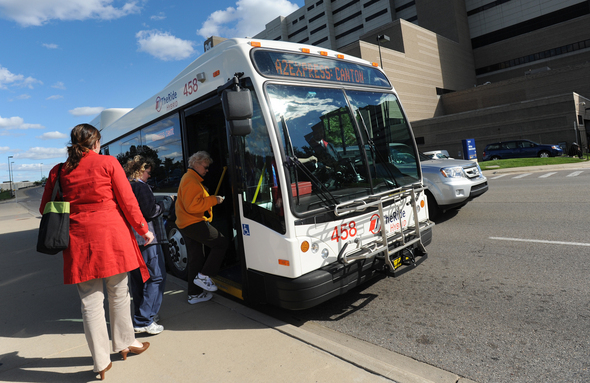
Patrons board the A2Express bus headed to Canton Township at a bus stop near the University of Michigan Cancer Center in Ann Arbor on Friday afternoon. The AATA is seeking public input on how to improve public transportation in Washtenaw County.
Melanie Maxwell I AnnArbor.com
Transit officials want to hear from those with an opinion on how public transportation can improve Washtenaw County as a livable, economically viable and environmentally sound community well into the future.
And they say forget about the costs for now.
Starting Tuesday, the Ann Arbor Transportation Authority will hold 20 public meetings at libraries, senior centers and colleges around the county to hear from residents on what services they would like to see in a 30-year master transit plan, which is now being developed.
Anything is on the table — more van pooling from townships, services to Detroit Metro Airport, or more connections between Ann Arbor and Ypsilanti.
AATA officials have already finished Phase I of the plan, which outlined a general vision from meetings over the summer with community groups, township councils, non-profits and university and government heads. The AATA officials also set up tables at eight festivals. And CEO Michael Ford has logged about 130 one-on-one meetings.
They hope to take the best ideas, roll them into about five potential scenarios to discuss in January and February, and finalize the plan in March, said AATA board Chairman Jesse Bernstein.
On Thursday, AATA officials made their final pitch before the series of meetings to a group of former board members, who know something about ambitious plans and the reality of funding.
“We’d like your help,” said Bernstein. “Help us get people to the meetings using your contacts. Get your friends, your neighbors and your colleagues there so they can tell us what they think.”
The former members heard a presentation prepared by AATA consultant Steer Davies Gleave on the area’s most pressing transit issues and the need for a long-term plan to address needs based on population projections.
Gaps identified
The key transit issues identified were the lack of access to lifeline services — like hospitals and supermarkets — for people without cars; congestion on roads; connectivity between towns in the county; lack of “transit on demand” services; and a senior population expected to grow from 10 percent to 23 percent of the population by 2040, based on projections by the Southeast Michigan Council of Governments.
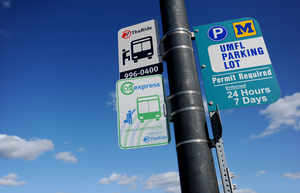
A2Express sign on a post at a bus stop at near the University of Michigan Cancer Center on Friday afternoon. AATA is taking a more regional approach to public transportation.
Melanie Maxwell I AnnArbor.com
“Much of this discussion took place 20 years ago when I was on the board,” said former member Marlene Hurst. “In each case, we were stopped or slowed by the lack of funding.”
Bernstein said that's why the current board decided not to talk about money in the master planning, for now.
“Because we are looking at 30 years into the future," he said. "If you don’t know where you’re going, how can you get there? We’re trying to show a different model.”
The AATA also is looking at a change of governance. Its current charter limits it to directly serve the City of Ann Arbor, and it provides regional services to other communities through pay-for-service.
To carry out the regional vision, the AATA would likely need a charter change, Bernstein said.
Funding issues
Yet money has to come from somewhere, said former AATA board member Thomas Fegan. Townships lack the ability to raise significant property taxes, he said.
“If you knew better what people would be willing to pay for services, that would help you narrow down options,” said former board member Larry Miller.
Bernstein said that's part of the Phase II options segment of the master plan process. “The consultant will ask what people would be willing to pay for," he said.
Former member Steve Thorpe suggested tax increment financing — paying for bonds with increased tax revenues created by development — for businesses along transit corridors that would benefit.
“It takes the burden off the general population,” he said.
Bernstein said when he was the CEO of Ann Arbor's chamber of commerce, developers were willing to foot the bill for stations and transit hubs if they're in areas where developers want to build.
The goals formulated so far in the plan are: to support economic growth by improving access to labor markets; promote livability by preserving green space with high density development along transit corridors; improving accessibility for people with limited financial means; protecting the environment by reducing cars on the road; and improving safety for riders.
The agency has also set up a website at movingyouforward.org where the public can weigh in on the plan. For a complete list of the public meetings, visit movingyouforward.org/get-involved/public-meetings.
Ned Randolph is a freelance writer for AnnArbor.com. Reach the news desk at news@annarbor.com or 734-623-2530.
Comments
AlphaAlpha
Fri, Oct 8, 2010 : 8:47 p.m.
Thank you Ms. Stasiak - 1. Since the 21% is attained with 'federal formula grant funds', the assertion that actual rider paid fares cover 15.2% of costs is correct. Recap: bus users only pay 1/6 of their share of costs. This is a problem. Your own survey shows essentially all riders could find other transportation if there were no bus. Should non users to pay for users? Many believe they should not. 2. Looking at page 25 of the document you cite we see total 2008 wages and fringe benefits for all 190 employees totaled $15,258,720; that $15,258,720 shared by 190 people works out to $80,309, the same as stated much earlier. Henceforth, let's be honest and clear, and report all the compensation... Recap: $80,300 per year average total compensation for each AATA employee. 3. Your claims of reducing pollution are suspect, as well. Your report shows your buses burned over 1.8 Million gallons of fuel in 2008. Wow. Here is a headline: "AATA burns 5,000 gallons of fuel every single day!" 1.8Mil into 6 million rides = 3/10 gallon per rider. Not too thrifty. So, 1. unfair revenue structure; 2. overly generous pay scheme; 3. fuel use way more than expected. Address these issues, and AATA will have a great future.
True
Thu, Oct 7, 2010 : 12:56 p.m.
I'm going to stay out of the middle of the existing financing issue since I haven't read up on the numbers. One area that could, and should, be introduced/improved is the addition of express transit of one sort of another (Rail, Bus, or Street Car) from park and ride style lots or, better yet, satellite terminals located at the outskirts of town. These services would be for commuters and would separated from the slower existing infrastructure that services those who need to the bus to come closer to their place of residence or destination. Currently taking the bus from the Ann Arbor Saline Meijer or Plymouth Road lots to downtown takes approximately 45 minutes instead of the 10-15 minutes it takes to drive in light traffic. If AATA wants commuters who have options to take public transit (and they should) then they have to make the options more appealing. A dedicated lane for buses or street cars, High Occupancy Vehicle lanes for buses and car/van pools, or a Rail line would make public transit as fast or faster than driving through traffic and then people would be willing to pay more and leave their cars outside of the city. This benefits everyone for the reasons others have mentioned of cleaner air, less parking structures, less traffic, etc. The key is making an express system that is attractive to commuters and visitors...if we can do that people will pay for it.
Mary Stasiak
Thu, Oct 7, 2010 : 7:12 a.m.
AlphaAlpha and others, Here is more information about the discussion regarding rider fares. The fare ratio of 21% for fixed route service includes Federal formula grant funds earned by the UM bus system and received by AATA in the amount of $1,194,360 in 2008. These funds were applied to the MRide agreement as fares for rides taken by UM faculty, staff and students. The funds are included as federal revenue in our accounting records. This information can be found on page 24 under Federal Non-Operating Revenue/Preventive Maintenance of our FY 2008 audit report at http://michigan.gov/documents/treasury/817548AnnArborTransportationAuth20090416_275373_7.pdf UM uses the Federal formula grant funds they earn to pay the fare for students, faculty, and staff on local, fixed-route service. In 2003, before MRide, UM riders were about 32% of AATA ridership. Since that time, the number of UM rides has increased by 72% to more than 2.3 million rides per year and 40% of AATA ridership. During the same period, Non-UM rides increased by 27%. The MRide program has proven to be beneficial to TheRide, UM and the Ann Arbor community in the following ways: Increased the use of transit service by University students, faculty, and staff Reduced demand for parking and the need to construct additional parking Increased productivity and cost-effectiveness of TheRide's transit service Provided for the operation of additional public transit service Reduced total vehicle miles travelled in Ann Arbor Reduced transportation emissions Increased sustainability of transportation Increased housing options and access to the community Reduced the cost of travel and parking costs for staff and students Increased transportation equity In addition, we can expect a reduction in emissions such as carbon monoxide (CO), volatile organic compounds (VOC) and oxides of nitrogen as a result of increased and continued transit use by UM faculty, staff and students. The estimated reductions are as follows: Carbon monoxide (CO) - 75,413 kilograms Volatile organic compounds (VOC) - 5,915 kilograms Oxides of Nitrogen (NOx) - 3,608 kilograms
Mary Stasiak
Wed, Oct 6, 2010 : 3:18 p.m.
AlphaAlpha and others, Here is more information about the discussion regarding rider fares. The fare ratio of 21% for fixed route service includes Federal formula grant funds earned by the UM bus system and received by AATA in the amount of $1,194,360 in 2008. These funds were applied to the MRide agreement as fares for rides taken by UM faculty, staff and students. The funds are included as federal revenue in our accounting records. This information can be found on page 24 under Federal Non-Operating Revenue/Preventive Maintenance of our FY 2008 audit report at http://michigan.gov/documents/treasury/817548AnnArborTransportationAuth20090416_275373_7.pdf UM uses the Federal formula grant funds they earn to pay the fare for students, faculty, and staff on local, fixed-route service. In 2003, before MRide, UM riders were about 32% of AATA ridership. Since that time, the number of UM rides has increased by 72% to more than 2.3 million rides per year and 40% of AATA ridership. During the same period, Non-UM rides increased by 27%. The MRide program has proven to be beneficial to TheRide, UM and the Ann Arbor community in the following ways: Increased the use of transit service by University students, faculty, and staff Reduced demand for parking and the need to construct additional parking Increased productivity and cost-effectiveness of TheRide's transit service Provided for the operation of additional public transit service Reduced total vehicle miles travelled in Ann Arbor Reduced transportation emissions Increased sustainability of transportation Increased housing options and access to the community Reduced the cost of travel and parking costs for staff and students Increased transportation equity In addition, we can expect a reduction in emissions such as carbon monoxide (CO), volatile organic compounds (VOC) and oxides of nitrogen as a result of increased and continued transit use by UM faculty, staff and students. The estimated reductions are as follows: Carbon monoxide (CO) - 75,413 kilograms Volatile organic compounds (VOC) - 5,915 kilograms Oxides of Nitrogen (NOx) - 3,608 kilograms
local guy
Wed, Oct 6, 2010 : 1:48 p.m.
If you're looking just at retail fares, it may be 15%, but AATA has other fare revenue -- i.e., MRide, GoPasses, etc. These are fees for rides and should count in the fare tally. When it is, the percent is 21%. I'm not sure what the riders' fair share is, as you put it. The community, employers, businesses, etc., all benefit from the transit system, just as they do benefit from schools, roads, libraries, police, etc. One could argue that fares should be zero. That's extreme. By making the riders pay 90% of the cost of the system (particularly since the system is more than fixed routes, it's also special services for seniors and the disabled, park and ride lots, and others that I'm sure I'm just not familiar with) is also extreme. By making riders pay a reasonable fee in addition to their taxes, etc., in the range currently charged, is reasonable, I believe. If service were more widely available and more frequent, then paying a bit more would be reasonable, too. I also bet there are other novel concepts for fare structures available, as well. Hopefully, if there are any good ones, it'll make it into the plan.
Mary Stasiak
Wed, Oct 6, 2010 : 1:45 p.m.
Last night TheRide held the first of 20 public meetings across the county to gather ideas and to create a shared vision for public transportation. The first meeting was held in Chelsea where 18 residents conveyed their ideas for the future. Here are some comments from the meeting: A train stop into Chelsea with connections to Ann Arbor, Metro Airport and other locations Service from Chelsea to St. Joes, Dominos Farms and to smaller employers Add a Park & Ride in Chelsea Train and light rail service is critical Work with employers to educate them on transit options Its exciting to see AATA broaden its scope beyond buses Improve the safety at the Chelsea Carpool Lot, there is no way to get across the street Add heat at the bus stops Connect with Jackson County Add trips to A2express-Chelsea service to accommodate more work schedules Make transit services flexible to accommodate more than work trips The service using the WAVE and connecting to TheRide takes too long People need to be educated that there is nowhere in the world where the transit system is paid for by the fare boxes. Even the car is subsidized by the government. The auto infrastructure is unsustainable We are a two-auto family because we have two different shifts. But transit has to be more convenient before I can drop a car. Parkland is important but youre not going to find a better spot than Fuller Road Station Increase bicycle racks on the buses Involve the Road commission to improve bicycle amenities Encourage everyone to watch An Inconvenient Truth to see other possible transportation solutions. Its a systems problem we need to solve. We had more options in the early 1900s than we do now. Please join the conversation tonight at the Ann Arbor District Library-Downtown from 6 p.m. - 8 p.m. Here is more information about some of the questions that were raised earlier: Compensation Information: All governmental units in the State of Michigan are required to submit their annual audits to the Michigan Department of Treasury. These audits are available on the web in.pdf form. Go to www.michgan.gov/treasury, click on Local Government Services, Click on Local Unit Audit Reports, Click on the Year, then the County. The compensation numbers are from the AATA FY 2008 audit, page 25 and can be located at http://michigan.gov/documents/treasury/817548AnnArborTransportationAuth20090416_275373_7.pdf The total wage figure includes $4,789,899 for Operators (bus drivers) and $3,233,443 for everyone else. Wages also include Fringe Wages for sick, vacation and holiday pay. MDOT requires transit agencies to reclassify these as Fringe Benefits, and they are listed separately on page 25. The same information is available from FY 2009 audit, also on page 25 at http://michigan.gov/documents/treasury/817548AnnArborTransportationAuth20100323_315871_7.pdf
Milton Shift
Wed, Oct 6, 2010 : 11:15 a.m.
Do you really think that the cost of a 1 mile bus ride is 7 bucks?
AlphaAlpha
Wed, Oct 6, 2010 : 10:38 a.m.
KenUM - Many good points. We all care about public appropriate transportation. In the new Age of Austerity, many previous assumptions will be questioned. We are not as wealthy as we were; there will be lowered living standards. Localguy - The 8% value was based on nominal fares, not all fares. If we include every form of fare shown on p. 24 of the financial report, total fare revenue in 2008 was $4.2 million; total AATA expenses shown on p.25 were $27.6 million; thus all manner of fares actually provided all of 15.2% of costs. Raising fares seven fold would allow riders to pay their fair share costs. As far as expertise is concerned, just have a look at the documents; the costs and expenses are all there; it's straightforward to deduce many facts from such observation. AATA's unreferenced numbers (e.g., 21%) were challenged; their silence is deafening. Should we just "Take their word for it"? Many think not.
Tom Teague
Wed, Oct 6, 2010 : 10:07 a.m.
@AnnArbor.com -In the future, could we commenters request a little context when you publish financial figures? For example, from my reading at the US Census site, it appears that the Washtenaw County Median Income figures you published do not include fringe benefits but instead are an amalgam of net income sources including salary, rents, alimony, etc. If so, Ms. Stasiak's exercise of removing the fringe package before calculating AATA's average salaries seems to be the correct route to comparing oranges to oranges. In the past six months, we've seen various commenters cite figures for average US salaries, Per-Capita County income, Ann Arbor Median Income, County Median, the city's total compensation costs, etc. The effect is dizzying and it would be great to have some basis of common understanding about these figures. Please help. I'd like to add that from my years of negotiating dozens of new-hire salaries for a very successful private-sector business, that we used a large amount of data to set those levels. The locally adjusted benchmarking approach, similar to what Ms. Stasiak outlined, was the most useful. I never once began a conversation with a prospective hire or my bosses by citing a single, diluted data point such as the average or median salary for every working person in the region.
kenUM
Wed, Oct 6, 2010 : 6:36 a.m.
If I may inject an interesting what if? to this discussion. I doubt that anybody has considered just how dependent the AATA has become on 3rd party financing. I think all of us are in agreement as to the importance of Public Transportation. To that end; the argument appears to be how to pay for it. What if U-M and the DDA decided to withdraw funding from the AATA and terminate the M-Ride and Get Downtown program? Would this not have a devastating affect on the current AATA service? Looking at this from the perspective of who pays and how much, would AATA not be forced to undergo massive service cuts, or a phenomenal fare increase to the point that many folks would not be able to afford the bus ride? One of my points that I was attempting to make, is how do we finance any new Public Transportation System realistically when setting up any 30 year wish list. Monorails and fixed guide ways and trolleys are exciting and some say sexy, but how affordable are they? Both AlphaALpha and local guy make interesting and valid points, it does not appear that anybody has resentment towards Transit. However, as a tax payer, I am concerned with rising costs, taxes and the fear that I may loose my house because of increased taxing issues. My salary is struggling to keep up as it is now. As the economy worsens, we are increasingly ask to vote for this and that; just look at the November ballot. So any figure that is based on user fees vs. tax money becomes important to me, and apparently to others.
local guy
Tue, Oct 5, 2010 : 10:03 p.m.
The 8% figure is your figure and is not based on any accepted way of calculating costs. I don't know what gives you the expertise to say that your assumptions for calculating costs are correct. AATA has shown in its response to you and on its website that fares account for 21% of the cost of the ride. Fares as a percentage of operating expenses make sense. Your number is likely accurate as a mathematical matter, but I'm far from convinced that it's a proper way to measure the issue; instead it's merely a way to come up with a number to support your conclusion (i.e., the end justifies the means). The federal, state and local governments have standards for reporting data and expressing the costs so that the numbers are consistent and include the same costs when building budgets, doing studies, etc. I defer to their standards for comparison. I'm sure we could come up with ways to show that highways cost more or less or that military operations cost more or less, but the accountants and other experts try to adhere to basic standards when they publish their information. You're entitled to your opinion, but it doesn't appear to be an accepted way to analyze the issue by any standard other than your own, it seems. Frankly, it seems like a Glen Beck trick to me; say it loud enough and often enough with a tone of indignation and it must be right. Simply put, x dollars per mile means nothing when you look at the cost for the service overall. Fares are not based on miles driven, but rather on service provided and are a means to cover costs. The goal of a transit system is not to provide a certain number of miles of service, but rather a certain amount of service. By the way, do you know how much it costs to resurface a road, per mile? I'm not a finance guy, but I'm not sure why we should assume your numbers make sense? Perhaps you should look at the numbers AATA has published and provided (i.e., the 21% number) and show how it's wrong. By the way, don't you have anything else to do? Again - take care and sleep well.
AlphaAlpha
Tue, Oct 5, 2010 : 9:19 p.m.
"the fact is that fares account for 21% of the cost for a fixed route ride" How do you figure that? Sources for the 8% value were cited above.
local guy
Tue, Oct 5, 2010 : 8:57 p.m.
Dear AlphaAlpha - Sorry you're bent on fighting the facts and distorting them towards your end. You seem to ignore that AATA responded to a number of the issues raised here and for some reason you're still stuck with the 8% argument when the fact is that fares account for 21% of the cost for a fixed route ride. I know you think it should be 90%, but there are really few public services which are so supported by the revenues generated by the users of the services. Public schools are one example. Objectively, there are many ways that public transit adds value to communities. In fact, I doubt that there is a vibrant economic center/city in the US that does not have and value its transit system. Our challenge is to find ways to pay for what is needed to take our community/city/state to the next level. Express lanes in lieu of a transit system is not the answer (and since I rarely use the highway, why should I pay for express lanes -- at least that seems to be your point). Most employers pay for parking and would be delighted to not have that burden. They either subsidize parking at public lots downtown, or build and maintain their own parking lots. And if you ask anyone at the DDA what it costs to build a parking structure above ground, I'm sure the number will hover around $35k per spot - spots that are empty more than half the day. If you want to know what it costs per spot underground, make sure you're sitting first. It's a huge burden. Let's not debate the issues here further because, frankly, none of us have sufficient data to make a fully informed judgment. We obviously know some of the issues, but we need more facts -- or at least the policymakers need more facts. We can express concerns, but we should also keep an open mind. The pros are gathering data and applying real facts and figures, and I'm not so cynical to suggest that their motives are contrary to the public interest. They will have some tough decisions to make and we may be asked to vote on their findings and proposals if they require major funding. I just can't speculate as to what they will come up with, but I think it is critical for us to have a plan and develop a coordinated transportation system (of which public transit is only a part) will be make sense to the generation which inherits it. In sum, let's not say no because it's easy. Let's understand that others need or at least benefit from these systems, and that some day you or I may be in a predicament in which we will need to depend on public transit to work, get health care, go to the game, etc. Instead of saying no, let's try to understand the issues and offer solutions. Take care, and good luck to you, too....
AlphaAlpha
Tue, Oct 5, 2010 : 8:31 p.m.
Good point, Mr. Shift. The financial numbers used came from the cited documents; you may well be correct, as the docs don't get overly specific on details; they simply show total income, total expenses, etc. If this government op is like many, it is likely the books as presented are less than entirely accurate, and typically the errors favor the agency. Wouldn't it be something if the AATA expenses are understated, and income overstated? That might be newsworthy albeit not unusual.
Milton Shift
Tue, Oct 5, 2010 : 8:21 p.m.
@AlphaAlpha You cannot assume that they rolled passes from employers and money from UM into the accounting for fares! Fares are paid once on boarding for one ride exactly. They are not going to be rolled together. If this were not accounted for separately, the numbers would suggest the real cost of a ride on the bus is over $10.
AlphaAlpha
Tue, Oct 5, 2010 : 8:19 p.m.
"I'm amazed that some folks have such resentment for public transit." They don't resent the public transit, they resent a very unfair method of paying for it. As stated, riders only pay 8% of their fair share. Non riders pay the rest. The many paying to benefit the few? Now, that's amazing. "-If we can lessen road use [...] we'll save tons of tax dollars and will be able to support public transit with those savings and still have funds leftover." Hasn't worked yet; expect more of the status quo "(I seem to recall each spot in an above ground lot costs over $35k, but I bet that's a low figure)" Ludicrous. Just call any paving company for a quote. Open minded is good, until parts fall out. "Public transit saves employers money" Most employers do not pay for employee parking. "many employees need transit to commute." Read the AATA documents: virtually 100% of riders said they'd be able to find non-bus alternative transportation. "they will save thousands of dollars on fuel and wear and tear on their vehicles" Then maybe they could pay their fair share of the ride cost? How about 92% instead of 8%? "-Wouldn't it be nice to have a less expensive way to get to the airport or Tiger's/Lions' or a concert? " It's not less expensive, unless of course you get non users to help pay your share of the fare. "maybe I'm somewhat biased" It's OK to be biased for what you believe in, but you owe it to yourself to get a better picture of the financial realities of things. Little of the world is as it appears; too many 'think' instead of 'know' Good luck. All - Wouldn't you think a responsive AATA would have had a greater presence here for this story? Their significant silence may be due to the likelihood that AATA already has a plan they wish to promote and pursue, with the 'public input' period merely an annoying formality. It's a common trick; it keeps the customers feeling they play a role.
local guy
Tue, Oct 5, 2010 : 3:11 p.m.
I've been following this discussion and wish to contribute a few points for consideration.... First, the planning issue is not "what kind of public transit we want," but rather, "what kind of transportation do we need and want." Perhaps this means no public transit, perhaps it means privatized operators, perhaps it means a combination, perhaps it's just the status quo, perhaps it means privately funded express lanes on the highways; perhaps it means some rail. My understanding of the article and the project is that AATA is seeking input as to what we envision we need and want, and then it will turn to what options are available to us to meet those needs and wants. The needs out-county may be different than those in the urban areas; seniors may have different needs than commuters; etc. The point is, we will never efficiently or effectively satisfy those community needs and wants unless we plan and coordinate those efforts. I certainly do not have all of the answers, and I doubt anyone does since no one knows all of the needs and issues. I'm pleased that AATA is taking this on. Public transit is much more than busses. Second, I'm amazed that some folks have such resentment for public transit. In that regard, I appreciate those who pointed out that the roads aren't busy all day long, nor are parking lots full all day, and there are plenty of roads and lots that I never use but understand that there are reasons my tax dollars support them. But let's step back a bit and look at the bigger picture. -If we can lessen road use, or require fewer roads to be widened, etc., we'll save tons of tax dollars and will be able to support public transit with those savings and still have funds leftover. -If fewer people drive to work, we'll need fewer parking lots. Parking lots cost millions (I seem to recall each spot in an above ground lot costs over $35k, but I bet that's a low figure), plus they take land off the tax rolls (at least in A2 where they're mostly public owned). Why are those who don't use those lots paying for them, particularly when they're empty for mor than half the day? Anyway, if we built fewer lots (the City and U of M, in particular), then we'd save the multi-millions it costs to park a few people and we'll collect more taxes on land (or put land to more productive uses). With a good public transit system, this becomes possible. -Public transit saves employers money, if their employees can get to work using it, since the employers will not have to pay for or provide parking (in city lots or lots they have to build). -Public transit helps employers and their employees since many employees need transit to commute. -Being on/near a bus route enhances property value to home owners, apartment owners, and businesses. -If people use transit on a fairly regular bases (not necessarily daily), they will save thousands of dollars on fuel and wear and tear on their vehicles, as well as no longer have to pay for parking. I think the studies show that households, even households which have a car or two, net savings between $5k and $10 per year when there is some regular use of public transit in the household! -The more people who use transit (i.e., buses, trains, etc.), the less congested will our roads become (and therefore delay or eliminate making them wider or adding new roads/highways), and the cleaner will be the air we breathe. -Wouldn't it be nice to have a less expensive way to get to the airport or Tiger's/Lions' or a concert? -Isn't it in our interest to at least consider how we (that is, all of us in the community even if we don't need it ourselves) can better move through our region and not be bound by artificial political boundaries? Let's think about these issues and keep an open mind about what we need to better connect one community to the other (for commutes, health care, school or entertainment), as well as how to better meet our needs for navigating through our own communities. I'd like to find a better way to get from one end of A2 to the other in a reasonably quick manner. I'm glad we have businesses and the U of M recognizing that there's value worth paying for to enhance our transit system -- but do we need more or less? I'm not at all bothered when I see an empty bus because I know that bus may be at the end or beginning of the volume within its run or that it's packed during rush hours, student class changeovers, etc. I also know that if we're to be a vibrant city and not just a bedroom community, we need to have density and ways for people to live here without themselves, their employees, their kids, etc., being limited by a need for an automobile and place to park. Yes, maybe I'm somewhat biased towards accepting the fact that public transit plays an important role, but that does not mean that I know what it should look like 10, 20 or 30 years from now. That needs review, from both a service and financial perspective. If we conclude that we can't afford or don't want to pay for more, so be it. But we shouldn't reach that conclusion by avoiding it. Let's confront it and provide AATA our input by writing here or attending these meetings they're holding all over the region. Thanks for reading this. I didn't mean to go on and on, but I'll stay quiet now. My key point, though, to those who think they're unjustly subsidizing a few riders, is to remember that those subsidies help more than just those riders.... they help all of us and ultimately serve to enhance our communities (both economically and environmentally), and save us money overall (both our governments and ourselves). We can't just say that use of taxes are bad when we see no direct/personal benefit, otherwise we'd have no schools (since not everyone has kids), no libraries, no military, no roads, etc. Government can't be everything to everyone, but everyone has some gain from these resources -- though these gains are often indirect. I'm not critical of the debate, but at this stage it need not be a debate. Instead, it can be expressions of what we'd like to see, what are our needs, and then how can transportation planning make life here easier and better. Thank you AATA for making this discussion possible. I do hope that it results in a meaningful and realistic plan. That's it for now.....
kenUM
Tue, Oct 5, 2010 : 9:37 a.m.
One point that Ms.Stasiak has failed to mention, is that the increase in ridership of 40% can be directly attributed to the M-Ride program that U-M pays more than $2 million per year; just so that Students, Faculty and Staff can ride services ALREADY in place. Additional funding is payed by the DDA for the Get Downtown program. Unfortunately, I do not have the DDA's financial amount paid to AATA handy for this program. As far as the fare increases go, while I do not have the documents at hand, the fares were increased mainly in order to maintain the Football Shuttles and Art Fair Shuttles due to Federal guidelines that restrict fares being charged for what amounts to Charter service. It would also appear based on minutes from previous board minutes (and I believe that Ms.Stasiak made mention to these items) that this was also put in place in order to get U-M to pay additional monies for the M-Ride program. These items were discussed at length during the board meetings when the fare increases were being discussed. One scenario was a free fare system for the AATA, this was quickly discarded as U-M and the "POSA" partners would likely stop making payments to the AATA. It appears as though we are paying double tax to AATA because of what U-M and the DDA pay to AATA, (we pay tax money for U-M and the DDA). These programs have not made the AATA more convenient to use. Former Board member Ted Annis pointed out repeatedly that U-M's bus system carries more passengers and operates a longer service day than AATA for half the price. Because of this and lets face it control issues, it does not make sense for U-M and AATA to be merged as Stephen Lands suggests. This is the same reason for the School bus consolidation. The cost per service hour is just prohibitive.
jns131
Tue, Oct 5, 2010 : 9:18 a.m.
Maybe we should do what some cities are already doing. Make older children take a public bus to school and elminate the hi school run? Might work over all and create a better income for AATA and reduce the need for school buses. Heck mine takes AATA over a school bus any day and we know what time the AATA will show up versus a late school bus that gets them late into school. Just a thought.
AlphaAlpha
Mon, Oct 4, 2010 : 9:40 p.m.
Mr. Landes - You may be on to something. Why not recommission the AAPS buses to be AATA buses during non school hours? Cheaper all around, likely nostalgic for the riders, as well. A school bus is could be a welcome alternative to walking. Mr. Shift - One can only assume your concerns were addressed by AATA in their cited financial documents. Ms. Stasiak - Thank you for your timely response. Much of your lengthy comment was cut and pasted from the cited documents. Regardless, it would be nice if you could directly address some of the points made here (e.g., riders only pay ~ 8% of the cost of a fair; $10 / mile, etc.), in addition to citing the usual PR related information. Also, please cite a source for your compensation numbers? The documents cited were the source for the commented numbers above. "The findings of the analysis identified that TheRide compares favorably to its peers..." Standard PR studies...no surprises when an organization commissions a study and finds-surprise-the organization is doing very well. No surprise at all. The problem, Ms. Stasiak, is the exorbitant cost of the services provided. The services are too expensive for the value received, to all but the riders, that is.
TripleVSix
Mon, Oct 4, 2010 : 5:04 p.m.
There needs to be a bus route that encircles the city. It's nuts to have to go downtown and switch buses in order to go, for example, from the southwest to the south side of town.
Mary Stasiak
Mon, Oct 4, 2010 : 3:53 p.m.
A response from TheRide in order to clarify several points: TRANSIT MASTER PLAN: It is important that the Transit Master Plan for Washtenaw County be a peoples plan and that the services TheRide provides in the future are those that meet citizens needs and that they are convenient, economical and are supported even by those who do not use them. We dont want this to be TheRides plan, and we dont want it to just sit on a shelf. We truly want all of Washtenaw County to make this plan their own. Thats why its important that the public meetings are as widely attended as possible. SERVICES: It is important to point out that TheRide provides many different services including fixed route, door-to-door (a.k.a. demand response) services for seniors and individuals with a disability who are unable to use fixed route services, late night shared-ride taxi services when fixed route services are not available, carpool and vanpool matching services, not to mention, Park & Ride lots. For comparisons sake, fixed route services are the least costly to operate while door-to-door services are typically the most expensive. FARES: In addition, TheRide has taken major steps to make sure that riders pay their fair share. TheRide has seen fixed-route ridership increase by 40 percent over the past four years and demand for its door-to-door services increase by 17 percent over the past three years. Fares paid by riders have been increased twice in two years. Fares represent one part of the costs to operate the service. Fares cover 21 percent of the cost on fixed-route service and 12.8 percent on the door-to-door services. SALARIES/FRINGES: Another area TheRide management has focused on over the past several years is in controlling the costs for fringe benefits. Its important to note that the total compensation in 2008 represents wages of $9,818,839 or $51,678 per employee and fringe benefits of $5,438,881. In 2008, TheRide converted its Defined Benefit Post Retirement Health Care Benefits to a Defined Contribution Health Care Savings Plan and in doing so reduced its unfunded $10.5 million liability to only $2 million, saving this difference over the next 20-25 years. EVALUATION: In an effort to evaluate the efficiency and effectiveness of services provided by TheRide, an internal organizational review and peer analysis was conducted in 2009. Twelve peer transit systems were identified and compared to TheRide. The transit systems were chosen based on their similarities to TheRide in 1) total operating expenses, 2) number of passengers carried and 3) miles of service provided. In addition to these criteria, other important factors considered were whether the peer transit agencies operated in a university community and whether the agencies faced a similar funding and economic environment. The peer systems chosen for the analysis were located in Durham, NC; Grand Rapids, MI; Kalamazoo, MI; Lansing, MI; Lexington, KY; Little Rock, AR; Madison, WI; South Bend, IN; Syracuse, NY; Tallahassee, FL; Toledo, OH; and Urbana, IL. The findings of the analysis identified that TheRide compares favorably to its peers in the areas of controlling increases in expenses, increasing ridership and providing services beyond the requirements of the Americans with Disabilities Act (ADA). The analysis also showed that TheRides financial and operating statistics are within expected ranges of those of its peer systems. In terms of total operating expenses, management decisions over the past several years have resulted in controlling costs so that the average annual rate of increase is about 1.4%, or well under inflation while the average peer system experienced cost increases of 4%. The peer review also identified that the cost per service hour for fixed route service is virtually the same as the peer average when adjusted for Regional Price Parities that reflect the overall costs of living in urban areas across the country. In terms of ridership, TheRide surpassed the peer group average in 2008. The rides per hour on fixed route service increased from 22.8 passengers in 2003 to 31.2 in 2008, when it became 4 percent higher than the average. Over that five-year period, TheRides bus ridership increased from four million to 5.9 million passengers. At the same time, the cost per fixed route ride decreased from $3.39 in 2003 to $2.37 in 2008, or at an average annual decrease of more than 5.4 percent. TheRide welcomes all Washtenaw County residents to attend our upcoming public meetings and share ideas to make the Transit Master Plan the best possible plan for countywide public transportation.
SonnyDog09
Mon, Oct 4, 2010 : 1:57 p.m.
"tax increment financing" means the creation of yet another bucket of money. The city will then complain that there is not enough revenue available to fund essential services like police and fire.
Milton Shift
Mon, Oct 4, 2010 : 10:30 a.m.
AlphaAlpha, have you taken into consideration that UM students don't pay fares because of subsidies given by the University of Michigan? They're a huge percentage of riders. Also a lot of employers get their employees passes so they aren't paying boarding fares either. So, the fact much of the money doesn't come from fares doesn't mean riders aren't paying for it indirectly. I hope you're taking this into account. Either way, be glad that some people are actually willing to ride that slow moving nausea cruiser; traffic and parking would be even worse without it.
jns131
Mon, Oct 4, 2010 : 9:11 a.m.
AATA has to re think that stop at Scio Church and Oak Valley. There are no stops on Oak Valley which there should be and this stop eliminated. You know how dangerous this stop is? I wish mine could use that library but I am terrified my child will get hit by cars that go 45 over that bridge. Yicks! AATA? Re think that stop and make it safer.
Stephen Landes
Sun, Oct 3, 2010 : 9:38 p.m.
Even with the move to consolidate school buses under the intermediate school district we still have three bus systems in A2 -- that cannot make sense. It seems to me that the first step should be to get ourselves to one bus system for the city, university, and public schools.
AlphaAlpha
Sun, Oct 3, 2010 : 7:36 p.m.
Hello foobar417 - Sincere curiosity prompts this simple question: How do you "factor in the societal costs"? And, what are those "societal costs"? In 2008, each bus cost over $10 for each mile it moved; doesn't that seem a bit high, in terms of actual cost?
sbbuilder
Sun, Oct 3, 2010 : 7:36 p.m.
foobar417 The data that AlphaAlpha supplied is anything but anecdotal. Those are hard numbers. Comparing roads to bus service is a great example of comparing apples to tangerines. If bus service completely went away, some people would experience a minor problem, some (a very few) a major problem, and for the rest of us, no problem at all. But if we did away with roads, I would imagine that that would put a major crimp in everyone's day. Hmmmm? May I ask what level of subsidy you would be comfortable with for a public service, such as AATA? Currently we are around 92%. If bus service expands, as proposed, that subsidy would most likely go even higher. At what point does a subsidy become untenable? Personally, I believe that the current level is much too high. It should probably be in the 45-55% level, if it were truly the vital public service that it touts itself to be.
foobar417
Sun, Oct 3, 2010 : 6:04 p.m.
How about... "We're all being taken for a ride by heavily subsidized (you and me) types of highways and roads that somehow make its sponsors feel good. Saw a road yesterday that had exactly ONE car...where had it come from and how much did the trip cost us? MDOT and Washtenaw Roads Commission have way too much money." "Thinking about people who rely on other parts of government infrastructure vs. selfish myopia" I believe is what defines liberals and conservatives. Get government out of what should be a private matter (roads). " Oh wait, let's pretend that gas taxes pay for all roads, wars to maintain the supply of oil, the hiddden costs of sprawl, and that the poor can all afford their own personal automobile. I know, let's pretend knee-jerk anti-government anything is "thinking." I'm no believer in government efficiency, but there are some areas where government is necessary, and public transportation is one of them. Just because you anecdotally saw one random empty bus doesn't mean public transportation is useless. If public transportation only runs when it would be full, then less people will use it, and the vicious cycle continues. If public transportation runs all the time, everywhere, then more people will use it, and the virtuous cycle continues. Public transportation is only "heavily subsidized" if you look at fare revenues. If you factor in the societal costs it reduces (e.g. sprawl, pollution, energy), then it is very cost effective.
packman
Sun, Oct 3, 2010 : 5:48 p.m.
We're all being taken for a ride by heavily subsidized (you and me) types of public transport that somehow make its sponsors feel good. Saw a bus yesterday heading east on Scio Church at the corner of Scio Church and Oak Valley Drive. I was stopped...the bus had exactly ONE passenger...where had it come from and how much did the trip cost us? AATA (and AADL) have way too much money. "Feeling vs. thinking" I believe is what defines liberals and conservatives. Get government out of what should be a private matter.
AlphaAlpha
Sun, Oct 3, 2010 : 3:57 p.m.
You are welcome, sbbuilder. Another look at the same documents reveals AATA spent $15,258,720 on 190 employees in 2008, which means the average total compensation if each employee was just over $80,300 per year. Likely the employees have had additional raises since then; regardless, $80,300 per year compares nicely to the $54,603 median county income reported by Mr. Jesse 2010-09-30. The bus folks are earning about 147% above county median. Are they taking taxpayers for a ride?
DFSmith
Sun, Oct 3, 2010 : 3:22 p.m.
I would like to see the AATA improve its services within the City limits of Ann Arbor, maybe offer buses running till later on at night, and see buses run more frequently on existing routes. Then, after making the AATA and its services more relevant for, and more efficient for the citizens of Ann Arbor, should they try extending services to towns outside Ann Arbor. For example, the #2C route runs once an hour during the day, and they end service early in the evening. Essentially, they have designed the route in a manner that acts as an disincentive to those Ann Arborites in that part of town.
sbbuilder
Sun, Oct 3, 2010 : 1:07 p.m.
Thank you AlphaAlpha for the numbers. I think the starting point for discussion should be to determine what percent a public service should be subsidized, and then stick with that. Right now, it's at 92%. I'm not sure how that compares to other municipalities of like size, or even smaller or larger ones. At some point you have to draw the line and say that a particular service has to generate a certain percentage of its operating costs. I don't think that has ever been determined for AATA.
AlphaAlpha
Sun, Oct 3, 2010 : 12:23 p.m.
Yes, AATA is very heavily subsidized by non-riders. Riders are paying only 8% of the true cost of their rides, and a lucky few are greatly rewarded by the many: The 2009 AATA Onboard Report states: "Only 11% of all riders account for 59% of all trips because they make twenty or more trips per week." A look at the budget numbers in the 2008 Financials document shows over $25 million spent on nearly 2.5 million bus miles yielding a cost of $10.30 per mile, with rider fares contributing only $2 million, or $0.81 per mile. Recap: riders pay less than 8% of their bus ride cost. The same Onboard report states these riders had other transportation options, were there no buses. That means a lucky few are unduly benefiting from the many. Perhaps the entire system should be replaced by existing, cheaper private transportation; at the very least, fares should rise dramatically.
Keepsitreal
Sun, Oct 3, 2010 : 11:40 a.m.
We need more public transportation, I'm all for it!!!!!
mike from saline
Sun, Oct 3, 2010 : 11:22 a.m.
@demistify "even though they have more to gain than the City of Ann Arbor" Oh yea, and what would that be?
kenUM
Sun, Oct 3, 2010 : 11:16 a.m.
@demistify Good point, that makes me curious as to how we are going to pay for this, with talk of the County wide Transit millage. We pay 2 mils now for AATA, I had information that this was to be financed through another 1 mil Property tax. If successful, will be paying 3 mils or does the original 2 mil tax disappear; leaving us with just a 1 mil tax? Now that Ypsi is going to have a Transit issue on the November ballot would they also be in the same situation paying additional taxes to support the Transit millage. How likely is any of this to become reality, 30 years..........things change!!
demistify
Sun, Oct 3, 2010 : 10:06 a.m.
The AATA is a City of Ann Arbor agency, heavily subsidized by city taxes. It has long had ambitions to extend its services beyond the city. The jurisdictions it seeks to expand into have shown little inclination to pay their fair share of the cost of these money-losing extensions, even though they have more to gain than the City of Ann Arbor. Until a way is found out of this systemic impasse, blue-sky planning is a waste of time.
jns131
Sun, Oct 3, 2010 : 9:43 a.m.
We are finding out that by using AATA for our child, she uses this to get to school faster then a school bus, saves us money on not having to wait an hour for ours to get to school. By the time the school buses are up and running ours is already heading to school via public transit. Once hi school hits she will take AATA permanently. I remember taking AATA from my parents house to WCC and EMU. Great job Ann Arbor. A Canton run? Wow. Wish there was one from Ypsi to that new shopping mall on Michigan in Canton.
Brad
Sun, Oct 3, 2010 : 8:39 a.m.
"And they say forget about the costs for now" Big surprise there.