

4 University of Michigan public safety failures that contributed to 6-month child-porn reporting delay
Related stories:
In winter 2011 University of Michigan President Mary Sue Coleman learned that at least eight officials failed to timely report a pediatrician caught looking at child pornography while at work.
The six-month reporting lapse occurred because of a variety of reasons, including poor decisions by university attorneys and the misconception that hospital security acted as police.
But perhaps one of the most significant factors leading to the lapse was the animosity between hospital security and university police, which multiple individuals say contributed to a "culture of fear and blame" between the units.
Simply put, security and police had a communication problem.
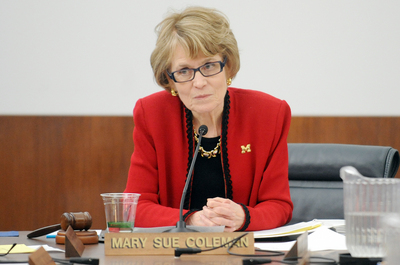
University of Michigan President Mary Sue Coleman reacts when the Board of Regents, in February, orders additional investigations of the six-month child porn reporting lapse. Coleman knew the order was coming.
Melanie Maxwell I AnnArbor.com
The Board of Regents in March commissioned Margolis Healy to conduct a review of the safety culture, where if fell short and how insufficiencies contributed to the six-month reporting lapse that allowed Stephen Jenson, 37, to work alongside children at University Hospital while viewing child porn at his home and, worse, during shifts at work.
The review cost the university $120,000 —$15,000 more than the school's original estimate— and investigators visited campus during a three-day period in April, interviewing dozens of hospital, housing, security and police officials.
The result was a scathing report of problems between the Department of Public Safety, hospital security and, less so, housing security.
Investigators found that high leadership turnover in DPS and unclear crime reporting protocol, coupled with disjointed communication and blatant distrust between units, crippled U-M's safety enterprise, putting the school at risk for a situation such as the Jenson incident.
The final report, along with another investigation that looked into the circumstances surrounding the Jenson incident, was announced Friday during a Board of Regents meeting in Flint. Citing attorney-client privilege, the university declined to release details of the Jenson investigation, which cost the school $487,000.
The reports prompted U-M to launch a Division of Public Safety and Security, which has oversight over campus police, hospital security and housing security. Although the division launched on Friday, U-M officials have offered few details, responding to questions by saying guidelines and parameters for the division haven't been fully set yet.
AnnArbor.com analyzed the Margolis Healy report and, pulling direct quotes from investigators, identified four primary problems of the U-M security enterprise.
The full report is available here: MargolisHealyFullReport.pdf
1) Broken and nonexistent trust between units:
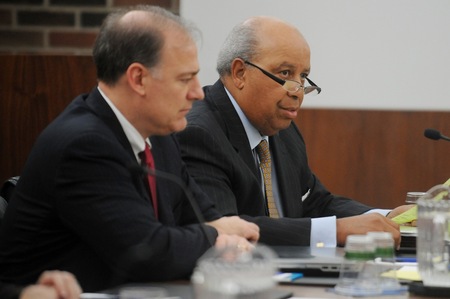
Speaking on behalf of the University of Michigan Board of Regents, S. Martin Taylor in February 2012 announced that U-M would order further investigations of the six-month child porn reporting lapse.
Melanie Maxwell | AnnArbor.com
- Relationship issues center on a lack of trust and poor collaboration between hospital security and DPS, and are less problematic with housing security.
- We could find no specific reference explaining why the relationships with DPS deteriorated, or if it was ever healthy. Some speculate that the relationships soured when DPS became a full service law enforcement agency in 1990 and believe this change brought about a new culture in DPS.
- One particular interviewee with a perspective into both organizations shared the belief that hospital security does not want to be accountable to DPS or have DPS involved in their “business.” At the same time, they articulated a belief that DPS is suspicious of hospital security; doesn’t respect its role; and ignores health care.
- Hospital security and DPS are protective of their respective areas of responsibility, and as a result may struggle to move beyond their points of view to address the tension and mistrust between them.
- [DPS officers'] perception that hospital security leadership has little interest in collaborating with DPS is pervasive.
- DPS officers shared examples of hospital staff (medical) not recognizing DPS authority and responsibility to investigate crimes on hospital property, and stories of hospital employees interfering with investigations.
- Too much emphasis has been placed on [whether firearms should be allowed in areas of the hospital], with little discussion of the underlying issue - the tension and lack of trust between DPS and hospital security front line staff.
2) Fear of DPS by some security officers, staff members:
- Many thought that DPS comes across as pushy and intimidating.... Among those we interviewed, DPS was not generally viewed as respectful of the hospital environment.
- We consistently heard that the average health care practitioner fears interacting with DPS because of their tactics. One often cited example, for instance, is the story of the HHC risk manager who was threatened with criminal charges while seeking advice from legal counsel to evaluate a release of information.
- Incidents contribute to a fear of DPS by some medical staff. [Examples include DPS officers acting like]: "This badge and gun give me the right to ask anyone questions," and examples of university police officers threatening to arrest HHC employees on obstruction of justice charges.
- Some hospital security interviewed perceives a negative attitude by DPS during interactions with patients, staff and visitors.
- There is a pervasive belief {among security] that DPS does not understand the security mission of the hospital and health care system, or how hospital security operates in furtherance of this mission. “We are always under attack by DPS and we do not know why,” many of the interviewees told us. “They do not look at us as a valuable resource/partner.”
- DPS staff confirmed that they have indicated that they would arrest medical staff for obstruction of justice and interfering with investigations. Threats of such arrests have become a core issue between DPS and medical, legal and security staff.
- [A housing employee said:] “we don’t need or want police in the buildings... no guns patrolling the hallways,” [This] struck us as indicative that this partnership does not exist.
3) Unclear roles between units and poor communication:
- All [units] use the moniker “Public Safety,” causing confusion for our team.
- In the hospitals and health care system, people seeking help often believe that they are speaking with, or calling, the police only to realize later that they are or were speaking to or calling a security officer.... The use of the emergency number 911 by both DPS and hospital security to contact their respective departments adds to the confusion.
- The hospital security website lists Director Marilyn Hollier as an associate director of public safety, presumably having a reporting line to the director of public safety but this is not the case. (An AnnArbor.com review shows that Hollier is still referred to this way on the website.)
- Regarding the issue of firearms in the hospital environment, DPS officers do not appear to accurately understand the rules and regulations that the hospital must follow in accordance with its accreditation status.
- Hospital administrators themselves may not appreciate how a well-trained and armed police service cares for their needs. The overall perception in DPS of an umbrella policy that DPS officers are not allowed to carry firearms in the hospital is problematic, and inaccurate.
- When a theft occurs in the Hospital, the hospital security investigator will determine if the incident is criminal in nature, and if it is, the investigator will call police dispatch so that a DPS officer can handle the situation.... DPS staff we interviewed... preferred to be called for all potential criminal incidents.
- The real issue is [setting clear] the expectations for DPS officers when in the hospitals and health care system.
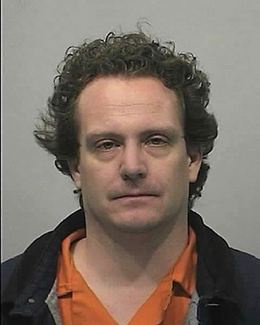
37-year-old Stephen Jenson
4) Lack of leadership and protocol
- Some of the hospital security staff we interviewed believes that a lack of stability in the leadership at DPS in recent years has contributed to the issues between the two departments. The instability has led to confusion in the areas of policies and procedures and the enforcement of rules and regulations.
- Lack of reporting priorities, collaboration and communication has led to a palpable lack of trust and respect between the front line staff of DPS and hospital security.
- DPS officers perceive that hospital security is permitted to investigate low-level crimes (it is unclear how these are defined), and only refers those crimes that require actual criminal charges to DPS.
- What is concerning is the lack of agreed upon protocols for what crimes are to be reported to DPS and when the report should be made. In this area, we see a slippery slope. Much of this is now being addressed in recently issued reporting guidelines.
- DPS personnel did not self-identify to us as service oriented, community policing and problem-solving officers. This is not how hospital security or housing security, by and large, experiences them.
- DPS police officers appear to be directing their attention towards validation from the greater law enforcement community and away from their focus on serving a university community as a community-oriented campus public safety organization. A community focus and enforcement are not dichotomous.
Kellie Woodhouse covers higher education for AnnArbor.com. Reach her at kelliewoodhouse@annarbor.com or 734-623-4602 and follow her on twitter.
Comments
Arborcomment
Tue, Oct 23, 2012 : 10:53 p.m.
As the Regents have decided to claim "Attorney-Client Priviledge" (ACP) the other report... You get a blow-by-blow description in the Margolis report of the daily grind and interaction between hospital security and DPS (and to a lessor extant housing security). In the Margolis report the "hospital administration, counselor and the administration expressed surprise that there was friction between hospital security and DPS". What total, complete, horse hockey. There has always been friction between hospital security, DPS and the DPS predecessor, Campus Security. Any administrator saying different to the Margolis folks is lying. Unclear guidelines, duties, roles, turf, and fiefdoms in three separate line organizations have existed at the UM since the early 80's and there were conflicts or incidents that reached all the way up in campus and hospital administrations. To say they were "surprised" is total hogwash. What they were doing was covering their behinds in the Margolis report, and the ACP'd Chicago report probably nails them on it by identifying systemic failures in leadership and administration. Meanwhile, they throw the Margolis report out for the public to gnaw on. Remove the ACP'D clause and release the full version of the other report.
sheepyd
Tue, Oct 23, 2012 : 5:44 p.m.
Why are so many people so down on UofM police? I've attended many events on campus including sporting events, seminars, training etc... and found them to be polite. I guess there is something I'm missing, I guess if there were some documented examples of the UofM police being heavy handed I'd believe some of these posts but lets face it, on a campus like UofM if the police were bullying people it wouldn't go well for the police. I'm sure UofM is an extremely difficult place to police with all of the political correctness and such. Before anyone brings up the trespass argument, remember that is a university policy that the police department is told to carry out, not the other way around. Hey AA.com, how about an interview with Chief Piersante, I don't know of any other police chief in Washtenaw County who is so mum on important issues like this one facing his department. I often see articles with quotes from Ypd's chief, Sheriff Clayton, EMU's chieft etc... I find those articles interesting and informative, perhaps Chief Piersante will help shed some light on how DPS will make these changes and move forward, lets give him the benefit of the doubt.
mohomed
Tue, Oct 23, 2012 : 5:14 p.m.
UM leadership better put a leash on their bully Police Officer's fast. UM police are almost the best paid in the State and do hardly any of the real work most police do as well. Shame on UM Police for intimidating our Hospital Employees who already work under extremely stressful situations. Good article higher education AAnews person. I worked at UM hospital for years and know many of the police officer's to be disrespectful and extremely full of themselves. Some were really good people though but most were officer's that worked in some other city for a long time and wanted a nice easy cop job that paid usually a lot more than they were used to making.
AlwaysLate
Tue, Oct 23, 2012 : 4:55 p.m.
Please do not become another Penn State!
LXIX
Tue, Oct 23, 2012 : 3:28 p.m.
Excellent synopsis. Now let's talk about the investigation of a serious crime and who in fact took charge. The keystone cop's "who's on first" routine will confuse any large organization. So it was refreshing to know the regents who might sit on other large corporate boards set up a working security structure. The missing piece to the piece is administration. How far up the ladder did the alarm go? Who called in the suits instead of report a crime to the police? Or the FBI? " It is a federal crime for any person to knowingly receive, possess, or distribute any child pornography..." Can anyone spell "coverup" or are we missing something here?
AlwaysLate
Tue, Oct 23, 2012 : 2:44 p.m.
I, like many in and around the University, have never viewed DPS as real police. And I'm sure DPS has been very cognizant of those feelings ever since the Board of Regents waved it's magic wand and created them. Their brutish behavior may be overcompensation for a deep-seated feeling of inferiority. Or they might just be brutes!
Honor
Wed, Oct 24, 2012 : 12:54 a.m.
I love how you make a blanket statement like that without any kind of facts or description of a particular incident. The incident in question had nothing to do with the POLICE, except for when they were called and they handled the situation. I am not a police officer with U of M PD, but am one. I have only the highest respect for the police officers there. They are both highly trained and extremely professional.
sheepyd
Tue, Oct 23, 2012 : 2:36 p.m.
Ever since this story first broke I wondered about UofM not learning a lesson from EMU. It wasn't that long ago that a University President, Vice President and Police Chief conspired to keep a murder investigation secret. After the arrest of the suspect all 3 lost their jobs, the university was fined hundreds of thousands of dollars and EMU's reputation was severely damaged. Fast Forward 6 years and UofM covers up a child pornography case, allows a deviant access to children and then spends months figuring out how to fix a problem that seems pretty obvious, stop concerning yourself with the reputation of your University and start concerning yourself with keeping people safe. Isn't that the primary mission of a University security or Police deparment. Hopefully the changes that need to be made are made quickly and the public safety department moves forward. I must say I think EMU learned a valuable lesson and I think they've done a good job at fixing their mistakes, hopefully UofM will as well.
AlwaysLate
Tue, Oct 23, 2012 : 2:46 p.m.
Correct! Penn State is also a good example of what not to do.
Laura Jones
Tue, Oct 23, 2012 : 2:05 p.m.
It seems clear to me that the University needs to get out of the policing business. They are not good at it, it is a distraction from their mission and it has proven quite unsafe for the people it is supposed to benefit. Instead, the University should take the funds and contract with the Washtenaw County Sheriff for services. It would augment the budget and police force of the Sheriff and provide a force that is both professional and knowledgeable. Moreover, there would be rotation in officers which would prevent kingdoms being built by any one small group. It would be well for the U to work with local law enforcement from a community perspective and for the U itself. It is hard to have your own rules and create insulated cordons of information when you do not control the force. I agree wholeheartedly with the comment that when one calls 911, one expects to reach a real 911 service, capable of dealing with any situation. The DPS should go away and the U return to its primary mission.
jen777
Tue, Oct 23, 2012 : 10:37 p.m.
Reading above, DPS is law enforcement agency. The issue was not DPS but the lack of reporting to DPS. This study was to address these issues. I have no issue calling 911 and having DPS show up - they are a law enforcement agency. It is the hospital security that wasn't; THe recommendations here is to have ONE area responsible for all aspects of security. I suggest folks reread the original reports and audit and realize this study was in response to trying to fix what was broken.
Laura Jones
Tue, Oct 23, 2012 : 9:12 p.m.
My point is that were there to be a broader police base, officers would be very familiar with the campus and where things are - like any city. They cover a wider area now and quite competently. I fail to see where they would be unfamiliar with building names whatsoever. More over, there is no University function that should trump law or responses to 911 calls. That's where problems begin - institutions believe they are above or excepted from the law when they control the power to report. We see examples of this with Penn State, with the women who are raped and it goes unreported beyond the University, with crimes which are "handled" by Universities instead of the law. Why would a police officer care any more about your daughter because they work for the U? I think there is a very good chance they would care less since the interests of your daughter could be at odds with the interests of the U, who is their employer. I stand by my comment.
lugemachine
Tue, Oct 23, 2012 : 2:21 p.m.
Lost in all of this is this fact: Once this incident (albeit six months later, due to circumstances beyond the control of DPS) was brought to the attention of DPS, it was professionally investigated by University Police Officers and brought to a quick conclusion. Ask Mr. Jenson how things went for him once DPS got involved. Oh, and personally, in the event the need should arise, I don't want my daughter (a current student) to deal with some Sherrif's deputy who doesn't know the first thing about how the University functions. You think you can "rotate in" officers who will quickly learn millions of square feet of facilities, navigate the hierarchy of the University and actually care about the students? By the time they "rotated out" they *might* have learned the names of a few buildings.
arborani
Tue, Oct 23, 2012 : 1:58 p.m.
How does a 911 call within the health system actually get to DPS (as opposed to the police)? I.e., on house phones, UM issued cells? What about cell phones privately held by employees, patients, the public?
Evalyn Yanna
Tue, Oct 23, 2012 : 3:19 p.m.
If you use a UM phone and dial "911" it goes directly to DPS.
Basic Bob
Tue, Oct 23, 2012 : 1:41 p.m.
This story seems to confirm what many have said already. The DPS campus police have regularly exhibited bullying behavior toward their community. It comes as no surprise to me that they are now being rewarded by absorbing responsibility for hospital security as well. Maybe they will now gain the self-confidence they seemingly lack in dealing with other employees and the public in a professional manner. The fear and distrust are likely to remain no matter how they restructure management.
justcurious
Tue, Oct 23, 2012 : 1:12 p.m.
Looks to me to throw all responsibility away from the supervising physician of the resident that reported finding the thumb drive and the Office of the General Counsel who decided to sweep the whole thing under the rug. Maybe they should go back to security guards acting like security guards and call the Ann Arbor Police when a crime may have been committed. As I said before, I never felt comfortable as a U of M employee having a 911 call go somewhere other than to a 911 dispatcher. The University community is so tied up in complications and chains of command and protocols that I would never trust their "system" with a serious law enforcement problem.
sheepyd
Tue, Oct 23, 2012 : 1:09 p.m.
By the way any private business or citizen can restrict a private citizen from carrying a concealed weapon on their private property, however no private citizen or business can restrict a police officer from carrying weapon while in performance of their duties. Notice I didn't say off duty, on duty a police officer can carry a firearm anywhere in the state of Michigan. UofM needs to learn the difference between these things before they make blanket statements about their accreditation. Perhaps if this no guns for police rule was realistic every criminal would just post a no guns sign on their property and then simply tell the police to go away when they came to arrest them, rediculous.
sheepyd
Tue, Oct 23, 2012 : 2:29 p.m.
If you don't believe me then post a sign outside your hospital, house, business, tree fort, that states all police officers must leave guns outside and then invite a serial killer or known child rapist onto such property and see if the police leave their guns outside.
sheepyd
Tue, Oct 23, 2012 : 2:25 p.m.
here we go with the semantics argument, bottom line, no institution, business, school, citizen, hospital, castle, spaceship, submarine, hot air balloon etc.... can restrict a police officer from carrying a firearm while on duty and in performance of their duties.
LAEL
Tue, Oct 23, 2012 : 2:16 p.m.
Hospital accreditation is separate from accademic accreditation.
seldon
Tue, Oct 23, 2012 : 1:36 p.m.
The UM Hospital isn't a "private business or citizen."
Kai Petainen
Tue, Oct 23, 2012 : 12:52 p.m.
DPS invites public to October 24 crime meeting University students, faculty and staff as well as members of the broader community are invited to attend the Department of Public Safety crime meeting at 11 a.m. Oct. 24, 2012. The meeting will be held in the Michigan Union Pendleton Room. The meeting, which brings together DPS shift supervisors and DPS officers involved in crime investigations as well as representatives from Housing Security and Hospital Security, will include a review of recent major crime activity and trends, current criminal investigations and crime prevention strategies. Questions, concerns and suggestions from the community members also will be welcomed and addressed. For more information about the meetings, contact Diane Brown, DPS public information officer, at (734) 936-2323.
Kai Petainen
Tue, Oct 23, 2012 : 12:50 p.m.
"DPS staff confirmed that they have indicated that they would arrest medical staff for obstruction of justice and interfering with investigations." Disturbing. In the real world, what would happen? What part of , "But that is the Michigan way – we do the right thing. Period." do they not understand?
sheepyd
Tue, Oct 23, 2012 : 12:45 p.m.
Wow, this seems like a hornets nest of problems. It seems to me like some of the fixes are pretty obvious, make sure that all crimes are reported to police and not security. Advise all employees to report criminal activity regardless of their thoughts on guns in the hospital (this seems weird by the way) I was at St Joes Hospital the other day and while I waited to see the doctor I saw a Washtenaw County deputy and an EMU police officer, neither one of these guys seemed to disrupt the health care being provided and the hospital kept helping people. As for the relationship between the security and police departments, grow up. If you are a police officer it doesn't give you the right to treat anyone less than, if you are a security guard with an inferiority complex then go to the police academy and become a cop, otherwise get comfortable with your roll.
OhioStater
Tue, Oct 23, 2012 : 2:54 p.m.
*role
Eugene Daneshvar
Tue, Oct 23, 2012 : 12:16 p.m.
The lack of "trust" described here most likely can be substantiated with specific examples not reported on by the news agencies. If journalists were to actually do their job and investigate and report on violations, accountability could be held and cultures of mistrust wouldn't be allowed to foster. This mistrust also exists between the student body and the administration- for good reason.
Eugene Daneshvar
Tue, Oct 23, 2012 : 3:27 p.m.
Hi Ron, Thank you for your comment. I agree that there is no transparency and the report should be public. I consider myself a "whistleblower" as well and your presumption is that people don't try to contact reporters on their own. They routinely do and I can understand some hesitation on the part of the media for following each claim. However, if a claim is serious enough where crimes were committed and accountability was not held within the organization, people do reach out for help from reporters to investigate legitimate offenses. Often we hear stories from investigators from local TV stations that lead to further investigation from law enforcement. This is the type of reporting that is missing. Of course, I don't advocate people to circumvent the established protocol for reporting crimes within their organization. The media avenue for justice should come as a last resort when part of the justice system is corrupt.
Ron Granger
Tue, Oct 23, 2012 : 1:32 p.m.
But there is no transparency. The report is secret. What hospital or university staff would dare speak to a reporter? You expect them to wander the halls of the hospital looking for people to interview? In this case the whistleblower was intimidated to the point of crying by a University lawyer who was trying to sweep this all under the rug.
GoNavy
Tue, Oct 23, 2012 : 11:47 a.m.
"Many thought that DPS comes across as pushy and intimidating.... Among those we interviewed, DPS was not generally viewed as respectful of the hospital environment." Shock of all shocks - disrespectful police. Wonder why police write "respect" on their cars? For the same reason Fox News tells you that they're "fair and balanced." When you just aren't, you have to write it down somewhere.
MiSola
Tue, Oct 23, 2012 : 11:39 a.m.
Incredible rationalization and denial. 1: "high leadership turnover in DPS and unclear crime reporting protocol" Let's rephrase this statement. The official's at DPS displayed a "wanton disregard" for the safety of children and Allowed a Pedofile continued to participate in the process of raping, recording and sharing recorded heinous acts against children. 2: "putting the school at risk for a situation such as the Jenson incident" One has to wonder if the Children that were raped, shared the concern of putting the School at Risk. Yet again, this is a case "wanton disregard" for the safety of children by putting them at risk; by allowing a known pedofile, continued freedom to do whatever brought him pleasure.
jen777
Tue, Oct 23, 2012 : 10:33 p.m.
I think you missed the point this was brought up - Hospital security/attorney did NOT report it DPS - acting in their own authority -
Chip Reed
Tue, Oct 23, 2012 : 10:51 a.m.
DPS was created by an act of the regents. The issue of whether or not they are "real police" has never been settled in many peoples' minds. Other police forces are accountable to their communities. Those in our town who are not affiliated with the U-M do not have that same relationship.
A2comments
Tue, Oct 23, 2012 : 10:45 a.m.
"a review of the safety culture at the university's safety culture"???
Kellie Woodhouse
Tue, Oct 23, 2012 : 11:28 a.m.
Indeed. Thanks.