

A fan remembers Ernie Harwell
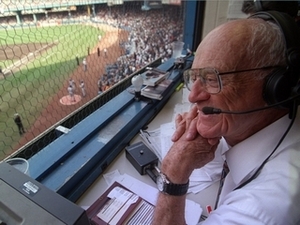
Ernie Harwell broadcasts his final home game at Tiger Stadium on September 27, 1999
Photo by Gabriel B. Tait, Detroit Free Press 1999
Though an author of memorable and best-selling books, songs, and poems, it’s not Mr. Harwell as author that we will miss most, but Mr. Harwell as the golden voice of baseball and eternal hope, often filtered through our grandparents’ handheld radios or teenage car stereos. His failure led him to his true love, and to what some of us love most.
On his last broadcast in 2002, Mr. Harwell signed off by saying, “Now, I might have been a small part of your life. But you’ve been a very large part of mine. And it’s my privilege and honor to share with you the greatest game of all.” Perhaps that’s how baseball, and many of the things that we love but take for granted, is for most people. A small but persistent entity. Something that is always there for us, yet we hardly notice. And in some ways Ernie Harwell’s broadcasting was just the same; a small gift consistently given, though not necessarily fully appreciated till it was gone.
For some of us, baseball means next to nothing. But to others, it means everything. For nearly my entire life it has been both: nowhere and everywhere, all at once. It is the intangible feeling that everything is OK with the world as long as that trusty rhythm of three up and three down drums on, inning by inning. It remains one of the only things that I can consistently talk about with my Dad and male friends, and one of the omnipresent memories of my youth, nearly background noise to so many memories.
After spending last night and this morning in silence as I read every article, tribute, and announcement of Mr. Harwell’s death, and watched more than a few incredibly well done videos chronicling his long career from Atlanta to Detroit, it became more and more apparent that my experience was not unique. My equation of Harwell’s Tigers broadcasts to summer nights and adolescence, or of Harwell to baseball itself is nothing novel. Yet this commonality between his thousands of fans and me did nothing to diminish the personal connection I felt—and feel—to this man who some consider the best sports broadcaster of all time.
No, my story is not unique, nor should it be. Instead, as it was for so many others, Mr. Harwell’s broadcasts were the paternal voice that told us goodnight and the friendly cajolement welcoming us to relax on a warm afternoon. He was ours, and we shared him equally.
As a son of Detroiters, to me Ernie Harwell was the synesthesia of humid summer nights under towering lights where the air hung heavy at Michigan & Trumbull as the ushers rolled up the gates so that people could exit after another Tigers loss while a few people trickled in, unable to resist the temptation for a few free innings regardless of the score. His voice reflected in the condensation around my grandfathers’ bottles of Stroh’s that glistened in the sun of another backyard BBQ. He was the fuzzy voice on the radio after church, revealing the real reason that God rested on the 7th day.
Back then there was seemingly always something I wanted to rush to, whether it was the next game for a chance at redemption or an afternoon freed from family obligation. My foolish dreams were always pushing me forward while Ernie Harwell’s voice wove in and out of surrounding conversation, gently keeping pace and measuring out my days and nights according to the perfect symmetry of the rules of baseball, game by game and out by out.
At moments like these, though, filled with sadness and silence, we’re gifted with the wonderful solemnity that follows such an important event. We can slow down, and perhaps realize that rushing onto the next thing may be understandable, but not necessary. In the long range, few of us rarely know where it is we’re rushing to. At best, some of us can only vaguely sense the things that we love, and endure when our temporary diversions and disappointments get in the way of where we think we should be. When you look at it like that, there’s no reason to rush at all, for it was Mr. Harwell’s initial failure that allowed him to do what he loved, and undoubtedly what he was meant to do. It was likewise his failure that has allowed so many of us to enjoy and reflect on how wonderful life can be.
I didn’t cry when I heard the news last night—the way I did when I watched Ernie say goodbye to Detroit and fans of baseball everywhere on an early autumn evening last September—but I did slow down. I turned off the radio. In the silence I thought about my life and what I was meant to do with it. Perhaps most importantly, I thought of my Dad, the man I owe my Detroit roots and Tigers allegiance to, and decided that I would call him in the morning and tell him that I love him, but only after we discuss baseball and everything else that means nothing and everything to us all at once; the way it was, and the way it will be.
Chris Gerben is a writing instructor only because he's a failed poet; and he has faith that that's as it should be. He can be reached at a2cgerben@gmail.com.