

Answer to Ayn Rand? 'Bang the Drum Slowly' is more than a baseball yarn
Dr. Wayne Baker welcomes back popular guest columnist Terry Gallagher. This is his fifth column this week…
We’re talking this week about what books (and movies and songs) you might find on a liberal’s bookshelf, in response to reports that Republican vice-presidential candidate Paul Ryan gives out copies of Ayn Rand’s novels to his staff.
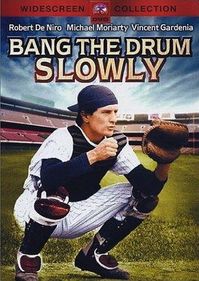
Well, here’s a suggestion that comes from out of left field (appropriately enough). Mark Harris’s 1956 novel Bang the Drum Slowly is more than a baseball yarn. One of the subplots concerns the contract dispute between the main character, an ace pitcher named Henry Wiggen, and his employers, the plutocrat owners of his team, the Mammoths.
After receiving what he considers an inferior offer, Wiggen says, “I opened it and looked at it and wrote a little note across the top saying I was taught in school where slavery went out when Lincoln was shot, and I stuck it back in the box, never signing it.”
But the major focus of the story is Wiggen’s commitment to sticking up for a teammate, a third-string journeyman catcher who is at a very vulnerable point in his career and his life. Because of Wiggen’s insistence, the catcher remains on the team, and his presence eventually serves to unite them, and their solidarity leads them to victory.
In these days of inflamed and extreme political rhetoric, it’s great to know that we can still see some humor in a comic novel whose hero demands fair pay from his employers. And at the end of the season, we see that good things might come our way if we stick up for the weakest and most vulnerable among us.
Fighting for fair pay? Isn't that socialism?
And what about sticking up for the weak? Is that a liberal value?
What would Ayn Rand do?
(Want to enjoy this baseball yarn? The Mark Harris novel, Bang the Drum Slowly, is in paperback, Kindle and audio versions at Amazon. The 1974 Bang the Drum Slowly movie, starring Robert De Niro, is on DVD. And, remastered for the Criterion Collection set on the Golden Age of Television, the 1956 Paul Newman version of the drama is boxed with "Marty," "No Time for Sergeants" and more.)
Comments
Erskine Fincher
Sun, Aug 26, 2012 : 4:53 a.m.
"Fighting for fair pay? Isn't that socialism?" No. No, it isn't. If you had ever studied Ayn Rand, you might have come across this passage: "The essential characteristic of socialism is the denial of individual property rights; under socialism, the right to property (which is the right of use and disposal) is vested in 'society as a whole,' i.e., in the collective, with production and distribution controlled by the state, i.e., by the government." -- Ayn Rand, The Virtue of Selfishness Refusing to work for less than you believe you're worth is capitalism. It doesn't become socialism until the government steps in and starts coercing people. Whether it's coercing companies on behalf of labor, or labor on behalf of companies, it claims to be acting on behalf of Society, and to hell with individuals and their rights. Is coercing people a liberal value? It didn't used to be. In the 19th Century, being a liberal meant believing in freedom: both social and economic freedom. Somewhere along the way socialists co-opted the liberal label, and corrupted its meaning. If what you desire is a society in which individual rights are violated for the (alleged) Common Good, do not call yourself a liberal.
Tru2Blu76
Fri, Aug 24, 2012 : 4:39 p.m.
Very nicely done - seriously. You have shown the flaw in Ayn Rand's dictum which lauds individualism and the "virtue" of the individual over the "collective." Simple fact which (the otherwise pretty smart) Ayn Rand devalued: Teamwork works and it works better than individual action. Two heads are better than one. And - as she herself complained: it's a shame that an individual is relatively helpless in the face of united action (but it's also well established fact). I sympathize with Ms. Rand because, as a daughter, she was enraged by the inequities wrought by Communist overlords against her father (she was from a Jewish family). But I posit that this early experience caused her to over-react and mistakenly think that all "mobs" are automatically morally evil. Put simply: novel writer Rand went on a life-long grudge vendetta against collective action of any kind. This is not valid thinking even by Rand's standards: it clearly involves a contradiction and Rand advocated "check your premise" when you encounter a contradiction. Wrong premise, Ms. Rand! Lets be clear: you didn't write this essay because of Any Rand - you wrote it because a certain politician likes Ayn Rand. So this is really about the manipulative strategies of politicians - using a "popular among some" philosophy to influence major political / philosophical matters. It's simple: Ayn Rand and right-wing politicians get a lot of press just because she and they are controversial. There is no real controversy: Ayn Rand erred (by her own standards!) in promoting individualism and attacking teamwork and unity. It's easy to see that Paul Ryan also erred - but it's also important to note that he shamelessly uses an erroneous "philosophy" to advance himself.