

Frank Lloyd Wright inspired this Ives Wood neighborhood Garden of Eden
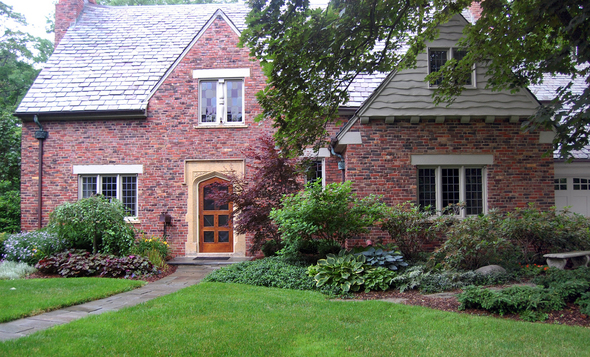
The landscape of Andrew Caughey and Shelly Neitzel's Ives Woods house blends in with the stately homes of the neighborhood.
Janet Miller | For AnnArbor.com
“They wanted the patio concealed from the street, but they didn’t want to enclose it so much that it was claustrophobic,” said certified landscape designer Tom Stempky, owner of Stempky Gardens.
So Stempky set out to create a garden that would blend with the Ives Woods neighborhood of stately homes but offer an Eden-like respite. He installed a patio of New York bluestone and surrounded it with common and collector item plantings, from a yellow dawn redwood, a feathery conifer with limey green new growth, to the dependable and long-flowering kousa dogwood.
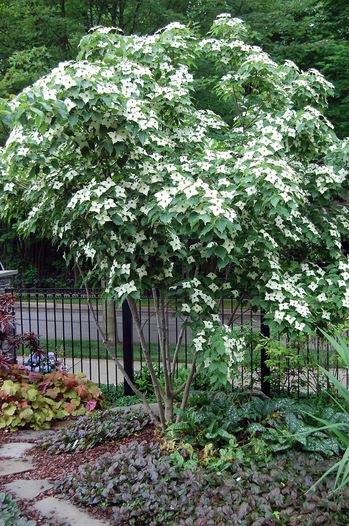
The kousa dogwood provides a visual screen but also weeks’ worth of dainty white flowers.
Janet Miller | For AnnArbor.com
Today’s fine gardens include three elements, Stempky said: Color, texture and variety. Some of that variety comes from including showpieces in the landscape, collector items not found in most gardens.
Stempky incorporated a number of surprises in the garden that encloses the patio:
• A whimsical blue atlas cedar, a grafted plant that looks as much like a piece of art as a plant. Its color matches the bluestone patio and breaks the vertical growth of the garden by adding a horizontal element.
• An Acer pseudoplatanus Eskimo Sunset tree with a speckled-leaf, it is a cross between a sycamore and a maple. Its orange-pink leaves of spring mature into green leaves splashed with cream and pink as the season progresses.
• A Korean fir, native to the higher mountains of Korea, with compact purple cones.
• A small kitchen garden just outside the back door gives a nod to functional gardening, offering herbs and tomatoes.
• An ornamental peach tree, with its burgundy leaves, tops out at a modest five or six feet. It occupies a corner of the garden, with a bed of lime and orange heuchera at its feet, creating a rainbow of color in a small space.
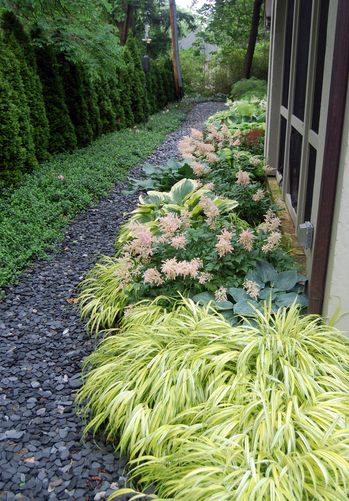
A winding path of ground up black slate mimics a river bed, and reflects a style promoted by architect Frank Lloyd Wright. There is ground cover on one side and a bed of hostas, ornamental grass and astilbe on the other.
Janet Miller | AnnArbor.com
In other areas of the garden, Stempky leaned toward tradition by including old-fashioned favorites such as hydrangeas, lilacs, Cantebury bells and bachelor buttons.
The front garden blends in with the neighborhood, with large mounding hostas and Japanese painted ferns accompanied by popular heuchera (coral bells) in the shade and Emerald Spreader Japanese yews under a giant shade tree. There is a tricolor beech, a flowering crabapple and Exbury azaleas that bloom orange in the spring. Orange has become a popular garden color, Stempky said.
Stempky, former landscaper for pizza magnate Tom Monaghan for 3-1/2 years, learned the Frank Lloyd Wright school of garden design.
“It’s not rocket science. When you make a garden, you invite the outside in,” he said.
A good garden can be appreciated from the outside and from the inside, he said. “It should be integrated into the house setting.”
Wright also influenced the outside of the garden. A curving path of ground up black slate stone imported from Pennsylvania runs behind the Ives Woods house.
Paths, according to the Wright way of thinking, should mimic a riverbed, Stempky said. The path runs through ground cover on one side and a bed of hostas, ornamental grasses and astilbe on the other.
Comments
Mike D.
Fri, Jul 8, 2011 : 1:51 p.m.
Sounds lovely, but this is a case where more photos would make the story more compelling. A wide-angle lens is a photojournalist's best friend.
Chip Reed
Fri, Jul 8, 2011 : 10:30 a.m.
Gosh, how come Mr. Renner's (note correct apostrophe) constructive criticism doesn't get deleted (as mine does)?
Chip Reed
Fri, Jul 8, 2011 : 2:10 a.m.
@Steve Pepple-If you would be so good as to not bother thanking me if you are going to expunge my comment...
Steve Pepple
Thu, Jul 7, 2011 : 7:04 p.m.
A grammatical error in the story has been fixed. Thank you to the reader who pointed it out.
Mark
Thu, Jul 7, 2011 : 6:40 p.m.
As an owner of one of the gardens on this year's walk, it was a pleasure to have 750 visitors come through our yard, and be wowed. Gardens don't have to be large nor complex, and every single one is different, reflecting the taste and abilities of the gardeners. Working in the garden is time well-spent, and a garden can be as good or better than any trip to a therapist.
Jeff Renner
Thu, Jul 7, 2011 : 4:01 p.m.
Acer pseudoplatanus is not actually "a cross between a sycamore and a maple;" it's a maple that looks somewhat like a sycamore. The two are not very closely related (they are in separate orders) and cannot hybridize. "Pseudoplatanus" means false sycamore. This is the end of the botany lesson for today.