

Claiming unused attic space in a home for a rental apartment
There are many reasons to claim rentable space in your home. Perhaps a family member needs a separate place to live, yet wants to be close to the family. If the house is located near a college campus, a small apartment might be ideal for a student, while providing additional income for the homeowner.
Adding a rental apartment can only happen in an area that is zoned R2, which means more than one family can live there.
Cities regulate neighborhoods to control density. R1 means zoning for single-family residences. R3 would be the zoning for multiple families such as apartment buildings.
It is important to check your zoning before investing in a project that the city might deem un-rentable. It is possible to go for a variance to change the zoning, but rarely is a city interested in changing the rules for a single homeowner. It is more likely that the variance would be granted in the home is adjacent to an area already zoned R2.
PROBLEM
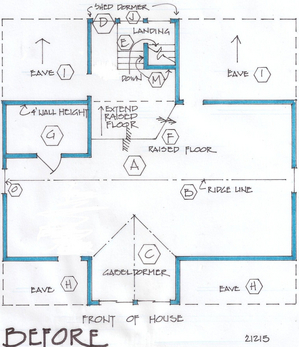
The new space for the apartment (A) was a big room that had been insulated and drywalled. The roof ridge line ran side to side (B), and the house had two dormers — a gable dormer (C) on the front of the house and a shed dormer (D) on the back, which provided headroom for the stairway (E).
At some point, someone built a floor (F) over the original floor. Apparently there had been a roof leak, and the floor boards had buckled. We evaluated the work and expense of removing this raised floor and to refinish the original floor and determined to keep the raised floor and just extend it a bit.
There was an enclosed room (G) which the homeowner planned to put a bathroom in, mostly because it was above the bathroom on the main floor. Unfortunately, the existing room would not work because of the size and also the diminishing head room.
There was eave space both on the front of the house (H) and the back (I). The value of the space was minimal because it tapered quickly. Little could be stored in these spaces efficiently.
SOLUTION
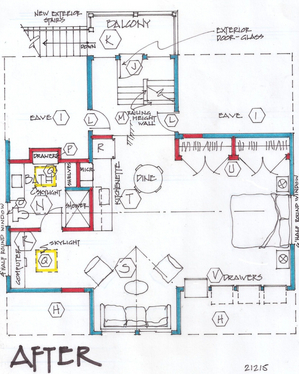
The largest eave spaces (I) were on the back of the house, so we provided access through custom fit doors (L). To provide as much light as possible, the wall by the stair (M) was shortened to railing height.
A new room for the bathroom (N) was positioned closer to the center of the gable roof (B). We changed the existing window for a shorter one (O) so we could place a toilet in front of it. The shower takes advantage of the highest ceiling height. Built in drawers (P) are recessed into the eave space for storage. Operable skylights (Q) are installed on either side of the ridge line.
The area outside of the bathroom is practical and attractive with the skylight and the addition of a four foot half round window. A built-in counter functions as a home office area (R).
The front dormer (C) is great as a lounge/visiting area (S). The center area is turned into a single counter kitchenette (T). The sink takes advantage of the plumbing in the shared wall. A microwave is at eyelevel and recessed in shelves that steal space from the bathroom. There is no stove or cooktop intentionally to minimize serious cooking in the apartment. A grill could be utilized on the balcony (K) outside.
Two generous closets (U) are added on one wall. Low built in drawers (V) are recessed into the front eave space (H). The largest area is reserved for the bed. Because of the closets, the bed shifts off center (of the ridge line (B)). We choose to center the six-foot half round window on the bed.
All of the attic space is used efficiently, and with natural light scattered about, the feeling in this new apartment is lovely.
Marcia Lyon is a professional remodeling designer and freelance writer, producing projects locally and several other areas across the U.S. and Canada. Her new book on remodeling design, “The Essential Planner for Home Remodeling,” is available at www.creatingspaces.net. You may contact her at Marcia@creatingspaces.net or at 515-991-8880.
Comments
Commoncents
Thu, Jun 7, 2012 : 4 p.m.
talk about hard to follow