

Using an exercise ball in your fitness routine
I have been working out for many years and always enjoy a new and exciting challenge. Once I learned how to use incorporate an exercise ball into my workout routine properly, I instantly saw its value and was totally sold on making it a vital part of both the instruction I give clients of any fitness level and my own fitness results.
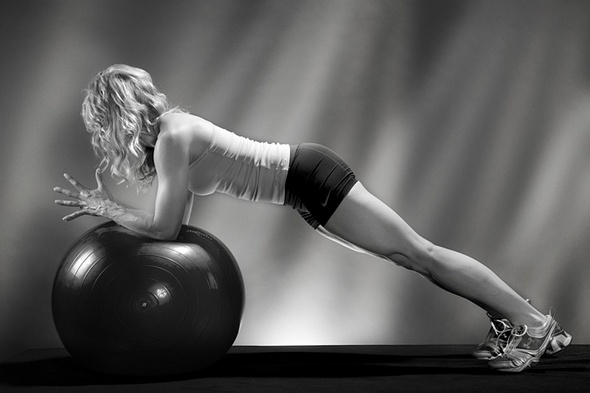
Photo by AJ Kahn
I first learned about the exercise ball back in the late '90s and I’ve been self-educating myself about the benefits and value of them ever since. Once I fell in love (or some would say became obsessed) with them, I went on a mission to learn as much as I could about the exercise ball. This is what I found out…
Most often referred to as an exercise ball, these big giant "toys" are also referred to by other names such as: “Stability balls,” “Swiss balls,” “Fitness balls,” "Physio Balls,” "Balance Balls." They are often used as part of a core strength training routine.
They were originally created by an Italian toymaker in the '60s and was incorporated into therapeutic settings shortly after. In my opinion their value as a toy still holds true today. I have a lot of fun throwing and kicking my exercise ball across the gym, and sometimes I even throw them at unsuspecting clients and friends. You can also run and dive onto one and "superman" across the top, and kids love to kick them around too! Usually the "fun" you can have with an exercise ball does very little damage, but remember to be careful, OK?
There are normally 2-3 sizes to choose from: 55cm, 65cm, 75cm. I normally recommend that people under 5'5" use a 55cm ball, people between 5'5" and 6'2" use a 65 cm ball and people over 6'2" use a 75 cm ball. If you have a number of different sizes available to you, simply sit on each size and choose the ball size that allows your knees to bend at a comfortable 90 degree angle. You should also choose based on your level of comfort when using each size. Finally, to get maximum benefit, choose a ball that is fully inflated and then simply look it over for potential weaknesses in the surface of the ball.
The basic body position to maintain throughout exercise ball movements is generally referred to as the neutral posture. Maintaining neutral posture throughout movements causes you to activate postural muscles and allows you to develop muscular balance throughout the body. The most formidable exercises are typically the most challenging when the participant truly understands where their body is in space and how to maintain the neutral position.
You can do many exercises at home using only body weight and work up quite a sweat. Some of my favorites are squats, push-ups, and simply balancing on the ball.
Squats
1. Stand facing away from wall, with the exercise ball behind you between your lower spine and wall, press body weight slightly into the ball. Feet should be hip-width apart and slightly in front of you.
2. Bending at knees and hips, slowly move into a sitting position as if attempting to sit in a chair, knees over your ankles. Keep the ball in contact with your back as you move.
3. Apply pressure evenly through heels and balls of feet and return to standing position, keeping the ball in contact with your back as you move.
Push-ups
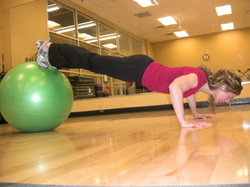
Advanced Exercise Ball Push-up
2. Walk or step your feet back so your body is in a plank position.
3. Bend your elbows and lower your upper body toward the ball, keeping your shoulders pressed down, away from your ears and your abdominal muscles engaged.
Balance With an Exercise Ball
1. Sit on the exercise ball, with your hands on your hips or on each side of the ball.
2. Sit up straight, lengthening your spine, keeping ears - shoulders- hips- in a straight line. Imagine a string pulling the top of your head up.
3. Plant your feet together on the ground in front of the ball.
4. Lift one foot off the floor and hold for 3 to 5 seconds. Switch legs.
Incorporating these exercises into your routine will be quite a challenge if you’ve never done them before. If you do them consistently, you will feel both your balance and stability improve. These exercises may sound easy, but they are actually quite challenging and mastering them can be a lot of fun. Take the plunge and try incorporating exercise ball exercises into your routine and you'll be amazed at the adaptations and improvements you'll see in your overall fitness level.
So I can certainly vouch for the effectiveness of using an exercise ball as a staple in my fitness routine. I’ve been using them for about 10 years now and still haven’t tired of the fun.
Jes Reynolds is an Ann Arbor Personal Trainer and the author of her own blog focused on core strength training and fitness results. Stay in touch by Subscribing to Jes Reynolds Fitness, find out about online fitness training with Jes or contact Jes directly at: Jes@JesReynolds.com.