

University of Michigan ceases use of cats in Survival Flight training
The University of Michigan has stopped its controversial use of live cats during Survival Flight training exercises.
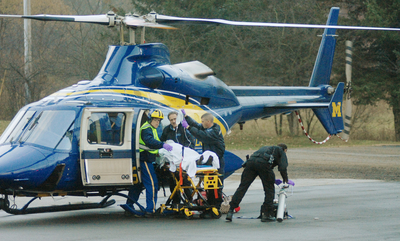
Rescue personnel help Survival Flight personnel load an injured person into a helicopter.
AnnArbor.com file photo.
The U-M Health System now uses robotic simulators in place of live cats. The switch, made after the last cat was used in July, came after more than 18 months of heated criticism from People for the Ethical Treatment of Animals and other animal rights activists who contend that using cats is unethical.
That criticism included a picket in February and a petition in May that included 100,000 signatures and called for U-M to stop using live animals in training for its Survival Flight program, an emergency air transport service.
"Simulators have reached the point where we can actually make substitutions," said Brian Fowlkes, U-M's executive director for animal care and use. Fowlkes said UMHS refrained from using simulators until hospital officials felt the technology was fully developed and tested.
Cats and pigs are used in Survival Flight training to simulate procedures done on infants. The cats were used for their windpipes and airways and the pigs are largely used for their lungs.
Fowlkes said the switch to simulators was not influenced by push back from animal rights activists.
"You're always looking at the situation to determine what’s going on," Fowlkes explained. "It wasn’t a direct response to the PETA activities. ... We made the switch based on the evolution of the simulators."
Justin Goodman, associate director of laboratory investigations at PETA, said simulators have long been in the "medical mainstream" and are adequate for the Survival Flight training. He believes PETA's persistence in protesting animal use in the training had a larger influence on the switch than U-M officials are willing to admit.
"This was a change that they've been fighting tooth and nail," he said.
In September 2010, UMHS claimed there was "no substitute" to using live animals in Survival Flight training.
“Despite the availability of simulators and other teaching aids, the unique environment in which Survival Flight nurses work requires these procedures to be performed using live tissue," UMHS said in a statement then.
From 2002 to 2011, UMHS used 23 live cats in its Survival Flight training. Sixteen cats were adopted, while seven were euthanized.
Recently, PETA obtained documents through Michigan's Freedom of Information Act that revealed U-M had euthanized two of the three cats it used in Survival Flight training in 2010.
That's in contrast to a UMHS official claiming no Survival Flight cats were euthanized in a letter to the editor published in the Michigan Daily.
Fowlkes said the letter contained a mistake due to a "miscommunication" within UMHS. He said UMHS was updated with correct information in August when the mistake was discovered.
"We obviously clarified it on the website subsequently," he said.
With the cats removed from training, UMHS spends about 1.5 hours of the 160-hour Survival Flight training using live animals.
UMHS has no plans to stop using live pigs, which are used to train for procedures dealing with the lungs. Fowlkes said simulator technology is still developing and being tested.
Goodman said simulator technology is advanced enough to replace the use of live pigs. He said the university's medical school used simulators to train students on the same procedure.
"They teach trauma surgeons the skills using the simulator and then they're using a pig to teach the same skills to nurses," Goodman said. "It just doesn’t make sense."
The difference, UMHS contends, is that physicians participate in a lengthier and more comprehensive training.
"The important thing is that the development of methodology has to be tested and verified so we know that it's working and would be suitable for the training," Fowlkes said.
Kellie Woodhouse covers higher education for AnnArbor.com. Reach her at kelliewoodhouse@annarbor.com or 734-623-4602 and follow her on twitter.
Comments
MiamiBeach
Fri, Dec 16, 2011 : 6:23 p.m.
I question the training of this or any procedure on animals. Two people that I know very well are permanently injured from having a tracheal tube forced down their throats. One person lost his voice because vocal cords were damaged and is forced to use hand signals, and the other person now has to drink liquids for the remainder of her life! And this was done at U of M. Therefore, it seems to me that practicing this procedure on cats or other animals defeats the purpose of what these medical people are doing to patients. Its very scary that you could go into the UofM ER and go home so damaged. What are these medical people thinking when performing this procedure?
nunya
Wed, Dec 14, 2011 : 3:14 a.m.
I notice that Ms. Woodhouse is the higher education reporter. I wonder if she is disappointed that this little story about cats is getting more attention then probably any other U of M educational story that she has written?
Fat Bill
Wed, Dec 14, 2011 : 1:01 a.m.
I'm with Belboz, I'm going to contemplate the fate of the pigs over a big ol' Dimo's BLT...
rrt911
Tue, Dec 13, 2011 : 7:58 p.m.
The people have spoken. They have been heard. I learned on humans. Nuff said.
rsa221
Tue, Dec 13, 2011 : 7:48 p.m.
Dear Ms. Woodhouse, I feel like the emphasis on PETA (which understandably evokes much adverse emotion in people) clouds the real issue here. A lot of individuals and groups were against this. I think a big objection to UofM's course was the use of shelter pets. Universities can choose to buy animals specifically bred for research. Probably the lesser of two sad situations in light of the stress a former pet must experience vs. an animal who has known a sterile environment. Although the animal model can produce controversial results, and I personally trust the simulator more, at least there are far less variables with a non-former pet. Is there a reason why Pound Seizure (info: <a href="http://www.pcrm.org/search/?cid=524" rel='nofollow'>http://www.pcrm.org/search/?cid=524</a> , <a href="http://www.voiceless-mi.org/pound-seizure-2/)" rel='nofollow'>http://www.voiceless-mi.org/pound-seizure-2/)</a> wasn't specifically mentioned? There needs to be more reporting on Class B Dealers, Bunchers, and the problems their "business" creates. The practice can affect our community, and on the most basic level by promoting the stealing of pets from backyards. I adopted my cat, slated for sale the next business day to a Michigan Class B Dealer, and she's been one of the very best parts of my life for the last 10 years. Thank you.
Elizabeth
Tue, Dec 13, 2011 : 7:47 p.m.
Thanks to the University of Michigan for ending the use of cats in these training exercises. Thanks to PETA for educating the university on better, humane practices. It's a good day for cats!!
Jamie Riddle
Tue, Dec 13, 2011 : 10:20 p.m.
Now go collect all of your stray cat friends and have a cat party.
Amanda
Tue, Dec 13, 2011 : 7:29 p.m.
This is an amazing victory for the animals! Bravo to the wonderful folks at PETA who work everyday to fight for the voiceless victims of so many forms of cruel abuse perpetrated by humans. Cruelty is still cruelty even when it happens behind closed laboratory doors under the guise of "science" or "research." Thank you for continuing to fight the tireless battle to save innocent animals from miserable fates at the hands of cruel vivisectors.
Rocco
Tue, Dec 13, 2011 : 7:29 p.m.
As a Michigan alum, I'm relieved that the University stopped digging in it's heels and turned the corner to the 21st century. Using simulators is the best thing for humans as well as being the right thing to do by cats. Now, let's get going on replacing the use of pigs, Michigan. Hats off to PETA...good work.
fashionfan
Tue, Dec 13, 2011 : 7:26 p.m.
Would you rather your Survival Flight crew be expertly trained on how to intubate a person or expertly trained on how to intubate a cat? The simulators will save human and animal lives. Thanks to the U-M students and PETA, who got this atrocity stopped. You have saved many lives.
rsa221
Tue, Dec 13, 2011 : 7:50 p.m.
Right on.
Gracie Friedrich
Tue, Dec 13, 2011 : 7:19 p.m.
I'm pretty amused by many of the comments on this article. It seems pretty clear that the University of Michigan was quite behind the times in its use of animals for this particular course. So, if we're only interested in what's best for the trainees, we should be celebrating this decision. Meanwhile, if we're concerned about the welfare of cats (which I would guess -- kidding aside -- most people are), then we should be happy with the decision. Now, I've have had the opportunity to meet some pigs on a friend's farm, and I have to say, they're pretty intelligent and interesting creatures. If there are alternatives to using pigs for this training--and it sounds like there are--the university should be using them!
john
Tue, Dec 13, 2011 : 7:16 p.m.
PETA has done what the UM refused to do -- surveyed the literature and come to a scientifically-based conclusion, namely that cats are not needed for intubation training nor are pigs needed for chest tube insertion/draining training. To claim that animals are necessary would be to go AGAINST the medical mainstream, since more than 95% of medical schools in the U.S. do NOT use animals in their curricula. This is clearly a case of the UM clinging to outdated pedagogy and changing posture only when PETA outed their lies that cats are "adopted" out. Bravo to PETA on helping UM advance their medical training training to be on par with the rest of civilized medicine.
Bobbie Mullins
Tue, Dec 13, 2011 : 7:13 p.m.
It seems to me that a simulator based on human anatomy would be a far superior training tool to a cat or a pig and that the university was refusing to switch simply because "that's the way we've always done it." Inertia can be a dangerous--and cruel--thing. Thank you, PETA, for dragging U-M kicking and screaming into the 21st century.
thinker
Tue, Dec 13, 2011 : 11:11 p.m.
Our tax dollars at waste?
Samantha
Tue, Dec 13, 2011 : 7:12 p.m.
Thanks to PETA! As is evident here, those who support vivisection will not hesitate to lie about it.
JustMyOpinion
Wed, Dec 14, 2011 : 1:52 a.m.
No one said anything about supporting vivisection here, except you, in an effort to bolster your argument.
LucyP
Tue, Dec 13, 2011 : 7:04 p.m.
This is great news. Thank you, PETA, for pushing U of M to do the right thing by switching to advanced simulators for this training. This decision will ensure that students get the up-to-date instruction they need to save lives without torturing and killing cats. It's a win-win move.
CobraII
Tue, Dec 13, 2011 : 4:16 p.m.
The PETA people should volunteer to have this training done on them, if they are so worried about a pig or cat.
belboz
Tue, Dec 13, 2011 : 4 p.m.
I'm too busy cooking a burger, walking around in my leather coat, using my animal tested cologne, while invading the natural habitat of the earth to understand the point of not using a cat to help make life safer for my kids.
bunnyabbot
Tue, Dec 13, 2011 : 3:46 p.m.
I am disappointed with the U giving in to bullies like PETA.
Ron Granger
Tue, Dec 13, 2011 : 2:45 p.m.
Toonces will not be flying the helicopter. Too bad.
Taylor Hulyk
Tue, Dec 13, 2011 : 2:22 p.m.
To all those people who keep saying, "do whatever it takes to train these flight crews," how about we use your pets...or better yet...even you? A little different perspective, huh? Also, animals that are taken to the Humane Society of Huron Valley are taken in and adopted...there is no timeline.
shutthefrtdoor
Tue, Dec 13, 2011 : 4:57 p.m.
I agree JMO... the original poster seems very emotional about this one...I believe a bit mis-guided...but definately emotional.
justcurious
Tue, Dec 13, 2011 : 2:41 p.m.
It's a fact that many people have come through life thinking that animals can't feel pain or suffering. To some, they are just dumb animals and don't matter. Serial killers often feel that way to an extreme. It is obvious that other Universities gave up the practice of using live animals long ago.
JustMyOpinion
Tue, Dec 13, 2011 : 2:37 p.m.
If there were no other animals available and it was necessary that some animals be used in such a way in order that human children have a better chance at survival, then yes, I would sadly give them one of my pets. As to your comment about using one of us, it clearly demonstrates a failure of logic; human life is not equal on value to cats or pigs. Sorry, but its true. PETA has a ridiculous manifesto in which they state a pig is a rat is a cat is a dog is a boy. The holes in that logic are so large as to be not worth refuting. Animals should be treated with respect in all cases including life flight use, but lets not confuse them with people.
Berda Green
Tue, Dec 13, 2011 : 2:19 p.m.
wowwwwwwwww didnt know that bout the u of m they got secrets omg omg
actionjackson
Tue, Dec 13, 2011 : 2:16 p.m.
"Let them eat ribs"
Andrew
Tue, Dec 13, 2011 : 2:16 p.m.
I am a bit curious where they get their cats from through. If they get them from the humane society and they were going to be put down anyway, then I'm OK with that. Their lives in a way went to save others. However, if the U is buying them from some mail-order catalog and these cats were bred specifically to be killed, that is a bit more upsetting. I'm almost sure the pigs are, and I'm sure they also have to be babies, so that is a bit upsetting.
rsa221
Tue, Dec 13, 2011 : 7:58 p.m.
@Andrew, one more link (via peta, sorry), but interesting info: <a href="http://www.peta.org/b/thepetafiles/archive/2011/12/08/university-lab-kills-cats-lies-about-it.aspx" rel='nofollow'>http://www.peta.org/b/thepetafiles/archive/2011/12/08/university-lab-kills-cats-lies-about-it.aspx</a>
rsa221
Tue, Dec 13, 2011 : 7:55 p.m.
@Andrew - They bought at least some of them from a Class B Dealer, who practices something called Pound Seizure. It really isn't as simple as their lives went to save other lives, when you know how these Dealers operate (lots of abuse & neglect violations for instance). If you're interested: <a href="http://www.voiceless-mi.org/pound-seizure-2/" rel='nofollow'>http://www.voiceless-mi.org/pound-seizure-2/</a> <a href="http://www.pcrm.org/search/?cid=524" rel='nofollow'>http://www.pcrm.org/search/?cid=524</a> The most notorious B Dealer I've heard about, CC Baird: <a href="http://www.lcanimal.org/index.php/investigations/investigations-in-the-field/class-b-dealer-cc-baird" rel='nofollow'>http://www.lcanimal.org/index.php/investigations/investigations-in-the-field/class-b-dealer-cc-baird</a>
jns131
Tue, Dec 13, 2011 : 3:55 p.m.
Should have read what I read that they were doing to dogs out in this one college. Some prestigious one at best, taking dogs and well........we won't go there. They stopped that after a few petitions went out. Kind of gross actually what they did do.
xmo
Tue, Dec 13, 2011 : 2:09 p.m.
I Love People that Eat Tasty Animals (PETA). What happens to the pigs? Do they roast them at Graduation?
jns131
Tue, Dec 13, 2011 : 3:54 p.m.
Lungs not included.
JustMyOpinion
Tue, Dec 13, 2011 : 2:32 p.m.
Budget cuts everywhere, so probably yes. ;-)
a2citizen
Tue, Dec 13, 2011 : 1:45 p.m.
How about asking for humans to volunteer in place of the cats? Start with the peta supporters. Let's see how altruistic they really are.
ferdcom
Tue, Dec 13, 2011 : 1:40 p.m.
"U-M's executive director for animal care and use"??? How much does that job pay???
a2citizen
Tue, Dec 13, 2011 : 1:43 p.m.
Well, he should be looking for a new job. No animals...no job one would assume.
Wolf's Bane
Tue, Dec 13, 2011 : 1:06 p.m.
About TIME!!!!!!!!
Major
Tue, Dec 13, 2011 : 12:33 p.m.
Oh yes, we all know how much more important animals are than humans, get real. Let's not forget about PETA, (what a joke) who opposes the no kill movement, and euthanizes an estimated 85% of the animals it takes in (from Wikipedia). Who's more credible here, PETA and their hypocrisy, or the worlds top notch research doctors/scientists? I'll side with those who've saved my life on at least two occasions thank you very much!!!!
Daniel Soebbing
Wed, Dec 14, 2011 : 4:52 p.m.
The only link that is used for citation for that 85% statistic in that wikipedia article links to a 2008 Newsweek article, which doesn't cite any source for that number. The Newsweek article does include a quote from a PETA spokesperson explaining why they oppose no kill shelters. PETA claims that no kill shelters are only able to achieve their no kill status by turning away a lot of animals that will have a low adoption rate. "... we would rather offer these animals a painless death than have them tortured, starved or sold for research." Doesn't sound like hypocrisy to me.
Jim Osborn
Tue, Dec 13, 2011 : 12:24 p.m.
I can't imagine my cat going on a helicopter ride, he freaks out bad enough in a car to the vet. All joking aside, What is important is what is best for the training of these flight crews.
shutthefrtdoor
Tue, Dec 13, 2011 : 4:12 p.m.
Hahaha! Jim I was thinking the same thing...those critters have sharp teeth and nasty claws...my cat would do a number on those poor EMT's! They'd be able to practice first aid on each other. He's called a Maine Coon Cat for a reason...LOL!!!
jns131
Tue, Dec 13, 2011 : 3:53 p.m.
I'm not a cat, but after the last plane ride I had from LAX? I'd be freaking out too. I am glad they do movies otherwise I be totally drunk.
snapshot
Tue, Dec 13, 2011 : 1:10 p.m.
Sometimes one has to be cruel to be kind. A cat freaking out on the way to the vet or training using an animal to save a human life. I'm siding with the U of M and defer to their expertise which I consider more credible than what PETA has to offer in medical training techniques.
golfer
Tue, Dec 13, 2011 : 12:24 p.m.
hey how about the art commission instead!
julieswhimsies
Tue, Dec 13, 2011 : 10:28 p.m.
Oh. Please.
DennisP
Tue, Dec 13, 2011 : 12:17 p.m.
Seems that PETA was right then. UM took a hard stance that live animals were essential to training. Now, all of a sudden, that isn't the case anymore. Either advancement in robotics over a period of under 12 months has been spectacular or the UM was being disingenuous all along. I'm more likely to believe the latter.
jcj
Tue, Dec 13, 2011 : 10:53 p.m.
"If PETA was right about the cats, it probably is right about the pigs too" Oh that's the logic you use? Probably? So lets see hmm. Since the prosecutor was right about a case he is probably right about all cases. Interesting logic!
DennisP
Tue, Dec 13, 2011 : 2:07 p.m.
Yes, eyeheart, I read the article. My point, that went entirely over your head, isn't that they stopped using all animals, my point was about their excuses the first time this story came out not long ago. At that time, no way no how could they use simulators--yet suddenly, after taking a look at things the UM decided that what was such an absolute need for cats suddenly could be done by simulators. This was only a few months back. I can't believe there was a sudden breakthrough in simulator technology in that short time period. Rather, someone got off his rear and looked at some of those options a little more closely, perhaps after a fire was lit underneath it. As for pigs: "Goodman said simulator technology is advanced enough to replace the use of live pigs. He said the university's medical school used simulators to train students on the same procedure." If PETA was right about the cats, it probably is right about the pigs too and UM remains disingenuous about the need for pigs. Whatever you may think about PETA, the issue isn't them, it is the UM and how it can be so adamant and inflexible one day and suddenly change the next. I won't be surprised that the pigs will soon be replaced too seeing as how they are using them in the med school already.
a2citizen
Tue, Dec 13, 2011 : 1:43 p.m.
... or UM decided to take the high road.
EyeHeartA2
Tue, Dec 13, 2011 : 1:41 p.m.
Did you read the article? It appears they still use pigs.
justcurious
Tue, Dec 13, 2011 : noon
"Recently, PETA obtained documents through Michigan's Freedom of Information Act that revealed U-M had euthanized two of the three cats it used in Survival Flight training in 2010. That's in contrast to a UMHS official claiming no Survival Flight cats were euthanized in a letter to the editor published in the Michigan Daily." Obviously, they can't be trusted to tell the truth about any of this. They will continue to torture the pigs until they are good and ready to quit.
jcj
Tue, Dec 13, 2011 : 7:19 p.m.
"Obviously, they can't be trusted to tell the truth about any of this" As if PETA can be trusted! LOL!
jjc155
Tue, Dec 13, 2011 : 5:41 p.m.
yep caught that on my re-read. Still doesnt change the way PETA works however.
jns131
Tue, Dec 13, 2011 : 3:51 p.m.
I'd like to know what PETA is going to do about the monkeys that they still use for experiments on. They are there and are still being used.
justcurious
Tue, Dec 13, 2011 : 2:37 p.m.
jjc - you didn't read the article, obviously because then U of M backtracked and said this... "Fowlkes said the letter contained a mistake due to a "miscommunication" within UMHS. He said UMHS was updated with correct information in August when the mistake was discovered."
jjc155
Tue, Dec 13, 2011 : 12:49 p.m.
oooooorrrrr PETA is distorting/fabricating the "truth. Totally would not put it past PETA to fabricate something like this to further their agenda. PETA has less to lose from there reputation by lying than U of M does. Im with A2commments, if U of M needs to use cats, pigs or anyother animal to ensure that their flight crews are properly trained, then so be it.
A2comments
Tue, Dec 13, 2011 : 11:59 a.m.
I want my Survival Flight crew expertly trained. If that requires that they use live pigs or cats, then they should use them. How many of these cats would have been euthanized anyway if they had not been used? The Humane Society euthanizes animals every day. PETA should focus their energy on getting people to sterilize their pets and let the medical experts do what is necessary to save human lives, which they obviously do with the utmost regard for all lives.
Daniel Soebbing
Wed, Dec 14, 2011 : 5:36 p.m.
It doesn't matter if the animals would have gone on to be euthanized. The point is that using these animals to practice invasive emergency surgical techniques is tantamount to torture (even if it is for a good cause). There is no reason to cause animals undue suffering if there is a better alternative.
omniskeptic
Wed, Dec 14, 2011 : 1:23 p.m.
More budget cutbacks. If we can't afford to pay pigs and cats to fly the helicopters, how do they think they can afford robots? And no cat I ever knew could fly straight, anyway. In the Army, most of 'em didn't make it past ground crew.
jcj
Tue, Dec 13, 2011 : 7:18 p.m.
@LucyP Wake up! What else is he going to say now? We would be better off with live cats but were going to use simulators? I think not!
LucyP
Tue, Dec 13, 2011 : 7:07 p.m.
It simply isn't necessary to use animals for these trainings. The article even quotes a U of M official saying so: "Simulators have reached the point where we can actually make substitutions," said Brian Fowlkes, U-M's executive director for animal care and use.
Silly Sally
Tue, Dec 13, 2011 : 12:54 p.m.
Its too bad that UM fall prey to political correctness and stops using live animals, if this is what is best to save himan life.