

Inside Washtenaw County Public Health: Why flu tracking is important

Laura Bauman, Washtenaw County Public Health. photo by Julie Stafford — WCPH
In the winter of 2003, two previously healthy children in Washtenaw County died suddenly from an unknown respiratory infection. We also were hearing about other children with severe respiratory illness and deaths in nearby counties.
This was very troubling to me as the epidemiologist for the Washtenaw County Public Health Department, and I didn’t have any answers to give the community regarding the cause of the outbreak. So, I sent a list of the affected children with a description of their illness to the Michigan Department of Community Health (MDCH).
Within two days, a team of epidemiologists from the Centers for Disease Control (CDC) and MDCH arrived in Washtenaw County to help me investigate the situation. Early in the investigation, influenza emerged as the probable cause of the illnesses and deaths.
Yet there were many questions to figure out. Was this a new strain of flu? Was the number of children affected unusual? Were we vaccinating the right groups of people?
Over the course of two weeks, our team of epidemiologists learned that regular seasonal influenza was causing the deaths and severe illness in local children. The national flu experts needed to know more quickly, since they were in the process of choosing the strains for the next year's flu vaccine.
No one knew if we were seeing an unusual number of deaths, since influenza deaths in children were not a reportable disease in 2003. Deaths in children due to influenza most likely occurred every year, but no one at that time had asked the medical examiners to test for flu or to report it to public health.
In 2003, there was no recommendation for giving flu vaccine to healthy children ages 2 to 17 years of age. Only the very young (6 month to 23 month-olds) and kids with chronic health conditions like asthma were supposed to get vaccinated. Both of the Washtenaw children who died were healthy and so had not received the flu vaccine.
Largely as a result of the epidemiologic investigation here in southeast Michigan, influenza deaths in children became a nationally notifiable disease starting in the 2003-04 flu season. The national flu epidemiologists now have a much better picture of how influenza is affecting children every year, and can make recommendations to help protect kids.
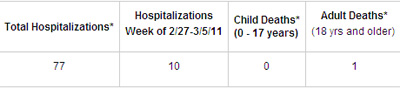
Hospitalizations and Deaths of Washtenaw Residents with Confirmed Influenza
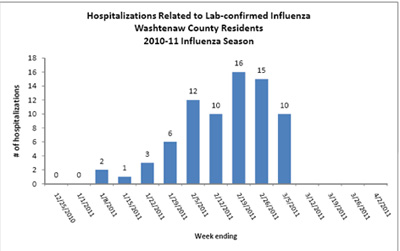
Hospitalizations Related to Labâ€confirmed Influenza for Washtenaw County Residents 2010â€11 Influenza Season
I analyze who is getting the most severely ill and whether they are vaccinated. I look for similarities between the individuals to see if there is a way for public health and clinicians to prevent future illness.
Starting this year, the CDC recommended that everyone 6 months and older receive a flu vaccine. Although no vaccine is 100 percent effective, it is one of the most effective tools public health has to protect the community.
The CDC published a scientific article on the investigation discussed in the blog. The MMWR (Morbidity and Mortality Weekly Report) is the CDC's voice for timely, reliable, authoritative, accurate, objective and useful public health information and recommendations.
Laura Bauman is the epidemiologist for the Washtenaw County Public Health Department. She can be reached at 734-544-6763
Comments
kmark
Wed, Mar 9, 2011 : 6:52 p.m.
The pandemic raised awareness of influenza and respiratory infections in general which lead to improved practices and better knowledge if the system which is a good thing. Now more people are being immunized which means there is a better level of protection for the population. Not only does the health department track things like flu outbreaks but also they track the rates of leading causes of early death such as physical activity, healthy eating, obesity, high blood pressure and tobacco use so that they can find ways to better protect our communities and help us stay healthy.