

Samaritan Counseling fills a gap with high-quality, ‘faith-sensitive’ mental health services
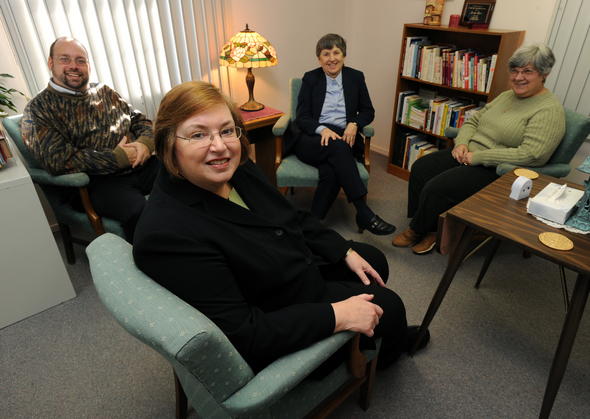
Samaritan Counseling Services Executive Director Jocelyn Pyett, in foreground, sits in her office with, from left, Bob Wright, therapist and education coordinator; Jocelyn Burkhead, president of the board; and Mary Ardner, board member.
Lon Horwedel | AnnArbor.com
Samaritan Counseling Services, a nonprofit outpatient mental health service based in Ann Arbor, is finding creative ways to fill that gap and continue its mission of providing affordable, professional counseling and therapy.
Samaritan Counseling Services began as Interfaith Counseling Service in 1986 with the mission of providing affordable counseling and preventative education that integrated psychology and theology. In 1994, it became accredited by the Samaritan Institute, an international pastoral counseling and psychotherapy organization. It is also accredited by the Council for Accreditation of Rehabilitation Services, Inc (CARF), according to Samaritan publications.
This means, said Executive Director Jocelyn Pyett, that Samaritan offers counseling and therapy with a quality, clinical approach, regardless of faith background or ability to pay.
“We’re not just putting out a shingle and offering Christian counseling,” said the Rev. Bob Wright, psychotherapist and educational director. “We’re offering high quality, evidence-based mental heath services.” Counselors also have some theology training so they are equipped to incorporate ‘faith-sensitive’ spiritual activities such as prayer, meditation, scriptural and ethical reflection. These “are introduced into counseling only in a way that is respectful of a person’s faith perspective,” Pyett says.
The organization cites a Gallup study that found “66 percent of the population prefers a counselor who is religious, and 81 percent want a counselor who can help them integrate their values and beliefs into the counseling process.” With clients’ permission, they often work closely with pastors to incorporate the pastoral perspective or faith community into their care plans.
In addition to psychotherapy and counseling for individuals, couples, families, children and adolescents, Samaritan partners with local congregations to assist in meeting the mental health needs of the community. They provide evaluation and education, marriage and parenting workshops, caregiver skills training, and many other programs to fill in gaps when clergy are “stretched beyond their limits of time and/or expertise.”
At the same time, Samaritan has had its own gaps to fill. From 2007 to 2009, Samaritan’s new admissions increased over 20 percent while total income decreased over 9 percent, according to their annual reports. To accommodate the deficit, Samaritan made significant budget cuts, including a 6 percent staff pay cut, and explored creative ways to bring in revenue while still providing fee-assisted services.
In addition to efforts to promote congregational, community and grant support, Samaritan launched some new services they hope will attract a broader audience: organization consultation and training, massage or relaxation therapy, and Life Education programs such as Couples’ Night Out, where couples come together with a therapist facilitator to discuss general relationship issues in a group setting.
On Nov. 5, Samaritan is hosting a major conference with Dr. William Struthers, a national expert in brain research and psychology to discuss Cyberporn and the Brain, presenting evidence-based, clinical research applicable to this rapidly growing issue. Three special sessions and a webinar will be offered that are targeted toward clergy, health care professionals, and the general public. Registrations are still open; call (734) 677-0709 or go to www.samaritanlive.com to register online.
Pam Stout coordinates Faith and Home and Garden coverage for AnnArbor.com. She can be reached at pamstout@annarbor.com.