

Commemorating Prophet Muhammad's night journey and the Martyrdom of the Bab
The Muslim and Baha’i faiths commemorate their founders today according to patheos.com and bahai.org.
The Baha’is of Ann Arbor remember the Martydrom of the Bab with a program at the Baha’i Center of Washtenaw County at 11 a.m.
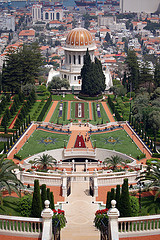
Shrine of The Báb and Terraces in Haifa, Israel.
Photo by flickr user djKianoosh
In the Baha’i fatih, July 9, 2010 marks the 160th anniversary of the Martyrdom of the Bab. According to bahai.org, the Bab was “one of the two main figures in the founding of their faith.” In 1844, he declared himself a messenger of God, "sent to prepare the way for the long-awaited promised one of all religions who would come to establish an age of universal peace".
The Bab was executed by a firing squad in Iran on accounts of heresy in 1850. His remains are in a shrine in Haifa, Israel. The Bab's martyrdom is commemorated with prayers and special services as one of the nine holy days in the Baha’i faith.
In the Muslim faith, both the Isra and Miraj are remembered on the 27 of Rajab on the Hijrah Calendar, the Muslim Lunar Calendar, which this year corresponds with July 9. The day marks the Prophet Muhammad’s night journey and ascension into heaven.
Although the exact date and acknowledgment of the journey differs around the world, according to islamonline.com:
Even if the date were proven, it would not be permissible for the Muslims to single it out for particular acts of worship, and it is not permissible for them to celebrate it, because the Prophet (peace and blessings of Allaah be upon him) and his companions (may Allaah be pleased with them) did not celebrate it and they did not single it out in any way.
According to bbc.co.uk, Rajab 27 or the Lailat al Miraj, is “celebrated by telling the story of how the Prophet Muhammad was visited by two archangels while he was asleep, who purified his heart and filled him with knowledge and faith."
During the night, the prophet is also said to have traveled from Mecca to Jerusalem and back in a single night. When in Jerusalem, according to sacredsites.com, on a rock now housed by the Dome of the Rock on the Temple Mount, Muhammad met past prophets such as Abraham, Moses and Jesus and led them in prayer. He then ascended into heaven “into the presence of Allah, from whom he received instructions for himself and his followers” before returning to Mecca.
One of the instructions received by the prophet, according to bbc.com, was the Salat. The Salat is the second pillar of the Islam tradition. It is a series of prayer, performed five times a day accompanied by specific rituals and sets of motions.
According to the article, A night journey through Jerusalem, on the Times Online, the Night of the Ascent, "is one of the most important feasts in the Muslim Calendar" because "it commemorates two crucial features of Islam - the sacredness of Jerusalem to Muslims and the obligation on every Muslim to pray five times a day." Mustafa Abu Sway, a professor of Islamic Studies in Jerusalem, told the Times that the significance of the journey "lies in that it was during it that the Islamic faith was defined not as an innovation but as a confirmation of the monotheistic tradition."
Katherine Axelsen is a Senior at the University of Michigan double majoring in English and Comparative Religion. She covers U-M campus, Faith and neighborhood stories for AnnArbor.com. For further questions, email her at kaxe@umich.edu.