

Mariinsky Orchestra delivers spellbinding 'Rite of Spring,' and much more, at Hill Auditorium
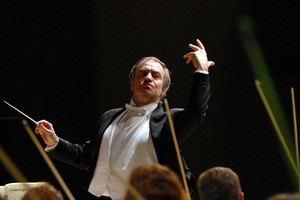
Valery Gergiev publcity photo
“A Hero’s Life”—“Ein Heldenleben,” by Richard Strauss—was the first piece on the Mariinsky Orchestra’s program Saturday evening at Hill Auditorium.
The evening’s subtext, though, was more “A Musician’s Life,” Version 2012: Delayed at the airport in Toronto, 30 of the orchestra’s musicians and their maestro, Valery Gergiev, almost didn’t make their University Musical Society date. They eventually reached Detroit Metro around 6:30 p.m.
UMS postponed the concert’s start a half hour, till 8:30 p.m. But there was no stinting—on energy or repertoire—despite the late beginning. Indeed, at 11 p.m., with the last decisive notes of Stravinsky’s “Rite of Spring” behind them, Gergiev and the musicians offered something lighter in the way of dance as an encore: the polonaise from Tchaikovsky’s opera “Eugene Onegin.”
Framing the officially announced program, the Strauss and the Stravinsky were the evening’s big, serious works; in between, for levity, was Shostakovich, who, though not necessarily the first composer to come to mind for such relief, was perfectly suited to the job when represented by his madcap Piano Concerto No. 1 in c minor, for piano, trumpet and string orchestra. The superb pianist Denis Matsuev, a favorite from his orchestral and solo engagements here, was at the keyboard; the very expressive trumpeter Timur Martynov was the second soloist.
For an orchestra that should have been breathless from its hasty unpacking, the playing all evening was unruffled in all the good ways—and stirring in all the good ways, too.
In the Strauss tone poem, Gergiev emphasized both the sweep and the structure of the hero’s journey. The playing was plush but not overly so, and the textures were always clear, highlighting Strauss’s motivic transformations. And orchestral color told the truth—as Strauss saw it, as hero of his own drama—of critics, lovers, conquerors and sages. Principal violinist Roman Simovich’s silken playing as “The Hero’s Companion” was wonderfully sensual.
In the Shostakovich, Matsuev led the merry, manic chase at the keyboard, abetted by the orchestra and by trumpeter Martynov. But this concerto is nothing if not mercurial, not only within movements, where the trumpet may intone a sweet melody you think the pianist will take up, but the pianist has hotter ideas to pursue, but between movements. A lyrical slow movement, albeit with a turbulent middle section, is the counterweight to outer movements that scurry and scoot (and borrow from the best, including Beethoven) with shameless and savory abandon and a sort of delicious ADD.
What was best about “Rite,” other than the chance to hear it live, was how this performance emphasized the orchestra as tribe. It’s a ritual, a pagan ritual, a ballet in which a maiden is danced to death, sacrificed by her community to propitiate the gods. So is it wild? Are its rhythms pounding and elemental and exciting? To be sure. They were all that in this performance. But somehow what triumphed was the organized nature, the inexorable progression, of this rite. And that was spellbinding.
Beyond that, of course, we heard three works that were so utterly different one from another. One, “Rite,” was a genuine centenarian, premiered 100 years ago. But the other two, though close to “Rite” in age—“Hero” dates from 1898, the Shostakovich concerto from 1933—are hardly works that would sit and chat comfortably with “Rite” on a park bench. They speak totally different languages; the program’s polyglot profile of the turn of the century and the years just after was certainly part of its appeal.
Comments
Max
Sun, Oct 28, 2012 : 10:14 p.m.
Why does the reviewer not talk about the marvelous, dark sound of this orchestra which distinguishes it from our American orchestras? And the beautiful brass playing that is integrated within the orchestral sound -- as opposed to, let´s say, the famed Chicago brass that is amazingly loud and often obnoxious vis-à-vis the rest of the musicians. This orchestra was amazing; the oboe, clarinet and french horn playing was sublime in Heldenleben. And this beautiful trumpet sound, dark, velvety ... Chicago could learn a lot from this orchestra as far as balance between the various sections of the orchestra is concerned. (And let´s keep the grading to schools)
James Toy
Sun, Oct 28, 2012 : 7:05 p.m.
In 1953 in Corsica I heard a radio broadcast of "The Coronation of Spring" (alternative title of "Le Sacre du Printemps"). The performance was conducted by Pierre Monteux, who had premiered the work in Paris in 1913, 40 years before -- in a climate so riotous that the dancers could not hear the orchestra, and the choreographer, Vladimir Nijinsky, had to try to keep the performance on track. As Susan Isaacs Nisbett noted, last night's performance of "Le Sacre" seemed inexorable. Indeed, the pregnant silences, the evocative solos and duets, and the savage outbursts of the full orchestra seemed pre-ordained. I believe that Igor Stravinsky himself stated that he was "the vessel through whom 'Le Sacre' passed". Last night 'Le Sacre' "passed through" the Mariinsky Orchestra and Valery Gergiev -- and through us, who were silent and motionless participants in the drama.