

Pilobolus bringing its unique, inventive dance back to Power Center
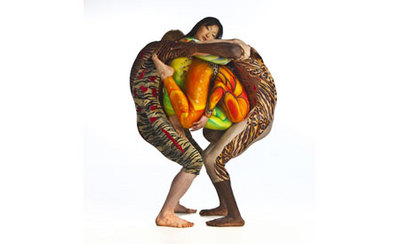
The dance company Pilobolus, named for a tiny sun-loving fungus that sends spores far through the air like a dancer shooting through space, celebrates 40 years of organic creativity and imagination this season.
Local audiences have been lucky enough to catch the company in many of those seasons. Once again, on Sunday evening, the Ann Arbor Summer Festival presents Pilobolus at the Power Center for the Performing Arts, in a program that spans virtually the whole of the company’s existence.
It’s a program that also gives a good sense of the morphology of Pilobolus, a boundary-hopping dance company (Is it gymnastics? Is it dance? were the frequent questions that greeted it 40 years back) that considers itself an organism, with multiple directors and much collaboration.
“Some of the works on the program have been in the repertoire almost without a break,” Artistic Director Robby Barnett said recently by phone, referring to the pieces on the Ann Arbor bill.
That’s the case with “Pseudopodia,” from 1973, a signature Pilobolus solo that is one of many to conjure the natural world through the dancer’s body. “It’s an icon of early thinking,” said Barnett of “Pseudopodia,” choreographed by the late Jonathan Wolken, another company founder-director.
PREVIEW
Pilobolus
- Who: 40-year old dance company with an eternally young spirit, presented by the Ann Arbor Summer Festival.
- What: Mixed modern-dance bill.
- Where: Power Center, 121 Fletcher St.
- When: 7 p.m. Sunday, June 24.
- How much: $10-$50, annarborsummerfestival.org online or Michigan League Ticket Office, 734-764-2538.
“One of the pleasures and satisfactions of work that’s remounted within the choregrapher’s memory is that you can fiddle with it, get rid of things that annoy you, make it better. There’s no canonical version till a choreographer dies. That’s an advantage and a disadvantage.”
In the particular case of “Day Two,” he said, the work is “a kind of composite of all the performances of ‘Day Two’ ever done, expanded to their ideal form. It’s a continually interesting consideration, how to maintain a work like this, how to make it interesting to us, and how to make fresh and accessible to dancers. Our own approach is to give the dancers leeway.”
And, he added, to recognize that over years and years of performance, idiosyncracies that make a work stellar tend to get lost, smoothed over by the waters of time, like river stones. “And that’s a pity.”
But “Gnomen,” a classic men’s quartet from 1997, is smooth by intention, lyrical in its impetus, potent in its imagery of mutual support.
Its four dancers are men whom we see as humans, interconnecting as such and not as puzzle pieces of some other organism - a transformation that occurs fantastically, in all senses, in Pilobolus’s oeuvre.
The audience will have a chance to look at one version of transformation in “All Is Not Lost,” from 2011, created by OK Go, Pilobolus and Trish Sie, in collaboration with the dancers. This is the live companion piece to Pilobolus’s video collaboration with the Grammy-winning band OK Go. From screen to stage, the game here is to play with multiple perspectives, gravity and dimensionality. “You see the dancers and then you see the effect of their motion at the same time,” Barnett said.
As Barnett noted, “Pilobolus has always been an arts collective.” It has never been tied, as other modern-dance companies were, to the work of a single creator (think Martha Graham, Merce Cunningham) whose passing would pose significant survival issues for the company. “But it occurred to us, since we were not a charismatic organization, not the single-person-name company, but a collective organization, socially, that our future lay in relationships.”
And expanding those beyond the company has been a hallmark of recent years, as the company has worked with artists as diverse as the late author-illustrator Maurice Sendak, comic book artist Art Spiegelman and master puppeteer Basil Twist.
These International Collaboration Projects include “All Is Not Lost,” the work with OK Go that’s on Wednesday’s bill, and the project that started it all, “Rushes,” from 2007, which Barnett made with the Israeli choreographic team Inbal Pinto and Avshalom Pollak.
“It’s a happy work,” Barnett said, “and audiences like it and the dancers like performing it. It’s what got us going on our catalog of interactive works. It’s given us enormous confidence that what we believed about what we were doing was valid. We do work in a particular way that has appealing benefits. Much of communication has become distant today, by photo or text, not by touching each other or physical contact. We are creating an intimacy that is not very common in this world. Live theater has a power that, as an endangered species, deserves protection. By doing these collaborations, we’re spreading the spores.”