

Moehringer's novel 'Sutton' asks, "Who are the bad guys here?'
Just after the financial meltdown of 2008, many bank executives, allegedly involved in the loss of millions of dollars of investor money, walked away with little or no punishment for their risky behavior, despite being caught in the act. Were a thief to enter a bank, steal the same cash at gunpoint, and be similarly caught, he would be off to jail for years.
Who, in this case, is more likely to be the recipient of the public’s indignation?
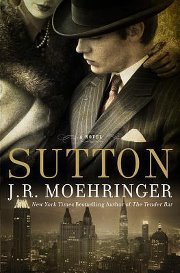
The 2008 crisis was, of course, just the most recent in our country’s history and not as different, in terms of the players and their egregious behavior, as one might think. This was so much the case in the 1930s and 40s in fact, that one bank robber, Willie Sutton, became a folk hero for robbing the banks that had garnered such distrust and hatred among the public. Pulitzer Prize-winning journalist J.R. Moehringer, author of the critically acclaimed memoir The Tender Bar, tells Willie's story in his new book, Sutton.
Moehringer calls the book a novel, and properly so as he takes some license with the incidents in Sutton’s life. The result is a rollicking journey through 40 years of history as recounted in a one-day car ride around New York City.
Moehringer successfully weaves Sutton’s narrative with historic events, evocative scenes and a creative plot line that envisions Sutton’s motivation being less about his fierce hatred of financial institutions and the economic injustice they foster, as it is about the unrequited love of a beautiful woman.
Willie Sutton was a prolific bank robber, having stolen nearly $2 million dollars over the course of his career. Though the phrase is now seen as urban legend, Sutton was said for many years to have answered the question of why he robbed banks with “because that’s where the money is.”
He was apprehended several times and served a good portion of his life behind bars but also escaped from three different prisons. He was a free-but-wanted criminal in 1952 when he was recognized by amateur detective Arnold Schuster on the New York subway. Sutton was apprehended, Schuster boasted about his role in nabbing Sutton, and a few days later, Schuster lay dead outside his house, the victim of a suspected mob hit.
On Christmas Eve, 1969, a series of Supreme Court decisions led to Sutton’s surprise release from Attica prison where he was serving a life sentence. Sutton was essentially kidnapped by a reporter in an effort to secure an exclusive interview. The newspaper wished to learn of Willie’s bank-robbing exploits and also to get the answer to a question: What did Sutton know about the Schuster murder? As Moehringer recreates the story, Sutton is anything but forthcoming with that bit of information.
Instead, the ex-con takes the straight-laced reporter, along with a hippie news photographer assigned to the story, on a day-long adventure down memory lane, with stops at the location of every noteworthy event in Willie’s life, from his birth in the Irish Town slums, to the home of his love, Bess Endner, and the sites of several bank heists.
Using flashbacks, Moehringer takes us from present-day 1969, to Sutton’s past life, as we re-live the planning of robberies and prison escapes, and more emotionally, how Sutton survives through each deed or hardship without his beloved Bess. For the reader, it becomes a story of people, but also of place (both geographic and social), and of time.
At each stop, Moehringer vividly recreates the occasions that shaped Sutton’s life and made him into one of the country’s most accomplished bank robbers and unlikely folk heroes.
Like Laura Hilenbrand’s Seabiscuit, Moehringer effortlessly weaves hefty research and references to illuminate his main character; to show how the man was created by the times, but also manipulated them to his advantage. We of course, don’t know what took place in the actual interview on that Christmas day, nor do we know the details of Sutton’s conversations or thoughts throughout his life. For that, we rely on Moehringer’s colorful imaginings, through which we come to indeed feel Willie Sutton’s heartbreak and root for his success.
Through the fictionalized musings and conversations, Moehringer illuminates Willie Sutton as a thoughtful man who hopes to better himself, and who uses his thieving talents to cultivate his life and fill it with the finer things. Though he may be but a bank robber, Willie is fond of roses, the classics, and even has a philanthropic streak.
And why should those bank executives be the only ones to enjoy fine suits and leather-bound books, we find ourselves asking. Why shouldn’t this poor kid from Irish Town use the talents he has perfected to even the score just a little? \
It’s an age-old Robin Hood theme, of course, but Moehringer is skillful at casting Sutton in a way that doesn’t beg for the comparison, but hints at it enough to put the reader firmly on Willie’s side.
Lori Sullivan is a freelance writer and book critic.