

How to brew French press coffee at home
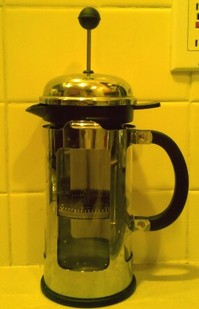
A modern French press, manufactured by Bodum
Matt Roney | Contributor
My last few posts have dealt with some of the basic mechanics of brewing great coffee —specifically, grinding and blooming. What do you say we get into an actual brewing method?
The French press is one of the most basic, being just slightly more complicated than pouring hot water over coffee. It’s been around since at least the mid-nineteenth century and is extremely popular worldwide.
(Something that I haven’t written on, but that is extremely important, is water quality. Luckily, Comet Coffee barista and all-around-nice-guy Sandy Bledsoe recently blogged about just that.)
French press is distinct from the more familiar drip method in that the coffee grinds are actually allowed to steep in water, rather than the water dripping through a bed of grinds. This provides a very even extraction, as each grind is given equal exposure to water. At the end of the steeping time, a fine metal screen is used to press the grinds to the bottom of the pot, so grind-free coffee can be poured.
Coffee made in a French press tends to be robust and oily, traits prized by its fans. This is due to the metal screen. Whereas a fibrous paper filter soaks up certain excess oils and catches even very fine coffee dust, a French press’s metal screen allows them through.
Of course, there’s a negative side to this as well — coffee made this way loses a lot of clarity, and some of the high, fruity notes found in many high-quality beans are covered up. Plus, some of the oils found in French press coffee, particularly cafestol, can raise cholesterol.
In any case, French press coffee is both excellent and very, very easy to do.
Note: These instructions are based primarily on experience, but I’ve also used Scott Rao’s wonderful The Professional Barista’s Handbook as a reference. Credit where credit is due!
Also, I’m assuming that the average reader doesn’t have a gram scale, so coffee is measured in tablespoons.
You will need:
1 French press
Any delicious coffee
Pure water, and a means of heating it
1 spoon
A timer
A measuring cup
A coffee grinder capable of delivering an even, coarse grind
Begin by bringing water to a boil. While you’re waiting for the water to boil, grind your coffee.
Use 2 level tablespoons, or 1 “coffee scoop” (they typically come with French presses) of grinds per 4 ounces of water. The grind should be coarser than you would use for drip coffee; I start with a grinder setting of 4 out of 10, but grinders vary.
Next, preheat the French press with a little hot water, and pour it out. It’s very important to brew with water that’s as close to 200 degrees as possible, so also be sure to preheat any measuring cup you may be using between the kettle and the press. Add the coffee to the empty press.
Once the water has come to a boil, remove it from heat until it reaches 200 degrees. If you don’t have a thermometer, this is approximately the temperature when the water has stopped boiling.
Pour the water over the coffee. You will quickly see a bloom begin to form as foam at the top of the water. Allow the bloom to continue for 15-20 seconds, and then break it with the spoon and briefly stir. This is to make sure that any grinds in the bloom have full exposure to the water.
Replace the lid, and press the plunger until it is just below the surface of the liquid. Allow it all to sit so that total steeping time — including bloom — is 4 minutes. Press the plunger all the way down, and pour.
Even though the grinds have all been pressed to the bottom, they will continue to extract. It’s important, then, to only make as much at a time as you are going to serve. If the final product is too acidic, try a longer steep with a coarser grind. If it seems flat, grind finer and steep less.
It’s worth pointing out that there are variations to these instructions, often involving different ways to deal with the bloom. James Hoffman demonstrates one such method here.
Matt Roney is a barista at lab cafe and a contributor to Radio Free Chicago. He can be reached by email here.
Comments
Ron Granger
Wed, Jun 8, 2011 : 3:49 p.m.
Love the french press, I use it every day. I am not so fond of Bodum's products. You can buy french presses at kitchen supply stores with genuine pyrex cylinders. Look for the logo on the cylinder. They are thicker and stronger than the generic bodum's. Heck, you can often buy the whole press for less than the cost of a replacement bodum cylinder. All of the recent bodums seem to have short plungers. I have read that they were shortened because Some People were pressing the coffee so hard that they were breaking cylinders. I briefly thought it might be important to have the longer plunger. But the thing is, the coffee grounds do not compress. My older plunger does reach the bottom, but I don't think it makes any difference. It's not like you're squeezing extra flavor out.
DFSmith
Wed, Jun 8, 2011 : 5:30 p.m.
Ron- do you know if any of the stores in Ann Arbor who might stock the French Presses that you recommend, with the higher quality pyrex glass cylinder? I need to buy a quality press or find a good replacement cylinder for my 1-cup sized Bodum press. TIA
DFSmith
Wed, Jun 8, 2011 : 3:08 p.m.
I make my coffee at home in either a French Press or in a Moka-Pot. Use a Hario "Skereton" hand burr grinder ( purchased at Comet Coffee) . Thanks for the French Press tips.
Matt Roney
Fri, Jun 10, 2011 : 3:04 p.m.
Those little Hario hand grinders are really awesome. I kind of regret not recommending them in my grinder article.